The discipline of Knowledge Management (KM) is rapidly becoming established as an essential course or module in both information systems and management programs around the world. Many KM texts pitch theoretical issues at too technical or high a level, or presenting a only a theoretical prescriptive treatment of knowledge or KM modeling problems. The Knowledge Management Primer provides students with an essential understanding of KM approaches by examining the purpose and nature of its key components. The book demystifies the KM field by explaining in a precise, accessible manner the key concepts of KM tools, strategies, and techniques, and their benefits to contemporary organizations. Readers will find this book filled with approaches to managing and developing KM that are underpinned by theory and research, are integrative in nature, and address softer approaches in manifesting and recognizing knowledge.
- 142 pages
- English
- ePUB (mobile friendly)
- Available on iOS & Android
eBook - ePub
Knowledge Management Primer
Chapter 1
What is Knowledge Management?
INTRODUCTION
Knowledge Management (KM) is a key approach designed to aid superior decision making and solve current business problems such as competitiveness and the need to innovate in a dynamic, complex and global environment (Wickramasinghe and von Lubitz, 2007). The premise for the need for KM is based on a paradigm shift in the business environment where knowledge is now recognized as central to organizational performance (Drucker, 1993; Ichijo and Nonaka, 2007; Jafari et al., 2008). This macro-level paradigm shift also has significant implications upon the micro-level processes of assimilation and implementation of KM concepts and techniques (Swan et al., 1999), i.e. the Knowledge Management Systems (KMS) that are in place.
We are not only in a new millennium but also a new era. A variety of terms, such as the Post-Industrial Era (Huber, 1990), the Information Age (Shapario and Verian, 1999), the Third Wave (Hope and Hope, 1997) or the Knowledge Society (Drucker, 1999), have been used to describe this epoch. Whichever term is used, there is agreement that one of the key defining and unifying themes of this period is KM. However, nearly ten years into this new millennium still too many practitioners and researchers alike, not to mention students, struggle to understand “what is KM?”
Given the importance of KM to all business operations, irrespective of industry or geographical location, understanding KM has become an imperative for researchers and practitioners. This book is intended to dispel any myths and help the reader understand what KM is and what it is not.
KNOWLEDGE MANAGEMENT (KM)
Central to KM is organizational knowledge, which exists at the confluence of people, process and technology (see Figure 1.1).
The key objective of KM is to create value from an organization’s intangible, as well as tangible, assets (Wigg, 1993). It is partly an amalgamation of concepts borrowed from numerous bodies of literature, including: artificial intelligence/knowledge-based systems, software
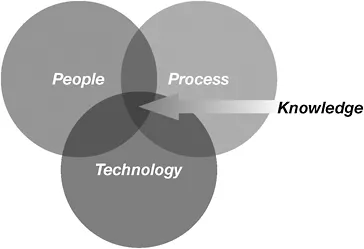
Figure 1.1 Knowledge: Intersection of People, Process and Technology.
Reproduced with kind permission of Doctrina Applied Research and Consulting LLC—www.consultdoctrina.com
engineering, BPR (business process re-engineering), human resources, data mining management and organizational behavior (Liebowitz, 1999). However, it is important to note that while KM might have developed from the confluence of these numerous bodies of literature, KM itself is not BPR or data mining, and KM offers something new.
In essence then, KM not only involves the production of information but also the capture of data at the source, the transmission and analysis of this data, as well as the communication of information based on or derived from the data to those who can act on it (Davenport and Prusak, 1998). Moreover, unlike data management which typically focuses on organizing and refining data as a means to an end, or information management that is predominately concerned with structuring and categorizing information, integral to KM is the extraction of relevant data, pertinent information and germane knowledge to aid in superior decision making (Wickramasinghe and von Lubitz, 2007). The relevance of the data, the pertinence of the information and the germaneness of the knowledge are determined by the specific context.
HOW DID KNOWLEDGE MANAGEMENT COME ABOUT?
There are few who would argue that the current business environment is global as well as complex and dynamic. To survive in such an environment requires the attainment of a competitive advantage. Such a competitive advantage must be sustainable, i.e. difficult for competitors to imitate.
Sustainable competitive advantage is dependent on building and exploiting an organization’s core competencies (Prahalad and Hamel, 1990). In order to sustain competitive advantage, resources that are idiosyncratic (and thus scarce), and hence difficult to transfer or replicate, are of paramount importance (Grant, 1991). A knowledge-based view of the firm identifies knowledge as the organizational asset that enables sustainable competitive advantage, especially in hyper competitive environments (Davenport and Prusak, 1998; Alavi, 1999; Zack, 1999). This is attributed to the fact that barriers exist regarding the transfer and replication of knowledge (Alavi, 1999); thus making knowledge and KM of strategic significance (Kanter, 1999).
Since the late 1980s, organizations have embraced technology at an exponential rate. This rapid rate of adoption and diffusion of ICTs (information and communication technologies), coupled with the ever increasing data stored in databases or information that is being continually exchanged throughout networks, necessitates organizations to develop and embrace appropriate tools, tactics, techniques and technologies to facilitate prudent management of these raw knowledge assets; i.e. adopt KM.
Finally, during the late 1990s many organizations, especially in the U.S., have been experiencing significant downsizing and the reduction of senior employees. These employees over time have gained much experience and expertise and, as they leave their respective organizations, this expertise leaves too. In an attempt to stem the loss of expertise and vital know-how, organizations needed to embrace KM.
Taking together the need for a sustainable competitive advantage, the need to manage terabytes of data and information, and the need to retain vital expertise and knowledge residing in experts’ heads, organizations throughout the world are turning to KM solutions.
KEY CONCEPTS
In order to understand what KM is, it is essential to understand several key concepts. Since, KM addresses the generation, representation, storage, transfer and transformation of knowledge (Hedlund, 1990), the knowledge architecture is designed to capture knowledge and thereby enable KM processes to take place. Underlying the knowledge architecture is the recognition of the binary nature of knowledge; namely its objective and subjective components. Knowledge can exist as an object, in essentially two forms, explicit or factual knowledge, which is typically written or documented knowledge, and tacit or “know how,” which typically resides in people’s heads (Polanyi, 1958, 1966).
It is well established that while both types of knowledge are important, tacit knowledge, as it is intangible, is more difficult to identify and thus manage (Nonaka, 1991, 1994). Further, objective knowledge, be it tacit or explicit, can be located at various levels; e.g. the individual, group or organization (Hedlund, 1990). Of equal importance, though perhaps less well defined, knowledge also has a subjective component and can be viewed as an ongoing phenomenon, being shaped by social practices of communities (Boland and Tenkasi, 1995).
The objective elements of knowledge can be thought of as primarily having an impact on process. Underpinning such a perspective is a Lockean/Leibnitzian standpoint (Malhotra, 2000; Wickramasinghe and von Lubitz, 2007) where knowledge leads to greater effectiveness and efficiency. In contrast, the subjective elements of knowledge typically impact innovation by supporting divergent or multiple meanings consistent with Hegelian/Kantian modes of inquiry (ibid.) essential for brainstorming or idea generation and social discourse. Both effective and efficient processes, as well as the function of supporting and fostering innovation, are key concerns of KM in theory. These issues are critical if a sustainable competitive advantage is to be attained as well as maximization of an organization’s tangible and intangible assets.
The knowledge architecture recognizes these two different, yet key aspects of knowledge and provides the blueprints for an all-encompassing KMS (Wickramasinghe and von Lubitz, 2007). By so doing, the knowledge architecture is defining a KMS that supports both objective and subjective attributes of knowledge. The pivotal function underlined by the knowledge architecture is the flow of knowledge. The flow of knowledge is fundamentally enabled (or not) by the KMS.
In addition, it is possible to change from one type of knowledge to another type of knowledge and this too must be captured in the knowledge architecture. Specifically, as proposed by Nonaka (1994), there exist four possible transformations: 1) combination—where new explicit knowledge is created from existing bodies of explicit knowledge, 2) externalization—where new explicit knowledge is created from tacit knowledge, 3) internalization—where new tacit knowledge is created from explicit knowledge, and 4) socialization—where new tacit knowledge is created from existing tacit knowledge. The continuous change and enriching process of the extant knowledge base is known as the knowledge spiral (Nonaka, 1994).
Once the knowledge architecture has been developed, it is then necessary to consider the knowledge infrastructure. The knowledge infrastructure consists of technology components and people t...
Table of contents
- Routledge Series in Information Systems
- Contents
- Figures
- Tables
- Preface
- Acknowledgements
- Foreword
- Chapter 1 What is Knowledge Management?
- Chapter 2 Knowledge Strategies and Knowledge Capture
- Chapter 3 Knowledge Tools and Techniques
- Chapter 4 Knowledge Management: A Systems View
- Chapter 5 Knowledge:The Organization, Culture and Learning
- Chapter 6 Applying Knowledge
- Epilogue
- Glossary
- Notes
- Index
Trusted by 375,005 students
Access to over 1.5 million titles for a fair monthly price.
Study more efficiently using our study tools.
Frequently asked questions
Yes, you can cancel anytime from the Subscription tab in your account settings on the Perlego website. Your subscription will stay active until the end of your current billing period. Learn how to cancel your subscription
No, books cannot be downloaded as external files, such as PDFs, for use outside of Perlego. However, you can download books within the Perlego app for offline reading on mobile or tablet. Learn how to download books offline
Perlego offers two plans: Essential and Complete
- Essential is ideal for learners and professionals who enjoy exploring a wide range of subjects. Access the Essential Library with 800,000+ trusted titles and best-sellers across business, personal growth, and the humanities. Includes unlimited reading time and Standard Read Aloud voice.
- Complete: Perfect for advanced learners and researchers needing full, unrestricted access. Unlock 1.5M+ books across hundreds of subjects, including academic and specialized titles. The Complete Plan also includes advanced features like Premium Read Aloud and Research Assistant.
We are an online textbook subscription service, where you can get access to an entire online library for less than the price of a single book per month. With over 1.5 million books across 990+ topics, we’ve got you covered! Learn about our mission
Look out for the read-aloud symbol on your next book to see if you can listen to it. The read-aloud tool reads text aloud for you, highlighting the text as it is being read. You can pause it, speed it up and slow it down. Learn more about Read Aloud
Yes! You can use the Perlego app on both iOS and Android devices to read anytime, anywhere — even offline. Perfect for commutes or when you’re on the go.
Please note we cannot support devices running on iOS 13 and Android 7 or earlier. Learn more about using the app
Please note we cannot support devices running on iOS 13 and Android 7 or earlier. Learn more about using the app
Yes, you can access Knowledge Management Primer by Rajeev K. Bali,Nilmini Wickramasinghe,Brian Lehaney in PDF and/or ePUB format, as well as other popular books in Business & Business General. We have over 1.5 million books available in our catalogue for you to explore.