Healthy Urban Planning aims to refocus urban planners on the implications of their work for human health and well-being. If many of the problems faced in cities are to be resolved, improving health will be the fundamental goal of urban planners. Poor housing, poverty, stress, pollution, and lack of access to jobs, goods and services all impact upon health. This book provides practical advice on ways to integrate health and urban planning and will be essential reading for urban planners, developers, urban designers, transport planners, and those working in the fields of regeneration and renewal. It will also be of interest to those with an interest in sustainable development.
- 208 pages
- English
- ePUB (mobile friendly)
- Available on iOS & Android
eBook - ePub
Healthy Urban Planning
About this book
Information
Part one
Concepts, principles and
practice
Part one introduces the concept of healthy urban planning. Chapter 1 presents WHO's definition of health, whereby health is not merely the absence of disease but includes human wellbeing and quality of life. It outlines the links between health and urban planning and defines the health objectives of planning. Chapter 2 describes the unique value of the Healthy Cities approach to urban management, showing why the movement is relevant to urban planners. Chapter 3 discusses the extent to which healthy urban planning has become a reality in cities participating in the WHO Healthy Cities project since 1987, providing viewpoints and case studies from a recent survey.
Chapter 1
The links between health and
urban planning
The Concept of Health
Health is a state of complete physical, mental and social well-being and not merely the absence of disease or infirmity. The enjoyment of the highest attainable standard of health is one of the fundamental rights of every human being, without distinction of race, religion, political belief, economic or social condition.
The above definition of health, formulated in the Constitution of the World Health Organization (1946), challenges the conventional assumption that health policy is a matter only for health care professionals. This chapter argues that health should be a central goal of many professions and agencies, and specifically, that urban planners have a key role in promoting a healthy environment. It has taken a long time for the change in consciousness encompassed in the WHO definition of health to be consolidated in practice; indeed, it was not until the late 1970s that the traditional research focus on pathogenesis (the cause of diseases) was integrated with research into salutogenesis (discovering the causes of health and acting to strengthen them). Many urban planning systems do not encompass health issues. Yet the quality of the environment and the nature of development are major determinants of health. Health in turn is an important stimulus to economic productivity. Health is about the quality of life experienced by people now, but planning for health implies a concern for future generations. Lifestyle and household decisions shape health, but these decisions are constrained by the economic and social opportunities, income, education and quality of the environment experienced by the household's members.
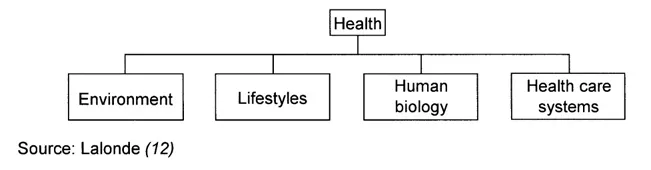
Various descriptive and interrelational models have been developed to explain the relationship between health and the total environment (biological, physical, social and economic). Fig. 1.1 helps to illustrate the links between the determinant factors of health and is well documented within WHO literature.
Fig. 1.1. The factors determining health
The model by Whitehead & Dahlgren (13) illustrated in Fig. 1.2 elaborates further and, in addition to identifying the factors influencing health, describes the four levels or strata of influence.
- In the centre are individuals with their predetermined genetic heritage, surrounded by influences on health that can be modified.
- The first stratum concerns personal behaviour and lifestyle, influenced by models of friendship and community regulations that may promote or damage health.
- The second stratum includes social and community influences: the availability or lack of reciprocal support in unfavourable conditions with consequent positive or negative effects.
- The third stratum incorporates structural factors such as housing and working conditions and access to services and facilities.
- The fourth stratum incorporates the factors that influence society as a whole: these include socioeconomic, cultural and environmental conditions.
Fig. 1.2. The main determinants of health
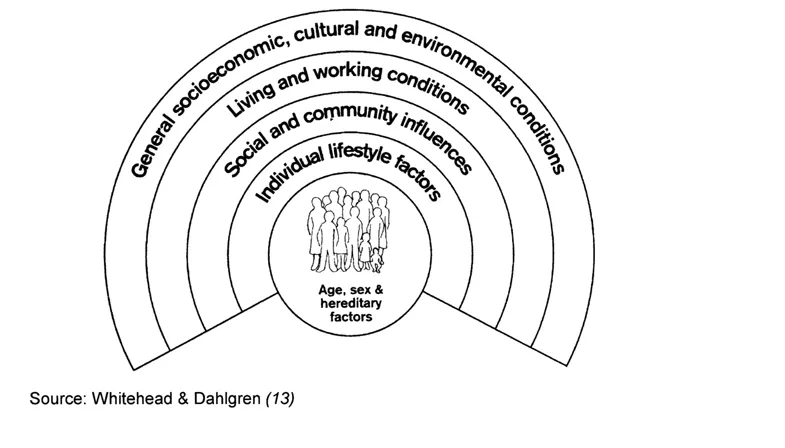
Fig. 1.3. The health gradient
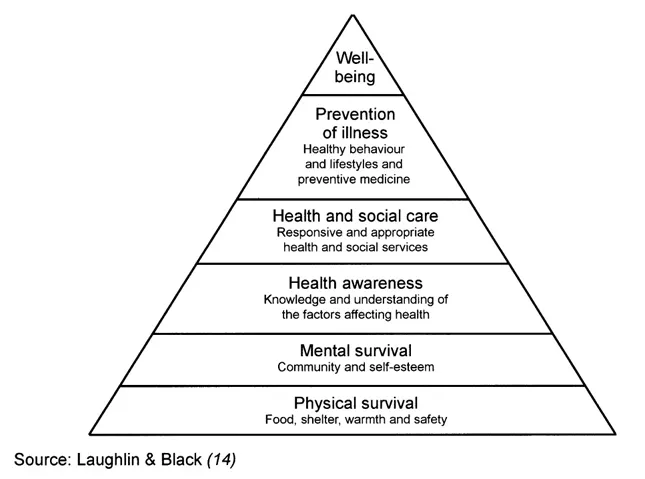
Fig. 1.3 illustrates the interaction of a range of health factors in society, represented as a health gradient. This implies that the slope of the health gradient varies according to socioeconomic background and that certain groups may be subject to a greater degree of poor health. Promoting health based solely on changing the traditional behaviour of the individual may have little impact on people who are less advantaged. This requires action from outside.
Good health or wellbeing are achieved through a number of stages, as set out in Fig. 1.3. The activity marked at the top of the triangle will not lead to good health without an activity that also concentrates on the lower levels, and the equilibrium of activity must reflect the characteristics of the local community. The interrelationship and mutual influence of all these factors means that any action to improve health must cover all the levels of the hierarchy at the same time.
The Effects of Urban Planning on Health
Urban planning refers to the institutionalized process of making decisions about the future use and character of land and buildings in city regions. Mechanisms to ensure that these decisions are taken in the public interest have evolved throughout Europe and differ according to a number of factors. These factors were recognized by the WHO Regional Office for Europe in 1999 (8):
The type of planning system that has evolved in each European country has depended on the country's legal system and institutional framework, the relative roles of the different actors in the development process and the degree to which a separate planning profession has emerged.
A number of texts on both planning systems and governance in Europe are available, and the similarities and differences between countries are thoroughly examined within these (3-5,8-11). Although urban planning systems may vary in different countries, the concepts, principles and goals that underpin those systems have much in common.
The prevalence of the medical model of health, which focuses on the individual and the treatment of illness and dominated the latter part of the twentieth century, is beginning to shift to the social model, in which health is the result of a series of socioeconomic, cultural and environmental factors, housing conditions, employment and community. Urban plans are prepared for physical development, but the goals of these plans are essentially social. Urban planning policy therefore significantly influences health throughout Europe.
The idea that health and urban planning are linked is not new (2). Indeed, in many European countries town planning originated early in the twentieth century as a result of consensual concerns about the health and housing of citizens. In the nineteenth century, the need to put an end to the epidemics rife in industrialized urban areas led to a close interconnection between public health and urban planning. This theme is being taken up again a century later.
These concerns were originally expressed in terms of space and infrastructure standards being established for housing and simple forms of land-use zoning. From this reactive approach emerged the more active form of intervention through making urban plans with the aim of establishing basic standards of provision within new development, using an approach that was also based on estimating and providing for the future needs of communities.
Many of the effects of urban planning decisions on the health of the population are ignored in contemporary planning practice, although there is great concern for specific aspects of health, such as road safety. Yet a careful analysis shows profound effects on all the levels of influence on individual health identified by Whitehead & Dahlgren (Fig. 1.2) (2,13). It is not simply a matter of accidents and road traffic policy. Rather the social goal of health can be a fundamental justification for and purpose of urban planning. A book produced as part of WHO's campaign on the social determinants of health (15) examines these determinants in detail. The solid facts: social determinants of health (16) examines policy and action for health geared towards addressing these issues.
Table 1.1 sets out the relationship between the main planning policy areas and relevant determinants of health. The determinants are organized by level (Fig. 1.2); all levels, from lifestyle choices to broad environmental variables, are affected.
Individual behaviour and lifestyle. The first level of influence is individual behaviour and lifestyle. The physical environment, which is shaped by planning decisions, can facilitate or deter a healthy lifestyle. The propensity of people to walk, cycle or play in the open air is affected by the convenience, quality and safety of pedestrian and cycling ...
Table of contents
- Cover Page
- Half Title page
- Title Page
- Copyright Page
- Contents
- Tables
- Figures
- Acknowledgement
- Introduction
- one Concepts, Principles and Practice
- two Guidelines for healthy urban planning
- References
- Annex 1 Health21: health for all targets for the European Region
- Annex 2 Cities participating in the WHO European Healthy Cities network in phases I, II and III
- Annex 3 Healthy Cities indicators during the second phase of the WHO Healthy Cities project (1993-1997)
- Index
Trusted by 375,005 students
Access to over 1.5 million titles for a fair monthly price.
Study more efficiently using our study tools.
Frequently asked questions
Yes, you can cancel anytime from the Subscription tab in your account settings on the Perlego website. Your subscription will stay active until the end of your current billing period. Learn how to cancel your subscription
No, books cannot be downloaded as external files, such as PDFs, for use outside of Perlego. However, you can download books within the Perlego app for offline reading on mobile or tablet. Learn how to download books offline
Perlego offers two plans: Essential and Complete
- Essential is ideal for learners and professionals who enjoy exploring a wide range of subjects. Access the Essential Library with 800,000+ trusted titles and best-sellers across business, personal growth, and the humanities. Includes unlimited reading time and Standard Read Aloud voice.
- Complete: Perfect for advanced learners and researchers needing full, unrestricted access. Unlock 1.5M+ books across hundreds of subjects, including academic and specialized titles. The Complete Plan also includes advanced features like Premium Read Aloud and Research Assistant.
We are an online textbook subscription service, where you can get access to an entire online library for less than the price of a single book per month. With over 1.5 million books across 990+ topics, we’ve got you covered! Learn about our mission
Look out for the read-aloud symbol on your next book to see if you can listen to it. The read-aloud tool reads text aloud for you, highlighting the text as it is being read. You can pause it, speed it up and slow it down. Learn more about Read Aloud
Yes! You can use the Perlego app on both iOS and Android devices to read anytime, anywhere — even offline. Perfect for commutes or when you’re on the go.
Please note we cannot support devices running on iOS 13 and Android 7 or earlier. Learn more about using the app
Please note we cannot support devices running on iOS 13 and Android 7 or earlier. Learn more about using the app
Yes, you can access Healthy Urban Planning by Hugh Barton,Catherine Tsourou in PDF and/or ePUB format, as well as other popular books in Architecture & Urban Planning & Landscaping. We have over 1.5 million books available in our catalogue for you to explore.