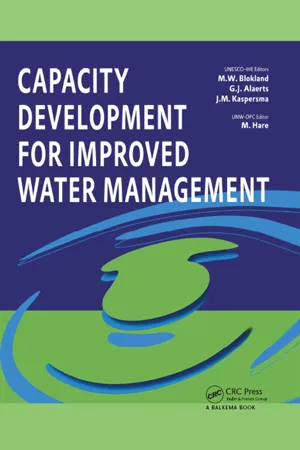
This collection of papers explains how knowledge and capacity development can contribute to improved, effective water management with a digest of lessons learned in the areas of development of tools and techniques, field applications and evaluation. The authors are prominent practitioners, capacity builders and academics within the water and capacity development sectors.
Capacity Development for Improved Water Management starts with an introduction and overview of progress and challenges in knowledge and capacity development in the water sector. The next part presents tools and techniques that are being used in knowledge and capacity development in response to the prevailing challenges in the water sector, and a review of experience with capacity change in other sectors. In the third part a number of cases are presented that cover knowledge and capacity development experiences in the water resources and water services sectors. This part also presents experiences on water education for children and on developing gender equity. The fourth part provides experiences with the monitoring and evaluation of knowledge and capacity building.
eBook - ePub
Capacity Development for Improved Water Management
- 408 pages
- English
- ePUB (mobile friendly)
- Available on iOS & Android
eBook - ePub
Capacity Development for Improved Water Management
About this book
Information
Part 1
Setting the scene
Chapter 1
PROGRESS AND CHALLENGES IN KNOWLEDGE AND CAPACITY DEVELOPMENT
World Bank and UNESCO-IHE Institute for Water Education
UNESCO-IHE Institute for Water Education
ABSTRACT
Knowledge and capacity development (KCD) involves something more than the strengthening of individual skills and abilities. Trained individuals need an appropriate environment, and the proper mix of opportunities and incentives to use their acquired knowledge. The article therefore discusses KCD for the water sector at three different levels, from individual to organizational to the institutional level and enabling environment. Secondly, the article describes the current conceptual approaches to KCD. They come from a wide variety of fields of social sciences, as well as from field practice and case studies, and are sometimes contradicting. Ideas about capacity originate from fields including organizational development, political economy, public administration, pedagogy, institutional economics and sociology. The most important views and fields, including some examples from the field that influence our thinking on KCD, are described and discussed. The article will discuss the link between knowledge and capacities, clarify that one of the basic capacities is to learn, and highlight the importance to create, share and manage the knowledge that results from learning, at the three levels. Extensive reference will be provided to the respective other chapters in the volume where more detail and case studies are provided, as well as examples of other approaches.
1.1 INTRODUCTION
It is nowadays generally agreed that capacity enhancement involves more than the strengthening of individual skills and abilities. Trained individuals need an appropriate environment, and the proper mix of opportunities and incentives to apply their acquired knowledge. Understanding capacity development therefore requires a more comprehensive analytical framework that takes into account the individual, the organizational and the institutional levels of analysis (Alaerts, 1999, EuropeAid, 2005, McKinsey, 2007). The water sector is a sector of particular complexity, and therefore highly dependent on strong institutions and individual capacities. This complexity derives from the fact that daily decisions of each and every individual in society impact on water management – regarding water use, water pollution, sanitation, etc. – which is different from, say the roads sector. Also, water is a bulky and fugitive resource that has to be managed continuously in order for it to be available in the right quantities at the right time to sustain life – not too little to avoid drought and not too much to avoid flood – which means that it requires heavy investment and laborious operation and maintenance. The decisions and behaviour of mothers and farmers, thus, matter as much as those of the Minister of Water Resources or of Public Works. Not surprisingly, this sector was one of the first to identify the need for capacity development and introduce focused capacity development programs (Alaerts et al., 1991).
The first UN Conference on Water, in 1977 in Mar del Plata, sounded for the first time the alarm bell over the vulnerable and finite nature of water in light of the rapidly growing demands on the resource. The Mar del Plata Action Plan prioritized the provision of drinking water and sanitation – “drinking water and sanitation for all by 1990” – and the need to save water and protect it from wastage and pollution. The 1981–1990 Drinking Water Supply and Sanitation Decade managed to dramatically increase the coverage for water services but proved on many counts less effective. It was outpaced by the growth in population and demand for water. This led to the recognition that strong institutions and proper social behaviour are as important as the infrastructure itself. Also, it was found that development of this sector would require a higher level of pro-activity and effective strategies to deal with future challenges. The UN Conference on Environment and Development in Rio in 1992, and the 2002 UN Millennium Development Goals re-iterated the same priorities. The 2006 World Water Forum in Mexico City again highlighted the role of strong local capacity. After three decades of major investment efforts the world has much achievement to show for, yet serious challenges remain, both old and new.
The exponential growth in demand for water, the strong urbanization, and the persistent poverty have kept the coverage rates for drinking water supply and sanitation at modest levels in some regions, though other regions are well on their way to close the gap. Still, major challenges remain: the water use efficiency and service reliability are often unacceptably low; many water supplies are precariously vulnerable; and pollution taints water quality much faster than pollution control measures can be put in place. Weak performance of the institutions and of the users remains the bottleneck, especially in sanitation and in general water service delivery. Yet, it could be argued that the main future concern will be on water resources sustainability, as the largescale and steady transformation of the earth’s surface by human interventions as well as by climate variability is rapidly adding new stresses on the natural eco-hydrological systems that will have to support the continual generation of water resources to meet the demand for water-for food production, for drinking, for hydropower and navigation, flood management, etc. Competition for access to water will rise.
Part of the knowledge to address these challenges is available. However, gaps still do exist in our knowledge, for example regarding how the global changes are going to affect us and what the responses should be, and how the water service delivery and the resource should be managed more effectively. This represents a first key challenge. Equally important, one often observes that even when available, this knowledge does not get readily translated into proper planning or effective action. Weak institutions, especially at local levels of government, and in many communities, form a second key challenge, in particular in developing nations. This lagging or constraining effect is especially visible in countries that are developing into modern economies, but it is a challenge for all societies as they continuously must adjust their sector to new outside changes or to new internal demands.
1.2 KNOWLEDGE AND CAPACITY
1.2.1 CAPACITY CONSTRAINTS TO APPLY KNOWLEDGE – THE CASE OF DEVELOPING ECONOMIES
Many countries – that is, their governments as well as their civil society – are observed to have a weak “capacity”: limited knowledge bases; small numbers of professionals with the right education and skills; and, in general, administrative and managerial arrangements, and laws and regulations (the “enabling environment”) that eventually fail to facilitate the swift and effective actions that in their aggregate can deliver the desired outcomes and results on the ground. First, knowledge is required that can identify and describe the issue, challenge or problem that one desires to be addressed. A different knowledge is required to then articulate how to address this. Thereafter, this knowledge needs to be communicated, shared, refined and confirmed among experts, peers and decision-makers as prerequisite for action, after which implementation of the action necessitates a functional and capable organization and an enabling policy and administrative environment to do so and mobilize the matching financial and other resources. The implementation capacity, thus, also depends on the knowledge and skills of the implementing agency, and the incentives it responds to. This creates the potential to act. However, this potential will materialize only in presence of positive incentives (such as, financial or political incentives, personal motives to further one’s career, etc.) which outweigh negative ones (such as, vested interests of an elite, lack of reward, opportunities to extract rents, etc.).
The action, therefore, comes as the aggregate of a series of sequential causal steps and decisions. The eventual outcome or impact from that action can be observed only much later, at substantial distance from the original knowledge. Hence, it is often tenuous to correlate the outcome with that knowledge, or with the capacity of the administration and the quality of the enabling environment. In addition, these processes take place in a dynamic and changing environment, and political contexts are continuously shifting. This difficulty to define unequivocal causalities is further compounded by the fact that similar outcomes can also be generated by several other sets of knowledge, capabilities and circumstances.
1.2.2 DEFINING CAPACITY
The concept of capacity refers to development in general, and several definitions have been proposed that reflect the theoretical (or political) frameworks from which the subject is approached (see Box 1.1).
1 Firstly, because of the original concern with effective government, the public administration science was one of the first disciplines to define “capacity” referring to the organizational structures and operational procedures of administrations. In this perspective, the public administration receives its capacity from the education and training of the civil servants, from proper administrative procedures, and appropriate incentives (e.g. Shafritz, 1985).
2 However, drawing experience and insight from the only modestly successful efforts in developing countries with the International Drinking Water Supply and Sanitation Decade spanning the 1980s, the water sector was early to devise a practical definition expressing its strong interest in making overall development programs more effective and sustainable, and to articulate in a coherent fashion the need for knowledge and capacity development (KCD) (Alaerts et al., 1991, 1999). This experience also highlighted the critical function of the “enabling environment” of the broader policy, legal and regulatory frameworks in which the public administration, and the investment projects funded by the international donor community, have to operate. For example, many regulations and procedures in other sectors one way or another were found to restrict the effectiveness of policies in the water sector: regulations on urban settlements, for example, make it often impossible to extend water services to “irregular” city quarters; human resource procedures in the civil service often preclude that incentives can be provided; and centralized administrations often have no place for a role by local water users. It became recognized that the water users, the consumer, the electorate and other distinct stakeholders in civil society have to play equally important roles in making things work at the local operational level of the household, the irrigation plot or the water catchment, and in providing the political foundation for decisions. This holds especially true in developing countries where the national government has often a very limited reach and capacity, and, thus, much depends on whether local users and communities are willing to take initiative, cooperate and contribute. This approach, in addition, also for the first time linked capacity with knowledge – as generated and disseminated by educational institutions and knowledge centres locally and at a global level. The water sector is increasingly considered a knowledge-intensive sector.
Box 1.1 What is capacity?
Shafritz (1985) approached capacity from the perspective of public administration sciences: “… any system, effort, or process … which includes among its major objectives strengthening of elected chief executive officers, chief administrative officers, department and agency heads, and program managers in general purpose government to plan, implement, manage or evaluate policies, strategies, or programs designed to impact on social conditions in the community”. The 1991 Delft Declaration (Alaerts et al., 1991) suggested “Capacity comprises well-developed institutions, their managerial systems, and their human resources, which in turn require favorable policy environments, so as to make the [water] sector effective and sustainable”. UNDP states that “Capacity is the ability of individuals, groups, institutions and organizations to identify and solve problems over time” (Morgan, 1993, UNDP, 1993). Hildebrand and Grindle (1994) emphasize the dynamic nature of capacity: “Capacity is the ability to perform appropriate tasks effectively, efficiently, and sustainably. This implies that capacity is not a passive state – the extent of human resources development, for example – but part of ...
Table of contents
- Cover
- Half Title
- Title Page
- Copyright Page
- Table of Contents
- Foreword UNESCO-IHE
- Foreword UNW-DPC
- Acknowledgements
- About the editors
- About the organisations
- About the authors
- Part I – Setting the scene
- Part 2 – Tools and techniques
- Part 3 – Areas of application
- Part 4 – Evaluation and indicators
- Author index
Trusted by 375,005 students
Access to over 1.5 million titles for a fair monthly price.
Study more efficiently using our study tools.
Frequently asked questions
Yes, you can cancel anytime from the Subscription tab in your account settings on the Perlego website. Your subscription will stay active until the end of your current billing period. Learn how to cancel your subscription
No, books cannot be downloaded as external files, such as PDFs, for use outside of Perlego. However, you can download books within the Perlego app for offline reading on mobile or tablet. Learn how to download books offline
Perlego offers two plans: Essential and Complete
- Essential is ideal for learners and professionals who enjoy exploring a wide range of subjects. Access the Essential Library with 800,000+ trusted titles and best-sellers across business, personal growth, and the humanities. Includes unlimited reading time and Standard Read Aloud voice.
- Complete: Perfect for advanced learners and researchers needing full, unrestricted access. Unlock 1.5M+ books across hundreds of subjects, including academic and specialized titles. The Complete Plan also includes advanced features like Premium Read Aloud and Research Assistant.
We are an online textbook subscription service, where you can get access to an entire online library for less than the price of a single book per month. With over 1.5 million books across 990+ topics, we’ve got you covered! Learn about our mission
Look out for the read-aloud symbol on your next book to see if you can listen to it. The read-aloud tool reads text aloud for you, highlighting the text as it is being read. You can pause it, speed it up and slow it down. Learn more about Read Aloud
Yes! You can use the Perlego app on both iOS and Android devices to read anytime, anywhere — even offline. Perfect for commutes or when you’re on the go.
Please note we cannot support devices running on iOS 13 and Android 7 or earlier. Learn more about using the app
Please note we cannot support devices running on iOS 13 and Android 7 or earlier. Learn more about using the app
Yes, you can access Capacity Development for Improved Water Management by Maarten Blokland,Guy Alaerts,Judith Kaspersma,Matt Hare in PDF and/or ePUB format, as well as other popular books in Technology & Engineering & Ecology. We have over 1.5 million books available in our catalogue for you to explore.