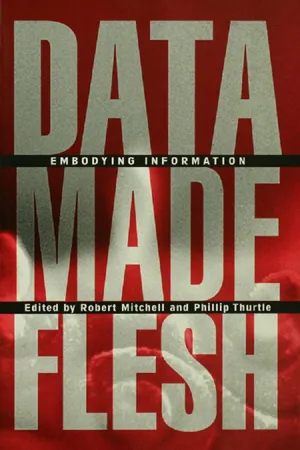
In an age of cloning, cyborgs, and biotechnology, the line between bodies and bytes seems to be disappearing. DataMade Flesh is the first collection to address the increasingly important links between information and embodiment, at a moment when we are routinely tempted, in the words of Donna Haraway, "to be raptured out of the bodies that matter in the lust for information," whether in the rush to complete the Human Genome Project or in the race to clone a human being.
eBook - ePub
Data Made Flesh
Embodying Information
- 304 pages
- English
- ePUB (mobile friendly)
- Available on iOS & Android
eBook - ePub
Data Made Flesh
Embodying Information
About this book
Information
Part I
Bodies Before the Information Age
Chapter 1
Reading the “Sensible” Body: Medicine, Philosophy, and Semiotics in Eighteenth-Century France
Over the past twenty years, through inspirations as diverse as Foucault, feminism, psychoanalysis, and cultural studies, scholars have taken a renewed interest in the body and the meanings it held during the French Enlightenment.1 This interest has in turn brought about a rediscovery of the period’s biomedical theory, a field that did much to shape knowledge during an era when the mind-body relation, the physical contours of the psyche, and the forms, limits and mechanisms of knowledge were all subjects of intense scrutiny and speculation.2 Thanks, in part, to the secular, empiricist, monistic intellectual climate cultivated by the philosophes, medicine and physiology were influential not just in discussions of materialism, sensationalist philosophy, and scientific method, but also in the period’s lively debates on human nature and diversity, on civilization’s ambiguous effects on the mind and morality, and–last but not least–on the widespread, multifaceted culture of sensibility.
The body has, of course, served since antiquity as “man’s most available metaphor.”3 However, each cultural–historical moment has its own particular ways of using the body as a metaphor or explanatory principle. In feeling-obsessed eighteenth-century France, the most productive and problematic somatic metaphor was that of the sensible body, a rich but ambiguous concept that provided physicians, moral philosophers, and literary writers with a very particular way of seeing things as they conducted their inquiries into the body, the mind, and contemporary society.4 Several ideas and theoretical suppositions were involved in that way of seeing: a certain notion of how the internal space of the body was organized; an assumption that the physical and moral realms of human existence were closely interrelated; a conviction that all natural phenomena had a profound interconnection; and a belief that there were causal structures underlying those phenomena—structures that the philosophically minded observer could uncover, provided that he had sufficient patience, perspicacity, and instinctual feeling for the operations of nature.
With its claims to privileged knowledge of the internal operations of the body, medicine has always had a philosophical aspect. However, the vitalist physicians of the French Enlightenment used the term “philosophical” to refer specifically to their new, putatively revolutionary vision of human life—one that, in pointed opposition to the mechanistic models that had long dominated the field—saw the body as a vibrant entity driven by its own inner dynamics. They perceived those dynamics as turning almost entirely around sensibility, a property they believed was the key both to understanding the living body and to making medicine a fully philosophical endeavor. As the prominent Montpellier theorist Théophile de Bordeu put it,
Sensibility can serve quite well as the basis for explaining all of the phenomena of life, whether it be in the state of health or in illness…. This is therefore the way of considering the living body that has been adopted by those who, among modern thinkers, have carried their speculations beyond practical medicine and the systems received in the schools at the beginning of the century. Such is the scope that philosophical medicine has assumed concerning the purely material functions of the body. The reign of feeling or sensibility is among the most extensive; feeling is involved in all the functions; it directs them all. It dominates over illnesses; it guides the action of remedies; it sometimes becomes so dependent upon the soul, that the soul’s passions take the upper hand over all the changes of the body; it varies and modifies itself differently in almost all the [organic] parts.5
This account of sensibility’s dominion over both somatic function and medical knowledge reflects the privileged, polysemous quality it enjoyed in Enlightenment culture at large. In the socio-moral theory of the day, sensibility was associated with notions like sympathy, virtue, pity, benevolence, tender feeling, and compassion.6 Yet it was also central to European physiological terminology beginning in the 1740s, when it edged out “irritability” as the word most commonly used to describe the innate reactive capacity held to underlie all the phenomena of life in the human body. In fact, the various meanings attached to sensibility tended to be mutually permeable because eighteenth-century authors used the word as a bridging concept—a means of establishing causal connections between the physical and the moral realms.7 Sensibility was, in short, fundamental to this period’s effort to forge a global, unified understanding of human nature: it was seen as the root of all human perceptions and reflections, as the innate and active principle of sociability that gave rise to human society, as a kind of sixth sense whose special affective energy was essential both to virtue and to art, and finally, as the paradigmatic vital force whose actions could be detected in every bodily function, be it healthful or morbid.
Eighteenth-century French thinkers thus exalted sensibility as an essential, all-revealing quality, the mainspring of all of the relations vital to human existence, from the intraorganic to the cosmic. At the same time, however, they viewed it as a potentially dangerous quality that could lead to emotional excess, moral degeneracy, and physical debilitation. Physicians were particularly concerned about the risks involved in sensibility and frequently cited it as the cause underlying the pervasive and troublesome problem of nervous ailments in worldly women, scholars, and other oversensitive sorts. Sensibility’s pathological effects seemed especially glaring in France’s cities, where life seemed to be a daily battle against all kinds of potential irritants, moral as well as physical.8 Exacerbating this threat was the putative degeneration that had occurred in the average Frenchman’s constitution, as measured against the robust, relatively insensitive state of the nation’s primitive ancestors. It was the darker side of sensibility that made a full-blown medical philosophy so crucially important for contemporary society, for only the physician equipped with such a philosophy could locate all of the hidden “rallying points” in the sensible body—the organs, centers, or nerve plexuses that might become trouble spots under excessive stimulation.9
Sensibility was, of course, strongly associated with the period’s ethical codes and class distinctions: it played a pivotal role in both sentimentalism and the chesslike game of seduction, physiognomic analysis and social one-upmanship that constituted aristocratic life in eighteenth-century France.10 However, the term’s sociomoral connotations came to be subsumed within the body-based meanings that pervaded the discourse of sensibility from midcentury on. That is, after sensibility emerged as the central notion of biomedical theory in the 1740s and 1750s, the process of reading and interpreting its manifestations became a fundamentally organic endeavor: sensationalist philosophers writing in the wake of John Locke built their models of the mind on the physical operations of the senses11; and writers as diverse as Denis Diderot, Jean-Jacques Rousseau, Choderlos de Laclos, and the Marquis de Sade strove to incorporate sensibility’s physical, material implications into their aesthetics, their social theories, and their literary works.12 Similarly, the primary meaning of semiotics during this period was medical: although semiotics in the linguistic sense certainly existed as an idea,13 the term itself typically denoted the signs and symptoms that physicians—along with the many nonphysicians who drew on their constructs—used to discern illness or dysfunction in the body. Among the many things that made sensibility so compelling was the fact that it seemed to provide an innovative way of connecting those signs and symptoms into a rich signifying whole.
Conditions were thus ripe in eighteenth-century France for a productive convergence between sensibility and semiotics—a convergence that created some very distinct models of intra-and interbodily communication. To uncover those models, I begin here by examining how theorists associated with the Montpellier medical school made sensibility a specifically medical concern, while also promoting medicine as the most authoritative branch of natural philosophy—and medical semiotics as the ultimate means of “observing” sensibility by tapping into the body’s inner voice or voices. I then sketch how the Montpellier theory of this property was received, both in its specifics and in its larger moral-philosophical repercussions, by Denis Diderot, a celebrated philosophe who saw the decoding of sensibility as the cornerstone of philosophy and literature, and whose dialogue Le Rêve de d’Alembert (1769) stages a playful response to philosophical medicine as embodied by a fictional personification of the real-life physician, Bordeu.
I. Sensibility and Medical Semiotics in the Encyclopédie
Given Enlightenment medicine’s overt philosophical aspirations, it is not surprising that it occupied a central place in the Encyclopédie, the period’s most ambitious effort to coordinate all existing knowledge under the umbrella term “sciences of man.”14 Some historians have suggested that, in its medical content, the Encyclopédie was primarily a work of vulgarization that translated conventional medical wisdom into terms that could be grasped by a general readership.15 Vulgarization is, however, too passive a term for describing the way in which medicine was represented in the Encyclopédie: as deployed by a small but energetic group of Montpellier medical vitalists, this multivolume work became a veritable défense et illustration of the most dynamic ideas emanating from contemporary medical theory—including some fascinating notions on how medical semiotics could be transformed into a faithful, authoritative transcription of the sensible body’s true inner language.16
The campaign to use the Encyclopédie as a means of promoting sensibility and philosophical medicine was conducted by a mere handful of authors. The most prominent of the group was Bordeu: although he only contributed the article CRISE to this work, he is one of the authors most frequently cited throughout the network of Montpellier-inspired medical articles. Henri Fouquet made six contributions, most notably “SECRÉTION,” an abstract of Bordeu’s treatise on glands, and the long entry “SENSIBILITÉ, SENTIMENT” (Médecine). However, the real driving force behind this effort was Jean-Jacques Ménuret de Chambaud, who wrote at least eighty-five articles for the last ten volumes of the Encyclopédie (volumes 8–17, letters H to Z, all published in 1765). Ménuret was only moderately successful as a practitioner and left little else to posterity beyond his numerous Encyclopédie entries.17 However, his contributions to this monumental enterprise are far more significant than has generally been acknowledged: he not only used his individual articles to maneuver vitalist medicine into a position of prominence over other, more established natural sciences, but also deftly deployed the cross-referencing system created by Diderot, the Encyclopédie’s energetic, influential coeditor.
In addition to underscoring the innovative physiopathology on which the medicine of sensibility was based, Ménuret and his colleagues were intent on demonstrating its profound importance for the hermeneutic art of medical semiotics. That part of their campaign took place in a series of texts that include Ménuret’s articles “OBSERVATEUR, OBSERVATION, POULS,” and “PROGNOSTIC,” as well as the anonymous essay SEMEIOTIQUE and Bordeu’s entry on CRISE. These articles served to publicize the new semiotic system put forth in Bordeu’s Recherches sur le pouls par rapport aux crises (1757), while also portraying the médecin philosophe as a heroic figure uniquely qualified to read the natural signs sent out by the body.
“SEMEIOTIQUE” is relatively short, but its reformist bent is immediately apparent. The author (most probably Ménuret) begins by declaring that semiotics should be recognized as a powerful instrument for penetrating into the inner recesses of the healthy or ailing body.18 This approach to semiotics stems directly from the new Montpellier doctrine of sensibility, which invested both the patient’s body and the practitioner’s with a special, dynamic mode of operation. The patient’s body is thus held to be driven by inner phenomena that have a “reciprocal correspondence,” a “mutual linking,” and a “natural gradation” (937). The signs emitted by this body are similarly naturally interrelated, such that a physician need only follow the pattern of actions and reactions formed by these signs in order to decipher what is causing the ailment with which he is confronted. Only a certain kind of physician, however, is able to detect those patterns: “Only the enlightened observer can direct a penetrating gaze into the most hidden recesses of the body, distinguish therein the state and the disorders of the various parts, recognize through external signs the illnesses that are attacking the internal organs, and determine the particular character and seat of those illnesses.” The body is a transparent machine for such an observer because he possesses a vision of its inner workings that goes beyond the usual limits of human understanding: “The mysterious veil that hides the knowledge of the future from frail mortals tears open before him; he sees with a confident eye the different changes that must occur in health or illness; he holds the chain that connects all events, and the first links that come into his hands reveal to him the nature of those that will come after, because Nature only varies in her external appearances: deep down, she is always uniform, and always follows ...
Table of contents
- Cover Page
- Half Title page
- Title Page
- Copyright Page
- Contents
- Acknowledgments
- Introduction Data Made Flesh The Material Poiesis of Informatics
- Part I: Bodies before the Information Age
- Part II: Control and the New Bodies Modes of Informational Experience
- Part III: Flesh Remembered Art, Information, and Bodies
- The Editors and Contributors
- Index
Trusted by 375,005 students
Access to over 1.5 million titles for a fair monthly price.
Study more efficiently using our study tools.
Frequently asked questions
Yes, you can cancel anytime from the Subscription tab in your account settings on the Perlego website. Your subscription will stay active until the end of your current billing period. Learn how to cancel your subscription
No, books cannot be downloaded as external files, such as PDFs, for use outside of Perlego. However, you can download books within the Perlego app for offline reading on mobile or tablet. Learn how to download books offline
Perlego offers two plans: Essential and Complete
- Essential is ideal for learners and professionals who enjoy exploring a wide range of subjects. Access the Essential Library with 800,000+ trusted titles and best-sellers across business, personal growth, and the humanities. Includes unlimited reading time and Standard Read Aloud voice.
- Complete: Perfect for advanced learners and researchers needing full, unrestricted access. Unlock 1.5M+ books across hundreds of subjects, including academic and specialized titles. The Complete Plan also includes advanced features like Premium Read Aloud and Research Assistant.
We are an online textbook subscription service, where you can get access to an entire online library for less than the price of a single book per month. With over 1.5 million books across 990+ topics, we’ve got you covered! Learn about our mission
Look out for the read-aloud symbol on your next book to see if you can listen to it. The read-aloud tool reads text aloud for you, highlighting the text as it is being read. You can pause it, speed it up and slow it down. Learn more about Read Aloud
Yes! You can use the Perlego app on both iOS and Android devices to read anytime, anywhere — even offline. Perfect for commutes or when you’re on the go.
Please note we cannot support devices running on iOS 13 and Android 7 or earlier. Learn more about using the app
Please note we cannot support devices running on iOS 13 and Android 7 or earlier. Learn more about using the app
Yes, you can access Data Made Flesh by Robert Mitchell, Phillip Thurtle, Robert Mitchell,Phillip Thurtle in PDF and/or ePUB format, as well as other popular books in Social Sciences & Computer Science General. We have over 1.5 million books available in our catalogue for you to explore.