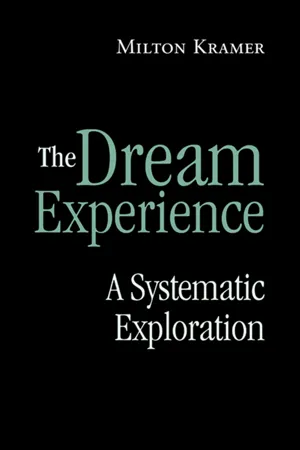
The Dream Experience provides the mental health professional with a systematic scientific basis for understanding the dream as a psychological event. Milton Kramer's extensive research, along with the findings of others, establishes that dreams are structured, not random, and linked meaningfully to conscious events in daily life and past memories. The book explores this link between dreams and consciousness, providing a review of information about normative dreaming, typical or repetitive dreams, and nightmares, while also showing how mental health professionals can use dream content in therapy with clients. Kramer's book is an illuminating description of dreaming for dreamers, therapists and neuroscientists.
- 264 pages
- English
- ePUB (mobile friendly)
- Available on iOS & Android
eBook - ePub
About this book
Information
CHAPTER 1
Introduction
A. The Historical Interest in Dreaming
The traditional interest in dreaming is to be found in the folk beliefs of dreamers who apparently were intrigued by their nocturnal experiences and sought an explanation for them (Lincoln, 1935). In most circumstances beyond their control, the ancients invoked a supernatural explanation. It was believed, in many traditions, that the will of God, or of the Gods, was revealed through dreams. The interpretations offered by the Biblical Joseph to the Pharaoh that explained the meaning of the seven fat kine (cows) followed by the seven lean kine led to his release from prison and elevation to high office. Joseph attributed the dream interpretation not to his skills but that God had interpreted the dreams (Hertz, 1976). The revelations of the Prophet Mohammed, recorded in the Koran, came to him in dreams where he was visited by the Angel Gabriel who spoke to him of God’s will (Dawood & Wyatt, 1991). The early church fathers became concerned about their congregants viewing all dreaming as a message from God (Sanford, 1968). They worried that the Devil might use the dream experience to mislead the believer. They recognized a distinction between dreams from above, from God, and dreams from below, from the Devil that could lead the dreamer astray (Van de Castle, 1994). To avoid the dangers of being misled by evil forces, the church fathers early on turned against dream interpretation and dream interpreters and vigorously discouraged any attention to the dream and especially to experiencing the dream as a revelation (Kelsey, 1968).
People through the ages have looked to the dream experience as a possible predictor of future events. In an unpredictable world filled with capricious Gods, foreknowledge then becomes a highly desirable commodity and premonitory dreaming a way to obtain such knowledge. Alexander the Great had laid siege to Tyre but was undecided about moving against the city. He had a dream of a Satyr. His court magician interpreted this by dividing the word Satyr and concluding that the meaning was Tyre is yours (Hughes, 1984; Kelsey, 1968). This interpretation apparently strengthened Alexander’s resolve and he attacked and conquered the city.
There was a possible premonitory dream that preceded the horrible air disaster that was the crash of an American Airlines DC-10 at Chicago’s O‘Hare International Airport on May 26, 1979 in which 275 passengers were killed. David Booth, a 23-year-old office manager in Cincinnati, Ohio had the same nightmare for 10 nights in a row. He heard the sound of large engines failing then he saw an American Airlines passenger plane swerve and roll in the air and crash into the ground in a red fire. David was deeply troubled by what he had experienced. “There never was any doubt to me that something was going to happen. It wasn’t like a dream. It was like I was standing there watching the whole thing.” On May 22, 1979, he called a psychiatrist at the University of Cincinnati, American Airlines, and the Federal Aviation Administration (FAA) office at the Cincinnati airport. The FAA took him seriously but couldn’t match the site to his description. The FAA felt the description of the crash bore a striking resemblance to what David had described. Was it pre-cognitive or coincidence? For some the question is an open one.
The belief in the curative and revelatory nature of dreaming was accepted and utilized by the Greek physicians who were members of the Asklepian cult (Meier, 1966). Asklepios was the Greek God of healing and his temples were places people came to be healed. Early on in the history of the Asklepian temples, the patient came to the temple and slept there, generally in the open, and had a dream experience that was healing. The temple grounds had many testimonials from patients who had been healed. Later on in the history of the temples, the practice changed, some have said degenerated. The patient came to the temple and slept, often with the aid of a potion, and the temple priest-physician moved among the sleepers in costume. On awakening, the patient reported his dream to the priest who interpreted the healing prescription that the God had communicated through the dream. Dependence on the expert for interpretation occurs early in the history of the effort to understand the import of the dream experience.
The 2nd century work on dream interpretation entitled Oneirocritica by Artemidorus of Daldis (White, 1990) provides a more sophisticated approach on which to base an interpretation of dreams than the simple and arbitrary substitutions of the dream books of the ancients. Artemidorus advised that the life circumstances of the dreamer be taken into account in guiding the interpretation including the identity, gender, age, marital status, financial status, ethnicity, health, and occupation, among other things. He believed in the premonitory nature of dreaming and used the outcome of his interpretations to underpin his interpretive approach. He warned to be cautious to separate dreams that can be taken at face value and those that are to be understood allegorically. Artemidorus recommended particular attention be paid to dreams with no obvious motivating force. He observed that dreams are often only a continuation of the day’s activities and he believed that dreams are often prompted by bodily needs or recent psychologically significant events. Recurrent dreams were to be regarded as especially significant. Artemidorus exemplified an insightful and valuable approach that went beyond what was usual for his time and is in concert with a modern view of dreaming.
It was in the 18th century with the beginning of the Enlightenment that the shift began to occur in the West from supernatural to naturalistic explanations in our understanding of the world and of man in that world. We might expect that the explanation for the dream experience and what the experience means, if anything, would have a more naturalistic and less supernatural explanation. This was indeed the case and the dream experience came to be seen as a consequence of physiologic changes in the dreamer. Nevertheless a segment of the population maintained a belief in a supernatural explanation of dreaming. My colleagues and I undertook to survey a statistically representative sample of adults in a mid-American city, Cincinnati (Kramer, Winget, & Whitman, 1971). In addition to asking each participant for a dream report, they were asked whether they believed that dreams could be premonitory and predict future events. Some 5% of our respondents stated that dreams could foretell future events. Perhaps in a country that has been described as the most religious in the Western world that some 1.5 million of our fellow citizens may express a belief in the supernatural should not be a surprise.
Does the belief in the premonitory nature of dreaming manifest itself in other ways? It has been said that the major work on dreaming that has captured the public’s imagination and has re-awakened and sustained an interest in dreams is Freud’s magnum opus The Interpretation of Dreams (Freud, 1955). Freud had an interest in the occult, but he rejected the notion that the dream in a supernatural manner could predict the future. Books such as Aunt Sally’s Policy Players Dream Book (Yronwode, 2003) and others like it reflect the general public’s interest in looking to dreams for information about what will happen in the future. Beginning in the 1890s in the black communities in the United States, a lottery-like illegal gambling game developed called “Policy.” The bets could be quite small, pennies, and the pay offs were 10 times the bet. The choice of the number to bet by the policy player often was chosen from a dream book such as Aunt Sally’s. The player would select the image from a dream he had and search the dream book for the number that was linked to his dream image. There has been some interesting speculation about the basis for the relationship between a number and a dream image. For example, the interlocking nature of 6 and 9 has been offered as the basis for relating 69 to sexual activity in dreams. Policy and particular numbers and images became so commonplace that they appeared in blues songs in the 1920s and 1930s. Illegal gambling expanded over time into the white community and control shifted to organized crime; the game was now called “the numbers.” Pay-offs were linked to numbers that appeared in the public domain such as the number of shares traded on a designated stock exchange and this helped maintain a belief in the honesty of the winning number. Interest in and the use of dream books that provided number equivalents for dream images remained high. I wonder if players in the legalized state run lotteries of today turn to current versions of Aunt Sally’s book. The ancient Egyptians used dream dictionaries with fixed symbols, e.g., the Beatty Papyrus III and the lottery player of today may well continue the same behavior. We have gone from the Beatty Papyrus (Van de Castle, 1994) to Aunt Sally’s over three to four millennia.
The other work that has sustained an interest in dreaming, as was noted earlier, was Freud’s The Interpretation of Dreams. It was written in the last decade of the 19th century and published in 1900. It was barely noticed when it first appeared and took eight years to sell out its first printing (Kramer, 1994). This was in contrast to the work of Darwin (Darwin, 2003)—The Origin of Species by Means of Natural Selection, published in 1859, whichh was an immediate best seller. Freud always felt that the dream book was his major work. Psychoanalysis went on to capture the popular imagination and became the preferred treatment for emotional distress, especially in the United States. Interest in understanding the forces in the unconscious, in the motives outside of our awareness that were the “true determinants” of our behavior and revealed what we really thought and believed, were eagerly sought. Freud had expressed the view that “The interpretation of dreams is the royal road to a knowledge of the unconscious activities of the mind.” This led psychoanalysts and later psychotherapists to encourage the reporting of dreams by their patients and to attempt through the use of the “free associations” of their patients to undo the dream work that created the disguise of the manifest dream that the patient experienced and reported. The therapist then could reconstruct the latent dream thoughts, the source of the manifest dream, that reflected the true feelings and motivations of the dreamer. Carl Jung (Jung, 1964a,b), an early disciple, collaborator, and finally a defector from Freud, in his Analytic Psychology, saw the dream experience as essentially a compensation for the exaggerated waking maladaptive traits of the dreamer. He recognized in the dreams characters, actions, and symbols were expressions of both individual and universal aspects of the human condition (Jung, 1974; Jung, 1984). The dream for Jung was revealing of the dreamer’s psyche and the task of the therapist was to grasp the meaning that was being expressed. Techniques such as the use of active imagination, amplification, and symbol interpretation were used in the search for the meaning of the dream. The value of this increased self-knowledge, this message to the dreamer from his unconscious, would be to enhance the development of the individuation process within the individual to become more self-actualizing. Alfred Adler (Adler, 1956; Schulman, 1969), an early disciple and the first major defector from Freud and psychoanalysis, in his Individual Psychology, saw the dream experience as providing the emotional motor power to support the dreamer’s striving toward his fictive life goal. As the individual came to terms with the need for superiority in order to enhance his life style and solved his waking problems with courage and social interest, the need to seek fictive and simplified solutions in dreams would diminish and dreaming would decrease if not cease entirely.
A fascination with and a firm belief in the revelatory and healing nature of dream exploration resides currently in two relatively small groups of people. One is involved with the Association for Research and Enlightenment in Virginia Beach, Virginia, that has built their beliefs on the work of the spiritual healer and mystic Edgar Cayce (Cayce & Cayce, 1971). The other group has a “new age” orientation and may be seen as growing out of the ideas and themes that flowed from Esalen. This “new age” group has developed ideas around dream sharing, the intrinsic truthfulness of dreams, and the healing nature of the dream experience (Ullman & Zimmerman, 1979). Those involved with leading and participating in “dream sharing groups,” so-called dream workers who generally are nonprofessionals, have come together with scientific researchers into the dreaming experience and formed the International Association for the Study of Dreaming.
The three major schools of depth psychotherapy, Psychoanalysis, Analytic Psychology, and Individual Psychology, in the first third of the 20th century placed a priority on the exploration of the dream experience in order to enhance an understanding of the dreamer. It is to be expected that psychotherapists would focus their attention on the dream reports of their patients and attempt to unravel the dream as it would facilitate an understanding and alleviation of the distress their patients were experiencing. Unfortunately, the basis for relating the dream experience to other aspects of the dreamer’s life was not on very sound ground (Fisher & Greenberg, 1977). The method for establishing meaning was left to the individual judgment of the therapist and patient. No systematic examination of the reliability of such judgments was undertaken. The linkage of the understanding gained from dream interpretation to other aspects of the patient’s psychic life was described only in an anecdotal manner. The therapists’ dream interpretive endeavor needed to be supported by reliability and validity studies as well as demonstrations of the linkage between sleeping and waking consciousness that would show the connection between the two. Otherwise the undertaking of dream exploration and interpretation would remain an arbitrary and idiosyncratic process even if an imaginative, entertaining and, at times, a helpful one.
B. The Dream Has Not Been Considered an Appropriate Topic for Scientific Study
There has long been a distrust of studying subjective states scientifically. Psychologists struggled for years to escape from the introspective approach championed by Titchener (Millon, 2004) The focus moved from a first person data source to a third person one, from a study of subjective states to the study of objective states that were not dependent on the vagaries of the experimental subjects’ reporting. The view of the behaviorist psychologist Watson (Millon, 2004) that the proper data for study was solely the directly observable became the only acceptable scientific position. The paradigmatic experiment was to study the relationship between a stimulus given to a subject and the resultant response and to ignore any processes that might have occurred in the “black box” between stimulus and response in the mind of the subject. This paradigm would, of course, preclude a scientific study of the dream experience. Those interested in dreaming reported clinical anecdotes of dreams told by a patient in therapy or, in rare instances, a study of the dream content of a group of people. It was only when a highly regarded academic psychologist, Calvin Hall, turned his attention to dreaming and provided a method for quantifying the dream report (Hall & Van de Castle, 1966) that a scientific approach to the dream experience became possible.
The study of the mind was enlivened with the development of the cognitive sciences that were stimulated by the introduction of computers and the concepts related to artificial intelligence. Cognitive science (Gardner, 1985) is a collaborative approach involving psychologists, philosophers, linguists, neuroscientists, computer specialists, and anthropologists. The focus of these endeavors is directed at understanding waking consciousness, particularly rational thought, and did not include studies of emotion or dreaming in their working agenda. Concomitantly, with this study of the mind and as a result of the discovery of various brain imaging devices, neuroscientists focused on brain localization studies linking various areas of the brain to observable behaviors. The view taken by those scientists who studied brain function was and continues to be that the important level of description for such an undertaking is biological rather than psychological. Patricia Churchland, a neurophilosopher, describes consciousness, of which dreaming is an example, as having its reality rooted in its neurobiology (Churchland, 2002). The view that consciousness is rooted in biology is captured in more specific terms by the neuroscientist Joseph LeDoux (LeDoux, 2002) when he says, “you are your synapses.” He proposes “a synaptic explanation of the self.” For many of these neuroscientists, the mind became epiphenomenal to the more fundamental brain processes (Hobson, 1988). Traume sind Schaume—mind, at best, became the foam on the beer that is the brain.
Some neuroscientists who became interested in consciousness were dismissive in their approach to the dreamer’s memory of the dream experience. Crick, a Nobel Prize winner for his work on the structure of DNA, saw the dream experience as a reflection of the process by which the brain rid itself of superfluous memories (Crick & Mitchison, 1983). This process was analogized by him to an offline clearance of data from a computer’s memory system to avoid an overload breakdown. He was of the opinion that dreaming dumped thoughts from the brain and thereby avoided the overloading of the brain’s memory capacity. This view of memory storage as similar to a storage facility with a fixed capacity does not square with our understanding of brain function.
Robert, in the 19th century (Freud, 1955), expressed a similar view of dream function, which Freud called the “excretion theory” of dreams, similar to that proposed by Crick. Robert describes dreams as “a somatic process of excretion of which we become aware in our mental reaction to it.… A man deprived of the capacity for dreaming would in the course of time become mentally deranged, because a great mass of uncompleted unworked-out thoughts and superficial impressions would accumulate in his brain and would be bound by their bulk to smother the thoughts which should be assimilated into his memory as completed wholes. Dreams serve as a safety-valve for the overburdened brain. They possess the power to heal and relieve.” The interference with or the loss of the function of dreaming in the Robert/Crick scenario leads to a “locked brain” as interference with the gastrointestinal function of motility leads to “locked bowels.” The dream deprivation experience of the New York disc jockey Peter Tripp who stayed awake for 201 hours in a glass booth in Times Square as a publicity stunt and experienced a psychotic breakdown during which he hallucinated and had persecutory delusions seemed to confirm the dangers of the loss of dreaming. Apparently Mr. Tripp had had a previous psychotic episode and the stress of the extended sleep deprivation appeared to trigger a reactivation of his disturbed mental state (Dement, 1974). Koranyi and Lehman had shown in a group of hospitalized, withdrawn, chronically ill schizophrenic patients that sleep deprivation reactivated their acute symptoms (Koranyi & Lehmann, 1960). As his science fair project in 1964, a 17-year-old high-school student, Randy Gardner, deprived himself of sleep and the accompanying dreams for 264 hours and did not become psychotic but showed impaired cognitive function and illusions. Some have challenged the rather benign description of the effect of the lengthy sleep deprivation on Randy and insist that he had transient psychotic symptoms (Ross, 1965).
The loss of the dreaming experience that is reported with certain types of localized brain lesions has as a consequence reports of disturbed sleep continuity not mental derangement (Solms, 1997). The disruption of sleep with the loss of dreaming is in keeping with Freud’s view of dreaming as having a sleep protective function and does not fit the waste product model that is implicit in the Robert/Crick theories of dreaming which may be seen as dismissive of dreaming as an experience.
The study of the dream experience is the study of the dream report that is a first person, subjective report as was noted earlier. Science, in studying human behavior, has insisted on focusing on external observables as its object of study, what are termed third person reports. Even in studying cognitive processes when two alleged internal mind processes are compared what is measured is the time it may take to complete a task. For example, comparing on a mental map how long it takes using your mind’s eye to go from New York to Chicago compared to New York to Los Angeles, the latter takes longer and the time difference is roughly proportional to the mileage differences (Kosslyn, 1980). The reluctance or refusal to study first person reports of experience, such as a dream, relates to a concern about the introspective ability of the subject to attend to and recall inner experiences and the willingness of subjects to report such potentially revealing and embarrassing thoughts as may occur in dreams. Given the vagaries of memory in the waking state such a...
Table of contents
- Cover
- Halftitle
- Title
- Copyright
- Dedication
- Contents
- Preface
- Acknowledgments
- Chapter 1 Introduction
- Chapter 2 Do Dreams Exist?
- Chapter 3 The Recall and Collection of Dreams
- Chapter 4 The Measurement of Dreams
- Chapter 5 Dreams and Psychological Differences
- Chapter 6 Normative Dreams, Typical Dreams, and Repetitive Dreams
- Chapter 7 Psychopathologic Dreams (Nightmares) and Dreams in Psychopathologic States
- Chapter 8 The Reactive Nature of Dreaming
- Chapter 9 Dreams and Waking Thought
- Chapter 10 Dream Meaning
- Chapter 11 The Functions of Dreams
- Chapter 12 The Biology of Dream Formation
- Chapter 13 Journey’s End? No, a Time for Assessment
- Bibliography
- Index
Trusted by 375,005 students
Access to over 1.5 million titles for a fair monthly price.
Study more efficiently using our study tools.
Frequently asked questions
Yes, you can cancel anytime from the Subscription tab in your account settings on the Perlego website. Your subscription will stay active until the end of your current billing period. Learn how to cancel your subscription
No, books cannot be downloaded as external files, such as PDFs, for use outside of Perlego. However, you can download books within the Perlego app for offline reading on mobile or tablet. Learn how to download books offline
Perlego offers two plans: Essential and Complete
- Essential is ideal for learners and professionals who enjoy exploring a wide range of subjects. Access the Essential Library with 800,000+ trusted titles and best-sellers across business, personal growth, and the humanities. Includes unlimited reading time and Standard Read Aloud voice.
- Complete: Perfect for advanced learners and researchers needing full, unrestricted access. Unlock 1.5M+ books across hundreds of subjects, including academic and specialized titles. The Complete Plan also includes advanced features like Premium Read Aloud and Research Assistant.
We are an online textbook subscription service, where you can get access to an entire online library for less than the price of a single book per month. With over 1.5 million books across 990+ topics, we’ve got you covered! Learn about our mission
Look out for the read-aloud symbol on your next book to see if you can listen to it. The read-aloud tool reads text aloud for you, highlighting the text as it is being read. You can pause it, speed it up and slow it down. Learn more about Read Aloud
Yes! You can use the Perlego app on both iOS and Android devices to read anytime, anywhere — even offline. Perfect for commutes or when you’re on the go.
Please note we cannot support devices running on iOS 13 and Android 7 or earlier. Learn more about using the app
Please note we cannot support devices running on iOS 13 and Android 7 or earlier. Learn more about using the app
Yes, you can access The Dream Experience by Milton Kramer in PDF and/or ePUB format, as well as other popular books in Psychology & Mental Health in Psychology. We have over 1.5 million books available in our catalogue for you to explore.