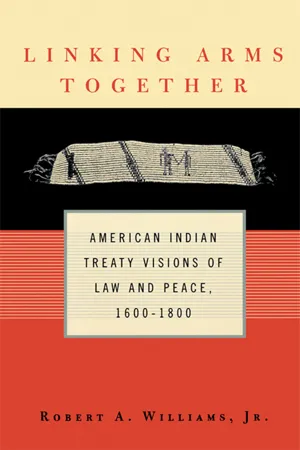
eBook - ePub
Linking Arms Together
American Indian Treaty Visions of Law and Peace, 1600-1800
- 204 pages
- English
- ePUB (mobile friendly)
- Available on iOS & Android
eBook - ePub
Linking Arms Together
American Indian Treaty Visions of Law and Peace, 1600-1800
About this book
This readable yet sophisticated survey of treaty-making between Native and European Americans before 1800, recovers a deeper understanding of how Indians tried to forge a new society with whites on the multicultural frontiers of North America-an understanding that may enlighten our own task of protecting Native American rights and imagining racial justice.
1
National Mythologies and American Indians
The National Mythology
The task of developing a more complete understanding of the response of American Indians to the coming of the white man immediately confronts a formidable obstacle: the great American mythos of frontier conquest. The national creation epic of a simple, agrarian, “Anglo” race of conquerors defeating “a fierce race of savages” for control and civilization of an extraordinary wilderness land has long provided us with a catalog of images and stories of who we think we are as a people.1 The mythos of white conquest has also defined what we think of Indians in our American history. It has functioned, to borrow from the cultural anthropologist Bronislaw Malinowski, as “a warrant, a charter, and often even a practical guide”2 for most Americans' understanding of American Indians as obstacles to their manifest destiny.
The deeply ingrained negative image of the Indian in the national consciousness represents a significant impediment to our acceptance of Indian tribalism's unique response to the coming of the white man to North America. We find it difficult to believe that American Indians responded to European colonial invasion by envisioning the beginnings in North America of the modern world's first multicultural society.
The Indian as Obstacle
The Indian's antagonistic role in the national mythology of western frontier conquest has deep roots in the American experience. As elegantly described in The Savages of America, Roy Harvey Pearce's classic study on the American Indian and the European-derived idea of civilization,3 a clearly identifiable set of themes regarding the tribal Indian's perceived difference emerged within a few short decades of the European invasion of America. These themes comprised the genesis of an important narrative tradition in the American public imagination.4 In this tradition, tribalism's deficiency and unassimilability set it apart from the superior agrarian civilization European-Americans sought to transplant in America from the Old World. Through this narrative tradition on tribalism's cultural inferiority, European-Americans, according to Pearce, came to understand the Indian, “not as one to be civilized and to be lived with, but rather as one whose nature and whose way of life was an obstacle to civilized progress westward.”5
Removing tribalism as an obstacle to white civilization's procession westward across North America emerges as the dominant theme of this tradition at an early point in the colonial encounter. The seventeenth-century Puritan leader Cotton Mather spoke with assurance that Providence ultimately intended success for His elect in the New World wilderness, though the Indian admittedly presented a formidable barrier. The “Promised Land,” Mather warned, “is all over filled with fiery flying serpents …. There are incredible droves of devils in our way.”6
The English promoter of New World colonization, Samuel Purchas, arguing for the benefits of Virginia's settlement by the English, put forward the following argument in favor of his nation's natural right to dispossess the savage tribes of America:
On the other side considering so good a Country, so bad a people, having little of humanity but shape, ignorant of Civility, of Arts, of Religion; more brutish than the beasts they hunt, more wild and unmanly than that unmanned wild county, which they range rather than inhabit; capitulated also to Satan's tyranny in foolish pieties, mad impieties, wicked idleness, busy and bloody wickedness.7
The narrative tradition of tribalism's incompatibility with European-derived civilization generated a richly diverse corpus of texts on both sides of the Atlantic. Thomas Hobbes drew on the tradition in his 1651 study on the fundamentals of government, Leviathan.8 In the state of nature, Hobbes's notorious text declared: “[T]here is no place for Industry … no knowledge of the face of the Earth; no account of time-no Arts; no Letters; no society; and which is worst of all; continual fear, and danger of violent death; and the life of man, solitary, poor, nasty, brutish, and short.”9 Hobbes's readers then learned that this abhorred primitive state of nature was more than just a philosophical conceit. Hobbes pointed to “the savage people in many places of America” to illustrate that this state of nature still prevailed in certain parts of the world. The Indians of America, he wrote, “have no government at all; and live at this day in that brutish manner as I said before.”10
John Locke, in his Second Treatise of Government, also relied on the narrative tradition of American Indian cultural inferiority to hypothesize a savage world of peoples without civilization or advanced law.11 Locke's late seventeenth-century declaration that “in the beginning, all the world was America” illustrates the widely diffused nature of the impact of a century of English colonial activity in the New World on so many aspects of English life and society.12 In his text's most oft-cited chapter on “Property,” Locke turned repeatedly to the narrative tradition of the Indian's deficient social state as a foil to illustrate his central argument that human labor was the basis of individual property according to natural law. The Indians of America, he wrote,
are rich in land and poor in all the comforts of life; whom nature having furnished as liberally as any other people with materials of plenty, i.e., a fruitful soil, apt to produce in abundance what might serve for good, raiment, and delight, yet for want of improving it by labor have not one-hundredth part of the conveniences we enjoy. And a king of a large and fruitful territory there feeds, lodges, and is clad worse than a day-laborer in England.13
The Great American mythos of white frontier conquest located another sustaining source of ideas on American Indian tribalism's cultural inferiority in the writings of the major European legal theorists on the Law of Nations. According to Emmerich Vattel's influential treatise, The Law of Nations or The Principles of Natural Law (1758),14 for example, no individual or community should be permitted to hold great tracts of land left uncultivated. Echoing John Locke's natural law argument on human labor as the basis of property, Vattel declared that the whole earth was designed by God to furnish sustenance for its inhabitants, “but it cannot do this unless cultivated. Every Nation is therefore bound by the natural law to cultivate the land which has fallen to its share.”15 Thus, Vattel castigated those peoples
who, though living in fertile countries, disdain the cultivation of the soil and … in order to avoid labor, seek to live upon their flocks and the fruits of the chase. This might well enough be done in the first age of the world, when the earth produced more than enough, without cultivation, for the small number of its inhabitants. But now that the human race has multiplied so greatly, it could not subsist if every people wished to live after that fashion. Those who still pursue this idle mode of life occupy more land than they would have need of under a system of honest labor, and they may not complain if other more industrious Nations, too confined at home, should come and occupy part of their land.16
According to Vattel's reasoning, Spain's conquest of the “civilized Empire of Peru and Mexico” was a “notorious usurpation” because those peoples engaged in large-scale crop agriculture. But, he went on, “the establishment of various colonies upon the continent of North America might, if done within just limits, have been entirely lawful. The peoples of those vast tracts of land roamed over them, rather than inhabited them.”17 Europeans, according to Vattel's reasoning, followed the dictates of natural law and the Law of Nations in dispossessing the “savages” of North America of their uncultivated lands.
Old World texts such as those produced by Hobbes, Locke, Vattel, and others became an important part of the Great American Mythology of Frontier Conquest.18 Generated from European myths about the deficient qualities of “savage” life in the New World, these texts spoke directly to European-Americans who could point to a venerable narrative tradition to justify the colonization of the Indians and their “waste” lands in America.
The Myth as Policy
Myths have consequences. The narrative tradition of Indian tribalism's cultural inferiority has been deeply impressed upon our understanding of the national experience and the Indian's negative role as part of that experience. Tribal Indians are peoples without civilization, without laws, and without place in the nation created by white Americans out of the frontier wilderness of North America. From the time of the Founding Fathers, the racist premises derived from this tradition have informed the basic framework of our nation's policies toward Indian tribalism and the basic rights of tribal Indians under U.S. law. The acts of genocide and ethnocide perpetrated against Indians under U.S. law have been justified as simply the extension of the West's enlightened reason upon the “savage” Indian-occupied frontiers of the New World.
Commander-in-Chief George Washington relied on the narrative tradition of Indian cultural inferiority in framing his recommendations to Congress on U.S. Indian policy immediately following the Revolutionary War. In a letter to Congress that patiently explained the most expedient strategy for the new nation's acquisition of the western frontier lands from the Indians, General Washington declared:
I am clear in my opinion, that policy and economy point very strongly to the expediency of being upon good terms with the Indians, and the propriety of purchasing their lands in preference to attempting to drive them by force of arms out of their country; which as we have already experienced is like driving Wild Beasts of the Forest which will return as soon as the pursuit is at an end and fall perhaps on those that are left there; when the gradual extension of our Settlements will as certainly cause the Savage as the Wolf to retire; both being beasts of prey tho' they differ in shape.19
Washington's recommendations were readily adopted by Congress as the foundation of the first U.S. Indian policy, an empire-building vision of America grounded upon the comforting, racist assumption that Indian tribalism was a doomed form of cultural existence on the North American continent. The “Savage as the Wolf” would retire westward when confronted by the onslaught of a superior white civilization.
John Quincy Adams, the great American statesman and rhetorician, deployed the narrative tradition of tribalism's cultural inferiority with an unrivaled degree of eloquence, persuasiveness, and skill during his public career.20 As president of the United States from 1825 to 1829, Adams was confronted with the problem of what to do with those Indian tribes east of the Mississippi River that had refused to fulfill Washington's prophecy of doom. The Cherokees, Chickasaws, Choctaws, Creeks, and Seminoles had maintained their cultural sovereignty despite having been caught for decades in the path of white civilization's progress across the continent. In his 1828 Message to Congress, Adams proposed the need for a “remedy” for such “unfortunate children of nature”:
[I]n appropriating to ourselves their hunting grounds we have brought upon ourselves the obligation of providing them with substinence; and when we have had the same good fortune of teaching them the arts of civilization and the doctrines of Christianity we have unexpectedly found them forming in the midst of ourselves communities claiming to be independent of ours and rivals of sovereignty within the territories of the members of our Union. This state of things requires that a remedy should be provided—a remedy which, while it shall do justice to those unfortunate children of nature, may secure to the members of our confederates their right of sovereignty and soil.21
Adams's proposed remedy for the nation's Indian problem drew upon a narrative tradition that had long situated the Indian as an obstacle on the frontiers of America's destiny. Adams proposed removing the remaining tribes east of the Mississippi River across the Father of Waters to an Indian territory out of the way of the intended trajectory of white settlement and civilization. Adams's proposal was soon adopted as a genocidal national policy by his successor, President Andrew Jackson, after the U.S. Congress passed the Indian Removal Act of 1830.22
The Myth as Source of Legal Rights
The famous American historian Frederick Jackson Turner announced the closing of the nation's western frontier in 1890. But Turner was really only perpetuating a long-standing narrative tradition concerning the Indian's role in the national experience when he wrote what he regarded as his closing chapter to the American creation epic. “[V]ast forests blocked the way; mountainous ramparts interposed; desolate grass-clad prairies, barren oceans of rolling plains, arid deserts, and a fierce race of savages all had to be met and defeated.”23 The Indian as foil; the savage, lawless contrast to pioneer values; the stubborn red-skinned obstacle to white civilization's dynamic westward march; the vanquished warrior at the end of the trail—these images the American mind calls up from its collective catalog of stories on the Indian in the national experience all originate in the Great American Mythology of Frontier Conquest.
In our own century of combatting racism in all of its forms,24 the narrative tradition concerning Indian cultural deficiency continues to define what we think of the Indian and Indian rights. Even justices of the U.S. Supreme Court feel no hesitancy in citing the mythology of Indian conquest as a reason to deny Indians justice under U.S. law. In the 1955 landmark case, Tee-Hit-Ton v. United States,25 for example, the tradition was called upon by the Supreme Court to provide the European-derived society that colonized North America with a legal justification for denying constitutional protection for the lands occupied by Indian peoples on the continent from time immemorial. According to Justice Reed's opinion for the Court in Tee-Hit-Ton:
The line of cases adjudicating Indian rights on American soil leads to...
Table of contents
- Cover
- Half Title
- Title Page
- Copyright Page
- Dedication
- Acknowledgments
- Table of Contents
- Linking Arms Together
- Other
- Introduction: Paradigms for Behavior
- 1 National Mythologies and American Indians
- 2 Treaties as Sacred Texts
- 3 Treaties as Connections
- 4 Treaties as Stories
- 5 Treaties as Constitutions
- Conclusion: Understanding American Indian Treaty Visions of Law and Peace
- Notes
- Index
Trusted by 375,005 students
Access to over 1.5 million titles for a fair monthly price.
Study more efficiently using our study tools.
Frequently asked questions
Yes, you can cancel anytime from the Subscription tab in your account settings on the Perlego website. Your subscription will stay active until the end of your current billing period. Learn how to cancel your subscription
No, books cannot be downloaded as external files, such as PDFs, for use outside of Perlego. However, you can download books within the Perlego app for offline reading on mobile or tablet. Learn how to download books offline
Perlego offers two plans: Essential and Complete
- Essential is ideal for learners and professionals who enjoy exploring a wide range of subjects. Access the Essential Library with 800,000+ trusted titles and best-sellers across business, personal growth, and the humanities. Includes unlimited reading time and Standard Read Aloud voice.
- Complete: Perfect for advanced learners and researchers needing full, unrestricted access. Unlock 1.5M+ books across hundreds of subjects, including academic and specialized titles. The Complete Plan also includes advanced features like Premium Read Aloud and Research Assistant.
We are an online textbook subscription service, where you can get access to an entire online library for less than the price of a single book per month. With over 1.5 million books across 990+ topics, we’ve got you covered! Learn about our mission
Look out for the read-aloud symbol on your next book to see if you can listen to it. The read-aloud tool reads text aloud for you, highlighting the text as it is being read. You can pause it, speed it up and slow it down. Learn more about Read Aloud
Yes! You can use the Perlego app on both iOS and Android devices to read anytime, anywhere — even offline. Perfect for commutes or when you’re on the go.
Please note we cannot support devices running on iOS 13 and Android 7 or earlier. Learn more about using the app
Please note we cannot support devices running on iOS 13 and Android 7 or earlier. Learn more about using the app
Yes, you can access Linking Arms Together by Robert A. Williams, Jr. in PDF and/or ePUB format, as well as other popular books in History & World History. We have over 1.5 million books available in our catalogue for you to explore.