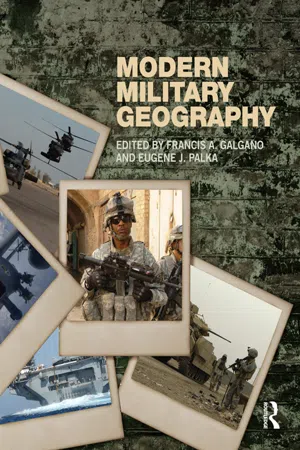
This book of contributed chapters by subject matter expertly provides an overview and analysis of salient contemporary and historical military subjects from the military geographer's perspective. Factors of geography have had a compelling influence on battles and campaigns throughout history; however, geography and military affairs have gained heightened attention during the past two decades, and military geography is the discipline best situated to explain them. Hence, the premise of this book and its contents are founded on the principle that geographical knowledge of space, place, people, and scale provide essential insights into contemporary security issues and promotes the idea that such insight is critical to understanding and managing significant military problems at local, regional, and global scales.
eBook - ePub
Modern Military Geography
- 442 pages
- English
- ePUB (mobile friendly)
- Available on iOS & Android
eBook - ePub
Modern Military Geography
Part I
Introducing military geography
GEOGRAPHIC INFORMATION has been used to support military operations for as long as history has been recorded. This is because there is a clear and fundamental link between geography and military operations—military operations take place in distinct operational environments such as jungles, deserts, oceans, and cities. They also take place in different operational contexts such as peacekeeping, disaster relief, civic action, and of course combat operations; thus, they are in part shaped by the nature of the natural and human landscape. Military operations have evolved through time with changes in military technology and with their scope. Different operational environments and contexts require different types of geographic information; consequently, military geography offers a unique and important vantage point from which to study the nature of military operations and their relationship with discrete landscapes and operational environments at diverse scales.
A geographer seeks to answer the question “Why is it like this here?” By their very nature, military operations are geographic: they occur in places; and places contain unique physical environments, climates, and culture systems. In essence, military operations involve time, space, and the nature of what exists within the confines of that time and space— this is an inherently geographic perspective. Military operations are a complex three-dimensional array of actions that have to be arranged in time and space. Geographers understand the components and processes—terrain, weather, climate, and people—that affect military operations in time and space. Military geography then is the application of geographic information, tools, and technologies to military problems across the spectrum of military operations from peacetime to war. Military geographers are uniquely qualified to examine the linkages between military operations and the nature of the space in which they take place because like all geographers they apply an integrated, multidisciplinary approach.
Through the centuries, the geographic nature of warfare has been obvious to military leaders; however, it was only during the nineteenth century that the distinct subfield of military geography could be identified. As warfare has evolved in complexity through two World Wars, countless low-intensity conflicts, the explosive growth in military technology, a proliferation of stability and support missions, and now the Global War on Terror, it has become impossible for one leader to keep pace with the ever-increasing demands for accurate and timely geographic information. Military planners have also acknowledged the complex linkages between terrain and cultural systems, as well as the extreme difficulty in understanding and predicting their impact. Modern military operations, which include a wide spectrum of potential wartime and peacetime endeavors, demand more precise and complex analyses of physical and cultural landscapes. This reality is the genesis of this book.
Military Geography has grown considerably as an academic subject during the past two decades. For example, the number of university geography programs offering Military Geography courses has grown by nearly a factor of four since 2001. This growth has been fueled in part by the collapse of the Soviet Union and transition from a bi-polar strategic world in 1989, through a decade of ethnic violence and peacekeeping operations, and now asymmetrical warfare and the Global War on Terror. These events demanded an increasing volume of ever more sophisticated geographic analyses, and clearly sparked interest in an academic subdiscipline that was essentially dormant—at least in the US—since the end of the Vietnam War. Without question the global geopolitical situation since the end of the Cold War and events following 9/11 have demonstrated the need for increased geographic awareness and research as military efforts shifted to peacetime and stability and support operations, but also the complexity of wartime operations as part of counter-terror operations have generated renewed public and academic interest as well.
Before 1998, the last published volume on military geography was Military Geography by Louis C. Peltier and G. E. Pearcy. Since 1998, seven legitimate Military Geography books have been published. Clearly, 1998 was a watershed year, and in that year Military Geography for Professionals and the Public by John Collins and Battling the Elements by Harold Winters were published. In 2001, Eugene Palka and Francis Galgano published an edited volume titled The Scope of Military Geography: Across the Spectrum from Peacetime to War. This was the first of two books published by Palka and Galgano that attempted to address the full spectrum of military operations from the perspective of the military geographer. Their second book, Military Geography: from Peace to War, was published in 2005 and incorporated analyses from Iraq and Afghanistan, as well as discussing topics such as military land management and base closure and re-alignment. Three other books have appeared on the market. National Geographic published in 2003, Blackwell a new title by Rachel Woodward (Military Geographies) in 2004, and Oxford University Press one edited by Colin Flint (The Geography of War and Peace) in 2005.
We have titled this book Modern Military Geography because we intend for it to connect contemporary subjects in military geography to the roots of the discipline. It is our intention to bring out this theme in the introductory section and reinforce it throughout the book. It is our belief that, in order for the reader to truly understand the scope of military geography, we would, out of necessity, have to present the full spectrum of subject matter and not focus on discrete aspects of military geography such as historical case studies or critical geographies. Thus, this book is organized into three discrete sections. In the first, Introduction to Military Geography, it is our aim to introduce the reader to military geography as a discipline, i.e. present its historical background, traditional subject matter, methodologies, and pedagogies. In the second part of the book, Historical and Operational Military Geography, we present the reader with a set of timeless case studies that illustrate linkages between warfare and geography. However, in that this is a more contemporary publication, we present not only historical case studies from the Civil War and the era of twentieth-century warfare, but also case studies that focus on the aftermath of the shattering of Yugoslavia, as well as Operation Enduring Freedom (Afghanistan), and Operation Iraqi Freedom. Finally, we complete our précis of modern military geography in the closing section, titled Applied Military Geography. In this section, we introduce the reader to a broad spectrum of contemporary military geography topics such as disaster relief operations, military land management and training analogs, ethnic warfare, issues relating to effective sovereignty and terrorism, and the rise of China as a military power, to name a few.
It would be impossible to overemphasize the importance of military geography during wartime. The dependence on geographic information has been fundamental to training, equipping, and deploying forces overseas throughout history; hence, relevant regional and systematic geographies routinely provide essential informational considerations to support decision-making. Ironically, most geographers are not military professionals and most military professionals are not geographers. Given this dilemma, we have created the introductory section of the book to provide all readers with a common understanding of military geography as a discipline, as well as a common introductory foundation in military science and geography. Finally, in this section of the book we intend to focus the reader on the seminal contemporary geographic issues affecting the discipline.
In Chapter One, Eugene Palka explains the history, scope, and recent developments of military geography in the US. This chapter will also provide the reader with a basic understanding of the nature and scale of geographic analyses, as well as common methods used by military geographers. The second and third chapters are complementary in that they are intended to provide non-military professionals and non-geographers with the basic concepts needed to understand fully the material presented throughout the remainder of the book. In Chapter Two, Frank Galgano presents an elementary introduction to military science for the layperson. Similarly, in Chapter Three, he introduces basic concepts in geography so that the non-geographer can approach the material in this book with a solid understanding of geographic terms, concepts, and methods. In chapters four through six, we present a set of related topics that are of seminal importance to modern military geographers— the undeniable linkage between environmental change, environmentally induced instability, and issues of military strategy and planning. Kent Butts offers an important synopsis of the evolving concept of environmental security in Chapter Four, and illuminates how it is influencing military decision-making at the strategic level. In Chapter Five, Amy Krakowka uses environmental security as a framework for analysis to examine the nexus between non-sustainable practices, environmental change, and latent ethnic conflict, and how they combined to trigger the genocide in Rwanda in 1994. At the strategic level, Eugene Palka examines the strategic imperatives engendered by the melting of Arctic sea ice. His examination of this complex geopolitical issue in Chapter Six is an excellent example of the dynamic geographic interactions of environmental change, international law, competition for resources, and military strategy. Finally, Bill Doe illustrates the fundamental link between military forces and the land in Chapter Seven. In this chapter, he provides a historical perspective of how the armed forces acquire and use land, as well as the environmental challenges associated with responsible land management.
Collectively, the chapters of Part I demonstrate the understandable utility, if not necessity, of military geography in the modern world. As long as military forces are used to solve problems, during peace and wartime, geographic variables must be considered as an integral part of all military plans and operations.
Chapter one
Military Geography in the US
History, scope, and recent developments
Introduction
MILITARY GEOGRAPHY emerged from the overlap between geography and military science, and in one respect is a type of applied geography, employing the knowledge, methods, techniques, and concepts of the discipline to military affairs, places, and regions (Palka 2003). The subfield can also be approached from a historical perspective (Davies 1946; Meigs 1961; Winters 1998; Palka and Galgano 2000, 2005), with emphasis on the impact of physical or human geographic conditions on the outcomes of decisive battles, campaigns, or wars. In either case, military geography has continued to keep pace with technological developments and military doctrine to effectively apply geographic information, principles, and tools to military situations or problems across the spectrum from peacetime to wartime (Corson and Palka 2004).
In the landmark publication American Geography: Inventory and Prospect (1954), Joseph Russell reported that military geography had long been recognized as a legitimate subfield in US academic geography. Despite the occasional controversy surrounding the subfield since his assessment (Association of American Geographers 1972; Lacoste 1973), and the dormant period it experienced within US academic geography during the Vietnam era, military geography displayed unquestionable resilience by the end of the twentieth century. Moreover, the turbulent years of the first decade of the twenty-first century have served as a catalyst for new opportunities within the subfield.
Throughout the twentieth century, professional and academic geographers made enormous contributions to the US Military’s understanding of distant places and peoples. Within most university libraries, one is apt to encounter a substantial collection of Area Handbooks authored initially by geographers during wartime. Some of the work by geographers within the Department of Defense (DoD) remains classified, but a significant amount of literature is in the public domain or considered “open source.” A brief examination of the roles and contributions of geographers within the DoD enables one to appreciate the discipline’s far-reaching impact on military affairs (Munn 1980). The trend continues today with hundreds of geographers employed by the Defense Intelligence Agency (DIA), the National Geospatial Intelligence Agency (NGA), and other organizations. Additionally, these agencies rely on the contributions of academic geographers and open-source literature more than ever before.
While most recognize the utility of military geography during a time of war, the subfield has also been important during peacetime, providing an important forum for the continuing discourse among geographers, military planners, political officials, and government agencies, as each relies upon geographic information, tools, and techniques to address a wide range of problems within the national security, humanitarian assistance, and installation management arenas. This chapter traces the history of military geography as a conscious field of study, chronicles its origin and development within the US, highlights recent developments, provides a current assessment, and proposes an agenda for the future.
Military geography’s early roots
The use of geographic knowledge to support military decision-making likely predates written history. Thompson (1962) traced the first use of military geography to Megiddo, near present day Haifa, Israel, where the Egyptians battled the armies of several Levant States in 1479 BC. Later historical writings are replete with examples of famous military leaders whose actions were influenced by their interpretation of geographic factors. Thucydides’ history of the Pelop...
Table of contents
- Cover Page
- Title Page
- Copyright Page
- Table of Contents
- Foreword
- Preface
- Part I Introduction to military geography
- Part II Historical and operational military geography
- Part III Applied military geography
- Contributors
- Glossary
- Index
Trusted by 375,005 students
Access to over 1.5 million titles for a fair monthly price.
Study more efficiently using our study tools.
Frequently asked questions
Yes, you can cancel anytime from the Subscription tab in your account settings on the Perlego website. Your subscription will stay active until the end of your current billing period. Learn how to cancel your subscription
No, books cannot be downloaded as external files, such as PDFs, for use outside of Perlego. However, you can download books within the Perlego app for offline reading on mobile or tablet. Learn how to download books offline
Perlego offers two plans: Essential and Complete
- Essential is ideal for learners and professionals who enjoy exploring a wide range of subjects. Access the Essential Library with 800,000+ trusted titles and best-sellers across business, personal growth, and the humanities. Includes unlimited reading time and Standard Read Aloud voice.
- Complete: Perfect for advanced learners and researchers needing full, unrestricted access. Unlock 1.5M+ books across hundreds of subjects, including academic and specialized titles. The Complete Plan also includes advanced features like Premium Read Aloud and Research Assistant.
We are an online textbook subscription service, where you can get access to an entire online library for less than the price of a single book per month. With over 1.5 million books across 990+ topics, we’ve got you covered! Learn about our mission
Look out for the read-aloud symbol on your next book to see if you can listen to it. The read-aloud tool reads text aloud for you, highlighting the text as it is being read. You can pause it, speed it up and slow it down. Learn more about Read Aloud
Yes! You can use the Perlego app on both iOS and Android devices to read anytime, anywhere — even offline. Perfect for commutes or when you’re on the go.
Please note we cannot support devices running on iOS 13 and Android 7 or earlier. Learn more about using the app
Please note we cannot support devices running on iOS 13 and Android 7 or earlier. Learn more about using the app
Yes, you can access Modern Military Geography by Francis Galgano, Eugene J. Palka, Francis Galgano,Eugene J. Palka in PDF and/or ePUB format, as well as other popular books in History & Historical Geography. We have over 1.5 million books available in our catalogue for you to explore.