Harry Potter's encounters with grief, as well as the grief experiences of other fictional characters, can be used by educators, counselors, and parents to help children and adolescents deal with their own loss issues. The Children Who Lived is a unique approach toward grief and loss in children. Focusing on fictional child and adolescent characters experiencing grief, this book uses classic tales and the Harry Potter books to help grieving children and adolescents. Included in the text and the downloadable resources are a number of activities, discussion questions, and games that could be used with grieving children and adolescents, based on the fictional characters in these books.
eBook - ePub
The Children Who Lived
Using Harry Potter and Other Fictional Characters to Help Grieving Children and Adolescents
- 208 pages
- English
- ePUB (mobile friendly)
- Available on iOS & Android
eBook - ePub
The Children Who Lived
Using Harry Potter and Other Fictional Characters to Help Grieving Children and Adolescents
About this book
Information
1
Using the Harry Potter Books by J. K. Rowling to Help Grieving Children and Adolescents
Like many of the best children’s stories, the Harry Potter books are filled with loss and death. Although these real-life issues are experienced in a magical world, not even wizards can easily explain them or take away their pain. But literature, like magic, can open up new worlds for people. It can show them a myriad of ways to look at problems, and many possible ways to survive losses and challenges, and even flourish beyond them.
Many children who have experienced the death of someone they care about grow up, like Harry Potter, not even knowing that they have the need or the right to grieve. Harry is told by his uncaring and abusive aunt and uncle, the Dursleys, that his mother and father died in a car accident that he survived. This is not true. He is not allowed to ask questions about it. Until the character Hagrid appears, like a bumbling fairy godfather, to give him hope, Harry has no way of knowing that any other future is available to him than the dismal life predicted for him by the Dursleys. The magical world of Hogwarts provides Harry, and the children who read the books, with the possibility that the world is not always what it seems to be. In terms of grief and loss, the books repeatedly show children that these are issues that can be talked about, and dealt with, even though it is never easy. Readers also learn that everyone experiences feelings of loss and grief in one way or another, and that surviving these problems can make us compassionate and strong, as well as sad and vulnerable.
Children who have experienced the death of someone close to them often feel different from their peers. They may experience varied reactions from others. Some people may pity them, some people may want to avoid them, and others may view them as brave for carrying on without the loved person. Because of the scar on Harry’s forehead, left when Lord Voldemort tried but failed to kill Harry, everyone knows that he is the “boy who lived” through the death of his parents and the attempt on his own life.
At Hogwarts School of Witchcraft and Wizardry, Harry learns that some of his peers have experienced the loss of loved ones. He also learns that many of his peers feel anxiety and sadness for other reasons. For example, even though his friend Ron has grown up as a wizard, and has many siblings at Hogwarts, he sometimes feels like an outsider because his family is poor, and they cannot afford to give him some of the things he wishes for. Although Hermione is one of the most respected students in the school, she sometimes feels like an outsider because both of her parents are Muggles, and because she takes studying and learning more seriously than do most of the other students. Although the focus of the present book is on how to help children and adolescents who are experiencing grief due to the death of someone they cared about, the discussion questions and activities may be able to be applied to wider experiences of grief and loss as well.
J. K. Rowling seems to show a special sensitivity to the anger and hurt that grieving children feel. As has been widely publicized, J. K. Rowling herself experienced the illness, and then death, of her mother at a young age. Shortly before the publication of Rowlings seventh book she noted “My mum died six months into writing (the books), and I think that set the central theme – this boy dealing with loss” (Lawless, 2007, para. 20).
Rowlings has also stated: “I think children are very scared of this stuff (death and loss) even if they haven’t experienced it, and I think the way to meet that is head-on. I absolutely believe, as a writer and as a parent, that the solution is not to pretend things don’t happen but to examine them in a loving, safe way” (Lawless, 2007, para. 20).
She has personally corresponded with several dying children who were fans of her books and with the parents of children who have died. For example, in January 2000, she sent an e-mail to Catie Hoch, an eight-year-old girl suffering from cancer, who she had heard about. Catie loved Harry Potter, and J. K. Rowling began a correspondence with her, telling her secrets about the fourth book that she was writing. When Rowling heard that cancer had spread to Catie’s brain, one month after her ninth birthday, and that she only had a few weeks left to live, Rowling began calling Catie, and reading her the yet unpublished Book 4 over the phone. Three days after Catie died, Rowling wrote to tell Catie’s parents that she felt privileged to have had contact with Catie. When Catie’s parents established the Catie Hoch Foundation to help young cancer patients, Rowling contributed to it (Gibbs, 2003).
Unit 1
HOGWARTS HOUSES AND OTHER WAYS TO IDENTIFY WITH CHARACTERS
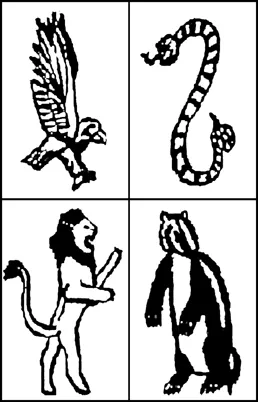
Readers often have favorite characters in the books they love. They may identity with some characters more than others. An easy way to get children and adolescents to talk about themselves, and to describe the person who died, may be to compare themselves and others to the Harry Potter characters. The books contain such a range of creatures, from good to evil, young to old, and magical to muggle, that all readers will have some characters they love to discuss. The books also explore important traits and possessions that shape various characters’ identities, like scars, wands, and house affiliation. These things may help children explore their own developing identity, and discuss how grief and loss have shaped or changed their identity.
Theme 2: Harry’s Scar*
The jagged scar on Harry Potter’s forehead marks him as someone who has experienced, and survived, a great loss. Although grieving children and adolescents do not have a scar to identify their loss, they may find that others identify them primarily as people who have lost someone to death. Their experience of grief and loss may have an important effect on their developing identity. Although scars “heal,” they do not leave us.
When people first meet Harry Potter, they often focus on his “fame” for surviving Lord Voldemort’s attack. People are impressed with him, and they also feel sorry for him, since he is an orphan. When Ron first meets Harry, he is eager to know about his scar, although later Ron is sometimes jealous of the attention Harry gets for being “the boy who lived.” Harry often resents this attention. Sometimes, however, Harry recognizes that people are not always as sensitive as they could be to his loss, or to the loss and grief of others. Because Harry has lost his parents, he can sympathize with the sorrow Neville feels for his institutionalized parents, and for the loss Luna feels about her mother’s death. He can also relate to some of the grief and guilt that Harry’s godfather Sirius feels about the deaths of Harry’s parents.
Harry’s scar seems to have positive, as well as negative, aspects. When discussing Harry’s scar in Book 1, Ch. 1, Dumbledore says that Harry will have the scar for life, and also that “scars can come in handy.” In Book 1, Ch. 2 we learn that the only thing Harry likes about himself is “the thin scar on his forehead.” The first question he remembers asking his aunt is how he got the scar. Once he knows the truth about the scar, it becomes a visible reminder of his parents’ love for him, as well as a mark of his grief. Harry’s scar also symbolizes his own strength and ability to survive. In Book 2, Dumbledore tells Harry that Voldemort may have put some of his powers into Harry when he gave him the scar, like the ability to talk to snakes through speaking Parseltongue. Harry’s scar also acts as a warning beacon to Harry, alerting him through pain whenever Voldemort and danger are near.
The scar therefore makes him unique in ways that are both positive and negative. Experiencing grief and loss is often a complicated process, and can affect children and adolescents in unexpected ways. They may find that they have actually gained some positive traits from experiencing their grief and loss. They may not want to acknowledge that anything positive could come from such sadness. They may need to be reassured that it is ok to change in both positive and negative ways after a loss.
In the real world, while scars may heal so well that they are difficult to see, they are still with us. In an interview with The Today Show, after writing Book 7, Rowling said that in her original version of the final line in Book 7, she planned it to be something like “Only those who he loved could see the lightning scar.” She decided to change it to the published version lines “The scar had not pained Harry for nineteen years. All was well” (Vieira, 2007, p. 5).
Both of these versions may suggest to children and adolescents reading the books that their grief, like Harry’s, will remain with them, but it may not be so intense later in their lives, and per...
Table of contents
- Cover
- Half Title
- Title Page
- Copyright
- Dedication
- Contents
- Acknowledgments
- Introduction: The Children Who Lived
- Section 1: Using the Harry Potter Books by J. K. Rowling to Help Grieving Children and Adolescents
- Section 2: Four Other Novels to Help Grieving Children and Adolescents
- Section 3: Games
- Section 4: More Craft Ideas
- Harry Potter Glossary
- References
- Index
Trusted by 375,005 students
Access to over 1.5 million titles for a fair monthly price.
Study more efficiently using our study tools.
Frequently asked questions
Yes, you can cancel anytime from the Subscription tab in your account settings on the Perlego website. Your subscription will stay active until the end of your current billing period. Learn how to cancel your subscription
No, books cannot be downloaded as external files, such as PDFs, for use outside of Perlego. However, you can download books within the Perlego app for offline reading on mobile or tablet. Learn how to download books offline
Perlego offers two plans: Essential and Complete
- Essential is ideal for learners and professionals who enjoy exploring a wide range of subjects. Access the Essential Library with 800,000+ trusted titles and best-sellers across business, personal growth, and the humanities. Includes unlimited reading time and Standard Read Aloud voice.
- Complete: Perfect for advanced learners and researchers needing full, unrestricted access. Unlock 1.5M+ books across hundreds of subjects, including academic and specialized titles. The Complete Plan also includes advanced features like Premium Read Aloud and Research Assistant.
We are an online textbook subscription service, where you can get access to an entire online library for less than the price of a single book per month. With over 1.5 million books across 990+ topics, we’ve got you covered! Learn about our mission
Look out for the read-aloud symbol on your next book to see if you can listen to it. The read-aloud tool reads text aloud for you, highlighting the text as it is being read. You can pause it, speed it up and slow it down. Learn more about Read Aloud
Yes! You can use the Perlego app on both iOS and Android devices to read anytime, anywhere — even offline. Perfect for commutes or when you’re on the go.
Please note we cannot support devices running on iOS 13 and Android 7 or earlier. Learn more about using the app
Please note we cannot support devices running on iOS 13 and Android 7 or earlier. Learn more about using the app
Yes, you can access The Children Who Lived by Kathryn A. Markell,Marc A. Markell in PDF and/or ePUB format, as well as other popular books in Psychology & Mental Health in Psychology. We have over 1.5 million books available in our catalogue for you to explore.