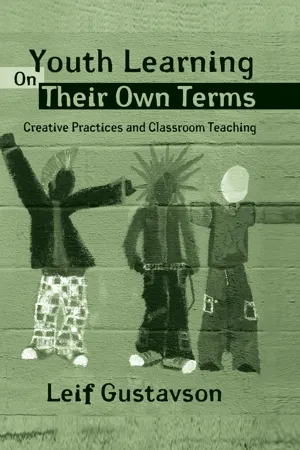
Youth Learning On Their Own Terms convincingly shows how developing a respect and understanding of the youth-initiated creative practices that occur outside schools can offer educators the opportunity to directly influence their teaching in schools by making classroom spaces personally meaningful and rigorous for both students and teachers.
eBook - ePub
Youth Learning On Their Own Terms
Creative Practices and Classroom Teaching
- 202 pages
- English
- ePUB (mobile friendly)
- Available on iOS & Android
eBook - ePub
About this book
Information
1
Multiple Writing (Con)texts
The Writing Life of a Zine Maker
By early spring of 1999 when I researched Ian’s creative practice of zine writing and spoken word, I could tell that certain things were not going well for him. In particular, he was having problems with school. His grades were falling and his parents as well as his teachers were concerned. I became aware of this slide in a few ways.
Around the first of March, Ian gave me a copy of his latest zine. This zine was a departure for him. He decided not to title it The Anti-social, the title he used for over a year. Instead of filling it with, in his words from the introduction of this zine, “social/political commentary through essays and pictures,” he titled it Harvey in the Well and filled it with his poetry and a few administrative artifacts from school. In the introduction to this zine, signed at the bottom by Ian, he explained that he no longer felt the need to publish The Antisocial. Several of his friends were publishing zines and Ian wanted to “make something that was purely self expression.” He ended this introduction by writing:
It’s easy to distribute a confrontational zine full of rants, interviews, and comics, many of which you are not even personally responsible for. It’s easy to hide behind layers of images, behind cynicism and sarcasm, behind dogma and rhetoric, behind the ideal of giving everyone a chance to express their political views. It’s quite another thing to stand naked.
One way in which he stood “naked” in this zine was to publish a progress report from his French teacher. He placed it in the middle of the zine: a photocopied reproduction of the progress report with the address of the school and the name of the teacher blotted out. The typed progress report read:
Ian’s most recent quiz has brought the written portion of his grade down from a C– to a D. Despite my suggestions to do so, Ian does not come to see me for extra help. I think it would help him to do some practice questions before he takes quizzes and tests. It would also help him to hand in a rough draft of a composition and to make an appointment with me to go over it before the final draft is due. However, Ian does not take the initiative to do these things. He is very quiet in class and I don’t think he has asked a question all trimester.
When I read this, my initial reaction was anger and frustration. Here again, I thought, is a teacher who has absolutely no idea about the other work that Ian is doing outside of French class. I was also amused by the irony that the French teacher wished that Ian would do more than one draft of a piece of writing before handing it in. If only she had a glimpse into the complex drafting process through which Ian crafted the writing for his zines and his spoken word pieces. It seemed rather obvious to me that here was a case of a class that Ian just did not care about. And the teacher framed it as Ian’s problem and not hers.
These feelings of mine were further fueled by another progress report that Ian included in this zine. This report, from the same trimester, was from his dance teacher. Ian had decided to take modern dance to fill his sports requirement at his school—a daring move for a young man, even at this fairly progressive institution. Ian placed this report on the page opposite his introduction. The dance teacher wrote this report in slanted cursive. It read:
Ian came to me as, what we call in the business, a totally “raw” dancer. He had no technique, no concept of how to “count” in dance. His body defied him when he tried to make it execute a step. But he consistently worked at it and worked it until he conquered the challenge. I admire him for this. Needless to say, he learned all the steps and danced well in the show. “Way to go, Ian!”
At the core of this honest and critical review of Ian’s work in dance is deserved praise for his steadfast effort to learn how to do something that this instructor intimates was almost unnatural to Ian at the beginning of the semester. Indeed, according to the teacher, Ian’s own body rebelled against the effort at first. The contrast between these two progress reports is stark. Why, I thought, was Ian doing so poorly in French, a subject that I knew he had excelled at in the past, and so well in a subject that was almost completely foreign to him at the beginning of the trimester?
With a few days’ distance from my initial reading of the zine and these two progress reports, I could see that Ian’s French teacher was legitimately concerned about Ian’s work. The teacher wanted him to do well and was a bit frustrated by his seeming lack of interest. Ian and I had a chance to talk about this one day in the car on a drive down to the city. There were times when we would be driving around, and something about the journey would open up a space to talk about serious issues. On this drive, Ian shared his frustration with school. This of course was not the first time he had expressed his ennui regarding classes, but there was a different tone. Before, he would talk about classes in a sarcastic way, saying what a waste of time they were, but then also continued to do well in them. Now there was a tinge of exasperation in Ian’s voice, almost as if he was not sure why he felt the way he did. He said, “I don’t need to take the practice SATs. I’m going to take the real ones next year anyway.” He complained that he did not feel like he had time to do his own work. He reiterated how inane he felt a lot of the work was for school. And he expressed consternation at many of his friends who seemed to just go through the motions of school, not thinking critically about what they were studying or why.
At one point on the drive down, I turned to Ian and said, “Can I talk to you as a friend for a sec?” He nodded. I told him that I was concerned about the way he was talking because I felt like he was allowing other people to control his education. I told him that I was afraid that if he “gave up,” his educational choices in the future would be limited. The way I remember this drive, I do not think Ian said anything after my cautionary monologue. We just stared forward through the windshield as we passed the jagged granite cliffs on the side of I-76.
This conversation, and Ian’s way of representing his present academic state, stayed with me over the course of that week, which ended, surprisingly, with a call from Ian’s father. It was late at night. I was in the kitchen, putting the dinner dishes away. Ian’s father and I had not talked much together up to this point in the research. He had asked a few questions about the research in the beginning, but most of my conversations were with Ian’s mother. Ian explained to me that his father was incredibly busy with his job and travels often. So when I received the call from Ian’s father, my interest piqued.
Ian’s father called me from his office. He said that at this point, he did not want Ian to know that we had talked, but that he knew that Ian respected me a great deal and that he and I spent a lot of time together. I remained silent as he worked his way to the reason why he wanted to talk to me. He asked me if I had noticed anything unusual about Ian’s behavior. I said, “No. Not really,” even as I had our recent conversation and his zine and school in the back of my mind. Ian’s father explained that both he and Ian’s mother were concerned about Ian. His grades were falling precipitously, and he did not seem to be well physically. He was not getting much sleep. He also did not seem to care about the fact that he was not doing well in school.
While we were talking, my mind replayed the progress reports and Ian’s and my conversation. I also thought about my own experience in high school. I thought about Ian and what was fair to him in terms of what I would share with his father. Did Ian tell me all of that stuff in the car in confidence? When I told him that I wanted to talk to him as a friend, did that change what was confidential and what was not? I was not sure what to say to his father so I told him about my own experience in high school. How, as a junior, I had burned out: “Used to go up to my room and just stare at the work”; “I didn’t even know where to start”; “I went down an entire grade point in my average.” “There were days,” I chuckled, “when I would come home from school and flop onto my bed with my shoes on and take a two- to three-hour nap.” I told him that my parents sent me to a psychologist, more than one, but it did not seem to help. I told him that the following year I found a reason to work again and made my way out of the slump.
I then reassured Ian’s father that I cared deeply about Ian and wanted him to be successful. I would also never want Ian to hurt himself in any way, I stressed. Ian’s father told me that they had set up a doctor’s appointment for Ian. He added that Ian was comfortable with this doctor and had had many conversations with him in the past. He asked me if I would mind keeping an eye on Ian and letting them know if there was anything that concerned me. I told him that I would.
An ambivalent feeling swept over me when I hung up the phone that night. I felt as if I had been dishonest to Ian’s father. At the same time, I felt as if I had to honor the trust between Ian and me. Finally, I was not sure how serious Ian’s current educational or “psychological” state was. Granted, he was falling behind in certain classes, but I had done the same thing. It happens to many students and they bounce back, I thought. In my mind, I had no doubt that Ian could rebound, if he wanted to. But what complicated the issue the most for me was the enormous amount of work and learning I had witnessed Ian do over the course of that year in our research and how that did not seem to factor into our conversation at all.
This chapter focuses on the work in which Ian was engaged in the midst of the academic struggles outlined above. In particular, I discuss Ian’s creative practice as a zine writer and spoken word artist over the course of a year. I begin by laying out a brief history of zine writing as a way of defining the art form. I move to showing how Ian became interested in zine writing and spoken word through the interrelation of experimentation and performance, and the community of practice he formed. I then show how his work evolved and changed over time in relation to the multiple aspects that contribute to the development of his creative practice. I do this by focusing on the evolution of one of Ian’s poems: “We are the Sons of John Brown.” Finally, I show how his performance of “We are the Sons of John Brown” pushed him into other spaces and performances that broadened his creative practice.
A Brief History of Zines and Zine Writing
A zine is a handmade, amateur publication that focuses on a particular interest of the publisher. It differs from a newsletter or magazine, for example, because of its handmade nature. While some zine writers may use desktop publishing software to lay out their zine (often termed an e-zine), many literally get down on the ground and, with scissors and glue, cut and paste their zine together. Zine writers often distribute their zines free of charge, for a donation, or for a minimal fee (one or two dollars an issue). They then photocopy additional copies to distribute.
The audience, like the interest, is specific and limited. Generally publishers of zines make no more than 2,000 copies of each issue to distribute. Chepesiuk (1997) describes zines as having “offbeat, frequently provocative and often weird names, such as Baby Fat, Diseased Pariah News, and Holy Titclamps,” the last title being a particular favorite of Ian’s. Chepesiuk continues, “They lampoon, attack, parody, entertain, or instruct on virtually any imaginable aspect of our culture, from AIDS to poetry, dirt bikers, New Wave comics, and the popular television program Beverly Hills 90210” (1997, p. 168).
The zine, as Chu (1997) suggests, has its roots as deep as Martin Luther posting his “Ninety-Five Theses” on the Castle Church door at Witten-berg. However, Friedman, the publisher of Factsheetfive, a bimonthly review of zines, traces the history of zines back to two origins. He suggests that contemporary zines, like Ian’s The Antisocial, are influenced by the Beat poetry of the 1940s and 1950s as well as by the pulp science fiction of the 1930s. Beat poets designed handmade chapbooks of their poems in order to distribute to interested readers. The pulp science fiction was primarily generated by sci-fi fans who would copy their own writing “commentary and manifestos” to friends and fellow fans of the genre (Gross, 1994). Both forms of media were produced outside of the legitimate publishing circuits of the time.
This underground publishing movement gained momentum in the 1970s with the explosion of punk music and punk culture. Music fans would publish zines based on whichever band they liked the most. Within these zines, the writers would also offer “general critiques of contemporary mores and aesthetics but always reflecting the personal tastes” of the publisher (Gross, 1994). These zines are often referred to as perzines (short for personal zines) because of the sometimes painfully personal nature of the content and the individual nature of the production and distribution.
The 1980s to early 1990s were considered to be the heyday of zines. According to some estimates, in 1992 there were over 20,000 zine titles published in the United States (Chepesiuk, 1997). Ian marked the early 1990s as a particularly rich time for zines:
So much great zines came out especially in the ’90s, you know? Not to hit on the whole zine revolution thing, but it’s true…And a lot of them were unique and didn’t have that sort of punk thing. I mean they obviously came out of punk in a way, but that wasn’t necessarily their primary thing. And a lot of them were quirky and ironic.
Contemporary zines run the gamut from traditional fanzines that follow the careers of particular bands to travel zines that document the journeys of the writers to political zines that rant against the status quo. Many zines incorporate all three of these genres. However, according to Gunderloy and Goldberg (1990), most zines have a half-life of about two years. Often, a person will only publish one issue and then stop. Some writers publish zines incredibly sporadically—only one or two a year and at random times. Libraries interested in collecting these primary sources of mass culture become frustrated because publishers may change the name of their zine every issue, making it difficult to catalogue the material. Chepesiuk (1997) and Chu (1997) suggest that the elusive quality of zines is purposeful because the writers are not interested in mass media exposure. In fact, many zine writers will discontinue their zines when and if they garner mass media attention. Greta, the publisher of Mudslap, contends, “If you’re mainstream, you can’t steal postage. You can’t plagiarize. You can’t ditch bills. You can’t be incendiary. You can’t be yourself” (Gross, 1994).
Like turntablism and graffiti, zines are a certain type of youth phenomenon. Most are published by people under the age of 30 (Chu, 1997). Like graffiti, many publishers of zines use their publications to manipulate traditional uses of text and image in order to make provocative meanings. Many zine publishers abhor white space on the page and will fill it with everything and anything, giving many pages a pastiche feel. Some zines, like Cometbus, a zine with an incredibly long publishing life (over 20 years), and one of Ian’s favorites, are nothing but text. Often, the text will “crawl off the page” (Gross, 1994); the words as icons create images and meanings. Zine writers also use the pages of their zines as a cross between a canvas and a piece of paper in order to manufacture their messages. Gunderloy writes that zines are places where “new languages are being invented and learned” (Gunder-loy & Goldberg, 1990, p. 58). Lankshear and Knobel add, “Mainstream discourses and values are subverted and pilloried in ways that often are quite delicious” within zines (n.d., p. 4). Zine writers often interweave text with pictures in such a way that both “images” take on new meanings. Like graffiti, zine writers walk the fine line between recognition and obscurity. Zine writers veil their identities much like graffiti artists do, often using pseudonyms, and select their audiences carefully through personally delivering the product and constructing a message that includes a limited audience.
Chu contends that youth use zines in order to carve out their own space within this media-saturated world. This space enables zine writers to circumvent the commodified and controlling world of adult-run, hence mainstream, media. In a world of fewer and fewer independent media voices, coupled with the increasing surveillance of youth, zines, in her opinion, are one of the last places that youth have agency. She writes, “As much as they are critiques of mainstream media, zines also point to media as one of the last hopeful environments where young people can assert a sense of agency by redefining a social space in otherwise constraining material circumstances” (Chu, 1997, p. 82). I see agency in the handmade nature of these publications as well. Because writers like Ian literally sit on the floor and piece these works together, they often maintain a high level of originality not seen in mass-marketed publications.
As the publishers of Central Park, a zine out of New York City, included in their introduction, “We feel the world is in dangerous need of a new perspective, and we choose what we want to publish based on how it might contribute to such a perspective.” From the 1930s to the present, zines as well as graffiti and turntablism have been spaces where youth control the production and distribution of ideas. In particular, Ian’s zines are spaces where he wrestles with issues that affect him. Zines are a space where he finds new and refreshing ways to interpret these issues as well as represent how he wrestles with them. Ian’s zines and spoken word pieces are sp...
Table of contents
- Cover
- Half Title
- Title
- Copyright
- Dedication
- Contents
- Series Editor's Introduction
- Acknowledgments
- Introduction
- Chapter 1 Multiple Writing (Con)texts: The Writing Life of a Zine Maker
- Chapter 2 The Shifting Creative Practices of a Puerto Rican–American Youth
- Chapter 3 Scratching, Cutting, and Juggling: The Turntablist as 21st-Century Scholar
- Chapter 4 Teaching and Learning: A Shared Practice
- Appendix: Researching with Miguel, Gil, and Ian
- References
- Index
Trusted by 375,005 students
Access to over 1.5 million titles for a fair monthly price.
Study more efficiently using our study tools.
Frequently asked questions
Yes, you can cancel anytime from the Subscription tab in your account settings on the Perlego website. Your subscription will stay active until the end of your current billing period. Learn how to cancel your subscription
No, books cannot be downloaded as external files, such as PDFs, for use outside of Perlego. However, you can download books within the Perlego app for offline reading on mobile or tablet. Learn how to download books offline
Perlego offers two plans: Essential and Complete
- Essential is ideal for learners and professionals who enjoy exploring a wide range of subjects. Access the Essential Library with 800,000+ trusted titles and best-sellers across business, personal growth, and the humanities. Includes unlimited reading time and Standard Read Aloud voice.
- Complete: Perfect for advanced learners and researchers needing full, unrestricted access. Unlock 1.5M+ books across hundreds of subjects, including academic and specialized titles. The Complete Plan also includes advanced features like Premium Read Aloud and Research Assistant.
We are an online textbook subscription service, where you can get access to an entire online library for less than the price of a single book per month. With over 1.5 million books across 990+ topics, we’ve got you covered! Learn about our mission
Look out for the read-aloud symbol on your next book to see if you can listen to it. The read-aloud tool reads text aloud for you, highlighting the text as it is being read. You can pause it, speed it up and slow it down. Learn more about Read Aloud
Yes! You can use the Perlego app on both iOS and Android devices to read anytime, anywhere — even offline. Perfect for commutes or when you’re on the go.
Please note we cannot support devices running on iOS 13 and Android 7 or earlier. Learn more about using the app
Please note we cannot support devices running on iOS 13 and Android 7 or earlier. Learn more about using the app
Yes, you can access Youth Learning On Their Own Terms by Leif Gustavson in PDF and/or ePUB format, as well as other popular books in Education & Education General. We have over 1.5 million books available in our catalogue for you to explore.