CHAPTER 1
Our more able pupils—the national scene
- Making good provision for the most able—what’s in it for schools?
- National initiatives since 1997
- Every Child Matters and the Children Act 2004
- Higher Standards, Better Schools for All—Education White Paper, October 2005
- Self-evaluation and inspection
- Resources for teachers and parents of more able pupils
Today’s gifted pupils are tomorrow’s social, intellectual, economic and cultural leaders and their development cannot be left to chance.
(Deborah Eyre, director of the National Academy for Gifted and Talented Youth, 2004)
The debate about whether to make special provision for the most able pupils in secondary schools ran its course during the last decade of the twentieth century. Explicit provision to meet their learning needs is now considered neither elitist nor a luxury. From an inclusion angle these pupils must have the same chances as others to develop their potential to the full. We know from international research that focusing on the needs of the most able changes teachers’ perceptions of the needs of all their pupils, and there follows a consequential rise in standards. But for teachers who are not convinced by the inclusion or school improvement arguments, there is a much more pragmatic reason for meeting the needs of able pupils. Of course, it is preferable that colleagues share a common willingness to address the needs of the most able, but if they don’t, it can at least be pointed out that, quite simply, it is something that all teachers are now required to do, not an optional extra.
All schools should seek to create an atmosphere in which to excel is not only acceptable but desirable.
(Excellence in Schools—DfEE 1997)
High achievement is determined by ‘the school’s commitment to inclusion and the steps it takes to ensure that every pupil does as well as possible’.
(Handbook for Inspecting Secondary Schools—Ofsted 2003)
A few years ago, efforts to raise standards in schools concentrated on getting as many pupils as possible over the Level 5 hurdle at the end of Key Stage 3 and over the 5 A*–C grades hurdle at GCSE. Resources were pumped into borderline pupils and the most able were not, on the whole, considered a cause for concern. The situation has changed dramatically in the last nine years with schools being expected to set targets for A*s and As and to show added value by helping pupils entering the school with high SATs scores to achieve Levels 7 and beyond, if supporting data suggests that that is what is achievable. Early recognition of high potential and the setting of curricular targets are at last addressing the lack of progress demonstrated by many able pupils in Year 7 and more attention is being paid to creating a climate in which learning can flourish. But there is a push for even more support for the most able through the promotion of personalised learning.
The goal is that five years from now: gifted and talented students progress in line with their ability rather than their age; schools inform parents about tailored provision in an annual school profile; curricula include a gifted and talented dimension and at 14–19 there is more stretch and differentiation at the top end, so no matter what your talent it will be engaged; and the effect of poverty on achievement is reduced, because support for high-ability students from poorer backgrounds enables them to thrive.
(Speech at National Academy for Gifted and Talented Youth—David Miliband, Minister for State for School Standards, May 2004)
It is hoped that this book, with the others in this series, will help to accelerate these changes.
Making good provision for the most able—what’s in it for schools?
Schools and/or subject departments often approach provision for the most able pupils with some reluctance because they imagine a lot of extra work for very little reward. In fact, the rewards of providing for these pupils are substantial.
- It can be very stimulating to the subject specialist to explore ways of developing approaches with enthusiastic and able students.
Taking a serious look at what I should expect from the most able and then at how I should teach them has given my teaching a new lease of life. I feel so sorry for youngsters who were taught by me ten years ago. They must have been bored beyond belief. But then, to be quite honest, so was I.
(Science teacher)
- Offering opportunities to tackle work in a more challenging manner often interests pupils whose abilities have gone unnoticed because they have not been motivated by a bland educational diet.
Some of the others were invited to an after-school maths club. When I heard what they were doing, it sounded so interesting that I asked the maths teacher if I could go too. She was a bit doubtful at first because I have messed about a lot but she agreed to take me on trial. I’m one of her star pupils now and she reckons I’ll easily get an A*. I still find some of the lessons really slow and boring but I don’t mess around—well, not too much.
(Year 10 boy)
- When pupils are engaged by the work they are doing motivation, attainment and discipline improve.
You don’t need to be gifted to work out that the work we do is much more interesting and exciting. It’s made others want to be like us.
(Comment of a student involved in an extension programme for the most able)
- Schools identified as very good by Ofsted generally have good provision for their most able students.
If you are willing to deal effectively with the needs of able pupils you will raise the achievement of all pupils.
(Mike Tomlinson, former director of Ofsted)
- The same is true of individual departments in secondary schools. All those considered to be very good have spent time developing a sound working approach that meets the needs of their most able pupils.
The department creates a positive atmosphere by its organisation, display and the way that students are valued. Learning is generally very good and often excellent throughout the school. The teachers’ high expectations permeate the atmosphere and are a significant factor in raising achievement. These expectations are reflected in the curriculum which has depth and students are able and expected to experience difficult problems in all year groups.
(Mathematics Department, Hamstead Hall School, Birmingham; Ofsted 2003)
National initiatives since 1997
In 1997, the new government demonstrated its commitment to gifted and talented education by setting up a Gifted and Talented Advisory Group (GTAG). Since then there has been a wide range of government and government-funded initiatives that have, either directly or indirectly, impacted on our most able pupils and their teachers. Details of some can be found below. Others that relate to MFL will be found later in this book.
Excellence in Cities
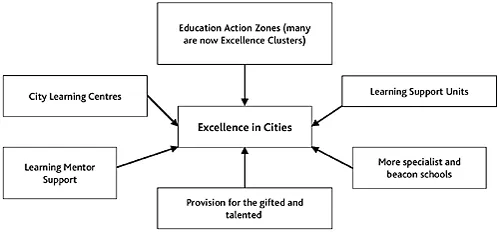
In an attempt to deal with the chronic underachievement of able pupils in inner city areas, Excellence in Cities (EiC) was launched in 1999. This was a very ambitious, well-funded programme with many different strands. In the first place it concentrated on secondary age pupils but work was extended into the primary sector in many areas. Provision for gifted and talented students was one of the strands.
Strands in the Excellence in Cities Initiative
EiC schools were expected to:
- develop a whole-school policy for their most able pupils
- appoint a gifted and talented coordinator with sufficient time to fulfil the role
- send the coordinator on a national training programme run by Oxford Brookes University
- identify 5–10% of pupils in each year group as their gifted and talented cohort, the gifted being the academically able and the talented being those with latent or obvious ability in PE, sport, music, art or the performing arts
- provide an appropriate programme of work both within the school day and beyond
- set ‘aspirational’ targets both for the gifted and talented cohort as a whole and for individual pupils
- work with other schools in a ‘cluster’ to provide further support for these pupils
- work with other agencies, such as Aimhigher, universities, businesses and private sector schools, to enhance provision and opportunities for these pupils.
Funding changes have meant that schools no longer receive dedicated EiC money through local authorities but the lessons learned from EiC have been influential in developing a national approach to gifted and talented education. All schools are now expected to adopt similar strategies to ensure that the needs of their most able students are met.
Excellence Clusters
Although EiC was set up initially in the main urban conurbations, other hot spots of underachievement and poverty were also identified and Excellence Clusters were established. For example, Ellesmere Port, Crewe and Barrow-in-Furness are pockets of deprivation, with major social problems and significant underachievement, in otherwise affluent areas. Excellence Clusters have been established in these three places and measures are being taken to improve provision for the most able pupils. The approach is similar to that used in Excellence in Cities areas.
Aimhigher
Aimhigher is another initiative of the Department for Education and Skills (DfES) working in partnership with the Higher Education Funding Council for England (HEFCE). Its remit is to widen participation in UK higher education, particularly among students from groups that do not have a tradition of going to university, such as some ethnic minorities, the disabled and those from poorer homes. Both higher education institutions and secondary schools have Aimhigher coordinators who work together to identify pupils who would benefit from additional support and to plan a programme of activities. Opportunities are likely to include:
- mentoring, including e-mentoring
- residential summer schools
- visits to different campuses and university departments
- masterclasses
- online information for students and parents
- advice on the wide range of financial and other support available to disadvantaged students.
One national Aimhigher project, Higher Education Gateway, is specifically targeted on gifted and talented students from disadvantaged groups. More information can be found at www.aimhigher.ac.uk.
National Academy for Gifted and Talented Youth (NAGTY)
Government initiatives have not been confined to the most able pupils in deprived areas. In 2002, the National Academy for Gifted and Talented Youth was established at Warwick University. Its brief was to offer support to the most able 5% of the school population and their teachers and parents. It did this in a number of ways:
| National Academy for Gifted and Talented Youth |
| Student Academy | Professional Academy | Expertise Centre |
| ● Summer schools including link-ups with CTY in USA. ● Outreach courses in a wide range of subjects at universities and other venues across the country. ● Online activities—currently maths, classics, ethics, philosophy. | ● Continuing professional development for teachers. ● A PGCE+ programme for trainee teachers. ● Ambassador School Programme to disseminate good practice amongst schools. | ● Leading research in gifted and talented education. |
NAGTY worked closely with the DfES with the latter setting policy and NAGTY increasingly taking the lead in the practical application of this policy—a policy known as the English Model, which, as ...