eBook - ePub
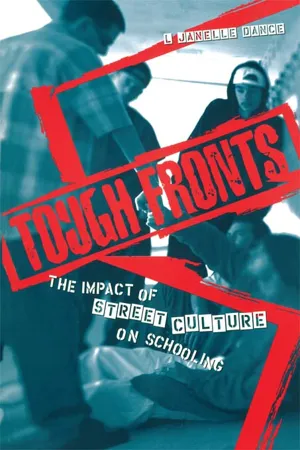
Tough Fronts
The Impact of Street Culture on Schooling
- 208 pages
- English
- ePUB (mobile friendly)
- Available on iOS & Android
eBook - ePub
About this book
Tough Fronts takes the difficult issues in urban education head on by putting street-savvy students at the forefront of the discussion on how to best make successful changes for inner city schools. Individual chapters discuss scholarly depictions of black America, the social complexity of the teacher-student relationship, individual success stories of 'at-risk' programs, popular images of urban students, and implications for education policy. With close attention to the voices of individual students, this engaging book gives vitality and legitimacy to arguments for school changes that have been lacking in previous discussions.
Information
part I
"Expert" Points of View
ONE
There Are No Agents Here
Scholarly Depictions of Black Americans
MURALS IN THE CITY
In urban and inner-city neighborhoods, where ethnic minorities subsist at or below the poverty line, you often come upon beautifully painted murals. These murals often burst with color and activity: children are playing, residents are lending one another a helping hand, flowers are growing, adults are mentoring and nurturing, or heroes like Malcolm X, Martin Luther King, or César Chávez are reincarnated in larger-than-life portraits as guardians of the neighborhood. Sometimes urban murals are somber memorials to lives lost to homicide, but more often they are full of life, activity, and agency The artists who create these murals often move beyond stereotypes to capture real, dynamic, fully human characteristics of individual residents, popular heroes, and community activities. These characterizations contrast sharply with the depictions of ethnic minorities in social scientific writings. Social scientists often shun artistic license like that taken by the painters of urban murals, that is, subjective license to vitalize and portray residents in vibrant colors. Social scientists filter urban residents through screens that are objective and analytical, sieves designed to yield empirically sound depictions. Social scientists paint dispassionate portrayals that are supposedly undistorted by researcher subjectivity and bias. Yet the scholar’s pen may yield more distorting portrayals than the mural painter s brush: social scientists often inscribe ethnic minorities in books, articles, and other texts as abnormal, monolithic, static, faceless, listless objects.
Sucheng Chan observes that scholars have portrayed ethnic minorities in the United States in four contrasting perspectives: ethnic minorities as deviant or deficient; ethnic minorities as valuable contributors to the American cultural mosaic; ethnic minorities as exploited victims relegated to the lowest social status positions within the institutional structure of the United States; and finally, ethnic minorities as “agents of history—men and women who make choices that shape their lives, even when these may be severely limited by conditions beyond their control.”1 Of these four perspectives, extreme characterizations of deficiency and victimization prevail as the most problematic when they eclipse individual agency. Although Chans research focuses upon Asian Americans, these four perspectives apply to other ethnic minorities, including White ethnic Americans, Hispanic Americans, Native Americans, and African Americans.2 With respect to the latter two groups, for example, scholarly portrayals swing between extreme characterizations of deficiency and victimization.
The pendulum of depictions for Native Americans (the Indigenous peoples of the Americas) swings between deficient, lazy red savages and victimized conquered people or vanishing people relegated to the past.3 For African Americans, the pendulum sways between deficient, genetically inferior welfare recipients and hapless descendants of American slavery and apartheid.4 These depictions stereotype Indigenous peoples and African Americans as beings without human agency, as pawns of biologically determined, primitive instinct or puppets on the strings of macro-structural forces, strings that control their every action, motivation, and aspiration. The historical episodes and legacies of inhumane government-sanctioned policies of conquest, land dispossession, and genocide, in the case of Indigenous peoples or Native Americans, or chattel slavery and apartheid, in the case of Blacks or African Americans, may be the most severe macro-structural predicaments imposed upon Americans of color within the borders of what has become the United States of America.5 Indigenous Americans and African Americans, as well as Mexican Americans, have been described as castelike or involuntary minorities. Unlike those ethnic groups who immigrated to the United States by choice, the ancestors of Indigenous, African, and Mexican Americans were dehumanized, colonized, and subsequently Americanized by forceful and often violent means.6 Hence, today, many Indigenous, African, and Mexican Americans, as well as other Americans of color, remain to be fully accepted as “real” Americans; they remain excluded from the fold of the American social fabric. Asian Americans have also experienced caste or apartheidlike treatment within the borders of the United States, treatment that ranges from laws barring Asian immigrants from entering the United States, to laws barring their acquisition of U.S. citizenship, to internment within concentration camps.7 Despite scholarly portrayals to the contrary, however, Americans of color have confronted, survived, succumbed to, overcome, or resisted devastating historical events and other social structural constraints not as passive pawns or puppets, but as dynamic agents of history.
Even when scholars leave human agency intact, however, Americans of color are often cast in images that are monolithic or undifferentiated. For example, Indigenous Americans are often portrayed as noble savages or children of nature who subsist within the spatial constraints of reservations, and African Americans have been cast as soulful and cool ghetto dwellers who subsist within the spatial constraints of inner-city neighborhoods.8 Monolithic images like the noble savage or the cool ghetto dweller transform the members of ethnic groups into an undifferentiated mass of cultural automatons. In these cases, scholars delimit the agency of Indigenous and Black Americans to a set of predictable responses, to an Indian way or Black way of doing things.9 To the contrary, Indigenous Americans and Black Americans exhibit group solidarity as well as intragroup conflict and individual dissent. It should go without saying that they exhibit a wide variety of responses, practices, and roles that range from the culturally unique to the ethnically hybrid, from the conventional to the innovative. Without a doubt, the well-being of many Americans of color continues to be severely constrained by forces beyond their control. The point I make here is not that social structural forces should be ignored or minimized. I emphasize that those Americans of color constrained are a vital segment of humanity, not lazy red savages, criminals, deviants, noble savages, or cool ghetto dwellers.
This chapter reviews scholarly depictions unique to Black Americans. Given the focus of Tough Fronts on Black male students from urban neighborhoods that are economically impoverished, my review of literature is skewed toward accounts of urban Black males in particular. The inclusion of studies on the Black middle class and Black women would yield a more comprehensive review of the literature. Yet, for the sake of drawing more attention to scholarship that applies to Black males from impoverished urban neighborhoods, studies limited to the Black middle class and Black women are not included.10 Among other things, this chapter revisits theories about the culture of poverty, the growth of the urban underclass, and oppositional culture, and then concludes with a constructive critique of these theories and notions. The remainder of this chapter focuses exclusively upon Black Americans. However, the previous paragraphs reveal that there are some striking similarities (or stubborn consistencies) in the manner that scholars characterize Americans of color in general, and Blacks and Indigenous peoples in particular. Unlike the artists who paint urban murals, scholars seem to have difficulty with moving beyond stereotypes to capture the real, dynamic, human agency of Americans of color.
THE SCHOLARLY GAZE UPON BLACK AMERICANS
Scholars often occupy positions of relative privilege within society. It is from such elite and lofty points of view that scholars have gazed upon Blacks in general and urban Black Americans in particular. This gaze has often degraded; other times it has flattered. But most of the time, it has been an essentialist gaze. I deliberately choose the words “essentialist” and “gaze” to characterize the academic enterprise of studying urban Black Americans. Disregarding contradictions and hybridity, as well as eclectic and syncretic practices, scholars have taken a long, fixed stare and found urban Blacks essentially inferior, or mainstream, or victims, or virtuous, or oppositional. A vast majority of academic accounts fall into three of these categories: Blacks as inferior, Blacks as mainstream, or Blacks as pawns or victims. There is a shortage of long, fixed stares that regard urban Blacks as individuals with human agency and diverse cultural practices. In Yo’Mama’s DisFUNKtional: Fighting the Culture Wars in Urban America, Robin Kelley applauds Drylongso: A Self-Portrait of Black America, by John Langston Gwaltney, as a noteworthy exception to the vast majority of scholarly accounts:
Few ghetto ethnographers have understood or developed Gwaltney’s insights into African American urban culture. Whereas Gwaltney’s notion of core [black] culture incorporates a diverse and contradictory range of practices, attitudes, and relationships that are dynamic, historically situated, and ethnically hybrid, social scientists of his generation and after—especially those at the forefront of poverty studies—treat culture as if it were a set of behaviors. They assume that there is one identifiable ghetto culture and what they observed was it.11
While reading in Drylongso the “personal narratives ... offered [to Gwaltney] in contexts of amity, security and hospitality,”12 one encounters the agency, range of practices, and diversity of attitudes voiced by Gwaltney s respondents. Instead of the usual depiction of static, monolithic objects, Gwaltney’s respondents are subjects; they figure prominently as vibrant, dynamic, opinionated individuals.
Broadly speaking, then, this chapter reviews five scholarly portrayals of Black Americans: (1) Blacks as essentially inferior, deviant, or dysfunctional; (2) Blacks as essentially mainstream or decent; (3) Blacks as essentially virtuous and central; (4) Blacks as essentially victims of historical and social-structural forces; (5) Blacks as essentially oppositional or antagonistic. Tough Fronts falls into a sixth and underdeveloped perspective: urban Black youths, to recall the words of Sucheng Chan, as “agents of history—[adolescents] who make choices that shape their lives, even when these may be severely limited by conditions beyond their control.”13 As I move from scholarly accounts of deviancy toward this book’s view of agency, I do not attempt to include every single study ever documented. Instead, I review works that are exemplars of these five perspectives. Furthermore, instead of summarizing each work in exacting detail, I discuss the dominant characterizations of Blacks conveyed.
Blacks as Inferior, Deviant, Dysfunctional
Enlightenment philosophy was instrumental in codifying and institutionalizing both the scientific and popular European perceptions of the human race. The numerous writings on race by Hume, Kant, and Hegel played a strong role in articulating Europe’s sense not only of its cultural but also racial superiority. In their writings ... “reason” and “civilization” became almost synonymous with “white” people and northern Europe, while unreason and savagery were conveniently located among non-whites, the “black,” the “red,” the “yellow,” outside Europe.
—Emmanuel Chukwudi Eze, Race and the Enlightenment14
As far back as the 1700s, western European scholars argued that Negroes were inferior to Whites. In the 1800s, Social Darwinists and eugenics scholars like Francis Galton would add their findings to claims about the inferiority of non-whites. Among other things, Galton once asserted that “the Negro has strong impulsive passions, and neither patience, reticence, nor dignity.”15 Like the twentieth-century eugenicists and Social Darwinists who followed, Galton called for social policies to control human breeding by discouraging breeding among groups deemed “inferior” and encouraging members of the “superior” groups to marry and procreate.16 Other eugenic policies pursued in the early 1900s included immigrati...
Table of contents
- Front Cover
- Half Title
- Title Page
- Copyright
- Dedication
- Contents
- Tables and Figures
- Foreword by Michael W. Apple
- Acknowledgments: “Props”
- Preface
- Introduction: A Study of Street-Savvy Students
- part I. “Expert” Points of View
- part II. The Perspectives of Street-Savvy Students
- part III. Solutions, Broader Implications, and Policy Suggestions
- Appendix: A Brief Review of Selected Literature: Effective Schools and Critical Theory
- Notes
- Glossary of Social Scientific Terms and Concepts
- References
- Index
Trusted by 375,005 students
Access to over 1.5 million titles for a fair monthly price.
Study more efficiently using our study tools.
Frequently asked questions
Yes, you can cancel anytime from the Subscription tab in your account settings on the Perlego website. Your subscription will stay active until the end of your current billing period. Learn how to cancel your subscription
No, books cannot be downloaded as external files, such as PDFs, for use outside of Perlego. However, you can download books within the Perlego app for offline reading on mobile or tablet. Learn how to download books offline
Perlego offers two plans: Essential and Complete
- Essential is ideal for learners and professionals who enjoy exploring a wide range of subjects. Access the Essential Library with 800,000+ trusted titles and best-sellers across business, personal growth, and the humanities. Includes unlimited reading time and Standard Read Aloud voice.
- Complete: Perfect for advanced learners and researchers needing full, unrestricted access. Unlock 1.5M+ books across hundreds of subjects, including academic and specialized titles. The Complete Plan also includes advanced features like Premium Read Aloud and Research Assistant.
We are an online textbook subscription service, where you can get access to an entire online library for less than the price of a single book per month. With over 1.5 million books across 990+ topics, we’ve got you covered! Learn about our mission
Look out for the read-aloud symbol on your next book to see if you can listen to it. The read-aloud tool reads text aloud for you, highlighting the text as it is being read. You can pause it, speed it up and slow it down. Learn more about Read Aloud
Yes! You can use the Perlego app on both iOS and Android devices to read anytime, anywhere — even offline. Perfect for commutes or when you’re on the go.
Please note we cannot support devices running on iOS 13 and Android 7 or earlier. Learn more about using the app
Please note we cannot support devices running on iOS 13 and Android 7 or earlier. Learn more about using the app
Yes, you can access Tough Fronts by L Dance,L Janelle Dance,L. Janelle Dance in PDF and/or ePUB format, as well as other popular books in Education & Education General. We have over 1.5 million books available in our catalogue for you to explore.