How do psychoanalysts explain human morality?
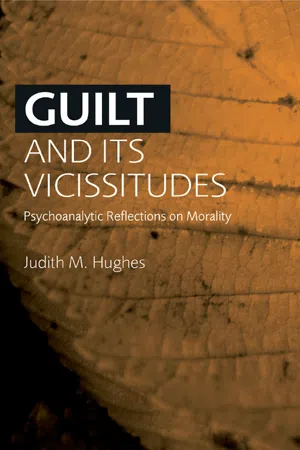
Guilt and Its Vicissitudes: Psychoanalytic Reflections on Morality focuses on the way Melanie Klein and successive generations of her followers pursued and deepened Freud's project of explaining man's moral sense as a wholly natural phenomenon.
With the introduction of the superego, Freud laid claim to the study of moral development as part of the psychoanalytic enterprise. At the same time he reconceptualized guilt: he thought of it not only as conscious, but as unconscious as well, and it was the unconscious sense of guilt that became a particular concern of the discipline he was founding. As Klein saw it, his work merely pointed the way. Judith M. Hughes argues that Klein and contemporary Kleinians went on to provide a more consistent and comprehensive psychological account of moral development. Hughes shows how Klein and her followers came to appreciate that moral and cognitive questions are complexly interwoven and makes clear how this complexity prompted them to extend the range of their theory.
Hughes demonstrates both a detailed knowledge of the major figures in post-war British psychoanalysis, and a keen sensitivity to the way clinical experience informed theory-building. She writes with vigor and grace, not only about Freud and Klein, but also about such key thinkers as Riviere, Isaacs, Heimann, Segal, Bion and Joseph. Guilt and Its Vicissitudes speaks to those concerned with the clinical application of psychoanalytic theory and to those interested in the contribution psychoanalysis makes to understanding questions of human morality.
- 154 pages
- English
- ePUB (mobile friendly)
- Available on iOS & Android
eBook - ePub
About this book
Information
Chapter 1
An unconscious sense of guilt
When Totem and Taboo appeared in 1912–1913, Freud's loyal followers greeted it with unreserved enthusiasm. Even before he had seen it in print, Ernest Jones ventured the opinion that it and “not the Traumdeutung [The Interpretation of Dreams] would be Freud's 'masterpiece.' ”1 Having had a chance to look at it, Sándor Ferenczi came to the conclusion that it “will one day be the nodal point of the study . . . of civilization.”2 The development of anthropology suggests that Ferenczi's prediction was wildly inaccurate. According to George Stocking, Totem and Taboo, with its “bit of highly conjectural history, . . . perhaps more than anything else in Freud, contributed to the alienation of anthropologists from psychoanalytic theory.”3 In one respect, however, analysts and anthropologists were in agreement: they regarded Totem and Taboo as a work of applied psychoanalysis, that is, bringing psychoanalysis to bear on ethnographic problems and in the process promising both solutions to those problems and something akin to experimental proof of Freudian postulates.
Totem and Taboo, while marking Freud's first interdisciplinary effort, also signaled a major departure in his thinking about morality. I plan to set aside the anthropological theorizing and to concentrate instead on Freud's ethical concerns, paying close attention to themes that Melanie Klein and her students chose to elaborate.
Freud had earlier written about one aspect of morality – the sexual. His paper “ 'Civilized' Sexuality Morality and Modern Nervous Illness” (1908), published four years before his essay on taboo, was an unsparing dissection of contemporary sexual ethics. Western society, he argued, with its insistence that both sexes practice abstinence until they married and that all those who remained unwed abstain throughout their lives, was demanding more than the flesh could bear. Marriage itself could not fully compensate for the prior restrictions – in part because even in marriage couples were obliged to content themselves “with a very few procreative acts.” Fear of pregnancy, at a time when “all the devices . . . for preventing conception” impaired “sexual enjoyment” or “hurt the finer susceptibilities of both partners,” first brought “the married couple's physical affection to an end,” and then, as a consequence, usually put a stop “to the mental sympathy between them.” Both partners thus found themselves back in the state they had been before their marriage, “except for being the poorer by the loss of an illusion.”4 Once more they found themselves tried to the utmost and at grave risk of nervous illness.
What kind of nervous illness? Here Freud distinguished between “two groups of nervous disorder,” the neuroses proper – otherwise known as the actual neuroses – and the psychoneuroses. In both an impaired sexual life figured as the pathogen. In the actual neuroses, the symptoms appeared to be of a “toxic nature”: they behaved “exactly like the phenomena accompanying an excess or a deprivation of certain nerve poisons.” In fact the form taken by the disease corresponded “to the nature of the noxae, so that often enough the particular sexual aetiology” could be “at once deduced from the clinical picture.” With the psychoneuroses, the causation was less transparent. Psychoanalysis, however, had made it possible “to recognize that the symptoms of these disorders (hysteria, obsessional neurosis, etc.)” were “psychogenic” and depended upon “the operation of unconscious (repressed) ideational complexes.” The complexes themselves had a sexual content: they sprang from unsatisfied sexual needs and represented a “substitute satisfaction.”5 By the time Freud sat down to write about “some points of agreement between the mental life of savages and neurotics,” he had lost interest in the actual neuroses. By then he had also refashioned his etiological account of the psychoneuroses: he had, after more than a decade of effort, replaced the seduction hypothesis with Oedipus, “the nuclear complex of every neurosis.”6
Along with this exclusive focus on the psychoneuroses and their oedipal origins, Freud shone a bright light on guilt. What did this entail? To explore morality by way of the psychoneuroses meant, in the first instance, never forgetting the neurotic's frequent “disregard of reality testing.”7 It meant, in the second instance discriminating among the psychoneuroses to find the best guide or guides. Freud turned explicitly to obsessional neurosis and phobia. (Hysteria showed up too, but its appearance was unheralded.) By the time he had completed Totem and Taboo – a decade before he formulated his notion of a superego – Freud was ready to suggest that guilt was well nigh inevitable.
The omnipotence of thoughts
Neurotics live in a world apart, where . . . only “neurotic currency” is legal tender; that is to say, they are only affected by what is thought with intensity and pictured with emotion, whereas agreement with external reality is a matter of no importance.8
For this “overvaluation of mental processes,” Freud used the term “omnipotence of thoughts.”9 He had taken it from a highly intelligent obsessional neurotic: Ernst Lanzer, a.k.a. the Rat Man. On October 1, 1907, the 29-year old, university-educated, man had shown up in Freud's consulting room. Ever since childhood he had been harassed by persistent worries. He mentioned, as an example, a compulsion to cut his throat with a straight razor. Just when “he was in the middle of a very hard piece of work the idea had occurred to him: 'If you received a command to take your examination this term at the first possible opportunity, you might manage to obey it. But if you were commanded to cut your throat . . ., what then?' He had at once become aware that this command had already been given, and was hurrying to the cupboard to fetch his razor.”10 Years of his life, he complained on first meeting Freud, had been wasted fighting such compulsions, commands, and prohibitions.
Ernst believed that his thoughts and feelings and wishes, whether good or bad, were omnipotent. He cited the following instance:
When he returned for a second visit to the hydropathic establishment at which his disorder had been relieved for the first and only time, he asked to be given his old room, for its position had facilitated his relations with one of the nurses. He was told that the room was already taken and that it was occupied by an old professor. This piece of news considerably diminished his prospects of successful treatment, and he reacted to it with the unamiable thought: “I wish he may be dead for it!” A fortnight later he was woken from his sleep by the disturbing idea of a corpse; and in the morning he heard that the professor had really had a stroke, and that he had been carried up to his room at about the time he himself had woken up.11
Neurotics – and not just obsessional neurotics – might live in this world of omnipotent thoughts. But they were not its only inhabitants. Children also resided there. By the time Ernst came for treatment, the equation neurotic equals infantile was an already well-established feature of Freud's thought.
In his paper “Formulations on the Two Principles of Mental Functioning” (1911), Freud distinguished between the pleasure and reality principles and postulated how the latter came to replace the former.
[T]he state of psychical rest was originally disturbed by the peremptory demands of internal needs. When this happened, whatever was thought of (wished for) was simply presented in a hallucinatory manner, just as still happens with our dream-thoughts every night. It was only the nonoccurrence of the expected satisfaction, the disappointment experienced, that led to the abandonment of this attempt at satisfaction by means of hallucination. Instead of it, the psychical apparatus had to decide to form a conception of the real circumstances in the external world and to endeavour to make a real alteration in them. A new principle of mental functioning was thus introduced; what was presented in the mind was no longer what was agreeable but what was real. . . . This setting up of the reality principle proved a momentous step.12
A step, however, that was never taken once and for all: “With the introduction of the reality principle one species of thought activity was split off; it was kept free from reality-testing and remained subordinated to the pleasure principle alone. This activity is phantasying, which begins already in children's play, and later, continued as day-dreaming, abandons dependence on real objects.”13
It was along this dimension, that is, of the relation to reality, that Freud discerned a similarity not only between neurotics and children but between children and “primitives.” Neurotics, children, and primitives all inhabited the realm of omnipotent thoughts.
Primitive peoples (and not just primitive peoples), Freud wrote, are convinced “that human individuals are inhabited . . . by spirits,” that is, by “souls which live in human beings [,] can leave their habitation and migrate into other human beings”; and are thus “independent of . . . bodies.” Beyond that, they populate the whole world – animate and inanimate alike – “with innumerable spiritual beings both benevolent and malignant.”14 How could one protect oneself from the malign? How might one acquire the power to harm one's enemies? These are the questions that magic is supposed to answer.
Freud drew on James G. Frazer to give instances of magic in action. One, for example, consisted in making an effigy of an enemy. Whatever was done to the effigy, the same thing happened “to the detested original”: whatever part of the effigy's body was damaged, the same part of the enemy's became diseased. And whether the effigy actually resembled the person it represented – in the Egyptian ritual Freud quoted, it did not – was of little moment.
Every night when the sun-god Ra sank down to his home in the glowing west he was assailed by hosts of demons under the leadership of he arch-fiend Apepi. . . . To aid the sun-god in this daily struggle, a ceremony was daily performed in his temple at Thebes. A figure of his foe Apepi, represented as a crocodile with a hideous face or a serpent with many coils, was made of wax, and on it the demon's name was written in green ink, the figure was then tied up with black hair, spat upon, hacked with a stone knife, and cast on the ground. There the priest trod on it with his left foot again and again, and then burnt it in a fire made of a certain plant or grass. . . . The service, accompanied by the recitation of . . . prescribed spells, was repeated not merely morning noon and night, but whenever a storm was raging, or heavy rain set in, or black clouds were stealing across the sky to hide the bright sun's disc. The fiends of darkness, clouds, and rain felt the injuries inflicted on their images as if they had been done to themselves; they passed away at least for a time, and the beneficent sun-god shone out triumphant once more.”15
This example, and others as well, suggested to Freud that the “explanation of all the folly of magical observances” is the mistaking of an association in thought for a similar connection in reality. Frazer, Freud noted, had earlier reached an identical conclusion: “Man mistook the order of their ideas for the order of nature, and hence imagined that the control which they have, or seem to have, over their thoughts permitted them to exercise a corresponding control over things.” At this point Freud expressed some dissatisfaction: “the associative theory of magic merely explains the paths along which magic proceeds; it does not explain its true essence, namely, the misunderstanding which leads it to replace the laws of nature by psychological ones.” Some “dynamic factor” was “evidently missing.” Here Freud brought omnipotence of thoughts into the discussion: “All we need to suppose is that primitive man had an immense belief in the power of his wishes. The basic reason why what he sets about by magical means comes to pass is, after all, simply that he wills it.”16
But Freud did not underline what was at stake: thoughts can kill. And given the lessons Ernst Lanzer had already taught him, Freud might have added that primitives are not alone in holding this conviction.
Obsessional neurosis and taboo
“Taboo,” wrote Freud, “is a Polynesian word,” not easily translated, nor readily defined. One set of meanings suggested the sacred and consecrated; another pointed to the dangerous and forbidden. The two sets had in common “a sense of something unapproachable” that expressed itself in prohibitions and restrictions. Among primitive peoples, the prohibitions were legion: “Every sort of thing is forbidden; but they have no idea why, and it does not occur to them to raise the question. On the contrary they submit to prohibitions as though they were a matter of course and feel convinced that any violation of them will be automatically met by the direst punishment.” And it occurred to Freud, and he assumed that it would to his readers as well, “that the moral and conventional prohibitions by which we ourselves are governed may have some essential relationship with . . . primitive taboos.”17
The forbidden sort of thing that Freud held up as an object-lesson was the restriction on “a man's intercourse with his mother-in-law.” This avoidance, he claimed, was more widespread and more strictly enforced than any other. He quoted the following example:
Among the Eastern Bantu “custom requires that a man should be 'ashamed of' his wife's mother, that is to say, he must studiously shun her society. He may not enter the same hut with her, and if by chance they meet on a path, one or the other turns aside, she perhaps hiding behind a bush while he screens his face with a shield. If they cannot thus avoid each other, and the mother-in-law has nothing else to cover herself with, she will tie a wisp of grass round her head as a token of ceremonial avoidance. All correspondence between the two has to be carried on either t...
Table of contents
- Cover Page
- Title Page
- Copyright Page
- Acknowledgments
- Abbreviations
- Introduction
- Chapter 1: An Unconscious Sense of Guilt
- Chapter 2: Reparation Gone Awry
- Chapter 3: Omnipotence Holding Sway
- Chapter 4: The Ego Gaining Ground
- Conclusion
- Notes
- Selected Bibliography
Trusted by 375,005 students
Access to over 1.5 million titles for a fair monthly price.
Study more efficiently using our study tools.
Frequently asked questions
Yes, you can cancel anytime from the Subscription tab in your account settings on the Perlego website. Your subscription will stay active until the end of your current billing period. Learn how to cancel your subscription
No, books cannot be downloaded as external files, such as PDFs, for use outside of Perlego. However, you can download books within the Perlego app for offline reading on mobile or tablet. Learn how to download books offline
Perlego offers two plans: Essential and Complete
- Essential is ideal for learners and professionals who enjoy exploring a wide range of subjects. Access the Essential Library with 800,000+ trusted titles and best-sellers across business, personal growth, and the humanities. Includes unlimited reading time and Standard Read Aloud voice.
- Complete: Perfect for advanced learners and researchers needing full, unrestricted access. Unlock 1.5M+ books across hundreds of subjects, including academic and specialized titles. The Complete Plan also includes advanced features like Premium Read Aloud and Research Assistant.
We are an online textbook subscription service, where you can get access to an entire online library for less than the price of a single book per month. With over 1.5 million books across 990+ topics, we’ve got you covered! Learn about our mission
Look out for the read-aloud symbol on your next book to see if you can listen to it. The read-aloud tool reads text aloud for you, highlighting the text as it is being read. You can pause it, speed it up and slow it down. Learn more about Read Aloud
Yes! You can use the Perlego app on both iOS and Android devices to read anytime, anywhere — even offline. Perfect for commutes or when you’re on the go.
Please note we cannot support devices running on iOS 13 and Android 7 or earlier. Learn more about using the app
Please note we cannot support devices running on iOS 13 and Android 7 or earlier. Learn more about using the app
Yes, you can access Guilt and Its Vicissitudes by Judith M. Hughes in PDF and/or ePUB format, as well as other popular books in Psicología & Ética y filosofía moral. We have over 1.5 million books available in our catalogue for you to explore.