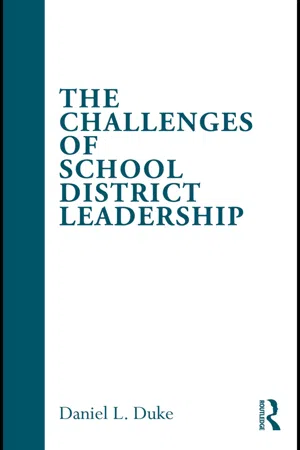
Despite the rising interest in school districts, there are relatively few comprehensive resources available for graduate students in educational leadership programs. The Challenges of School District Leadership takes the position that the best way to prepare the next generation of school district leaders is to make certain that they are prepared to address the unending challenges that characterize public education today. Drawing on the latest research as well as actual examples, the book spotlights ten of the perennial challenges facing superintendents and school boards. Among the challenges discussed in detail are balancing equity and excellence, accommodating demographic change, coping with the increasing politicization of district leadership, deciding how to organize (or reorganize) a school system, and meeting the demands of educational accountability. This text is appropriate for graduate students in educational leadership, education policy, and the politics of education as well as school district leaders.
- 288 pages
- English
- ePUB (mobile friendly)
- Available on iOS & Android
eBook - ePub
The Challenges of School District Leadership
About this book
Information
1
Strategic Challenges
1
THE CHALLENGE OF COMPETING PRIORITIES
ACCESS TO EXCELLENCE
Thomas Jefferson High School for Science and Technology is arguably the finest public school in the United States. Opened in 1985 by Fairfax County Public Schools in northern Virginia, the high school offers a learning environment and a curriculum designed for high-achievers. Courses frequently are taught in laboratory settings created through the generosity of local corporations. AT&T, for example, helped set up a Telecommunications Laboratory. The Life Sciences and Biotechnology Laboratory was initiated by Hazleton Laboratories, Inc. Honeywell, Inc. provided support for the Computer Systems Laboratory. Jefferson students benefit from state-of-the-art technology and instructors with advanced degrees.
The success of Thomas Jefferson High School for Science and Technology can be ascertained from the performance of its students in academic competitions and on various standardized tests. Jefferson students annually win more National Merit Scholarships and take more Advanced Placement tests than students from any other high school. Graduates of Jefferson go on to attend the most prestigious colleges and universities in the nation.
There is only one problem with Thomas Jefferson High School for Science and Technology. It cannot accommodate all the students who want to enroll. Knowing that admission to Jefferson almost ensures academic success, parents in Fairfax County begin grooming their children for the entrance examination in middle school. Expensive private programs to prepare students for the examination flourish in Fairfax County. Parents realize that there are 420 openings for ninth graders each year and that the number of students seeking admission far exceeds 420. In 2001, for example, 2,884 eighth graders sat for the entrance examination.
Fairfax superintendents have learned to be on their guard at the beginning of every school year because the racial and ethnic make-up of Jefferson’s entering class invariably becomes a public issue. When Dan Domenech learned that the entering class of 2001 contained only 2 African-American and 7 Hispanic students out of 420 rising ninth graders, he decided that the admissions process had to be revised. Born in Cuba, Domenech was well aware of the importance of a high quality education for all groups of students.
Domenech considered several options. Slots at Jefferson could be allocated by geographic region. Given the residential patterns in Fairfax, such a policy would produce more minority representation. Alternatively, each racial and ethnic group could be guaranteed a specified number of slots at Jefferson. The problem was that Fairfax County was comprised of dozens of racial and ethnic groups with substantial populations. Neither of these policies was received well by parents of white and Asian parents whose children typically filled most of the slots at Jefferson.
Eventually Domenech decided on a compromise of sorts. The traditional selection criteria, which included the admission examination results and teacher recommendations, were to be used for 400 ninth grade slots. The remaining 20 slots were reserved for under-represented neighborhoods. Domenech understood that few people would be pleased with this compromise, but at least it represented a step in the right direction.
*****
As superintendent of a large and highly diverse school system, Dan Domenech faced an important challenge. The reputation of Fairfax County Public Schools depended, to a great extent, on its ability to offer programs of academic excellence, programs epitomized by Thomas Jefferson High School for Science and Technology. At the same time, he was obligated to do everything in his power to promote educational equity. How could every student who sought admission to Jefferson be guaranteed access? Was such an outcome even desirable? Could a top quality program be sustained if enrollments increased? Would it be better to shut down Jefferson than to continue to operate the school and deny access to hundreds of students? Such questions go to the very heart of every high-performing school district’s mission.
WHAT IS THE MISSION OF A PUBLIC SCHOOL DISTRICT?
When the U.S. economy began to struggle in the face of growing foreign competition in the late 1970s and early 1980s, corporations were accused of trying to do too many things. The key to success, according to business gurus like the authors of In Search of Excellence (Peters & Waterman, 1982), was to “stick to the knitting.” Corporations, in other words, should decide what they were best at producing and concentrate on producing it. Using excess capital to acquire unrelated businesses was no substitute for continuously improving the core business.
Should public school districts heed such advice? Is it possible for a public school district to develop a truly focused set of priorities? U.S. history reveals a tendency for virtually every social problem eventually to produce a plea for public schools to get involved. Americans’ expectations for public education over the past century have been ambitious, diverse, and oft en controversial. When the United States fell behind the Soviet Union in the space race, public schools were called on to produce more scientists and engineers. When policy makers finally acknowledged that minorities were victims of discrimination, public schools were called on to lead the march to an integrated society where all people would be treated fairly. In his history of Hamilton High, Grant (1988) describes one incarnation of the high school in which the focus of attention shift ed from academics to a host of social services. To address the needs of its changing student body, Hamilton High initiated “free breakfast and lunch programs for children on welfare, sex education programs, drug counseling, suicide prevention programs, medical advice and counseling for pregnant teenagers, an in-school nursery for children of students, and after-school child care” (p. 66).
It is impossible to understand the mission of public schools and school districts without understanding the social and temporal contexts in which they function. Priorities are formed in the crucible of contemporary culture. Contexts change, and with change come new problems for educators to confront. Some of these problems have no precedent. The pressures on schools in the aftermath of the September 11 terrorist attacks and Hurricane Katrina come to mind. Other problems are all too familiar for veteran school district leaders. Of this second set of problems, perhaps no two are more familiar than the demands for educational equity and educational excellence. When it comes to determining school district priorities, this pair of concerns typically are at, or near, the top of the list.
From Brown to No Child Left Behind
A quick survey of the educational issues that have dominated the agendas of policy makers since the end of World War II reveals the persistence of equity and excellence. Having fought and died to protect American democracy, African Americans returned form World War II to a society where they were denied the full benefits of democracy. Their insistence on freedom from racial discrimination led to the landmark Brown v. Board of Education in 1954 (Imber & Van Geel, 2000, pp. 189–191). The foundation for the case derived from the equal protection clause of the Fourteenth Amendment, which forbids any state from denying citizens the equal protection of the laws. The Supreme Court agreed with the plaintiff in Brown that segregated schools for blacks were inherently unequal. The path to school integration thereby was paved.
Before substantial numbers of black students could travel that path, however, another educational priority interceded. One month after federal troops were sent to Little Rock, Arkansas, to ensure the peaceful integration of Central High School in September of 1957, the Soviet Union successfully launched a satellite that orbited the Earth. Americans grew concerned that their nation had fallen behind in science and technology. Demands were made to increase the rigor of high school education. Only by raising the quality of instruction in key courses such as mathematics and physics would the United States be able to match the achievements of its Cold War rival. James Bryant Conant (1959), former president of Harvard University, called for small high schools to be consolidated, thereby creating large enough pools of high-achieving students to enable teachers to group students by ability. To challenge these students, a variety of accelerated courses, including Advanced Placement courses, were developed, and high school tracking became institutionalized in public high schools. Eminent scientists displaced teachers as curriculum developers, and teachers spent their summers attending workshops and institutes in order to be able to implement the rigorous new curriculums.
As school districts around the country geared up to address the need for higher educational expectations, attention began to shift back to matters of equal opportunity. The intent of the Brown decision remained unrealized, as states in the South either openly resisted desegregation or pursued policies of token desegregation. In the first of a series of initiatives that marked the beginning of a much more active role in public education, the federal government pressed for passage of the Civil Rights Act of 1964, which enabled the Attorney General of the United States to initiate lawsuits to compel school districts to desegregate. The law also made it possible for federal funds to be withheld from segregated school systems. A year later, Congress passed the Elementary and Secondary Education Act, the most comprehensive education bill up to that time. The primary focus of the bill, especially its Title I, was to provide greater access to educational opportunities for disadvantaged children. All poor children, not just poor black children, stood to benefit from the federal government’s expanding role in public education.
The federal focus on expanding educational opportunities continued for nearly two decades. New groups of students received protection under the Fourteenth Amendment. In 1972 Congress passed Title IX of the Education Amendments Act, thereby enabling females to enjoy the same educational benefits as males. The needs of non-English-speaking students received similar attention as a result of a court decision in 1974. The ruling in Lau v. Nichols compelled school districts to abandon the sink-or-swim practice of assigning non-English-speaking students to regular classrooms where many were unlikely to learn what they needed to progress in school. A year after Lau, Congress passed Public Law 94-142, the Education of All Handicapped Children Act. The bill guaranteed procedural due process for all children identified as having special needs based on physical, cognitive, and emotional handicaps. In little over ten years, considerably more than half of the students attending public schools in the United States were placed under the protective umbrella of federal law. In the process, the principle of equal educational opportunity, which had driven initial efforts to assist black students and poor students, was joined by another important principle—educational equity.
While interpretations of the meaning of educational equity continue to vary, a fairly common understanding of its implications holds that the term is an acknowledgment that, under certain circumstances, providing unequal treatment may be necessitated in order to redress the prior effects of discrimination and educational inequities. Equal opportunity, in other words, may be insufficient to make up for the accumulated effects of poverty, racial bias, and other social hurdles.
As the United States began to experience economic problems, first in the mid-1970s with sharply rising prices for petroleum and then with stiff competition from industrial powers Japan and Germany, fears surfaced that all the attention being devoted to educational entitlements had eroded the academic rigor of public schools. As a result, young American workers were perceived to lack the preparation needed to sustain traditionally high levels of productivity. To make matters worse, too few Americans were opting for careers in science, engineering, and technology. National concern culminated in the 1983 blue-ribbon commission report entitled A Nation at Risk (National Commission on Excellence in Education, 1983).
The authors of A Nation at Risk indicated that the very security of the American way of life had been jeopardized by declining student achievement, watered-down curriculums, and low academic expectations. Embarrassing comparisons were drawn between the achievement of U.S. students and students in other countries. Among the report’s recommendations was that all students should undertake a rigorous program of study and that expectations for acceptable performance must be raised substantially. When educational excellence had been called for previously, identifying the brightest students and providing them with accelerated coursework had been the preferred prescription of policy makers. A Nation at Risk proclaimed that nothing short of educational excellence for all students would ensure that the United States remained competitive in an increasingly global economy.
As states and school districts busied themselves with raising graduation requirements, increasing expectations in core areas such as mathematics and science, eliminating unchallenging electives, and developing common curriculum standards, concerns once again surfaced regarding students who struggled academically. Drawing on the title of the report issued by the National Commission on Excellence in Education, educators and advocates expressed...
Table of contents
- CONTENTS
- PREFACE
- INTRODUCTION
- 1 Strategic Challenges
- 2 Operational Challenges
- 3 Fundamental Challenges
- INDEX
Trusted by 375,005 students
Access to over 1.5 million titles for a fair monthly price.
Study more efficiently using our study tools.
Frequently asked questions
Yes, you can cancel anytime from the Subscription tab in your account settings on the Perlego website. Your subscription will stay active until the end of your current billing period. Learn how to cancel your subscription
No, books cannot be downloaded as external files, such as PDFs, for use outside of Perlego. However, you can download books within the Perlego app for offline reading on mobile or tablet. Learn how to download books offline
Perlego offers two plans: Essential and Complete
- Essential is ideal for learners and professionals who enjoy exploring a wide range of subjects. Access the Essential Library with 800,000+ trusted titles and best-sellers across business, personal growth, and the humanities. Includes unlimited reading time and Standard Read Aloud voice.
- Complete: Perfect for advanced learners and researchers needing full, unrestricted access. Unlock 1.5M+ books across hundreds of subjects, including academic and specialized titles. The Complete Plan also includes advanced features like Premium Read Aloud and Research Assistant.
We are an online textbook subscription service, where you can get access to an entire online library for less than the price of a single book per month. With over 1.5 million books across 990+ topics, we’ve got you covered! Learn about our mission
Look out for the read-aloud symbol on your next book to see if you can listen to it. The read-aloud tool reads text aloud for you, highlighting the text as it is being read. You can pause it, speed it up and slow it down. Learn more about Read Aloud
Yes! You can use the Perlego app on both iOS and Android devices to read anytime, anywhere — even offline. Perfect for commutes or when you’re on the go.
Please note we cannot support devices running on iOS 13 and Android 7 or earlier. Learn more about using the app
Please note we cannot support devices running on iOS 13 and Android 7 or earlier. Learn more about using the app
Yes, you can access The Challenges of School District Leadership by Daniel L. Duke in PDF and/or ePUB format, as well as other popular books in Pedagogía & Educación general. We have over 1.5 million books available in our catalogue for you to explore.