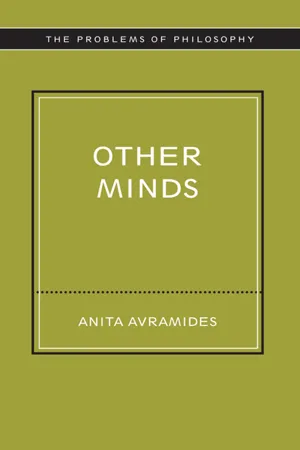
How do we know whether there are other minds besides our own? The problem of other minds raises many questions which are at the root of all philosophical investigations - how it is we know, what is the mind and can we be certain about any of our beliefs?
In this compelling analysis of 'other minds' Anita Avramides traces the question from the Ancient Sceptics through to Descartes, Malebranche, Locke, Berkeley, Reid and Wittgenstein. The second part of the book explores the views of influential contemporary philosophers such as Strawson, Davidson, Nagel and Searle.
Other Minds provides a clear insightful introduction to one of the most important problems in philosophy. It will prove invaluable to all students of philosophy.
- 352 pages
- English
- ePUB (mobile friendly)
- Available on iOS & Android
eBook - ePub
Other Minds
About this book
Information
Knowledge of other minds
CHAPTER I
Ancient and modern scepticism and the problem of other minds
INTRODUCTION
The sceptic is a familiar figure in philosophy. His questions have dominated the subject since ancient times. The sceptic challenges, among other things, our claims to know about – or to be justified in our beliefs about – the world around us. The sceptic also raises questions about our knowledge of other minds. Most contemporary discussions of scepticism take their lead from the writings of Descartes, and in particular his Meditations on First Philosophy. While Descartes does not explicitly discuss questions concerning the mind of another, it is true to say that his philosophical work bequeaths this problem to us.1 And it is notable that the problem is directed specifically at the mind of others, of our own mind there can be no doubt. Starting from the secure point of knowing my own mind the question is raised: How do I come to know that another has a mind?
If we were to think that the sceptic has a standard repertoire, then we would expect sceptics of all times to raise this question about other minds. It would come as something of a surprise, then, to learn that, on the whole, the sceptics of ancient times did not raise this question. The sceptic does not have a standard repertoire. I propose to try to understand how the question of other minds arises for Cartesian scepticism by comparing and contrasting this scepticism with that proposed by ancient philosophers. I shall suggest that what such a study reveals is that the problem of other minds is not, au fond, an epistemological problem.
THE ANCIENT SCEPTICS: A BRIEF INTRODUCTION
As with so many philosophical problems, the problem of scepticism concerning our knowledge of the world has its roots in the writing of the ancient Greek sceptics. There were, in ancient times, two main schools of sceptical thought: the Academic and the Pyrrhonian. Both were primarily concerned to reject the views of the Dogmatists, and chief among these, the Stoics. There are two aspects of Stoic philosophy that it is important to note for our purposes. The first is that it has a clear practical dimension: the concern is to attain happiness and peace of the soul in the conduct of everyday life. To this end the Stoics turn to science and the pursuit of scientific knowledge. Following from this, the second aspect of Stoic philosophy to be noted is this: the Stoics are optimistic about the achievement of knowledge through a science founded on the unarguable truth of certain perceptions. On the Stoic view, some perceptions are such that they simply grab you and drag you to the truth. A perception which is both clear and compelling – and for which there is no countervailing reason sa is one from which the soul cannot withhold assent. The Stoics believe that it is upon such perceptions that science is founded.
This belief in the positive knowledge that is to be gained from science is the target of sceptical attack. Academic scepticism is usually identified as the first school of sceptical thought. It developed within Plato’s Academy under the leadership of Archesilaus in the early part of the third century BCE, and was revitalized in the second century BCE by the dialectician Carneades. The Academic sceptics urge their opponents to set out their views and then systematically oppose them. In this way they aim to provide a demonstration of opposing argument.2 This method is designed to undermine the Stoic’s claim that knowledge is attainable. The Academic sceptics also argue that the clear and compelling perceptions of the Stoics are liable to be illusions, hallucinations or the product of a dream. Contrary to the dogmatism of the Stoics, the Academic sceptics aim to show that there is no criterion for determining truth. The end result of the sceptic’s line of thought is that the (Stoic) Sage should suspend judgement about, or withhold assent from, all propositions. Should the Sage do this, however, a certain problem is thought to arise: if he does withhold assent, how is the Sage to act? It should be noted that the Academic sceptic shares with the Stoic a similar practical dimension to his philosophy: the motivation is to attain peace and happiness in the conduct of life. The question is, if the sceptic is right to conclude that the Sage must withhold assent, how is he to attain this happiness? At this point the Academic sceptic introduces the idea of the reasonable or the plausible: despite his refusal to submit to dogma, the Sage will act in accordance with that which he takes to be the more reasonable or plausible.3
There is another school of sceptical philosophy in ancient times which also opposes the dogmatism of the Stoics, but which formulates its scepticism differently from the Academics. This is Pyrrhonism.4 Pyrrhonism could be said to be both older and younger than Academic scepticism: older because its founder, Pyrrho of Elis, pre-dates the Academic sceptics by about fifty years; younger because its theoretical formulations are due to Aenesidemus who lived and wrote some two hundred years after the early Academic sceptics. Pyrrhonists are the more thoroughgoing of the ancient sceptics: they make no concession to the reasonable or the plausible; they accept the conclusion of the sceptical argument and aim to accommodate it in their daily life. In this they claimed to follow Pyrrho who, it is alleged, was a living example of a complete doubter, a man who would commit himself to nothing beyond what seemed to be the case.
There are several stories reported concerning Pyrrho which illustrate both the aim and the inherent difficulties of Pyrrhonism. Here is one: It is reported that Pyrrho was once standing on the deck of a ship caught up in a raging storm. Also on board was a pig, who continued to eat his supper despite the panic and frantic activity of the passengers all around him. Pyrrho is said to have pointed to the pig, unperturbed by the storm, as an example of what they should all be like. Another story points up the difficulties in this advocated way of life. It is reported that Pyrrho was once frightened by a vicious dog. When charged with failing to practise what he preached – that is, not to commit oneself to the belief in the danger posed by the dog which in turn brings about one’s fear – Pyrrho is said to have replied that it is regrettable that it is so difficult to divest oneself of one’s humanity.5 What one learns from the example of Pyrrho’s life is the extent of the Pyrrhonist’s commitment to live his scepticism. It is not just that such a sceptic renounces knowledge (for that may be consistent with the retention of belief), but he renounces the very beliefs by which we ordinarily live. Or rather, he renounces a commitment to the truth or falsity of these beliefs. It is in reaction to this that Hume wrote in his Enquiry Concerning Human Understanding that ‘a Pyrrhonian cannot expect, that his philosophy will have any constant influence on the mind: … On the contrary, he must acknowledge, if he will acknowledge anything, that all human life must perish, were his principles universally and steadily to prevail. All discourse, all action would immediately cease; and men remain in a total lethargy, till the necessities of nature, unsatisfied, put an end to their miserable existence.’6
It is not altogether clear, however, that Hume is right in his condemnation of the Pyrrhonist. Without further argument, it looks as if Hume simply overlooks the fact that the Pyrrhonist does not reject action, just commitment to the truth of one’s beliefs. It is important to remember that the Pyrrhonist does not formulate his scepticism in a void. Like the Academic sceptics and the Dogmatists, he is motivated by the question, How should we live our lives so that we might achieve happiness or tranquillity (ataraxia)? Tranquillity, according to the Pyrrhonist, will descend upon us once we suspend judgement in the face of opposing argument; it comes when we stop chasing it. A comparison is sometimes drawn with the painter Apelles who strove to achieve the effect on canvas of the horse’s foam, but only achieved it when he finally gave up and flung his sponge at the canvas.7 There is no tranquillity in life when one spends one’s time arguing for this or that opinion – that way lie frustration and anxiety. Better to accept the teachings of the sceptics. Do not seek a criterion of truth. Furthermore, action in accordance with what is more reasonable or plausible is not a solution. Better to settle for suspension of judgement (or epoche). Epoche is the prelude to ataraxia.
There does, however, appear to be a tension between the achievement of tranquillity and the Pyrrhonian sceptic’s concern with propounding a way of living. If we do abandon the dogma of the Stoics, and if we do reject what is more reasonable or plausible, how are we to act? It looks as if we have to conclude with Hume that Pyrrhonism is incompatible with living. But this is to overlook the fact that the Pyrrhonian advocates a life in accordance with appearance. To this end he proposes the following fourfold scheme of life:
(i) Be guided by nature as you perceive it.
(ii) Yield to the constraints of bodily drives such as hunger and thirst.
(iii) Keep to the laws and customs of the society.
(iv) Take instruction in the arts.
At first sight the recommended life looks no different from the ordinary one. The difference is that in the ordinary case we believe that the opinions that guide our actions are true or matter, whereas in the recommended life we manage to suspend belief or judgement as to the truth of our opinions. The important thing to notice is that action is not discouraged – only commitment. We are to act as one who has no reason to act one way or another; we may as well flip a coin. Allowing ourselves to live in accordance with the fourfold scheme of life would seem to serve the same purpose as the toss of a coin.8
While Pyrrho allegedly provided his followers with an example of a way of life, he wrote nothing. It was Aenesidemus and his followers who provided the theoretical formulations of the sceptical doctrine. Following on from the Academics, these sceptics developed arguments, or tropes, which were designed to lead us to a life devoid of commitment. A record of these arguments is available in the writings of Sextus Empiricus, a Pyrrhonian sceptic who lived around 200 CE. Sextus’ Outlines of Pyrrhonism is a compendium of Pyrrhonist thought dating back to Aenesidemus, and includes the Ten Modes of Aenesidemus as well as a further Five Modes usually attributed to Agrippa.9 In his Ten Modes Aenesidemus sets out the modes or ways in which things give rise to belief and then shows how each of these modes produces conflicting beliefs of equal persuasiveness. The conclusion he wishes us to draw from all this is that these modes should not be relied on to put us in touch with the truth.
Of the Ten Modes, the first five are particularly interesting for our purposes. Sextus characterizes the first four modes as ‘arguments from the subject judging’. The First Mode presents the argument from differences in animals. One form of this argument begins by noting the way that sense impressions differ when the organ of sense is altered in a man (say, because he is suffering from jaundice), and concludes from this that the very different sense organs of non-human animals must produce sense impressions in them that are different from those in us. So, for example, the sense of touch is different in fleshy animals than in hard-shelled or thorny ones, and different again in feathered or scaled animals. The question is then pressed, What reason is there for taking the perceptions of one kind of creature to be revealing of the way things really are? The Second Mode presents the argument from differences in humans. This argument is designed either to supplement or to replace the argument of the First Mode. It may replace that argument if one were to believe, for whatever reason, that the perceptions of man are superior to those of all other animals. The Second Mode restricts its observations to men. Even when we do this, what we find is that there are differences in the bodies of men that result in the same object affecting different men differently. This is clear from the fact that each man takes his pleasures – as well as his displeasures – in different things. Again the question is pressed: What reason is there for taking the perceptions of one man to be revealing of the way things are in reality? In the Third Mode the argument from different senses is invoked. It is pointed out, for example, that honey can appear pleasant to the tongue but unpleasant to the eyes, that perfume can be pleasant to the smell but disgusting to the taste, and so on. Here the question is pressed: Why take the perceptions of one sense to be more revealing about how things are in themselves than those of another? Finally, in the Fourth Mode attention is drawn to the various states of the body and the way perceptions are affected by these states. Thus, it is pointed out that things appear different to a joyous man and a grief stricken one, to a drunk and a sober man, to an old and a young man, to one awake and one asleep, and the like. Again it is asked: Why trust the judgements of a man in one state rather than another? The Fifth Mode is one of several that Sextus characterizes as combining elements from arguments from the subject judging with elements from arguments that he characterizes as arguments from the object judged’. This mode draws attention to the fact that the same object can appear differently due to differences in its position, distance and place. Thus, for example, the same tower may appear round from afar and square close up, and the light of a lamp will appear dim in sunlight but bright in the dark. Such observations make it impossible to give one sense-impression preference over another.
The point of making such observations and pressing these questions is to encourage us to suspend our judgement. The study of these arguments is meant to banish dogma. It is only by avoiding dogma that the Pyrrhonist believes that we can achieve tranquillity in our everyday lives.
ANCIENT GREEK SCEPTICISM AND THE PROBLEM OF OTHER MINDS
Let us now look a little more closely at the scepticism bequeathed to us by the Pyrrhonists. What these sceptics challenge is our ability to come up with a criterion of truth which is independent and which can be used to determine what an object is really like. Very roughly, we could say that the sceptics of ancient times bequeathed to us a scepticism about the world. We must be very careful how we understand this.
In the writings of the ancient sceptics we find arguments not dissimilar to those familiar from any contemporary textbook on epistemology. There is reference to the jaundiced eye, the square tower viewed from a distance and to dreams. Les...
Table of contents
- Cover
- Title
- Copyright
- Dedication
- Contents
- Preface
- Acknowledgements
- Overview
- PART ONE Knowledge of other minds
- PART TWO The problem of other minds
- PART THREE The conceptual problem of other minds
- Notes
- Bibliography
- Index
Trusted by 375,005 students
Access to over 1.5 million titles for a fair monthly price.
Study more efficiently using our study tools.
Frequently asked questions
Yes, you can cancel anytime from the Subscription tab in your account settings on the Perlego website. Your subscription will stay active until the end of your current billing period. Learn how to cancel your subscription
No, books cannot be downloaded as external files, such as PDFs, for use outside of Perlego. However, you can download books within the Perlego app for offline reading on mobile or tablet. Learn how to download books offline
Perlego offers two plans: Essential and Complete
- Essential is ideal for learners and professionals who enjoy exploring a wide range of subjects. Access the Essential Library with 800,000+ trusted titles and best-sellers across business, personal growth, and the humanities. Includes unlimited reading time and Standard Read Aloud voice.
- Complete: Perfect for advanced learners and researchers needing full, unrestricted access. Unlock 1.5M+ books across hundreds of subjects, including academic and specialized titles. The Complete Plan also includes advanced features like Premium Read Aloud and Research Assistant.
We are an online textbook subscription service, where you can get access to an entire online library for less than the price of a single book per month. With over 1.5 million books across 990+ topics, we’ve got you covered! Learn about our mission
Look out for the read-aloud symbol on your next book to see if you can listen to it. The read-aloud tool reads text aloud for you, highlighting the text as it is being read. You can pause it, speed it up and slow it down. Learn more about Read Aloud
Yes! You can use the Perlego app on both iOS and Android devices to read anytime, anywhere — even offline. Perfect for commutes or when you’re on the go.
Please note we cannot support devices running on iOS 13 and Android 7 or earlier. Learn more about using the app
Please note we cannot support devices running on iOS 13 and Android 7 or earlier. Learn more about using the app
Yes, you can access Other Minds by Anita Avramides in PDF and/or ePUB format, as well as other popular books in Philosophy & Epistemology in Philosophy. We have over 1.5 million books available in our catalogue for you to explore.