- 176 pages
- English
- ePUB (mobile friendly)
- Available on iOS & Android
eBook - ePub
Travel Writing
About this book
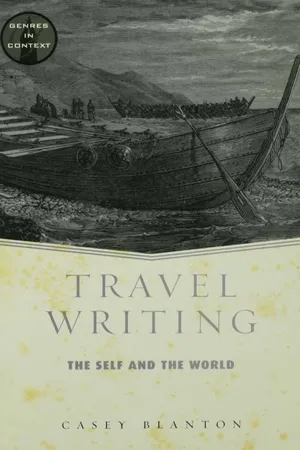
Blanton follows the development of travel writing from classical times to the present, focusing in particular on Anglo-American travel writing since the eighteenth century. He identifies significant theoretical and critical contributions to the field, and also examines key texts by James Boswell, Mary Kingsley, Graham Greene, Peter Mathiessen, V.S. Naipaul, and Bruce Chatwin.
Information
Chapter 1
NARRATING SELF AND OTHER:
A HISTORICAL OVERVIEW
Melville's Ishmael, sole survivor of an epic journey and something of a travel writer himself, discovers the central dilemma of travel literature when he begins to tell the reader of Moby-Dick about Queequeg's home: “It is not down on any map. True places never are.”1 Ishmael's attempts to represent the exotic island homeland of his friend are frustrated by the inherent difficulty of faithfully rendering the foreign into familiar terms. As every travel writer knows, maps and books can tell only part of the truth. By what process, using what models, does the traveler presume to describe, to interpret, to represent people and places who are other to him? What encounter is included, what person omitted? What vistas extolled, what river left behind? Despite these very real difficulties, every travel writer also knows that he or she will find a way. And the large, unruly, amorphous set of discourses we call “travel literature” is a testament to that effort.
Travel literature has a long and honorable history. Early travelers’ accounts like those of Herodotus (History of the Persian Wars, ca. 440 B.C.E.), Strabo (Geographica, ca. 23 C.E.), and Pausanias (Guide to Greece, ca. 170 C.E.) are evidence of a vigorous nascent genre. These narratives and the ones that follow them render in words the strange, the exotic, the dangerous, and the inexplicable; they convey information about geography as well as human nature; they try, as Ishmael tried, to tell a kind of truth that paradoxically may be untellable. This compelling urge to describe the journey does not diminish throughout history, and there seems to be no end to the wealth of travel texts. But, as we shall shortly see, both the purpose and the style of these narratives do evolve substantially over time. It is a kind of evolution that betrays its long ancestry because the more narrow group of narratives that we have come to call “the modern travel book” has inherited elements of all of its predecessors as well as its close cousins. This complex family, then, includes memoirs, journals, and ships’ logs, as well as narratives of adventure, exploration, journey, and escape.
Despite changes in style and purpose, the effect of these narratives on the reader has not diminished. From Marco Polo to Bruce Chatwin, travelers’ tales about distant places and exotic cultures have proven to be remarkably popular reading. The persistence of this kind of writing is undoubtedly related to human curiosity and to a travel writer's desire to mediate between things foreign and things familiar, to help us understand that world which is other to us. But curiosity alone does not account for the persistence of this genre.
What may go further toward explaining travel literature's longevity is its narrative power, both literal and symbolic. The travel narrative is a compelling and seductive form of storytelling. Its reader is swept along on the surface of the text by the pure forward motion of the journey while being initiated into strange and often dangerous new territory. The traveler/narrator's well-being and eventual safe homecoming become the primary tensions of the tale, the traveler's encounter with the other its chief attraction. Indeed, the journey pattern is one of the most persistent forms of all narratives—both fiction and nonfiction. Works as various as the Odyssey, Gilgamesh, Moby-Dick, and the travel books of Mungo Park, Gertrude Bell, and Jan Morris all follow this ancient pattern: departure, adventure, and return. Yet, these works resonate with a symbolic and psychological truth that goes beyond their compelling narrative surfaces. The transformation from a literal journey to a psychological or symbolic one may occur for a number of reasons. The shift works on an intuitive level because of what Joseph Campbell calls the existence of the “monomyth,” where the hero is seen as one who travels along a path of self-improvement and integration, doing battle with the “others” who are the unresolved parts of himself or herself. Wholeness is associated with homecoming when the quest cycle is complete.2 In her book on the journey narrative in American literature, Janis Stout suggests that the symbolic power of these tales resides in “the elemental questions of epistemology, the relation between subject and object, knower and known.”3 In an explanation similar to Campbell's, she focuses on the bifurcation of the traveling self into “considering subject and considered object” (Stout, 14) where the experiences in the outer world can be “transferred” to the self that is being scrutinized, thus converting the journey into a mode of introspection. Whether fiction or nonfiction, there exists in the journey pattern the possibility of a kind of narrative where inner and outer worlds collide. But, as a survey of the development of the genre will show, the balance of that dialogue between the mind of the traveler and the observable world has not remained constant. As the purpose of travel has shifted from political exploration or mercantile errands to travel for its own sake, gradual but fundamental changes have occurred in the narratives that describe these trips. Those changes occur at the nexus of the traveler's concern with inner and outer worlds.
At one end of the spectrum lie the object-bound journey accounts of sailors, pilgrims, and merchants whose trips were inspired by necessity or well-defined purpose: exploration, devotion, or economics. These journey narratives of early travelers usually appear as ships’ logs or, more commonly, as in the case of Christopher Columbus, letters to king, sponsor, or loved ones at home. In these accounts, people and places of the outer world are described in what is taken by the narrator to be a factual, disinterested way; the narrator's thoughts and reactions are all but hidden. (This is not to say, of course, that the narrator's purpose is hidden as well. Even while reporting in an ostensibly factual way, most early explorers and travelers undoubtedly had political and religious agendas concerning the places they were describing. Cortés's documents to the king of Spain, for instance, while purporting to be factual accounts of his travails in Mexico, were clearly designed to curry favor and to raise more money for his adventures.) At the other end of the rather long and continuous line of travel accounts lie the more explicitly autobiographical travel books that we have come to expect today as travel literature. In the works of twentieth-century travel writers, especially ones like Graham Greene, V. S. Naipaul, and Bruce Chatwin, social and psychological issues are more important than facts about places and events. Sights and vistas may not be as central to the narrative as issues of religion, politics, and social behavior. But more important, there exists at the center of travel books like Greene's Journey without Maps or Naipaul's An Area of Darkness a mediating consciousness that monitors the journey, judges, thinks, confesses, changes, and even grows. This narrator, so central to what we have come to expect in modern travel writing, is a relatively new ingredient in travel literature, but it is one that irrevocably changed the genre.
These two types—neither pure as we shall soon see—adopt different narrative strategies. The impersonal journey narratives usually have a rather flat, linear structure—flat in the sense that there is no rising and falling action, no organizing dramatic strategy. The events are reported chronologically, following the itinerary of the trip. On the other hand, a more consciously crafted work of travel literature, while usually existing within a chronological framework, often borrows from the world of fiction to establish motivation, rising and falling action, conflict, resolution, and character. These two poles exist largely only in theory. In reality, the two constantly impinge upon one another. Anyone who has read Columbus's travel accounts knows that his own personality by way of his desires and fears creeps into his representations of the New World. And even the most self-conscious autobiographical tales of travel, like those of Claude Lévi-Strauss, Lawrence Durrell, or James Fenton, rely on rather factual descriptions of people and places wholly outside the mind of the traveler. Yet, the distinctions are important. Genuine “travel literature,” as opposed to what has been called “pretravel,” depends upon a certain self-consciousness on the part of the narrator that was not seized upon until after the Renaissance and, in fact, not highly developed until the concern with “sensibility” in the eighteenth century.4
What we have come to expect today as travel literature contains a balance of these two elements: impersonal and personal. “Successful travel literature,” says Paul Fussell in his anthology about the subject, “mediates between two poles: the individual physical things it describes, on the one hand, and the larger theme that it is ‘about’ on the other” (Fussell 1987, 126). What travel books are “about” is the interplay between observer and observed, between a traveler's own philosophical biases and preconceptions and the tests those ideas and prejudices endure as a result of the journey. The reverberations between observer and observed, between self and world, allow the writer to celebrate the local while contemplating the universal. To catch the spirit of the genre of travel literature, then, is to isolate these later, post-Enlightenment narratives into a recognizable group with certain characteristics. Among the chief characteristics are a narrator/traveler who travels for the sake of travel itself; a narrative style that borrows from fiction in its use of rising and falling action, character, and setting; a conscious commitment to represent the strange and exotic in ways that both familiarize and distance the foreign; a writerly concern with language and literature; and finally, thematic concerns that go beyond descriptions of people and places visited. Perhaps travel writer and novelist Norman Douglas says it best.
[T]he reader of a good travel book is entitled not only to an exterior voyage, to descriptions of scenery and so forth, but to an interior, a sentimental or temperamental voyage, which takes place side by side with that outer one,… the ideal book of this kind offers us, indeed, a triple opportunity of exploration—abroad, into the author's brain, and into our own. The writer should therefore possess a brain worth exploring; some philosophy of life … and the courage to proclaim it and put it to the test. (Quoted in Fussell 1987, 15)
Despite these very real distinctions, the latter “genuine” travel books owe much to their predecessors. Travel writing as a genre has, as we have seen, a complex, impure heritage. Many of the elements that constitute a generic description of travel literature in its final form can also be located in embryonic form in these early works of “pretravel.” And, as a survey of the history of travel writing will show, the evolution of the genre produced some giants in whose shadows the modern travel writer must journey and write.
In the earliest travel writing, the physical world newly discovered was more compelling than the mind of the traveler, and the narrator's purpose was to record the details of this often exciting journey. The travelogues of early explorers and historians for the most part reveal exotic sights and strange customs. In his Histories, the fifth-century (B.C.E.) Greek traveler, Herodotus, shows a zest for the exotic, balanced with a historian's temper for verification and fairness. It is crucial for Herodotus to observe Egyptian animal sacrifices himself, for instance, rather than depend upon other travelers’ tales for their existence. “Now, I believe these statements about Egypt and those who make them, as I myself am finally convinced that they are so, because I have seen Egypt.”5
Yet, despite the obvious importance of Herodotus as “the father of history,” he may not be, as some claim, the first travel writer. Mary B. Campbell makes a good case for the European writer Egeria as the first true travel writer.6 As a nun from Southern Europe, Egeria's fifth-century (C.E.) journey takes the form of a pilgrimage to the Holy Land. What remains of her letter to her fellow nuns revels a direct link with travel writing today that Herodotus's Histories does not. While Herodotus did in fact travel, and while he did narrate in the first person, there is little sense of an organizing principle in his Histories aside from his desire to explain the origins of the Greek and Persian wars. Places are listed almost randomly; there is no sense of a person taking the trip on whom the reader can rely for a sense of place. Egeria's organization of her trip, though clearly a self-effacing effort, nonetheless shows the hand of a traveler going from place to place and interpreting (albeit as stations of the cross) events and sights.
Then I remembered that according to the Bible it was near Salim that holy John baptized Aenon. So I asked if it was far away. “There it is,” said the holy presbyter, “two hundred yards away.” Thanking him I asked him to take us, and we set off. He led us along a well-kept valley to a very neat apple-orchard, and there in the middle of it he showed us a good clean spring of water which flowed in a single stream. There was kind of pool in front of the spring at which it appears holy John Baptist administered baptism.7
In this passage, one senses the mind of a traveler guiding us not only with her sense of the symbolic importance of the landscape but also with some attention to the physical details of the landscape, so different from that of her home. The inclusion of interrogation and quoted language, so rare in early travel accounts, places Egeria squarely in the center of the narrative as the inquiring, curious traveler. Yet this letter marks only a beginning in the long road toward the modern travel book. Clearly the sights of the holy land are iconographic for Egeria. The people who live there are unimportant since, for her, the pilgrimage is a trip back in sacred time. Likewise for Herodotus, the places and people he meets are generally important as living verifications of widely known stories and early histories. For both writers, the plot of their narrative is essentially given rather than invented.
By the thirteenth century, travelers—mostly missionaries and merchants—pushed the frontiers of geographical knowledge past the Holy Land to include the Far East. This period is framed by two intrepid Western travelers: Marco Polo and Christopher Columbus. Both men were determined to travel to the East far beyond their Italian home ports, Polo as a diplomat and Columbus as a government-sponsored explorer. Both offered the world narratives of their voyages, and between these two widely different accounts of the “East,” fairly dramatic changes begin to occur in terms of narratives that dare to present a new world. In his Travels (ca. 1299), Marco Polo promises “many remarkable and extraordinary things” and he does not disappoint the reader. His book, written after his travels with the help of a ghostwriter, is full of the wonders and grotesque beings that his world had come to expect from the mysterious East. Of the inhabitants of Zanzibar he reports:
They are quite black and go about completely naked but for a loincloth. Their hair is so curly that they can only comb it when it is wet. They have wide mouths and turned-up noses. Their eyes and lips are so protuberant that they are a horrible sight. Anyone meeting them in another country would mistake them for devils.8
This description, emphasizing the otherness of the natives of Zanzibar—their revolting non-Western appearance—easily leads Polo to associate them with demons. It is a good example of the tendency of all travelers until very recently to carry with them the unexamined values and norms of their own culture and to judge foreign cultures in light of those habits of belief, thus ...
Table of contents
- Front Cover
- TRAVEL WRITING
- Half Title
- Title Page
- Copyright
- Dedication
- Contents
- Preface
- Chronology
- Chapter 1 Narrating Self and Other: A Historical Overview
- Chapter 2 “Vain Travelers”: James Boswell and the Grand Tour
- Chapter 3 Victorian Women Travelers: Mary Kingsley
- Chapter 4 The Modern Psychological Journey: Graham Greene
- Chapter 5 Nature-Travel Writing: Peter Matthiessen
- Chapter 6 “Splenetic Travelers”: V. S. Naipaul
- Chapter 7 “Lying Travelers”: Bruce Chatwin
- Chapter 8 Envoi: Writings of Place and the Poetics of Displacement in the Works of Paul Theroux and Roland Barthes
- Notes and References
- Bibliographic Essay
- Recommended Titles
- Index
Trusted by 375,005 students
Access to over 1.5 million titles for a fair monthly price.
Study more efficiently using our study tools.
Frequently asked questions
Yes, you can cancel anytime from the Subscription tab in your account settings on the Perlego website. Your subscription will stay active until the end of your current billing period. Learn how to cancel your subscription
No, books cannot be downloaded as external files, such as PDFs, for use outside of Perlego. However, you can download books within the Perlego app for offline reading on mobile or tablet. Learn how to download books offline
Perlego offers two plans: Essential and Complete
- Essential is ideal for learners and professionals who enjoy exploring a wide range of subjects. Access the Essential Library with 800,000+ trusted titles and best-sellers across business, personal growth, and the humanities. Includes unlimited reading time and Standard Read Aloud voice.
- Complete: Perfect for advanced learners and researchers needing full, unrestricted access. Unlock 1.5M+ books across hundreds of subjects, including academic and specialized titles. The Complete Plan also includes advanced features like Premium Read Aloud and Research Assistant.
We are an online textbook subscription service, where you can get access to an entire online library for less than the price of a single book per month. With over 1.5 million books across 990+ topics, we’ve got you covered! Learn about our mission
Look out for the read-aloud symbol on your next book to see if you can listen to it. The read-aloud tool reads text aloud for you, highlighting the text as it is being read. You can pause it, speed it up and slow it down. Learn more about Read Aloud
Yes! You can use the Perlego app on both iOS and Android devices to read anytime, anywhere — even offline. Perfect for commutes or when you’re on the go.
Please note we cannot support devices running on iOS 13 and Android 7 or earlier. Learn more about using the app
Please note we cannot support devices running on iOS 13 and Android 7 or earlier. Learn more about using the app
Yes, you can access Travel Writing by Casey Blanton in PDF and/or ePUB format, as well as other popular books in Literature & Literary Criticism. We have over 1.5 million books available in our catalogue for you to explore.