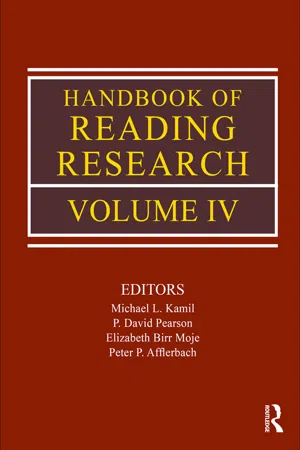
The Handbook of Reading Research is the research Handbook for the field. Each volume has come to define the field for the period of time it covers. Volume IV follows in this tradition. The editors extensively reviewed the reading research literature since the publication of Volume III in 2000, as portrayed in a wide array of research and practitioner-based journals and books, to identify the themes and topics covered. As in previous volumes, the focus is on reading research, rather than a range of literate practices. When taken as a set, the four volumes provide a definitive history of reading research. Volume IV brings the field authoritatively and comprehensively up-to-date.
eBook - ePub
Handbook of Reading Research, Volume IV
- 774 pages
- English
- ePUB (mobile friendly)
- Available on iOS & Android
eBook - ePub
Handbook of Reading Research, Volume IV
About this book
Information
Part 1
Conduct of Reading Research
1
Researching the Teaching of Reading through Direct Observation
Tools, Methodologies, and Guidelines for the Future
James V. Hoffman, Beth Maloch
The University of Texas at Austin
The University of Texas at Austin
Misty Sailors
The University of Texas at San Antonio
The University of Texas at San Antonio
When all was quiet, one of the pupils called out: “I ain’t got no ruler.” In answer to this the teacher, without correcting or even paying the slightest attention to the incorrect language that had been used by the child, said to him: “You don’t need a ruler. Do it the way you done it yesterday.” Then the words of the oft-repeated (spelling) list were slowly dictated by the teacher. When the word “steal” was reached, she remarked: “Spell the ‘steal’ you spelled this morning, not the ‘steel’ you spelled yesterday.” When the word “their” was reached, the teacher asked, “How do you spell ‘their’?” “T-h-e-i-r – their,” sang the children. What kind of a ‘t’ do you use in their?” “Capital ‘t’” one of the pupils answered. “That’s right,” said the teacher … Here the teacher said to me, “They don’t use capital letters regularly in this class; I only let them use capitals when they write proper names and proper things.”
(Joseph Mayer Rice, 1893, p. 72)
Joseph Mayer Rice has been variously credited as the “inventor of the comparative test” (Engelhart & Thomas, 1966); a “founder of the progressive movement” (Graham, 1966); and even as the “father of research in teaching” (Berliner, 2007). Whether these titles exaggerate Rice’s contributions to education or not, it is widely agreed that Rice, a medical physician, was one of the very first to venture into classrooms to study teaching. Rice was fundamentally concerned with the quality of schooling in America. He had studied education in Europe and was impressed with the “scientific” approach being taken there. Over a period of 5 months, beginning in January of 1892 and finishing in 1893, he visited classrooms in 36 cities to “witness” as much teaching as possible (p. 2). He relied only on “personal observation of teaching” (p 5). In every school district he observed in at least 30 to 35 classrooms, claiming to have observed over “twelve hundred” teachers. It is not entirely clear the method Rice used to record his observations nor is there detail on his process of analysis. The book is filled with some transcripts of classroom interactions suggesting that his noting taking could have been quite detailed. Rice recorded his observations and reported his findings over a series of years using both periodical writing (chiefly in The Forum) and in book form (Rice, 1893). Rice was highly critical of the schools he visited and the teaching he observed identifying only four of the systems he visited as deserving of positive attention and decrying most of the others as being “unscientific” and “mechanical.”
Rice believed strongly in the connection between “scientific” practices and student achievement. He returned to the four systems he identified as having outstanding teaching and gathered additional student data on spelling, arithmetic, reading, and writing. He argued that these data (all positive in terms of student performance) supported his claim for the close relationship between teaching and learning. In 1897 Rice presented his claims supported by classroom research to an annual meeting of school superintendents in New Jersey (Berliner, 2007). Leonard P. Ayers (1912) reported on the event:
The presentation of these data threw that assemblage into consternation, dismay, and indignant protest. But the resulting storm of vigorously voiced opposition was directed, not against the methods and results of the investigation, but against the investigator who had pretended to measure the results of teaching spelling by testing the ability of the children to spell. In terms of scathing denunciation the educators there present, and the pedagogical experts who reported the deliberations of the meeting to the educational press, characterized as silly, dangerous, and from every viewpoint reprehensible the attempt to test the efficiency of the teacher by finding out what the pupils could do. With striking unanimity they voiced the conviction that any attempt to evaluate the teaching of spelling in terms of the ability of the pupils to spell was essentially impossible and based on a profound misconception of the function of education. (p. 300)
Rice was not deterred from his purpose by this response and continued making his appeals directly to the public. Rice was convinced that the flaws in public education were the result of poor organization and leadership in schools as well as poor teacher preparation.
I asked one of the primary grade teachers whether she believed in the professional training of teachers. “I do not,” she answered emphatically. “I speak from experience. A graduate of the Maryland Normal School once taught under me, and she wasn’t as good a teacher as those who come from the High School.” One of the primary teachers said to me: “I formerly taught in the higher grades, but I had an attack of nervous prostration some time ago, and the doctor recommended rest. So I now teach in the primary, because teaching primary does not tax the mind.” (Rice, 1893, p. 58)
Rice attempted, in his writing, to walk the fine line between “blaming” teachers and “blaming” the system that created them. He hoped that his inspection of teaching could lead to the reform of teaching from the mechanical to the scientific.
By today’s standards for educational research, we would likely judge Rice’s efforts as short on methodological rigor (e.g., descriptions of the tools used in the observations) and just slightly over the top on subjectivity, politics, and passion. The most disappointing aspect of Rice’s work, however, comes in the fact that while he may have transformed educational measurement and the emphasis for linking teaching to testing, he failed to inspire educational researchers to move into classrooms to conduct more rigorous examinations of teaching. One must fast-forward at least 75 years from the turn of the century to begin to find significant research in the teaching of reading that was conducted in the context of classrooms (Dunkin & Biddle, 1974). This is particularly the case, as we will document in this chapter, with respect to research in the teaching of reading.
Our focus for this chapter will be on describing the tools and methodologies used to observe the teaching of reading in classrooms. Our path takes us from the conceptual, to the historical, to the present, and then to the future.
TOOLS AND MEDIATION IN OBSERVATIONAL RESEARCH
All observational research studies, regardless of methodology, rely on tools. These tools include the means for the recording of data (e.g., the pencil, the computer, the video camera), the formatting or organization of these data (e.g., a checklist, a blank page), and the mental operations or frames of the observer that filter what is recorded (e.g., purposes, expectations, attention, experience). While there is a strong tradition in physical and social science research to use the term “instrumentation” to describe methods, we favor the use of “tools”. Instrumentation has strong technical and deep behavioral roots in research. In contrast, the term tool recognizes the social mediation involved in all human activity and knowledge construction. The tools of research always mediate the processes of data gathering and the interpretation of the data.
The dual concepts of “tool” and “mediation” are central to the socio-cultural theory of Vygotsky and his colleagues (see Cole, 1996). The structure and development of human psychological processes are co-constituted by the interaction with tools. The tools are physical and psychological (including language) and mediate learning. In Cole’s terms, the mediational triangle includes the inquirer, the object of the inquiry and, indirectly, the tool(s) of inquiry (Cole, 1996). This means, according to Cole, that humans are part of their world and unable to step outside and view the world from the “outside.” Pertinent to research, Cole (1996) points out: “traditional dicho tomies of subject and object, person and environ ment, and so on, cannot be analytically separated and temporally ordered into independent and dependent variables” (p. 103). Cole (1996, p. 203) describes Wartofsky’s (1973) framework for artifacts (including tools and language) as represented in three levels. Artifacts, according to Wartofsky, can be viewed as primary, secondary, and tertiary. Primary artifacts are associated with tools of production (e.g., a pencil). Secondary artifacts grow out of the application of primary artifacts (e.g., a list of practices). Tertiary artifacts are far removed from practice and are essentially conceptual or imaginative (e.g., Rice’s publication and presentation of his findings to leverage for change in practice). Tool use in research can be seen in terms of primary artifacts (associated with production) as in the use of a computer to record data; secondary artifacts (as in the data as represented in various forms through stages of analysis); and tertiary artifacts (as in the ways in which communities interpret these data into larger cultural meanings).
Just as our experiences with the world are shaped by and shape our thinking, the tools and technology used in observations also have a similar effect. This is seen in the evolution of tools for research in the natural sciences (e.g., the study of planets and the cosmos). We align ourselves with Mitcham (1994), who claims that (we) “think through technology” as well as Ihde (1991) who argues that instruments used in research do not merely “mirror reality” but mutually constitute the investigated reality. Ihde maintains that perception is co-determined by the tools or technology of inquiry. Certain aspects are placed in the foreground (and others in the background) by the technology used and can make certain aspects of the observed visible that might otherwise be invisible. According to Ihde, neglecting the role of instruments (i.e., technological artifacts) in science leads to naïve realism. In considering the tools of observation in research it is important to emphasize a “particular” use of a tool in a time and place does not generalize to all other contexts. The social situatedness of tool use and its local meaning must always be recognized.
Given the important role of tools in the conduct of observational research, we focus attention in our review on the qualities and descriptions of the tools used to observe. Our intention is to inspect the ways in which tools come to embody a way of thinking (i.e., a culture of inquiry) that is passed on from one generation (of researchers) to the next—sometimes without a critical analysis of the historical roots and meanings embodied in the tools used.
We believe that the tools of scientific research must meet the highest standards for rigor. We believe that, as these tools are refined, the field of reading research will be better positioned to increase understandings of teaching, of the relationships between teaching and learning, and of the relationship of teaching to teacher knowledge.
GOALS
Through this research review we will attempt to:
1. Characterize the range of tools and methodologies used to gather observational data on teachers;
2. Identify trends in the uses of the tools and methodologies;
3. Discuss concerns or cautions over the tools and methodologies;
4. Describe emerging and promising tools and methodologies; and
5. Propose a set of guidelines for observational research in reading.
We have organized this chapter into four parts. We set the stage for the movement into observational studies of teaching reading in part 1 through a look at the foundational reading research in the 1960s and 1970s as well as a broader look at the research in teaching literature. We describe the procedures we have followed in the identification of tools and methodologies that have been used to study the teaching of reading in part 2. Next, we describe our findings related to the use of tools and strategies that reflect a “quantitative” research perspective (part 3) and the use of tools and strategies that reflect a “qualitative” research perspective (part 4). Finally, we use the findings from our review to articulate a set of guidelines that we hope can help guide the future of observational research in reading in positive directions.
PART 1. BACKGROUND: FOUNDATIONAL RESEARCH
Jeanne Chall’s (1967) classic and enormously popular book Learning to Read: The Great Debate can be used to characterize the dominant research paradigm for reading research through the first ...
Table of contents
- Contents
- Dedication
- Transitions
- Preface
- Part 1 Conduct of Reading Research
- Part 2 Development of Reading
- Part 3 Process of Reading
- Part 4 Teaching and Learning of Reading
- Part 5 Contexts of Reading
- Index
Trusted by 375,005 students
Access to over 1.5 million titles for a fair monthly price.
Study more efficiently using our study tools.
Frequently asked questions
Yes, you can cancel anytime from the Subscription tab in your account settings on the Perlego website. Your subscription will stay active until the end of your current billing period. Learn how to cancel your subscription
No, books cannot be downloaded as external files, such as PDFs, for use outside of Perlego. However, you can download books within the Perlego app for offline reading on mobile or tablet. Learn how to download books offline
Perlego offers two plans: Essential and Complete
- Essential is ideal for learners and professionals who enjoy exploring a wide range of subjects. Access the Essential Library with 800,000+ trusted titles and best-sellers across business, personal growth, and the humanities. Includes unlimited reading time and Standard Read Aloud voice.
- Complete: Perfect for advanced learners and researchers needing full, unrestricted access. Unlock 1.5M+ books across hundreds of subjects, including academic and specialized titles. The Complete Plan also includes advanced features like Premium Read Aloud and Research Assistant.
We are an online textbook subscription service, where you can get access to an entire online library for less than the price of a single book per month. With over 1.5 million books across 990+ topics, we’ve got you covered! Learn about our mission
Look out for the read-aloud symbol on your next book to see if you can listen to it. The read-aloud tool reads text aloud for you, highlighting the text as it is being read. You can pause it, speed it up and slow it down. Learn more about Read Aloud
Yes! You can use the Perlego app on both iOS and Android devices to read anytime, anywhere — even offline. Perfect for commutes or when you’re on the go.
Please note we cannot support devices running on iOS 13 and Android 7 or earlier. Learn more about using the app
Please note we cannot support devices running on iOS 13 and Android 7 or earlier. Learn more about using the app
Yes, you can access Handbook of Reading Research, Volume IV by Michael L. Kamil,P. David Pearson,Elizabeth Birr Moje,Peter Afflerbach in PDF and/or ePUB format, as well as other popular books in Education & Research in Education. We have over 1.5 million books available in our catalogue for you to explore.