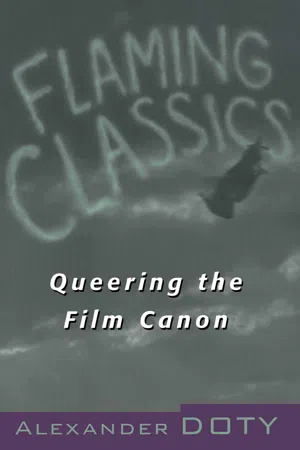
This lively, opinionated, and playful look at the movies is a must-read for film buffs, and for anyone interested in gender, sexuality, and popular culture. One thing's for sure. After reading Flaming Classics you'll know you're definitely not in Kansas anymore.
- 256 pages
- English
- ePUB (mobile friendly)
- Available on iOS & Android
eBook - ePub
About this book
Information
SIX
“He’s a transvestite!” “Ah, not exactly.” How Queer Is My Psycho
The more I watch Psycho, and read what has been written about it, the less certain I am about what to make of Norman Bates psychosexually.1 Should I read him as homosexual/gay? Or does the film seem to represent him as straight? Maybe he’s bisexual? Some viewers attempt to steer clear of these questions by suggesting Norman is asexual or childlike, and, therefore, he should not be considered in sexual terms. To these people, I would say that anyone who constructs a peephole in order to watch women undressing is not asexual, and that the term “polymorphous perversity” isn’t connected to children for nothing. Most critics and the public appear to be divided between understanding soft-spoken, stuttering Norman as another one of Hitchcock’s “crazy—and I mean crazy—dykes and faggots,” and finding him a frightening and/or pitiable straight guy ruined by his too-close relationship with his mother.2 Even in its straight incarnations, however, Norman’s sexuality is understood as perverse somehow: he is the quintessential mama’s boy gone horribly bad. But this incestuous mama’s boy coding is also the basis for reading Norman as homosexual. Granted the dominant cultural trope of mama’s-boy-as-homosexual is a tired one, but it has maintained its pop Freudian, pop culture power.
Like Robin Wood, I would be only too happy to call Norman “straight” and cite statistics that show straight men are the perpetrators of almost all violent crime against women.3 Besides this, straight men often maintain intense, adulatory relationships with their mothers: “I want a girl just like the girl that married dear old dad,” and all that. Even the original Oedipal tale about a man killing his father and sleeping with his mother was, to put it in contemporary terms, a straight narrative. But much as I’d like to understand

Norman as straight, the film, coupled with certain hoary, yet culturally pervasive, cliches, finally makes it difficult.
Psycho is a more subtle case of what, more recently, generated arguments in relation to the Buffalo Bill figure in The Silence of the Lambs.4 While director Jonathan Demme and scriptwriter Ted Tally denied that woman-skinner Buffalo Bill was meant to be understood as gay, critics and audiences were split in their responses. Of those who consciously considered his sexuality, some saw Bill’s murdered male lover, desire to be a transsexual, nipple ring, colorful silk wrapper, made-up face, tucked penis, and dog named Precious as certain signs of gayness, while others felt these things were not necessarily codes of homosexuality, but of a gender crisis. As with Psycho, however, most viewers who did not want to label Buffalo Bill “gay,” had to admit that there was something (or many things) nonheteronormative about him.
I said it during the The Silence of the Lambs debates, and I’ll say it again here about Psycho’s Norman Bates: why not use the term “queer” in these cases?5 Looking back, it seems that the often divisive debates between and among gays, lesbians, and straight feminists over The Silence of the Lambs actually may have helped foster some of the early development and use of queer theory within film and popular culture studies, as the concept of “queerness” offered a way to discuss nonheteronormative gender and sexuality, and their interrelationship, in a way that avoided the “yes s/he is-no s/he isn’t” binaries that can pit gay men against lesbians and straight feminists. In the case of The Silence of the Lambs, private and press arguments found many gay men condemning the film for perpetuating what they saw as yet another gay psycho killer stereotype (or two, if you count effete Hannibal Lecter), while some lesbians and straight feminists lauded the film’s feminist hero, Clarice Starling, while ignoring or downplaying the question of Buffalo Bill’s sexuality.6
“Queer”: as in not clearly identified as homosexual, bisexual, or heterosexual, while also, in certain, usually gender, particulars, not fitting into current understandings of normative straightness. This describes Buffalo Bill, but it also describes Norman Bates if you look at what might otherwise be called the “incoherent” or “muddled” gender and sexuality coding surrounding his representation, as well as the range of psychosexual readings audiences and critics have given the character. Even Psycho’s famous preview trailer, in which Hitchcock takes the audience on a tour of the Bates house and motel, encourages such a range of readings as the director refuses to complete his thoughts about Norman:
This young man, you had to feel sorry for him. After all, being dominated by an almost maniacal woman was enough to drive anyone to the extreme of… Well, let’s go in [to the parlor]. (Pointing to the picture of Susannah and the Elders that hides Norman’s peephole) This picture has great significance because… Let’s go along to cabin number one. I want to show you something there.
Calling Norman Bates “queer” doesn’t necessarily free his character from the charges of pejorative or stereotypic representation that have been brought against him (or, rather, against the makers of the film) by some critics and audiences, but it does allow us to consider his character more complexly outside of the kind of binaries that have stalled “yes s/he is-no s/he isn’t” debates. In Norman Bates’s case, you have to ignore or downplay too much in order to formulate an argument about his character that works within the established binaries of heterosexual-homosexual and masculine-feminine. Referring to Norman as bisexual might work, but only in the sense that his character is not clearly coded as homosexual or heterosexual, not because of any suggestions that he is attracted to both men and women sexually. When we add the gender “confusions” the film attaches to Norman, it would appear that “queer”—at least in relation to the definition above—best describes someone like Norman. Tania Modleski has remarked:
As the figure of Norman Bates suggests, what both male and female spectators are likely to see in the mirror of Hitchcock’s films are images of ambiguous sexuality that threaten to destabilize the gender identity of protagonists and viewer alike.7
Psycho has long been held up as the prototype of all sorts of films, including those in which a sexual “perversion” of some sort serves as the final narrative surprise or shock. Even on first viewing, however, anyone with an eye for queerness will not be all that surprised when Norman appears at the fruit cellar door in his ill-fitting wig and housedress. For while the narrative has him being shyly flirtatious and sexually suggestive with Marion as he checks her into her room—touching the “soft” mattress, being unable to say the word “bathroom,” inviting her to share dinner with him in his parlor, and nervously offering up some subconscious Freudian sexual symbolism with “Uh, y-you get yourself settled, and—and take off your wet shoes, and I’ll be back…with my trusty umbrella”—certain aspects of Anthony Perkins’s performance, as well as what seem to be the intrusions of his jealous mother, are also working to establish Norman as “effeminate” and mother-dominated.8
These initial attempts to confuse, or, as I would have it, to queer Norman in terms of his sexuality and gender are echoed later in the film when detective Arbogast questions Norman about Marion after asking him if he spent the night with her:
Arbogast: Let’s just say for the uh—just for the sake of argument—that she wanted you to gallantly protect her—you’d know that you were being used—that uh—you wouldn’t be made a fool of, would you?
Norman: Well, I’m—I’m not a fool.
Arbogast: Well, then—
Norman: And I’m not capable of being fooled! N-not even by a woman!
Arbogast: Well, it’s not a slur on your manhood. I’m sorry.
Norman: Now let’s put it this way. She might have fooled me—but she didn’t fool my mother.
This brief exchange is riddled with sexuality-related gender tensions. Arbogast suggests that one conventional straight cultural and narrative position for men—the gallant protector of women—is somehow not really masculine enough, indeed it might be understood as a weakness. Even though he apologizes to Norman, it’s clear to both Norman and the viewer that Arbogast is indeed trying to “slur” Norman’s “manhood” with his insinuations. For his part, Norman first attempts to assert his masculinity by insisting that he can’t be fooled “even by a woman,” then admits that Marion may have fooled him, “but she didn’t fool my mother.” So he is, in effect, admitting that he is less than conventionally masculine because a woman did fool him—and that another woman (his “invalid” mother) was actually more intelligent than he. Within the context of this discussion, he has placed himself, culturally and narratively, in a feminine position (foolish, unperceptive, gullible, weak), while putting his mother in a more masculine one. Soon, mother also will reveal a “masculine” physical strength that belies Norman’s comments about her when she rushes from her bedroom to attack and kill a snooping Arbogast.9
Even when we discover “mother” is within Norman, she is represented as the dominant/masculine one, with the boyish Norman as the weaker/feminine (or effeminate) aspect of a split personality. Long before the revelations of the final scenes, however, the film asks us to understand Norman as (ef)feminized by his strong mother, and, in relation to this cross-gendered narrative space, to question his heterosexuality to some extent, even if on a subconscious level. As Raymond Bellour and others have pointed out, the troubling questions about Norman begin with his name: “Nor-man: he who is neither woman…nor man, since [as we discover later] he can be one in the place of the other, or rather one and the other, one within the other.”10 To this I would add that “Norman” is a letter away from “normal,” and that within “Norman” is “Norma” (what his mother personality is called in the Robert Bloch novel) and “ma.”
Norman and Marion’s famous dinner in the parlor is, perhaps, the sequence that causes most first-time viewers to consciously think there might be something “wrong” with Norman. Again at the center of this discomfort is Norman’s mother. When Marion asks if he goes out with friends, Norman responds, “Well, uh—a boy’s best friend is his mother.” Commenting upon the death of his mother’s boyfriend, Norman observes that “a son is a poor substitute for a lover.” The parlor sequence is where incest is most clearly put forward as the explanation for why Norman acts so tentatively around a woman he seems to desire.11 One way of understanding Norman is as someone whose incestuous desires are constantly in conflict with his “normal” heterosexual urges. Hence his alternating awkward flirting and voyeurism with state...
Table of contents
- CONTENTS
- ACKNOWLEDGMENTS
- INTRODUCTION1
- ONE Render unto Cesare: The Queerness of Caligari
- TWO “My Beautiful Wickedness”: The Wizard of Oz as Lesbian Fantasy
- THREE Queerness, Comedy, and The Women
- FOUR The Queer Aesthete, the Diva, and The Red Shoes
- FIVE Everyone’s Here for Love: Bisexuality and Gentlemen Prefer Blondes
- SIX “He’s a transvestite!” “Ah, not exactly.” How Queer Is My Psycho
- PERMISSIONS
- INDEX
Trusted by 375,005 students
Access to over 1.5 million titles for a fair monthly price.
Study more efficiently using our study tools.
Frequently asked questions
Yes, you can cancel anytime from the Subscription tab in your account settings on the Perlego website. Your subscription will stay active until the end of your current billing period. Learn how to cancel your subscription
No, books cannot be downloaded as external files, such as PDFs, for use outside of Perlego. However, you can download books within the Perlego app for offline reading on mobile or tablet. Learn how to download books offline
Perlego offers two plans: Essential and Complete
- Essential is ideal for learners and professionals who enjoy exploring a wide range of subjects. Access the Essential Library with 800,000+ trusted titles and best-sellers across business, personal growth, and the humanities. Includes unlimited reading time and Standard Read Aloud voice.
- Complete: Perfect for advanced learners and researchers needing full, unrestricted access. Unlock 1.5M+ books across hundreds of subjects, including academic and specialized titles. The Complete Plan also includes advanced features like Premium Read Aloud and Research Assistant.
We are an online textbook subscription service, where you can get access to an entire online library for less than the price of a single book per month. With over 1.5 million books across 990+ topics, we’ve got you covered! Learn about our mission
Look out for the read-aloud symbol on your next book to see if you can listen to it. The read-aloud tool reads text aloud for you, highlighting the text as it is being read. You can pause it, speed it up and slow it down. Learn more about Read Aloud
Yes! You can use the Perlego app on both iOS and Android devices to read anytime, anywhere — even offline. Perfect for commutes or when you’re on the go.
Please note we cannot support devices running on iOS 13 and Android 7 or earlier. Learn more about using the app
Please note we cannot support devices running on iOS 13 and Android 7 or earlier. Learn more about using the app
Yes, you can access Flaming Classics by Alexander Doty in PDF and/or ePUB format, as well as other popular books in Media & Performing Arts & Film History & Criticism. We have over 1.5 million books available in our catalogue for you to explore.