Growing older can be a time of great joy and satisfaction for men as they look back on their accomplishments and gain more free time, but it can also be a challenging and distressing experience, especially for those men raised with the very traditional notions of what it means to be a "real man." This book will help practitioners working with older and aging men understand the eras in which these men were raised, how they view the world, the gender role conflicts they experience, and the physical, mental, and emotional challenges and problems they face during the later stages of their lives. The authors discuss theories of masculinity and aging and therapeutic considerations for working with this special population. Making use of many detailed case studies, they explore the psychological issues that are commonly faced by older men, such as depression, anxiety, cognitive impairment, and substance use and abuse, as well as effective screening and assessment techniques, and treatment approaches. They then conclude with a look at the future directions of psychotherapy with older men.
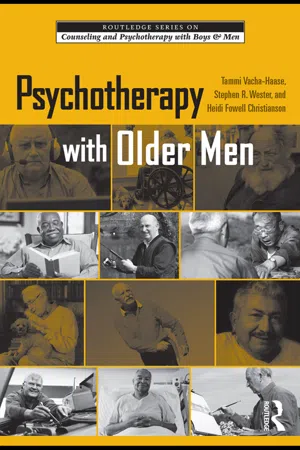
eBook - ePub
Psychotherapy with Older Men
- 214 pages
- English
- ePUB (mobile friendly)
- Available on iOS & Android
eBook - ePub
Psychotherapy with Older Men
About this book
Information
CHAPTER 1
Life as an Older Man
Richard Donovan, age 70, was the older of two children. His sister, age 55, now lived in a different state, and his parents had recently died. Mr. Donovan never married, instead devoting 45 years of service to the local high school, first as an English teacher and later as the principal. Described by his colleagues as gentlemanly and civil, Principal Donovan valued rules and procedures that served him well in his academic roles. He could be a perfectionist at times, based on his belief that high standards were needed to mold children into proper adults. Colleagues, as well as parents of students, often noted he could be rigid and controlling. To fill his days after retirement, Mr. Donovan decided to volunteer at the high school where he had served so long. However, this experience did not go well; he often tried to take over projects and was described by other volunteers as bossy and domineering. Mr. Donovan became easily offended by what he called the inefficiency of the other volunteers. This would be followed by a ranting discourse on how the younger generation had deteriorated, exhibiting behaviors that would not have been tolerated while he was principal. Mr. Donovan had long been accustomed to having people serve him in his personal life; being unmarried, he hired people to clean and cook for him. Interested in academic pursuits, he retained a handyman and a mechanic to complete lawn care and car repair. However, as his health deteriorated, Mr. Donovan began to demand the same servile treatment from professionals in the health care system. He was often frustrated, as he believed the health care providers did not “put forth their best efforts” and were “unresponsive” to his needs. When confronted, Mr. Donovan became more demanding of those around him, which led to many health care workers avoiding him in response to his sharp criticism.
How would Mr. Donovan best be understood and his behavior described? Is he simply a demanding, grouchy old man who wants his own way? Is his behavior reflective of outdated standards and a sense of patriarchal entitlement? Or are his actions somehow related to a values system, stemming from both his gender and the time period in which he was born?
Growing up and growing old in the United States involve expected rites of passage and unique challenges that provide an important context for understanding, conceptualizing, and ultimately providing psychotherapy for older men. Thus, to conceptualize older male clients, the therapist must be aware of the multitude of factors involved in the individual man’s development, both historically and in more recent events.
Mr. Donovan learned what society expected of him as a man during a very specific time in this country’s history. That is, Mr. Donovan was born into World War II, experiencing his teenage years and early adulthood during those postwar years. The zeitgeist of that time shaped his attitudes and values, as well as his expectations for himself as a man and the world around him. During his adulthood, Mr. Donovan was able to build a successful life and career around those expectations. However, these same values and “rules of behavior” now seem to be interfering with his current functioning; he appears to be unaware that the behaviors that were once valuable to him and adaptive to many situations throughout his life are no longer allowing him to be successful in his current stage of development and life circumstances.
Thus, the life of an older man can be understood only through an integration of gender, age, cohort, and individual personality characteristics. Not doing so, conversely, runs the risk of dismissing both a lifetime of experience and a rich history. Psychotherapy with older men such as Mr. Donovan should begin with an integration of basic knowledge of masculinity, including masculine scripts and male socialization, as well as the aging process, such as normal versus pathological aging, fact versus fiction, and stereotypes. Contextualization of older men’s experiences is a necessary requirement for understanding the complex clinical presentation of older men and a key to providing gender, cultural, and generationally appropriate care.
MASCULINE SCRIPTS
Mahalik, Good, and Englar-Carlson (2003) detailed seven “masculine scripts” (p. 124) that often arise during the course of psychotherapy with male clients. The “strong and silent” (p. 124) script stresses the importance of being stoic and unemotional, lest men be labeled as less manly than their peers. The “tough-guy” (p. 124) builds on this idealized script, stressing the suppression of emotions so as to be called “tough in the face of pain” while also responding to situations through physical prowess. The “give-’em-hell” (p. 125) script, conversely, downplays emotions and instead focuses on the importance of physical action or violence as a method of achieving goals. For example, from early in childhood, boys are often taught that fighting with others is a means to an end, required to build character that is critical to successful manhood. Emotions in this context are acceptable, as long as they do not convey vulnerability. The outcome of following these scripts for decades is commonly exhibited in older men; a lower range of emotional expression, with the exception of anger or aggression, becomes the preferred mode of communication.
Consider the time frame in which Mr. Donovan came of age. He was born in 1940, and his early childhood was characterized by World War II and the sacrifices made during that campaign. He may have had a family member serving in the war, or perhaps he had family contributing on the home front, through the USO or other volunteer organizations. Certainly the civilian population cut back on many things to support the troops, including having rubber drives and recycling campaigns and rationing, and also lived with lower incomes because of family members serving. This environment would likely instill many values consistent with the strong and silent and tough guy scripts. Complaining, for example, would be seen as inappropriate, and the expression of any disappointment or sadness would be stifled, as one would quickly be reminded that those fighting overseas had it much worse. These views would continue to be reinforced even after the war ended, as soldiers returned home, many of them burying their experiences. The societal norm indicated that war experiences were not to be talked about, and everyone was to move on with life (Winters, 2006). In sum, Mr. Donovan, like the other boys and men, was taught not to demonstrate sensitivity or express tender emotions; signs of weakness or presentation of vulnerability were not acceptable.
Two additional male scripts center on the importance of sexuality, and specifically heterosexuality, in a young boy’s life. The “playboy” and “homophobic” scripts refer to the expectation that so-called real men are sexually active, often in a nonrelational fashion. Virility is associated with masculinity and of greater value than tender relationships focused on feelings other than those of a physical nature. Building on the implications of the playboy script, the “homophobic” script (Mahalik et al., 2003, p. 125) stresses the absolute nature of relationships with others, especially men. From the playboy perspective, close and caring relationships are not important and exist only as a means to obtain physical pleasure. Between men, therefore, such intimate relationships cannot develop because of potential appearances of homosexual intentions. The expression of love for siblings, friends, and even fathers becomes difficult if not impossible. Early learning of these scripts can cause older men considerable challenges given physical sexual changes in later life, when sexual relations become less of a central feature in their lives. In addition, with age, the father and son relationships may evolve, as do peer interactions, leaving questions about how to approach such change within the context of previously embraced masculine scripts.
Another two scripts draw on the importance of success and achievement in a man’s life. The “winner” and “independent” scripts (Mahalik et al., 2003, p. 126) describe how messages regarding masculinity across the life span associate being male with victory over adversity and obstacles in life; this also includes defeating other men, formal competition or not. Men are generally expected to achieve victories independently, without the need of assistance from others. Indeed, the image of John Wayne as Shane and Clint Eastwood as The Man With No Name each riding out to face their fate alone is etched into the fabric of modern Euro-American culture. These images communicate the importance of individual accomplishments, with men being encouraged to be independent, focusing on hard work, physical strength, and emotional restraint to attain success in life.
Mahalik and his colleagues stressed that many of these scripts are adaptive to men, either when they are enacted flexibly or when they are considered contextually valid. For example, men who are able to switch between a tough guy script on the job and a deeper emotional availability at home are far less likely to encounter difficulties. How men experience the world, as well as their ultimate social scripts and roles, is intertwined with the social, political, and cultural advances of their time. Addis and Mahalik (2003) offered a social constructionist perspective to understand this process. In brief, a man’s contexts are an environment in which he constructs the scripts that guide his understanding of what it means to be a man. Thus, for some men and under some conditions, certain behaviors are adaptive and appropriate; however, under different conditions or for different men, those same behaviors interfere with functioning. Consider Mr. Donovan. His value system and the behaviors it promoted were contextually understandable and adaptive during his adult life. However, at a later stage of life, when he was no longer employed and in charge and was beginning to experience a decline in his health, those same behaviors actually interfered with his functioning and ability to be successful in his environment.
Thus, when working with older men, therapists will find it particularly important to assess and identify their cohort-related experiences and belief systems, not as pathology but as a sign of socialization. The process of psychotherapy involves understanding older men through their eyes, gaining a sense of their needs from their lived experiences and the scripts they embrace. Older men are individuals who have been shaped by distinct social and cultural movements and who are experiencing age-related, developmental aspects of the life span.
Older men, for example, undergo physical changes and increasing health issues related to aging and the cumulative effect of chronic illness, psychological challenges, social stereotypes (e.g., ageism, devaluation), and cohort-related socialization. Mr. Donovan is merely one example of this interaction of cohort-specific expectations and deteriorating health conflicting with the belief systems of those around him. His inability to switch from male scripts that most likely helped him to succeed in his professional career is now hindering his forming positive relationships in his retirement, as well as the ability to obtain medical care.
DISENGAGEMENT THEORY
Disengagement theory (e.g., Cummings, Henry, & Damianopoulos, 1961) is well positioned to explain the experiences of older men. In one example, Cummings and Henry argued that men have an instrumental role in society that is primarily associated with their employment; a point that Mahalik and colleagues would have agreed with given their narrative on both the winner and the independent scripts. When the job ends, often in the form of retirement, older men transition to a period of life associated with less participatory involvement. This results in a circular process, in that less involvement means fewer interactions that might also contradict the push to disengage.
Older men may be prone to the disengagement process given their socialized tendency to avoid the expression of tender emotions (e.g., the tough guy and the strong and silent scripts) required to form the close interpersonal ties that might resist disengagement. Consider that Mr. Donovan’s interpersonal difficulties did not become readily apparent until after he retired and decided to return to the school system as a volunteer.
Admittedly, disengagement theory is not without its critics (e.g., Hill, 2005), and the use of such a pessimistic theory to explain the experiences of older men might seem anathema. However, in many ways societal views regarding older men reinforce the idea that disengagement not only occurs but is both expected and encouraged. Cultural images attribute expectations of strength, intelligence, and status to younger men while suggesting that older men are incompetent, infirm, and an undesirable distraction on the busy lives of their adult children. Such ageism is a widely accepted phenomenon that broadly explains a series of inappropriate evaluations, stereotypes, and implicit social messages negatively characterizing men in their later years of life.
SOCIAL STEREOTYPES: AGEISM AND DEVALUATION
Many people in advancing age may resist identification with the older adult identity or change their physical appearance (Jones & Pugh, 2005) in an attempt to maintain a sense of culturally relevant personal identity and competence. Katz and Marshall (2003, 2004) argued that older adults, both men and women, experienced pressure from a culture driven by pharmaceutical products encouraging hormone replacement and revitalized sexual functioning. Unfortunately, a side effect of pharmacological marketing interventions targeted at maintaining sexual virility in older men can have the negative impact of reinforcing gender-specific expectations throughout late life where men are expected to continue to be strong, powerful, and sexually driven (Marshall & Katz, 2006).
The Healthy Aging Movement
The healthy aging movement, for all of its positive encouragement of healthy behavior and positive physical and cognitive activity, has also been strongly criticized as an ageist conceptualization of later life. Advertisements encouraging sexual virility, unwrinkled skin, mountain biking in late life, and keeping active regardless of circumstances provide implicit cues to younger and older people that one must actively prevent the determents of aging. This image is to support active aging, in contrast to becoming a feeble, frail, dependent, helpless older adult. Unfortunately, these subtle social messages do not account for the likelihood that growing old can sometimes result in the occurrence of illness and disability in the absence of amoral behavior, leaving much room for older and younger individuals alike to negatively evaluate and subsequently dismiss physically, cognitively, and emotionally ill elders.
Scholars have also criticized the current social construction of aging. Katz and Marshall (2003) argued that the healthy aging movement, encouraging individuals to combat decreases in functioning, changes in physical appearance, and changes in lifestyle to “successfully age,” is blaming and negative toward older adults. Specifically, if one has an illness or lives with a functional impairment or disability, the healthy aging movement subtly indicates that this is due to a character flaw of the individual rather than to a natural decline associated with aging. Within the healthy aging movement, older adults are personally responsible to maintain a risk-averse lifestyle, and if they do happen to experience illness or disability, there must be a personal flaw worthy of significant blame. Marketing targeted toward sustaining youth, physical, functional, sexual, and cognitive, provides the implicit message that one has the tools to maintain health and not age. As a result, older adults may engage in behaviors, activities, and attitudes to preserve their gender and age-related social status (Calasanti & King, 2007).
Social Messages to Men
In an analysis of the differential representation of men and women in anti-aging discourse, Calasanti and King (2007) found current social messages men receive about aging suggest that masculinity is biologically and hormonally based, with more testosterone being less feminine and elderly. Loss of testosterone and an increase in estrogen level is readily equate...
Table of contents
- The Routledge Series on Counseling and Psychotherapy With Boys and Men
- Contents
- Series Foreword
- Preface
- Acknowledgments
- CHAPTER 1 Life as an Older Man
- CHAPTER 2 Gender and Aging
- CHAPTER 3 Therapeutic Considerations in Working With Older Men
- CHAPTER 4 Transitions and Life Adjustments
- CHAPTER 5 Depression
- CHAPTER 6 Anxiety
- CHAPTER 7 Health, Chronic Physical Illness, and Disability
- CHAPTER 8 Management of Substance Use and Abuse
- CHAPTER 9 Cognitive Impairment
- CHAPTER 10 Concluding Thoughts on Psychotherapy With Older Men
- APPENDIX: RECOMMENDED RESOURCES
- REFERENCES
- INDEX
Trusted by 375,005 students
Access to over 1.5 million titles for a fair monthly price.
Study more efficiently using our study tools.
Frequently asked questions
Yes, you can cancel anytime from the Subscription tab in your account settings on the Perlego website. Your subscription will stay active until the end of your current billing period. Learn how to cancel your subscription
No, books cannot be downloaded as external files, such as PDFs, for use outside of Perlego. However, you can download books within the Perlego app for offline reading on mobile or tablet. Learn how to download books offline
We are an online textbook subscription service, where you can get access to an entire online library for less than the price of a single book per month. With over 1.5 million books across 990+ topics, we’ve got you covered! Learn about our mission
Look out for the read-aloud symbol on your next book to see if you can listen to it. The read-aloud tool reads text aloud for you, highlighting the text as it is being read. You can pause it, speed it up and slow it down. Learn more about Read Aloud
Yes! You can use the Perlego app on both iOS and Android devices to read anytime, anywhere — even offline. Perfect for commutes or when you’re on the go.
Please note we cannot support devices running on iOS 13 and Android 7 or earlier. Learn more about using the app
Please note we cannot support devices running on iOS 13 and Android 7 or earlier. Learn more about using the app
Yes, you can access Psychotherapy with Older Men by Tammi Vacha-Haase,Stephen R. Wester,Heidi Fowell Christianson in PDF and/or ePUB format, as well as other popular books in Psychology & Developmental Psychology. We have over 1.5 million books available in our catalogue for you to explore.