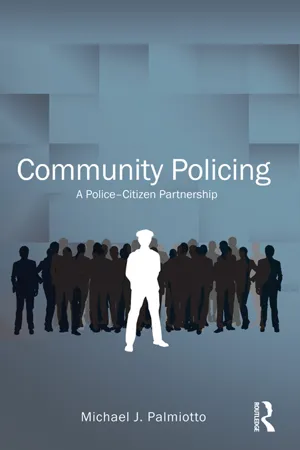
This textbook discusses the role of community-oriented policing, including the police image, public expectations, ethics in law enforcement, community wellness, civilian review boards, and what the community can do to help decrease crime rates. In addition, the author covers basic interpersonal skills and how these might vary according to the race, sex, age, and socioeconomic group with which the officer is interacting. Finally, students learn how to initiate new programs in a community, from the planning process and community involvement to dealing with management and evaluating program success.
- 376 pages
- English
- ePUB (mobile friendly)
- Available on iOS & Android
eBook - ePub
About this book
Information
1
POLICE HISTORY RELEVANT TO COMMUNITY POLICING
CHAPTER OBJECTIVES
- Understand why knowledge of police history is important for understanding policing today.
- Be familiar with the crime-fighting image of policing.
- Be familiar with police issues of the 1960s.
- Be familiar with governments’ influence on policing in the 1960s.
- Be familiar with the concept of police professionalism.
- Be familiar with the various eras of policing.
Introduction
The philosophy of community policing is being advanced as the new policing system for the twenty-first century. How can police administrators, leaders, or students of policing support or even understand the value of and need for community policing in our contemporary world if they lack knowledge of where police have been? How can effective decisions and policies be implemented if those politicians and police administrators making decisions have no knowledge or understanding of police history? Formal policing as we know it today is relatively new, being less than two centuries old. Knowledge can be gained from familiarity with the historical role the police have played in society. This holds true even though the history of policing is sketchy and the variety of roles the police have played in the past have not all been documented. There does appear to be sufficient information of value to modern-day police. For example, anyone familiar with policing or police officers often hears the claim that they are not social workers, but in the late nineteenth century and early twentieth century, the police performed tasks that are currently per formed by social service agencies, including finding jobs for the unemployed, operating soup kitchens, and using the police station as a night shelter.
Politicians and police administrators, along with police supporters and students of policing, should understand the history of policing, including its various strategies and police methods, if they hope to have an impact on the field. Police decision makers with a knowledge of the various police roles and tactics used throughout history should be in a better position than those with no or limited knowledge of police history to improve policing or at least avoid some of the problems that have occurred in the past.
American Policing
The Metropolitan Police Act of 1829 that established the London police force became the model for American policing. The New York City Police Department is often credited for initiating the modern police department in America in 1845. Before that time, American peacekeeping strategies were similar to those of the English. Boston founded the first night watch in America in 1634; it consisted of six soldiers and an officer. Two years later, a town watch, consisting of townspeople and not military personnel, was initiated to keep the peace. This system lasted until 1712, when Boston voted to pay their watchmen (Bopp and Schultz 1972, 17–18). Charlestown in 1680 and Philadelphia in 1682 appointed constables who had responsibilities similar to those of their English counterparts. As in England, county governments appointed sheriffs as their primary peace officers, and it was an obligation of citizens to serve as watchmen and constables (Johnson 1981, 5).
The American Revolution
During the American Revolutionary War, peacekeeping was maintained by troops, who were English or American, depending upon who occupied the area. After the war, peacekeeping reverted back to civilian control. Providence, in 1791, retained 12 night watchmen to take over the public safety duties performed by the militia. In 1801, Boston became the first city to mandate that permanent night watchmen be employed. That same year, Detroit hired its first civilian police officer. More and more civilian peacekeepers were being employed after the Revolutionary War because of the growth of cities and the increase in crime associated with them (Bopp and Schultz 1972, 25–28).
Traditional peacekeepers—sheriffs, constables, and night watchmen—were unable to control crime occurring in American cities. The crime during this period consisted of violence, riots, and vice. Modern America still has these problems, but today the responsibilities to solve them have been given to community policing officers.
To regulate Philadelphia’s crime problem, Stephen Girard, upon his death, left the city of Philadelphia financial resources for public safety. With the Girard money, Philadelphia established a day force of 24 police officers and a night force of 120 night watchmen. Maintaining separate day and night watches created difficulties in peacekeeping. Recognizing this, New York legislature unified the day and night watches of the New York City Police Department in 1845. New York City had the first unified police force in the United States, modeled on the London Metropolitan Police Department. The combining of day and night patrols became the model of American police departments (Bopp and Schultz 1972, 33–38).
Modern policing developed in America during a period marked by disorder and violence. Most American cities experienced mob disorder. A variety of factors appear to have contributed: conflicts of native Americans with Irish and German immigrants; racial conflict, with whites attacking abolitionists and free blacks; economical disasters, which led mobs of financially ruined investors to attack banks and employees to destroy the property of their employers; attempts to solve issues of morality, as when brothels were attacked as a means of cleaning up the city; and political conflicts, as in the case of the frequent mob riots on election days in major cities such as New York, Philadelphia, and Baltimore. It was generally left to the militia to suppress riots. The series of major riots in American cities led to the establishment of the “new police,” the forerunner of our contemporary police departments (Walker 1977, 4–5).
The New Police
Unlike our police of today, the “new police,” when first formed in New York City in 1845, did not wear uniforms or carry firearms. Not until the mid-1850s did New York City require police officers to wear uniforms. Eventually, the requirement that officers wear uniforms was adopted by other cities. Firearms began to be used in the 1840s. Without formal approval, police officers began carrying them to protect themselves from armed thugs. Eventually, the cities gave formal approval for police officers to carry firearms. Today, we expect police officers to be armed and to wear uniforms.
During the nineteenth century, city populations increased substantially. Cities that were hamlets grew into urban centers. Industrialization increased the demand for workers. Cities grew substantially, with immigrants arriving from foreign countries. There was also a migration from the farms to the cities. This influx of population into cities affected policing in three ways. First, it increased the geographical size of the cities enormously to accommodate this influx and thus the police were unable to maintain a suitable presence on the city streets. Second, the poor crowded into overflowing neighborhoods where they could afford the rents. Overcrowded neighborhoods became slums where violence and tensions commonly occurred. Third, thousands of various ethnic, national, and racial groups were living in close quarters. These included blacks, Irish, Germans, Scandinavians, Italians, Poles, and Jews (Johnson 1981, 36).
Changes in Policing
Policing in American cities during the nineteenth century was primarily decentralized and neighborhood oriented. The major dilemmas of the policing model were corruption, inefficiency, incompetence, and political influence. A number of Americans wanted to see improvements in American policing, and eventually there were attempts to improve the administration of police departments. The first attempt to control city police departments was in New York State in 1857. Based on the claim that New York City was too corrupt to govern itself, the state legislature passed a law—the Metropolitan Police Bill, modeled after Sir Robert Peel’s London Metropolitan Police Bill—that placed the New York City Police Department under state control by putting it under the supervision of a board appointed by the governor. State control of police departments spread to other states: Baltimore in 1860, St. Louis and Chicago in 1861, Kansas City in 1862, Detroit in 1865, and Cleveland in 1866. There was some opposition to this development. In addition, there was a lack of uniformity in controlling police agencies throughout the state (Fogelson 1977, 43–44).
Around the turn of the century, the Progressive movement emerged as a voice to improve city government, including policing departments. This movement reflected upper-middle-class concerns to safeguard the honesty of public officials, establish uniform standards, and operate by well-defined regulations and procedures (Johnson 1981, 67). A city police department in which each captain responded to his neighborhood’s customs could not expect to possess uniform standards. Disorder and drunkenness were acceptable among some ethic groups, and the police who recruited from these ethnic groups looked the other way when minor offenses were committed. A tolerance toward brothels, public intoxication, and rowdiness was not acceptable to the upper classes of America’s cities. Police critics of this period supported scientific management and the hiring of specialists to solve a city’s problems. They were disturbed not only by the lack of uniform police standards but also by the lack of discipline and efficiency and the poor quality of police personnel.
The National Prison Association, founded in 1870, championed civil service, police training, and a nonpartisan police department through its Standing Committee on Police. However, changes in policing come slowly. Civil service was adopted by New York City in 1883 and by Chicago in 1895. A major crusader for police change in New York City was the Reverend Charles Parkhurst, president of the Society for the Prevention of Crime. Parkhurst charged that police corruption and vice were rampant in New York City. His campaign led to the New York legislature establishing the Lexow Commission in 1849 to investigate police activities. The commission found political interference with the police process, police connivance with criminals, and police payoffs for appointments and promotions (Johnson 1981, 66–67).
An outcome of the Lexow Commission was the creation of a four-member board of police commissions for New York City. Theodore Roosevelt was appointed president of the board and served a two-year term. Roosevelt worked to improve the quality of police recruits, raise standards of police performance, and curtail corruption. The crime-fighting image of the police was projected under Roosevelt’s tutelage through awards of medals and certificates to patrolmen for specific acts of bravery. Roosevelt’s purpose was to motivate the rank-and-file patrolmen to be productive (Walker 1977, 46). Although the image of police as crime fighters was not accurate, it persisted and is still with us today. Even today, there are police chiefs who sell policing to politicians and the public by arguing that the police are crime fighters. This myth is even believed by some rank-and-file police officers. However, the community policing philosophy runs counter to the crime-fighting image. Community policing officers are problem solvers who work in partnership with neighborhood residents to solve crime and disorder problems.
The Crime-Fighting Role
Critics of policing in the nineteenth century advocated police training; the elimination of corruption, police brutality, and inefficiency; and the removal of politics from police affairs. Nineteenth-century police officers, as mentioned earlier, were expected to perform activities not normally associated with policing, including charity work, street cleaning, and boiler inspection. Critics believed that such assignments distracted police from their crime-fighting task and diminished the image of the police. Their goal was to professionalize the police, and they felt that this could best be accomplished by giving the police the new image and goal of crime fighting. Police chiefs in America readily accepted that police should be primarily crime fighters. The foremost change agent for improving police departments in the first half of the twentieth century was a strong advocate of the crime-fighting mission. August Vollmer, who began his police career as a town marshal in Berkeley, California in 1905, and ended up being police chief there until 1932, is credited with being the chief spokesman for the professionalization of the police and their training in the science and technology of all aspects of crime-fighting work (Carte and Carte 1975, 2).
With Vollmer and other police chiefs advocating crime fighting as the most important mission of police, it did not take long before this philosophy became ingrained in the police culture. Crime fighting was sold as the primary function of the police, even though crimes such as homicide, rape, and assaults are usually not preventable by the police and are often not even solved. The philosophy of crime fighting is reflected in those departments that still do “bean counting,” or counting the number of arrests that each officer makes. In some police departments, officers are rewarded for what are considered “good arrests,” or arrests for which there is sufficient evidence to obtain a conviction.
The police have difficulties in implementing their crime-fighting philosophy when the community refuses to cooperate with them in providing information about drugs, gambling, or prostitution and when they are dealing with juvenile gangs. To be successful in fighting crime, they must decide which crime or crimes their resources should be concentrated upon.
While Vollmer was president of the International Association of Chiefs of Police in 1922, he made a number of recommendations. He suggested that police departments began employing clerks, typists, photographers, and other professionals such as identification experts. He also supported lateral entry for police officers, claiming that the system of requiring all police officers to work their way up through the promotional process was inadequate. Vollmer had nine additional recommendations for improving policing and the criminal justice process:
- Increased use of policewomen, especially in the “vast field of pre-delinquency.”
- Police schools for training purposes, wherein the content “may vary slightly in different communities, but the fundamentals in the police school curriculum should be identical in all departments.”
- Modern equipment, such as signal devices, wireless telephony and telegraphy, automobiles, motorcycles, motorboats, and laboratory apparatus. We must be prepared to meet the criminal with better tools and better brains than he possesses if we hope to command the respect of the community that we serve.
- Greater emphasis on crime prevention as our principal function.
- More police contribution toward solving the problem of unnecessary delay and miscarriage of justice in criminal trials.
- Uniform national and even international laws, uniform classification of crimes, simplified court procedures, better methods of selecting and promoting properly trained jurist and modern requirements.
- Abandonment of trial-and-error methods of crime solving for more efficient scientific techniques and crime laboratories, enlisting the aid of microscopists, chemicals analysts, medico psychologist, and handwriting experts.
- Centralized and improved methods of maintaining police records. A bureau of records, if properly organized, is the hub of the police wheel.
- Petitioning of universities to devote more time to the study of human behavior and its bearing upon political and social problems and to the training of practical criminologists, jurists, prosecutors, policemen, and policewomen.
(Carte and Carte 1975, 56–57)
The crime-fighting model did establish the image of the American police as trained professionals who concentrated on solving crimes and had the skills to control crime i...
Table of contents
- Cover
- Half title
- Title Page
- Copyright
- Table of Contents
- Series Foreword
- Preface
- 1. Police History Relevant To Community Policing
- 2. Understanding Police Culture
- 3. Police Discretion, Police Misconduct, and Mechanisms To Control Police Misconduct
- 4. Concepts, Strategies, Experiments, and Research Findings That Have Influenced Community Policing
- 5. Communities and Neighborhoods
- 6. Multiculturalism and Organizational Change
- 7. Crime Prevention and Community Policing
- 8. Problem-Oriented Policing
- 9. Community-Oriented Policing
- 10. Planning the Implementation of Community Policing
- 11. Selected Approaches to Training and Planning
- 12. Distinctive Community-Policing Programs
- 13. The Future of Community Policing
- References
- Index
Trusted by 375,005 students
Access to over 1.5 million titles for a fair monthly price.
Study more efficiently using our study tools.
Frequently asked questions
Yes, you can cancel anytime from the Subscription tab in your account settings on the Perlego website. Your subscription will stay active until the end of your current billing period. Learn how to cancel your subscription
No, books cannot be downloaded as external files, such as PDFs, for use outside of Perlego. However, you can download books within the Perlego app for offline reading on mobile or tablet. Learn how to download books offline
Perlego offers two plans: Essential and Complete
- Essential is ideal for learners and professionals who enjoy exploring a wide range of subjects. Access the Essential Library with 800,000+ trusted titles and best-sellers across business, personal growth, and the humanities. Includes unlimited reading time and Standard Read Aloud voice.
- Complete: Perfect for advanced learners and researchers needing full, unrestricted access. Unlock 1.5M+ books across hundreds of subjects, including academic and specialized titles. The Complete Plan also includes advanced features like Premium Read Aloud and Research Assistant.
We are an online textbook subscription service, where you can get access to an entire online library for less than the price of a single book per month. With over 1.5 million books across 990+ topics, we’ve got you covered! Learn about our mission
Look out for the read-aloud symbol on your next book to see if you can listen to it. The read-aloud tool reads text aloud for you, highlighting the text as it is being read. You can pause it, speed it up and slow it down. Learn more about Read Aloud
Yes! You can use the Perlego app on both iOS and Android devices to read anytime, anywhere — even offline. Perfect for commutes or when you’re on the go.
Please note we cannot support devices running on iOS 13 and Android 7 or earlier. Learn more about using the app
Please note we cannot support devices running on iOS 13 and Android 7 or earlier. Learn more about using the app
Yes, you can access Community Policing by Michael J. Palmiotto,Michael Palmiotto in PDF and/or ePUB format, as well as other popular books in Politics & International Relations & Criminology. We have over 1.5 million books available in our catalogue for you to explore.