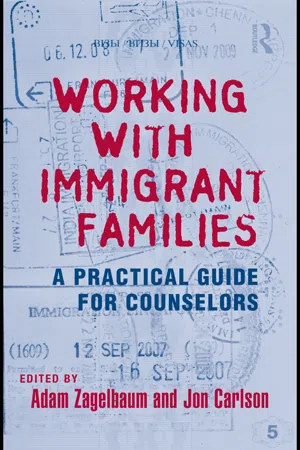
eBook - ePub
Working With Immigrant Families
A Practical Guide for Counselors
- 296 pages
- English
- ePUB (mobile friendly)
- Available on iOS & Android
eBook - ePub
Working With Immigrant Families
A Practical Guide for Counselors
About this book
This book aims to create a foundation that respects theory, culture, and the mental health professions and to initiate the practical and needed discussions about how to work with immigrant families.
Information
Chapter 1
Orientation to Working With Immigrant Families
Adam Zagelbaum and Jon Carlson
Contents
Issues That May Be of Common Consideration for Working With This Population 4 | ||||
Immigration Defined 6 | ||||
Refugees and Asylees 7 | ||||
Naturalization 8 | ||||
Immigrant Family Needs 9 | ||||
Roles of the Therapist 10 | ||||
Race, Ethnicity, and Culture 13 | ||||
The Concept of Family 14 | ||||
Text Overview 14 | ||||
Conclusion 18 | ||||
Discussion Questions 19 | ||||
References 19 | ||||
Mr. A, a 45-year-old businessman from Africa, immigrated to the United States with his wife, Ms. A, and their three children, X (16), Y (14), and Z (13), four years ago. Mr. A wanted to establish himself in America, in the hopes that he could achieve the “wealth of the American dream.” There were severe gaps between rich and poor, as well as great tensions, within his native country’s caste system. He viewed America as a n opportunity to “escape” the slow growth and progress made within his community and to provide his children with “greater opportunities to learn and achieve success.” Visitors from church groups and universities had shown him how the American dream could be possible for him and his family. Ms. A stood by her husband’s decision to move, even though the children were less than enthusiastic about leaving close friends behind. Mr. A believed that the church and university he was admitted to would help everyone with this transitioning process.
When he began his initial work at the university’s accounting program, Mr. A found himself putting significant amounts of time and energy into his studies, which kept him away from his family during many hours of the day. He remained at the university from what appeared to be sunrise to “pitch black” for nearly every weekday. Though he was respected for his knowledge and determination back home, Mr. A found some of the people within the university to be somewhat “controlling” and “demanding,” whereas he had been accustomed to making most of his decisions without questions. His children had not adjusted well to the move, as his eldest son, X, was placed into a juvenile detention center for participation in a theft from a neighbor’s home. His youngest son, Z, was also getting into trouble at the local middle school for not listening to the teachers and not following the orders of administrators. The daughter, Y, was close to her mother and seemed to be diligently following the wishes of both parents to behave properly and do well in school. Mr. A believed that it was the community’s responsibility to work with him and his family, especially because the communal approach was commonplace for everyone in his home country. Many of the interactions that he would have with schoolteachers, administrators, and university staff would be perceived as confrontational because of the fact that Mr. A was identified as “unwilling to take responsibility” for his children’s actions. Some of his younger university classmates would also perceive Mr. A as “bossy” and “condescending” because he would often speak in class from what they perceived to be an “expert” view. The communal viewpoint and collectivistic worldview became a problem for the individualistic people Mr. A would encounter in America. Though members of the local church and some neighborhood friends would assist Ms. A with matters from time to time, the boys were largely unsupervised on a consistent daily basis. Frustrated and stressed from the pressures of his academic responsibilities, Mr. A would have a difficult time during parent–teacher conferences where negative behaviors of his youngest son would be discussed. He believed his intelligence and abilities as a father and student were constantly being doubted, and he saw the school staff as “insulting” people who were calling his child “mean and delinquent.” It seemed that they were viewing Z as someone likely to follow the path of his oldest brother, and Mr. A was angered and hurt that he appeared to be viewed as the main cause.
Ms. A appeared to be in a difficult position herself, often becoming teary during these school encounters and upset that her husband would be upset. She appeared hurt that she could not “keep order” among her sons like her husband could but also knew that her husband had to do his best to succeed in school. She was often too upset to speak.
Mr. A would continue to call Z’s school counselor as a way of trying to monitor the situation brewing with his son at school. He also agreed to have his eldest son placed into an alternative school, in hopes that this would remedy the situation. Mr. and Ms. A believed that these actions would be able to “get them through” these situations, so that Mr. A could complete his schooling and be able to work at a “regular job” that would allow for more time to be spent with his family. Ms. A was eventually able to find some temporary work as well, to become more active in the community and befriend more people.
Unique Influences on the Client. Mr. A, though clearly a talented and gifted individual, had both significantly high academic expectations within the university to perform well and high interpersonal expectations among staff and faculty of his sons’ public schools to properly “adjust” his children’s behaviors. These were pressures not placed on Mr. A in his country of origin. Mr. A became highly defensive and agitated when most school officials would strongly recommend that his children be placed in alternative settings, because it indicated a lack of concern or interest in aiding Mr. A with his personal and family issues. He believed people were not able to see his strengths and abilities and were looking for faults within his children to corroborate these negative beliefs.
I (Adam) first encountered Mr. A while I was an intern, and his son, Z, was referred to me for his school-based disciplinary issues. Up until this point in my professional life, I mostly gathered information from teen clients to assess interpersonal issues, as well as ways in which their academic goals could be better reached in accordance with school guidance concerns. I worked with Z for about eight sessions. Of which, about four included interactions with Mr. A and another two included Mr. and Mrs. A.
Working with Mr. A demonstrated to me the fact that certain aspects of the American educational system, as well as acculturating to American communities, were difficult for immigrants to work with. Though Mr. A and his family were capable of learning English as a second language and were respected for their hard work in terms of individual successes such as gaining admittance into graduate school, and being able to find individual work, they were not viewed by their children’s schools as a well-functioning family unit. This individualistic way of thinking leads highly educated and experienced immigrants like Mr. A to believe that people are looking for faults within the family. Many of the issues regarding his sons that Mr. A was being challenged on appeared to be beyond his sole responsibility. Immigrants like Mr. A are not always informed of how deep the individualistic mode extends when dealing with assessment and treatment of behavioral and psychological concerns.
Working in the school counseling intern and school counselor roles, I encountered other immigrant clients like Mr. A even when I was working in different regions of the United States. There were many people who achieved well educationally and socially within their countries of origin but were not viewed as talented and capable individuals when their children were having difficulty following directions or maintaining on-task behaviors in classrooms.
The experience underscored the frustrations that communalistic clients often experience with individualistic values, which create a circle of finger-pointing and defensiveness when disciplinary issues arise. One important lesson I learned from working with Mr. A and his family was that men can experience extreme disadvantages within their family and social interactions when faced with this clash of individualistic and communalistic values. Being targeted as an ineffective parent, along with the stresses and strains of needing to perform well in graduate school, creates a sense of global failure for the individual who was previously viewed as an effective contributor to the village. The A family found financial assistance for family therapy, which they were able to receive at a nominal fee as a result of Mr. A’s status as a graduate student. It would later uncover some key issues for Mr. A and his family. Mr. A had reduced contact with his family because of his academic pursuits in the first place. When he was spending time with his family, he was focused on how to deal with the failures of his sons, which further reinforced how Mr. A had been struggling within his roles as a worker and a father. His wife was also challenged to become more involved with the issues of X and Z, suggesting that she was not working hard as well to make things more manageable. The loss of communal perspective and spotlighting of individual shortcomings that Mr. A had been experiencing forced him to reach out to others, which was a different circumstance of obtaining community resources than he would normally have done in his native country. Nevertheless, it did allow him and his family to better cope with his son’s issues that arose during the resettlement process.
Issues That May Be of Common Consideration for Working With This Population
The importance of recognizing the “person as community” as well as the communal worldview cannot be understated in this case. Cohen (2009) implored psychologists to consider many forms of culture that include variables such as religion, socioeconomic status, and region within a country to better address how similarities and differences can allow for clients and mental health professionals to most effectively work together. The American mind-set of individualism does not allow for many to understand that sometimes it actually does “take a village to raise a child.” Although many have heard this saying, just hearing the saying does not always translate into fundamental action and/or understanding of what it means to have a shared responsibility for the development and adjustment of a child. Many theoretical assertions have often placed primary responsibility on the parents when a child misbehaves and can devalue the strengths of the family system when doing so.
Ogbonnaya’s (1994) concept of the person as community takes into account that individuals are the product of past relationships with family, groups, and institutions. When this concept is coupled with Amir’s (1992) notion of the contact hypothesis, counselors are encouraged to start their work with positive expectations of a group or family to recognize the strengths and effective aspects they possess. In doing so, resistance among participating clients is likely to be minimized, and a better working alliance can be formed.
For example, another family that I encountered was the B family, which was from Asia. The family was composed of a husband, wife, eldest son in high school, and younger daughter in middle school, almost identical to the A family. The family members also followed a collectivistic norm in that they focused on each other’s needs more than any one of their own. If the mother was sick, it was the son’s and daughter’s duty to care for her while the father would be at work. It is not an uncommon practice for children to miss school for such a reason. Many Americans do not understand this concept and often view this as a poor practice that hinders the educational rights of the children. This is yet another issue that immigrant families encounter when they demonstrate values that go against the lifestyle norms of the United States. Fortunately, as a result of learning this concept and seeing the collectivistic strengths of this family system, many teachers and administrators at the B children’s schools were able to make alternative arrangements for homework assignments and missed days of academic work, which would eventually allow for the children to catch up on assignments and lessons, which allowed them to remain on pace with their peers. The social stressors of fitting in at school and within the community were also that much more easy for the B family members to process during the course of family therapy because of the positive contact that they had with the therapist, who understood their system in a way that was not “weak” or “anti-American.”
The members of the C family, who were devout to their Islamic heritage, woul...
Table of contents
- The Family Therapy and Counseling Series
- Contents
- Series Editor’s Foreword
- Preface
- Contributors
- Chapter 1 Orientation to Working With Immigrant Families
- Chapter 2 Theories of Acculturation and Cultural Identity
- Chapter 3 Theories of Family Therapy
- Chapter 4 Working With Hispanic/Latino(a) Immigrant Families
- Chapter 5 Working With European Immigrant Families
- Chapter 6 Working With African Immigrant Families
- Chapter 7 Working With Asian Immigrant Families, Part I: Far East, Southeast Asia, and Pacific Islands
- Chapter 8 Working With Asian Immigrant Families, Part II: South Asia
- Chapter 9 Working With Middle Eastern Immigrant Families
- Chapter 10 Working With Australian Families: Invisible Immigrants
- Chapter 11 Immigrant Families From Regions With Emerging Research
- Chapter 12 Working With Intercultural Immigrant Families
- Chapter 13 The Future of Counseling Immigrants and Their Families
- Appendix A: National Resources on Cultural Competence
- Appendix B: Practical Guidelines for Mental Health Professionals Working With Immigrants
- Index
Trusted by 375,005 students
Access to over 1.5 million titles for a fair monthly price.
Study more efficiently using our study tools.
Frequently asked questions
Yes, you can cancel anytime from the Subscription tab in your account settings on the Perlego website. Your subscription will stay active until the end of your current billing period. Learn how to cancel your subscription
No, books cannot be downloaded as external files, such as PDFs, for use outside of Perlego. However, you can download books within the Perlego app for offline reading on mobile or tablet. Learn how to download books offline
Perlego offers two plans: Essential and Complete
- Essential is ideal for learners and professionals who enjoy exploring a wide range of subjects. Access the Essential Library with 800,000+ trusted titles and best-sellers across business, personal growth, and the humanities. Includes unlimited reading time and Standard Read Aloud voice.
- Complete: Perfect for advanced learners and researchers needing full, unrestricted access. Unlock 1.5M+ books across hundreds of subjects, including academic and specialized titles. The Complete Plan also includes advanced features like Premium Read Aloud and Research Assistant.
We are an online textbook subscription service, where you can get access to an entire online library for less than the price of a single book per month. With over 1.5 million books across 990+ topics, we’ve got you covered! Learn about our mission
Look out for the read-aloud symbol on your next book to see if you can listen to it. The read-aloud tool reads text aloud for you, highlighting the text as it is being read. You can pause it, speed it up and slow it down. Learn more about Read Aloud
Yes! You can use the Perlego app on both iOS and Android devices to read anytime, anywhere — even offline. Perfect for commutes or when you’re on the go.
Please note we cannot support devices running on iOS 13 and Android 7 or earlier. Learn more about using the app
Please note we cannot support devices running on iOS 13 and Android 7 or earlier. Learn more about using the app
Yes, you can access Working With Immigrant Families by Adam Zagelbaum, Jon Carlson, Adam Zagelbaum,Jon Carlson in PDF and/or ePUB format, as well as other popular books in Psychology & Mental Health in Psychology. We have over 1.5 million books available in our catalogue for you to explore.