An imaginative and passionate synthesis of form and function, Landing on the Wrong NOte goes beyond mainstream jazz criticism, outlining a new poetics of jazz that emerges not from the ivory tower but from the clubs, performances, and lives of today's jazz musicians.
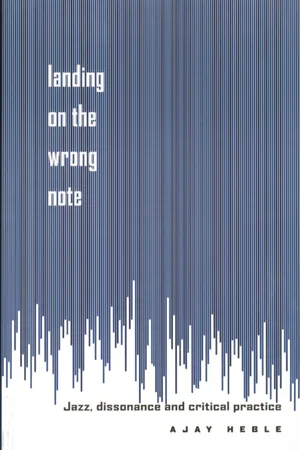
- 272 pages
- English
- ePUB (mobile friendly)
- Available on iOS & Android
eBook - ePub
About this book
Information
The Poetics of Jazz | 1 |
From Symbolic to Semiotic |
Prelude
I suggested in my introduction that evolutionary accounts of jazz history need to be interrogated for the ways in which they elide the music’s history of involvement in the formation of social identities and their attendant forms of privation and struggle. This chapter, I feel compelled to admit, grew out of just such an evolutionary account, for when I began working on this project (or an earlier version of it) more than a decade ago, I myself sought to map out the ways in which the harmonic vocabulary of jazz had evolved from its early forms of diatonic realism into a modernism of atonality. I was convinced that I saw parallel histories of momentum, resonant analogies between the ways in which representationalism was being rejected in contemporary literary theory as well as in the cultural practice of much contemporary jazz; I was convinced too that this turning away from representationalism was, in both cases, a healthy, even an exhilarating, development. As the rest of this book should make clear, there are plenty of reasons why I might now want to take issue with the latter judgments. For starters, how can I claim (as I do throughout) that jazz is embedded in social processes, in struggles for access to representation and identity formation, while also applauding its efforts to retreat from that very social world into an autonomous realm of language as a self-sufficient system of signs?
Intellectual honesty requires that I declare my discomfort on this front. But I don’t so much want to disown that earlier argument (published in a 1988 essay in Textual Practice), as much as I want here to open it up to its complexities and contradictions. For it still seems useful to me to rehearse that earlier work (despite its now-evident limitations) as a model for understanding jazz’s shifting position in relation to the larger questions about identity, language, and representation which I’ll take up in various ways through the course of this book. The present chapter, then, will bear the traces of my earlier argument, just as it will bear too the traces of the institutional conditions which gave rise to that argument. I’ve sought to preserve these traces because they open up purposeful and compelling questions about how jazz might be read in the context of language and its relation to the organization and mobilization of social identities. In so doing, in fact, they engage another key debate into which this book seeks to enter: the debate about our understanding of the relationship (read: split or fit?) between aesthetics and ethics.
That relationship, indeed, is another, perhaps broader, way of indexing and reaffirming the link I spoke of earlier between academic work and community-facing activity, or, to return to Nathaniel Mackey’s way of putting it, between word and world. The shifts in jazz that I will trace in this chapter are, I think, very much part of that same set of debates, for they too involve just such questions about how language (in this case musical language) might be said to be connected to the organization of (and resistance to) social relations of power and privilege. How, for example, are we to understand the ideological workings of jazz’s musical properties? Is the movement from diatonic jazz to atonality and free collective improvisation really best understood as a movement away from representationalism (and toward a modernist notion of autonomy)—as I suggested in my Textual Practice article—or might it better be described in terms of a shift to a new form of social realism, a newly articulated effort to reflect, alter, and mediate contemporary social relations?
The argument that follows is a version of that Textual Practice piece. While the spirit and sweep of the argument remain faithful to the original, I’ve interpolated several revisionary arguments in sidebars that run through the course of the text. These interpolations serve both as a kind of paradigm for my own refusal to allow interpretive habits to settle into an orthodoxy and as a prod to consider how polyphony and dissonance might function as models for critical practice. The dissonances that have emerged over time in my own criticism go hand in hand with the aesthetic and political reevaluations made by many of the musicians themselves. As John Coltrane’s radically different interpretations of a popular tune such as “My Favorite Things” reflect changes in his own perspectives on music in its cultural moment, so too do my reevaluations of recurrent critical themes require periodic, and sometimes radical, reconsideration.
Much of today’s jazz argot runs the risk of becoming nettled by any number of traditional emotive approaches (jazz isn’t a type of music, it’s a feeling!) which see forms of representation and expression inherent in musical structure. The tendency to think of jazz as a spontaneous expression of the performer’s emotions clouds our awareness of the fact that jazz, like language, is a system of signs.1 Though it is certainly not my purpose to deny the claim that music, through sound, communicates emotion, I want, in this chapter, to look at the ways in which various trends in the music have invited us to recognize the extent to which jazz as a language has found itself yielding to a formalist as well as to an emotive approach. By tracing salient developments in the history of jazz from swing to the present day, we can observe a series of fundamental changes which have taken place both in the theory of music and in the theory of language.
I begin with certain diatonic assumptions, with seven notes arranged into a scale of five whole tones and two semitones—a system of organizing tones which was held for the longest time to be the natural law of Western music. According to this system, one note, the tonal center or key, serves as a guiding principle, with the function of all the other notes in the scale being determined by their relationship to this one note. Diatonic music, then, proceeds by positing a variety of relationships between tones and their respective meanings. Specific intervals and isolated chords are said to represent determinate meanings. According to conventional structures of Western harmony—where the triad constitutes, as it were, the State of Nature—the interval of a major third is said, for example, to represent happiness. The minor third, by contrast, becomes a metaphor for sadness, the seventh a reflection of the state of longing. Given the “natural” state of the triad, the presence of the diminished fifth was once thought to be a sign of the “devil in music” owing to its perceived wrongness in sound (Cooke, 43). Such traditional structures of expression, however, inevitably limit the artist’s ability to create.
Historically, the laws of tonality have also invited artists to explore other means. What’s musically constraining for some artists can, in other words, become genuinely liberating for others. Within the established structures of Western diatonicism there are many composers and musicians who have created deeply innovative structures of practice. Louis Armstrong certainly comes to mind in this context, and I’ll have more to say about this aspect of his work in later sidebars. It’s wrong to suggest that jazz has evolved, that it has become “better” or “more sophisticated,” though the sonic palette has widened. Of importance are the changing social, historical, and institutional contexts that have given rise to different sonic resources in jazz: instead of speaking of the ways in which laws of tonality have “limited the artist’s ability to create,” we ought perhaps to turn our attention to the varying contexts that governed those laws.
Within a universe of discourse dominated by diatonic rules, “[t]he presentation of musical ideas” is, as H. H. Stuckenschmidt puts it, “as thoroughly bound … as the words of a lyric poem are by rhythm or metre” (30). The laws of tonality—conducive to an emotive approach to music—like the laws of language, prevent the artist from exploring a broader range of potential musical options and opportunities. Deviations from the rigid rules of tonality were originally seen as grammatical errors and solecisms: “violations of the due process of composition” (Stuckenschmidt, 31).
Tonality posits a key center with tonic as home plate—tonic as womb. The desire to go back is not arbitrary. “Return to the tonic” is precipitated by the overtones heard when a given note (say a C on the piano) is sounded. Any melodic movement from one tone to another already generates a desire to return to the original tone. As we expect riddles to have answers, so we expect structures to have meanings. Diatonic music begs for completion. Its very structure is one of resolution. Similarly, the traditional realist novel, based on plot, fosters the illusion of telos, of order in the world, of patterned evolution toward a final goal. The heaven-on-earth endings of the Victorian novel—based on a pattern of narrative expectation—are, I want to argue, roughly analogous to the tonal expectation of a return to the tonic in diatonic music. We can see the marriages at the end of a Dickens novel, say, as being structurally related to the cadential formulas (II-V-I or IV-V-I) which govern the endings of much Western tonal music. Both marriage and return constitute order, completion, satisfaction, and harmony
Repetition in music can never be exact because the specificity of its historic moment will have changed
But, as Barbara Herrnstein Smith has pointed out, “we cannot ever really ‘return’ to the beginning point.in a … piece of music; we can only repeat it” (27). For Smith, the same is true of poetry. Roman Jakobson has suggested that “[o]nly in poetry with its regular reiteration of equivalent units is the time of the speech flow experienced, as it is—to cite another semiotic pattern—with musical time” (358). The repetition of sounds, then, becomes important for music as well as for poetry. Jakobson’s interest in small-scale similarities of syntactic and morphological elements—elements which are, as it were, beneath the threshold of consciousness—can be applied to certain cadential expectations of diatonic jazz. Reiterated patterning of notes was, indeed, one of the hallmarks of Louis Armstrong’s playing. It’s there, for example, in the repetition of the notes G and E flat throughout his muted quarter note solo in “Mahogany Hall Stomp,” an improvisation which Gunther Schuller sees as one of the defining moments of the meaning and feeling of swing (see Schuller, 183). Similarly, Armstrong’s first solo in “Savoy Blues” (Vocalion, 3217) provides another apt example of the way in which the repetition of sound patterns prepares us for resolution. Here, the final note C is anticipated by the appearance of the same note in the polyrhythmic cycle of three that precedes the last bar (Sargeant, 96–97). Linearity—a sense that we are moving from beginning to end (the solo will not just stop randomly)—is inscribed even in these improvisational passages. Music like Armstrong’s, through its use of repeated melodic fragments and polyrhythmic cycles, is based on a teleological evolution toward a goal—an end, home base, the tonic.
The history of jazz can be told in four words, Louis Armstrong, Charlie Parker.
Miles Davis
There’s much in Armstrong’s oeuvre that threatens to break free of diatonic structure—the slides, the capacity (legendary in his performances) to spin endless breaks, the high tessituras, the rhythm. Indeed, Western harmony was but one of many different sensibilities at work in early jazz. My argument clearly won’t hold for rhythm (which reflected an African sensibility rather than a Western teleological model of practice), for timbre, or for the non-European sonorities in the muted trumpet work of Cootie Williams and the work of some other jazz artists.
In the space of less than a century, the history of jazz has betrayed a steadily changing character. Developing from the early styles of ragtime, New Orleans, and Dixieland, it has evolved through a neo-classicist renaissance of bebop into a modernism of atonality. Louis Armstrong will always be remembered for his robust style and emphatic tone. His trumpet playing, an extension of his own voice, tastefully explored those “blue” regions—the third and seventh degrees of the diatonic scale flattened. The poetry of his horn, however, remains steeped in the rudiments of a diatonic tradition. His smooth and eloquent improvisations are defined by an “on the beat” style, and the ends of his solos, like the ends of his songs, are governed by standard harmonic progressions. His use of the familiar II-V-I cadence—often quoted precisely because the tonics of these chords are a fifth apart—recaptures the tonal bias in its attempt to provide a strong and well-founded harmony.
To the extent that Armstrong’s music constitutes an attempt to imitate the singing and speaking inflections of the human voice, it reveals itself to be yearning after the illusion of presence that has traditionally been associated with speech. Such a transference of vocal inflections to the realm of instrumentation suggests, perhaps, a desire to have music represent things or emotions in much the same way that words might be said to refer to objects and ideas in the actual world. Poet/dramatist/essayist Amiri Baraka (then LeRoi Jones), in his book Black Music, insists that each note in an Armstrong solo “means something quite in adjunct to musical notations. … The notes mean something; and the something is, regardless of its stylistic considerations, part of the black psyche as it dictates the various forms of Negro culture” (15; emphasis in original). This representational dimension of Armstrong’s jazz, this hankering after an essence that can be accessed only by simulating the apparent presence of speech, however, finds itself paradoxically moving away from representation. Armstrong’s horn, though an extension of his own voice, is already once removed from it, and as such it cannot help but become the initial step in the movement toward a nonrepresentational practice of modern jazz. Despite appearing to valorize speech as a form of presence, despite playing a kind of music which, if Baraka is correct, purports to represent certain emotions or conditions, Armstrong’s trumpet playing mediates between the human voice and any attempt at representation. It is at once an attempt to recover the illusion of presence and an admission of its distance from any sense of an origin.
Theodor Adorno, in his review of Wilder Hobson’s American Jazz Music and Winthrop Sargeant’s Jazz: Hot and Hybrid, claims that instrumental imitations of vocal inflections, such as those I have been examining with the example of Louis Armstrong, are forms of a “deceptive ‘humanization’” (169). Rather than bringing the instrument closer to the musician, Armstrong’s technique, as Adorno would have it, reveals another site of desire—a desire for mechanization: “The vocalization of the instrumental,” writes Adorno, “serves not only to produce the appearance of the human, it serves also to assimilate the voice into the realm of the instrumental: to make it, as it were, an appendage to the machine” (170). If Armstrong’s horn is, as Baraka would have it, an expression of a specific social or cultural attitude, then, by transferring the inflections of his human voice onto his horn, a machine, Armstrong is already caught up in what, by Adorno’s account, might be seen to be a process of dehumanization. Machines, as Gilles Deleuze and Félix Guattari maintain in their Anti-Oedipus, designate themselves in an “overcoded” way; they symbolize human emotions which they have replaced and which are no longer necessary. The transfer, then, from voice to horn, rather than enabling the musician to recuperate the attitude that Baraka insists gave rise to jazz in the first place, serves instead to distance the performer from any possibility of self-present meaning in music.
It is the musician’s very desire to represent emotion which thus becomes responsible for the “veering off of signification” (the phrase is Lacan’s) in modern jazz. What I have been trying to suggest, more precisely, is that Louis Armstrong’s trumpet playing, by simulating through style and pattern the inflections of his own voice, works to conceal the cultural or social attitude that it wishes rather to reveal. Already evident in a music which is seen to be reclaiming the presence of human speech is its failed attempt to idealize the horn as signifier by bestowing upon it a materiality that it does not possess. Armstrong, though an exemplary figure in the diatonic tradition, is already forcing us to question the assumptions of that tradition, to question the time-honored belief that emotions constitute the substance of musical sounds.
We are now ready to enter a new era. The fabled bop of Charlie “Bird” Parker grew out of the ennui with antecedent forms of jazz. Baraka sees bop as a reaction to the sterility of swing as it became part of the mainstream in American culture (Black Music, 16). Anchored in a predictable tonal groove—with a predilection for diatonic forms of resolution—jazz had become too patterned, too diatonic. Bird’s flight into chromaticism thus became wha...
Table of contents
- Cover
- Half Title
- Title
- Copyright
- Dedication
- Contents
- Preface
- Acknowledgments
- Introduction
- 1. The Poetics of Jazz: From Symbolic to Semiotic
- 2. The Rehistoricizing of Jazz: Chicago’s “Urban Bushmen” and the Problem of Representation
- 3. Performing Identity: Jazz Autobiography and the Politics of Literary Improvisation
- 4. “Space Is the Place”: Jazz, Voice, and Resistance
- 5. Nice Work If You Can Get It: Women in Jazz
- 6. Capitulating to Barbarism: Jazz and/as Popular Culture
- 7. Up for Grabs: The Ethicopolitical Authority of Jazz
- Conclusion: Alternative Public Spheres
- Works Cited
- Sound and Video Recordings Consulted
- Index
Trusted by 375,005 students
Access to over 1.5 million titles for a fair monthly price.
Study more efficiently using our study tools.
Frequently asked questions
Yes, you can cancel anytime from the Subscription tab in your account settings on the Perlego website. Your subscription will stay active until the end of your current billing period. Learn how to cancel your subscription
No, books cannot be downloaded as external files, such as PDFs, for use outside of Perlego. However, you can download books within the Perlego app for offline reading on mobile or tablet. Learn how to download books offline
Perlego offers two plans: Essential and Complete
- Essential is ideal for learners and professionals who enjoy exploring a wide range of subjects. Access the Essential Library with 800,000+ trusted titles and best-sellers across business, personal growth, and the humanities. Includes unlimited reading time and Standard Read Aloud voice.
- Complete: Perfect for advanced learners and researchers needing full, unrestricted access. Unlock 1.5M+ books across hundreds of subjects, including academic and specialized titles. The Complete Plan also includes advanced features like Premium Read Aloud and Research Assistant.
We are an online textbook subscription service, where you can get access to an entire online library for less than the price of a single book per month. With over 1.5 million books across 990+ topics, we’ve got you covered! Learn about our mission
Look out for the read-aloud symbol on your next book to see if you can listen to it. The read-aloud tool reads text aloud for you, highlighting the text as it is being read. You can pause it, speed it up and slow it down. Learn more about Read Aloud
Yes! You can use the Perlego app on both iOS and Android devices to read anytime, anywhere — even offline. Perfect for commutes or when you’re on the go.
Please note we cannot support devices running on iOS 13 and Android 7 or earlier. Learn more about using the app
Please note we cannot support devices running on iOS 13 and Android 7 or earlier. Learn more about using the app
Yes, you can access Landing on the Wrong Note by Ajay Heble in PDF and/or ePUB format, as well as other popular books in Media & Performing Arts & Ethnomusicology. We have over 1.5 million books available in our catalogue for you to explore.