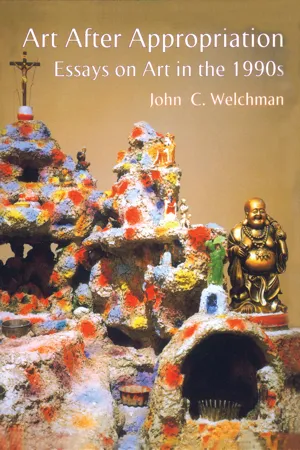
Beginning with the first comprehensive account of the discourse of appropriation that dominated the art world in the late 1970s and 1980s, Art After Appropriation suggests a matrix of inflections and refusals around the culture of taking or citation, each chapter loosely correlated with one year of the decade between 1989 and 1999. The opening chapters show how the Second World culture of the USSR gave rise to a new visibility for photography during the dissolution of the Soviet Union around 1989. Welchman examines how genres of ethnography, documentary and travel are crossed with fictive performance and social improvisation in the videos of Steve Fagin. He discusses how hybrid forms of subjectivity are delivered by a new critical narcissism, and how the Korean-American artist, Cody Choi converts diffident gestures of appropriation from the logic of material or stylistic annexation into continuous incorporated events. Art After Appropriation also examines the creation of public art from covert actions and social feedback, and how bodies participate in their own appropriation. Art After Appropriation concludes with the advent of the rainbow net, an imaginary icon that governs the spaces of interactivity, proliferation and media piracy at the end of the millennium.
John Welchman is Professor of Modern Art History, Theory and Criticism at the University of California, San Diego. He is the author of Modernism Relocated (1995) and Invisible Colors (1997); and editor of Rethinking Borders (1996), and a forthcoming three-volume anthology of the writings of LA artist MIke Kelley. Welchman has contributed to numerous journals, magazines, museum catalogues and newspapers, including Artforum; New York Times; Los Angeles Times; International Herald Tribune; Los Angeles County Museum of Art; Tate Gallery; Museum of Contemporary Art, Los Angeles; Reina Sofia, Madrid; Haus der Kunst, Munich
- 312 pages
- English
- ePUB (mobile friendly)
- Available on iOS & Android
eBook - ePub
About this book
Information
CHAPTER 1
Photographies, Counter-revolution and Second Worlds:
Allegories by Design, 1989
This is the first of a two-part meditation on the making and reception of photographies in the USSR at the end of its history.Chapter 2, I look at wider issues in the understanding of the post-totalitarian visual field—problems of avant-gardist visuality, of public visual space, of the Western and non-Western televisualisation of social change, and of the representation of sexuality.
The historical moment in which the exhibitions were staged is crucial. Late 1989 was the heyday of glasnost, the very last period in which it still seemed possible that the political mechanisms of the USSR could be opened out on the basis of a liberalised, capitalised, but still Party-based and centripetal model of Socialist polity. It would be nearly two years before the putsch of August 1991 precipitated the final dissolution of both Party and Union. Late 1989 was both the final moment of fullness, and a nostalgic point of failure in the imagination of Gorbachevian reformism; a time when the political and representational practices of the Soviet Union were being stretched to their limits, but had not yet cracked or fallen. I begin, then, in the historically poignant hiatus immediately before the onset of an entropic tailspin in the project of universal Socialism.
Sketching something like an archaeology of this recent past, I am concerned with the cultural and institutional conditions of possibility for a set of representational practices that deferred neither to the dominant constructions of Western theory/practice, nor to the emergent counter-centrist discourses of the ‘Third World’. This will lead to a consideration of what I want to call the second-sites of difference.2 In the domains of Soviet photography, visual art and exhibition practice during the years around 1989, there is much that needs to be forgotten and much that must be re-articulated. Western articles and reports on this moment of profound social and cultural transition have tended in the main to colonise, appropriate and package the art of glasnost. They have tagged it with Western European or American art labels, offering a capital bridge for the accreditation of erstwhile despised and unmarketable Socialist Realism and its parodic aftermath, egregiously seeking out ‘the new’ in the great ‘lost’ metropolises of Europe. Citizens who read Deleuze have been found (or invented).
In Moscow and other capital cities of the former Union, the invisible high-priests of postnational culture were administering the last rites to the late modernist avant-garde. Eagerly assisted by the (understandable) contrivance, in various forms, of Russian artists and photographers, they were backed by the dubious resources of a new class of cultural managers who made perhaps the most obvious mark on the day-to-day cultural life of urban Russia at the end of the 1980s.
Amidst the resultant spectacle of purportedly buoyant mercantilism, however, there is a somewhat neglected social context; one fraught with cynicism, opportunism and sheer material deprivation, which in my view overwhelms the uncritical avant-gardist narratives of the Western press. Artists have been visited, spot-lit and formally appraised, ‘movements’ and ‘tendencies’ discerned, the relatively few group exhibitions found and reviewed. Yet the arbitrariness and groundlessness of these forays is everywhere revealed by a poverty of understanding that fails either to account for their historical production or adequately assess their place in the dense and tangled network of ‘returns’ that characterise the last Soviet moment. Assisted by its sheer market and media power, Western criticism has attempted doubly to appropriate late- and post-Soviet image production—first, by literally taking it over; and, secondly, by imagining that a filament of appropriationism secures Soviet representation to its ideological past according to Western-style logic. In what follows, I dispute the historical and theoretical assumptions that predicate both of these appropriative paradigms.
As Soviet culture was unevenly released from the Stalinist cultural blockade of the 1930s, the late 1980s spawned a diverse assemblage of practices. Some were glimpsed, though seldom fully visible, in the flicker of the Soviet 1960s, but most had never really had their day. In 1989 we are witness to a barrage of abstractions, figurations, parodies, erotica, performances and conceptualisms that weave in and out of an intermittently discerned Western art history and across the margins of an even more sparely documented Soviet cultural and political past.
Instead of reporting on individuals, or attempting to bundle them together under the rubric of an ‘avant-garde’, I want to examine the contents, selection and display policies, and the larger social context of two exhibitions. The first was an ‘official’—or semi-official—show offering important insights into the structural changes that took place in the cultural policy of the Soviet Union: ‘The Age of Khrushchev’, installed in The Central Palace of Youth (Komsomol), Komsomol'skiy Prospekt, Moscow and running from August to September 1989. The second, discussed in Chapter 2, was one of several internationally circulated exhibitions that attempted to intervene in the generic reconstruction of Soviet and post-Soviet art and documentary photographies.3
The Khrushchev Allegory
For Western viewers, exhibition-going in Moscow involves a certain loss, for we are offered significantly fewer bearings than in the exhibition systems of Europe or the US. The material displayed is differently staged, differently framed, differently received and takes its place differently within the constitution of the metropolitan social fabric. Yet our disorientation prompts important questions: how does a contemporary, large-scale, late-Soviet exhibition produce its meanings? How does it signify in different ways here from there? In what, precisely, does its difference from a Western ‘blockbuster’ consist? And what kind of knowledge can we gain in—and out of—the West from such interrogations? I want to begin with an interpretative reconstruction of ‘The Age of Khrushchev’, presented as a tour around it. The exhibition lends itself to such discussion as its modular organisation and curatorial strategies were developed as an allegorical hybrid of revisionary history, social nostalgia, national self-affirmation and informational sponsorship. Unlike an ‘art’ exhibition staged in the West, ‘The Age of Khrushchev’ was arranged not around artists, their significant works and related documentation, but as a sequence of historical nodes and thematic clusters whose contents and structures were threaded together as a subtle cultural commentary on the achievements of Soviet reformism.
Consider this: a modular aluminum grid lit by two angle-poise lamps fronts a grainy, elongated, black and white photograph of Nikita Sergeyevich Khrushchev declaiming at a podium before the Supreme Soviet. In the months following, Khrushchev will replace Bulganin as Premier (1957) and take upon himself the headship of both State and Party. Behind the assembled representatives in the photograph is an out-sized statue of Stalin, his hand cupped, his legs locked in a pseudo-Hellenistic forward gait, his head angled and slightly uplifted. Khrushchev rests his hands wide apart on the lectern and leans into the microphones. The delegates strike the accustomed poses of ranking bureaucrats at their business. At the base of the photo-tableau (which is loosely tied with string to the pristine, moulded aluminum) is a triangle of white plastic exhibition material rising six inches from the floor like a giant step. On it, sheets of broken glass overlay the yellowing front pages of Pravda from 1956 and 1957, headlined with denouncements of Stalin, the Stalinist regime and Stalin's political acolytes. Around the apex of the triangle are miniature statues of Stalin, lying chipped and prone; one is lassoed around the head and hung from an aluminum girder, another is balanced on one of the dictator's severed arms. Stalin's body-parts are interspersed with scattered nails and twine, and sit in an irregular brocade of what looks like designer scuffmarks.
Or consider the widened corridor space separating the two antechambers of the exhibition, which offers a selective resumé of the Stalinist epoch from the early 1930s until his death in 1953. We become surrogate tenants relocated amid the ragged domestic appurtenances of a mid-century Muscovite apartment: underfoot is a tattered fringe of standard carpet; we look over to grimy acanthus wallpaper (read: the squalour of domesticated neo-classicism); stained washbowls (signifying the indeterminacy or absence of water-flow) and junked wooden cabinets; we cook on a stove that has barely made it beyond the primus; we look at ourselves in a tarnished mirror set under a strangled light bulb. We dwell in a cove of un-mod-cons. The space is ‘decorated’ with a twig lodged in a soup-pot, a black and white nuclear family snapshot, and a brownish grisaille head-and-shoulders image of the benign Leader, referred to in this posture as Soso (Stalin's diminutive). An unpainted wooden window gives onto a backlit photograph of one of the seven Stalinist pirok (‘wedding-cake’) mid-rises that framed the urban panorama of mid-century Moscow.
A different coefficient of modernity is present throughout the exhibition in the form of an aluminum entablature, though it is minimized to a few out-of-the-way, light-bearing brackets. The ‘look’ and effect of the installations and their design quotients are evasive. In Western terms (that historically, of course, have no place) we might say that Ed Kienholtz meets Ilya Kabakov under the semi-official auspices of the state in an astonishing project that emblematises the un-Socialist reality of everyday life by simulating it as it was. Nostalgic realism substitutes for the Real of Socialism, now forever on hold in a phantasmal past.
Adjoining this ‘preamble’, the main body of the exhibition opens into a spacious hall. Iterated images of the death and deprivation of the pre-1953 years give way to literal and allegorical representations of social, political and cultural reconstruction; and to the first appearance of a ‘new world’ of multiple colours after the symbolic ubiquity of black, white and red. We are bathed in the glimmer of a new moment of internationalism, openness and expectation that is imaged around us in a plenitude of affirmatory documentations, reconfiguring the stark, alienated anonymity of the mid-century Soviet through the calculated provision of a glowing nimbus of historical optimism. The photographic effect is efficiently transformed from a fragment of communal death to a gloss on life in the future perfect.
The archival photographs we encounter offer an exuberant, polychrome St Basil's, glittering in the afternoon sun; a vaguely smiling conference of women tractor-drivers; a candid shot of students at a lecture, attentively leaning forward, sporting wrist-watches and paisley shirts; an image of massgymnastics so angled that it undermines the expected messages of order, symmetry and uniformity; people with suitcases in unobstructed transit; dozens of bird's-eye views of wooden nineteenth-century Moscow shanties passively giving way to the faceless geometries of modernist urban renewal; bridges, hairdressers, children beaming on their potties, the Melbourne Olympics, a snatched kiss. The photographic register is soft LIFE. This is the Soviet 1960s, organised obliquely to simulate, if not explicitly to vie with, the American age of Pop.
In the complex political scenography that supersedes these upbeat generic indices of people and places, the archival Khrushchev is incessantly returned as the demiurge of Soviet internationalism. Alongside Nasser, sitting with Eisenhower, chatting with Pittsburgh steelworkers, posing with Nixon in 1959: a whole galaxy of inter-territorial moments subtends Khrushchev's accumulation of the credentials of world diplomacy. These are some of the captions of the day: ‘Khrushchev thanks an Indian peasant for his gift of a table’ (1960); ‘Roswell Garst falls in an attempt to throw a cornstalk at newsmen’ (during Khrushchev's visit to Garst's farm in Iowa, part of his 1959 trip to the US)
The repetitious language of the Soviet leader's various poses (of attention, studied informality etc), which catch those thousand interludes between ‘events’—and define the very project of photo-journalism—is relatively unencumbered by the formal and dramatic concern of Western magazine photography for the unusual, the unitary or the untoward. For the Western viewer, this results in one of many powerful disorientations. There is almost no arena in the West in which an assemblage of contextually and photographically uninflected images can be reconvened (not in the newspaper with its field of separated singular images, nor in the museum exhibition with its curatorial accent on difference and sensation). The effect of this repeated grid of normative scenes, therefore, is to engender a kind of seductive factography—a strong fantasy-image of the political real that paradoxically out-manoeuvres the slicker, speedier sequences of cathartic actions that circulate in the West. In the midst of this particular effort of real politik, then, the theatrical connotations of the famous incident at the United Nations in 1960, when Khrushchev pounded a lecturn with his shoe during a speech by the Spanish delegation4 (graphically imaged in the show), are readily deflected to the service of righteous indignation. The moment of unconstructed passion is not lost in a garland of constructed flourishes.
The remainder of the Khrushchev-era show was organised in half a dozen thematic booths and cul-de-sacs, which radiated from a modest central repository of Soviet industrial effects culled from the turn of the 1950s: a bicycle with a put-put engine, a dinosaur gramophone, sundry plastic radios and an oversized TV unit with minuscule screen and in situ magnifying glass. These unseductive commodities constitute the allegorical as well as the literal centre of a highly coded exhibition: in the second age of openness (Gorbachev's glasnost) there is the hope (if not the assurance) of a repetition, or rather a delayed realisation, of the production values of the first (Khrushchev's semi-Socialist 1960s).
The booths re-presented both the totems and taboos of social life in the USSR under Khrushchev. The ‘Kosmos’ section featured a doggie oxygen tank and space suit; and a real (stuffed) space dog (the much-beloved Strelka) staring at a model sputnik. Yuri Gagarin was imaged as the darling of a hundred official space fêtes, and the first woman astronaut (Valentina Tereshkova) confirmed as a runner-up star in the implied domestic space race—ranked somewhere, the chronology seemed to suggest, behind both man and dog. All the booths contained objects, documents and ‘arrangements’, but none were presented with such bravura as the heap of junked icons that held the middle ground of the ‘religion’ compartment.
Stalin Pantocrator
Against what official, historical modes of photographic representation is the Komsomol exhibition articulated? And how can we measure its distance from the orthodox modalities that are parodically laid out in the show's complex structure-as-commentary? Such questions demand specific attention to the many forms of public photographic display deployed by the Stalinist Soviet (and by Stalin's successors up to and including Gorbachev). These include the informational exhibition; the political iconography of the public photo-portrait (whimsically interrogated in the work of Vassili Kravtchouk, see below); the dissemination of photographs in the 1930s ‘carnivals’; illicit, private or amateur photographs; and the circulation of photographic images published by the State-controlled presses and appearing in official newspapers, journals and other publications. Each of these appearances has its particular economy of production and reception, though all, of course, were intended to reflect the will of the Party-State. In order to think through the political saturation of visual signs in the USSR, I will outline the shape and implications of one genre of Party-State-sanctioned photography represented by Sovetskoe foto iskusstvo (Soviet Art-Photography), a photoalbum published i...
Table of contents
- Cover
- Half Title
- Full Title
- Copyright
- Contents
- Introduction Gglobal Nets: Appropriation and Postmodernity
- Chapter 1 Photographies, Counter-revolution and Second Worlds: Allegories by Design, 1989
- Chapter 2 Photographies, Counter-revolution and Second Worlds: Releases and Counter-appropriations, 1989
- Chapter 3 New Bodies: The Medical Venus and the Techno-grotesque, 1993-1994
- Chapter 4 Faces, Boxes and The Moves: On Travelling Video Cultures, 1993
- Chapter 5 Public Art and the Spectacle of Money: On Art Rebate/Arte Reembolso, 1993
- Chapter 6 –Peeping Over the Wall—: Narcissism in the 1990s, 1995
- Chapter 7 Parametrology: From the White Cube to the Rainbow Net, 1996
- Chapter 8 Culture/Cuts: Post-Appropriation in the Work of Cody Hyun Choi, 1998
- Chapter 9 Some Horizons of Medialisation: The Rainbow Net, 1999
- Index
Trusted by 375,005 students
Access to over 1.5 million titles for a fair monthly price.
Study more efficiently using our study tools.
Frequently asked questions
Yes, you can cancel anytime from the Subscription tab in your account settings on the Perlego website. Your subscription will stay active until the end of your current billing period. Learn how to cancel your subscription
No, books cannot be downloaded as external files, such as PDFs, for use outside of Perlego. However, you can download books within the Perlego app for offline reading on mobile or tablet. Learn how to download books offline
Perlego offers two plans: Essential and Complete
- Essential is ideal for learners and professionals who enjoy exploring a wide range of subjects. Access the Essential Library with 800,000+ trusted titles and best-sellers across business, personal growth, and the humanities. Includes unlimited reading time and Standard Read Aloud voice.
- Complete: Perfect for advanced learners and researchers needing full, unrestricted access. Unlock 1.5M+ books across hundreds of subjects, including academic and specialized titles. The Complete Plan also includes advanced features like Premium Read Aloud and Research Assistant.
We are an online textbook subscription service, where you can get access to an entire online library for less than the price of a single book per month. With over 1.5 million books across 990+ topics, we’ve got you covered! Learn about our mission
Look out for the read-aloud symbol on your next book to see if you can listen to it. The read-aloud tool reads text aloud for you, highlighting the text as it is being read. You can pause it, speed it up and slow it down. Learn more about Read Aloud
Yes! You can use the Perlego app on both iOS and Android devices to read anytime, anywhere — even offline. Perfect for commutes or when you’re on the go.
Please note we cannot support devices running on iOS 13 and Android 7 or earlier. Learn more about using the app
Please note we cannot support devices running on iOS 13 and Android 7 or earlier. Learn more about using the app
Yes, you can access Art After Appropriation by John C. Welchman,John Welchman in PDF and/or ePUB format, as well as other popular books in Art & Art General. We have over 1.5 million books available in our catalogue for you to explore.