![]()
CHAPTER 1
Pioneers of management theory
1.1 Definitions
There are terms regularly used in management ‘speak’ so the author has given his own definitions based on his own readings and experiences.
Management: Each situation is almost invariably unique. Management should assess all the relevant factors available and make a decision concerning the problem in question.
Administration: Administrators work primarily to a set of rules and decisions are made based on these guidelines. There can be some flexibility in ‘bending the rules’ but usually administrators are concerned that a new precedent might be set if the rules are not followed. It should be noted that in most organisations, especially medium and large, management and administration functions exist side by side. For example, wages and salaries would be seen as an administrative function.
Accountability: An employee is accountable for his or her actions and reports to a supervisor.
Responsibility: An employee is responsible for actions taken, but is also responsible for the actions of those reporting directly to them. Responsibility registers highly in employee job satisfaction.
Delegation: Is probably the hardest act to carry out by a manager. In essence it means delegating part of one’s responsibility to a subordinate and allowing that person to have complete responsibility for the work delegated. Many managers fall down on this by either delegating roles and jobs they do not wish to carry out, or worse still, continue to take actions and decisions relating to the tasks delegated. This latter failure is often due to a lack of confidence in others. It can be extremely frustrating for the subordinate.
1.2 Introduction
There are far too many contributors to management theory to cover all, so those selected are people who have made, in the author’s opinion, significant contributions and to whom he can closely relate, relative to his own experiences. This is important for the reader to understand, as there are many others who have contributed equally and may well be more in tune with the experiences of the reader. The author has also ‘cherry picked’ the topics that have influenced him and these in no way represent a complete coverage of the respective writers’ works. Hence when browsing through the many management texts on offer, readers should widen their knowledge beyond the content of this book.
1.3 Development of management theory
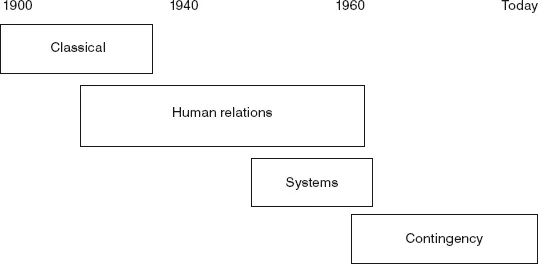
Serious management thinking has been developing for just over 100 years. It can be broadly classified into four categories: classical, human relations, systems and contingency, which have occurred sequentially as approximately demonstrated in Figure 1.1. It is difficult to indicate precisely when one finishes and another starts. Pre-classical management was based primarily on trial and error, but the classical school saw the need to apply scientific approaches to management, at the exclusion of the human factor. This exclusion was addressed at the next phase when the human element was considered. After the Second World War the theory was redirected to look at systems and processes. More recently there has been awareness that all schools had something to offer and a more holistic approach has been taken.
Figure 1.1 Timeline of management theory schools
1.4 The classical school
It is necessary to place this development of management thought into its historical context. At the end of the nineteenth century labour was cheap, plentiful and considered primarily as a resource, rather than a ‘human resource’. If the steel furnaces were not being filled with coal fast enough, you just added extra manpower. Little or no thought was placed on the efficiency of labour. There are three key theories in this school: Scientific, Administrative and Bureaucratic, developed primarily by Taylor, Fayol and Weber respectively.
1.4.1 Scientific management – F.W. Taylor (1856–1915)
Taylor joined the Midvale Steel Works in Pennsylvania, USA, as a machine shop labourer in 1878 and, within six years, had risen through the ranks to become chief engineer after which he moved to the Bethlehem Steel Works. He observed that workers were not working at their full potential and came to the conclusion it was because they were concerned that if they worked flat out, others would lose their jobs. The wage systems in place discouraged higher productivity, as they were often structured so if productivity increased above the set standard, incentive payments would be cut. Many of the working methods had been handed down from generation to generation of employees without any consideration on how to improve productivity.
Taylor was interested in applying scientific techniques to management believing this was the way to deal with low productivity and developed his Four Principles of Scientific Management:
1. Evolve a science to study each element of a person’s work to develop the best method disregarding traditional rule of thumb methods.
2. Scientifically select then train, teach and develop the workers using these methods (in the past the workers had chosen their own work and trained themselves).
3. Obtain co-operation with the employees to ensure all the work was carried out to best possible method.
4. Divide work and responsibility so management takes the responsibility for planning work methods, using the scientific principles, and the workers are responsible for carrying out the work to these methods. In the past workers had chosen how to carry out the tasks.
Taylor was interested in measuring the output of operatives to establish the best way to carry out tasks which he called time study, subsequently referred to as time and motion study which became the basis of work study as known today (Operations Management for Construction, Chapter 3). He also developed wage incentive schemes to increase productivity.
One of his famous studies was the use of shovels in the Bethlehem Steel Works. He noted that operatives used the same shovel irrespective of the type and weight of the material they were loading. Using scientific measurement he established what mattered was the total weight of both the shovel and the materials, which he determined to be 21 pounds. He was able to increase shovelling productivity almost four-fold as a result.
1.4.2. Administrative management – Henri Fayol (1841–1925)
Whilst Taylor was developing his ideas in America, Henri Fayol was revolutionising management thinking in France. He was brought up in a upper middle-class family and trained as a mining engineer, working his way up to become managing director of Commentry-Fourchampboult et Decazeville, a coal mining and foundry combine. Whereas much of Taylor’s work concentrated on the production part of the process, Fayol was interested in management principles from the chief executive’s point of view. He was concerned with designing an efficient organisation structure based on administration.
He developed a definition of management based on five functions (note some texts refer to six, separating forecasting and planning), which in essence are still valid. These are:
• forecast and plan
• organise
• command
• co-ordinate
• control.
Any business needs to examine and forecast what is likely to happen in the future, be it the marketplace in which one is to sell products or services, i.e. the demand side, or on the supply side to establish the availability of resources, notably labour and materials. All of this takes account of economic trends. The company has to produce a corporate plan that brings together the needs of all sections of the business to meet the corporate objectives, followed by operational plans to assist in executing these needs in practice. These should be flexible enough to take account of changing circumstances and assist in predicting courses of action.
The management needs to provide the material and human resources and build up an organisational structure so the work can be executed to meet the plan. This requires management to stand back and decide on a structure; in other words, how the business should be divided into groups of activities or functions, who should be responsible to whom, the number of people one should be responsible for and so on.
Logically following on from the above is the need to have the authority to command so that the organisation, now structured, can enable optimum return from all employees in meeting the corporative objectives. Command is the relationship between a manager and his or her immediate subordinates. The quality of command results from the manager’s ability to demonstrate knowledge of the business, subordinates, the quality of contact with them, and to inspire confidence.
However, this in itself will be insufficient if the interface between the different parts of the organisation is not explored and co-ordinated. Fayol wrote that co-ordination is necessary in ‘binding together, unifying and harmonizing all activity and effort’. Too often departments work in isolation without understanding how their actions impact on another. This issue is addressed in ISO 9001:2004 Quality Management Systems Requirements written a century later (Operations Management for Construction, Chapter 8).
The final element is to monitor that all the previous elements are functioning in line with the plans, commands and instructions.
He further expounded 14 principles as follows:
1. Division of work
By performing only one part of the job, a worker can produce more and better work for the same effort. Specialisation is the most efficient way to use human effort.
This view was the basis of much of the thinking in mass production, such as cars, where each worker was given a clearly defined task.
2. Authority and responsibility
Authority is the right to give orders and obtain obedience, and responsibility is the corollary of authority.
This ignores the human element that today might question the competence of the superior requiring that authority should also be linked to the need to obtain respect. However at the time the position automatically commanded respect and authority.
3. Discipline
Obedience to organisational rules is necessary.
The best way to have good superiors, and clear and fair rules and agreements is to apply sanctions and penalties judiciously. Nobody would disagree with this in principle, but the emphasis is on punishment rather than on congratulations and positive motivation. There is a danger that by taking this too literally there becomes a conflict with 14 below.
4. Unity of command
There should be one and only one superior for each individual employee.
This on the face of it is correct especially in the context of executive line management, but as can be seen in functional management organisations (section 2.3.2), there are legitimate situations where a person is responsible to two people, one for discipline and performance, and the other for the quality of their expertise.
5. Unity of direction
All units in the organisation should be moving towards the same objectives through co-ordinated and focused effort.
This would be a valid statement today.
6. Subordination of individual interest to general interest
The interests of the organisation should take priority over the interests of an individual employee.
This should occur at all levels of the organisation. Whilst the concept is valid, there can be conflicts with this and the ambitions of employees who can often usurp this position by providing their superior with the views and answers they think they want, so as to impress and be noticed, whereas a healthy debate and disagreement may better serve the organisation.
7. Remuneration of employees
The overall pay and compensation for employees should be fair to both the employees and the organisation.
Any organisation needs to balance what it can afford with an equitable distribution to its employees. There is no perfect system even today as the endless debates over ‘fat cats’ and pay compatibility demonstrates.
8. Centralisation
There should be a balance between subordinates’ involvement through decentralisation and managers’ retention of final authority through centralisation.
Centralisation is always present to a greater or lesser extent depending on the size of the company and quality of its managers. The larger the organisation, the more stretched are the lines of communication between 10 Pioneers of management theory the board and the lower parts of the organisation. This makes control more difficult as the further away from the centre the more autonomous the parts can become. How much is permitted should be a function of the capabilities of the personnel.
9. Scalar chain
Organisations should have a train of authority and communication that runs from the top to the bottom and should be followed by managers and subordinates.
A follow-on from centralisation....