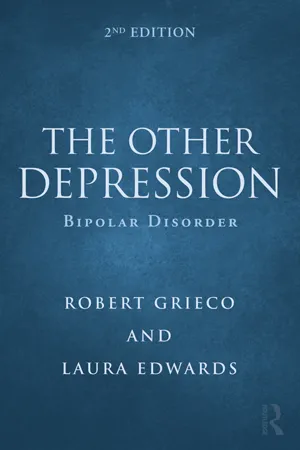
In The Other Depression, Grieco and Edwards help people understand and destigmatize those afflicted with bipolar disorder. Topics discussed include the genetic signature and environmental stresses and underpinnings of this disease, along with how it alters the functioning of the brain, and how it can be treated. The authors also introduce resources available to bipolar people and their families and suggest strategies for coping and getting on with life.
- 191 pages
- English
- ePUB (mobile friendly)
- Available on iOS & Android
eBook - ePub
About this book
Information
1
Discovering Bipolar Disorder
Claire
Fourteen years ago, in the seventh year of my medical practice, a woman appeared in my office with the most perplexing set of ailments I had ever seen. She was debilitated by migraine headaches, back pain, chronic abdominal pain, insomnia, depression, and anxiety. I referred her to one specialist after another, hoping to find someone who could get a handle on her case. And they all tried. She saw a neurologist for her headaches, a gastroenterologist for her digestive disorders and an orthopedic doctor for her back pain. She was scoped for diseases of the pancreas and gall bladder. But no one found a cause for her symptoms. This went on for years.
Then I thought, okay, maybe her problems all have one common root in some mental disorder, because that is sometimes the case. I sent her to psychiatrist after psychiatrist until she had seen every psychiatrist in the county. She was a difficult patient. She skipped appointments, paid her bills late or not at all. She had an insatiable appetite for medication, but she had issues with every medication she took; it made her sick or she couldn’t live with the side effects or it did nothing to help her.
So she kept ending up back in my office. Trying to treat her was frustrating. I could have given her 15 different diagnoses, and each one of them would have been right, but none of them would have defined her problem. I knew I wasn’t getting anywhere, and she was getting worse. At one point she had lost so much weight that I had to put her in the hospital to get a feeding tube placed. There, as a last resort, I started her on a medicine used to treat bipolar disorder (BD). I did not think she necessarily had BD, but she had something. There was a chance this medicine would work for her, and it was one of the few things we hadn’t tried.
The medication transformed her. When I saw her in my office two weeks later, she was symptom free and ecstatic. She wanted me to take that tube out of her. Then she wanted me to tell her where this medicine had been all of her life.
Throughout my career as a family practitioner, I believed that depression and other mental illnesses were at the root of many of my patients’ physical complaints, so I studied them, watched for them, and made myself a family practice “specialist” in psychiatry. I treated and taught about depression, anxiety, obsessive-compulsive disorder, attention-deficit/hyperactivity disorder, and posttraumatic stress disorder. But I put BD in a different category. I thought of it as a rare, severe problem, like schizophrenia, that I needed to know only enough about to send the patient to the emergency room or to a psychiatrist. Since it was so uncommon and the medications used to treat it were so difficult and dangerous to use, it was better for me not to try to deal with it myself. But my accidental success with Claire prompted me to rethink this position and reeducate myself about BD. This book has arisen from my new understanding of this illness. It is the story of bipolar disorder from the vantage point of a family doctor. Since about half my patients come to me for psychiatric problems, it is a subject I have become passionate about.
Bipolar disorder, I discovered, is a mysterious and greatly misunderstood mental illness. It is much more common and much more deadly than we think it is, and does not look like what we think it looks like. The misconceptions about this illness that are prevalent throughout the general culture pervade even the medical and psychiatric community.
As it turns out, this disorder, which I thought was so rare, is anything but rare. Every day I had been seeing patients with all of the signs of BD, but because of my preconceptions, I did not recognize them. I was not alone in my blindness. Mental health specialists initially misdiagnose 40%–70%1 of their bipolar patients.a More than a third of bipolar patients suffer with symptoms for ten years and have seen three to four doctors before their condition is diagnosed.2
Bipolar disorder can be the hidden cause of many seemingly unrelated conditions. Someone with BD may have any combination of anxiety, insomnia, fatigue, premenstrual disorder, attention-deficit/ hyperactivity disorder, seasonal affective disorder and migraines; legal and financial problems; and difficulties with marriage and work. He or she is likely to abuse drugs or alcohol. He or she may be irritable or violent. But when most doctors (and patients) think of BD, this is not the picture that comes to mind. Instead, they think of someone in the extreme manic phase of the illness: an animated and impulsive person who talks a mile a minute, spends a lot of money, and makes big plans. Most who suffer from bipolar disorder are not really like that. Those who are, are not like that very often, and when they are, they generally do not seek treatment. We must understand that BD is rarely going to manifest itself to us as the classic mania we expect. Therefore, we need to be acutely aware of the many ways in which it does manifest itself.
It is important that we not lose time in identifying and treating bipolar disorder. Untreated, it causes enormous suffering. Almost one out of every five people afflicted with it commit suicide.3,4,5And because bipolar disorder commonly begins in the teen years, many of these suicides are occurring among young people.5 We hear in the news about teen suicide and the link between suicide and antidepressants. But we seldom hear that bipolar disorder is behind most of these suicides and that bipolar people can be completely destabilized, and therefore put at risk, by antidepressants given to them without regard to their illness.
Bipolar disorder is treatable. The rapid jarring mood swings that precipitate suicidal impulses can be controlled. But doctors, psychiatrists, and people who work with young adults need to know what to look for.
References
1. Bowden, C. L. (2001). Strategies to reduce misdiagnosis of bipolar depression. Psychiatric Services, 52, 51–55.
2. Hirschfield, R.M., Lewis, L., & Vornik, L.A. (2003). Perceptions and impact of bipolar disorder—How far have we really come? Results of the National Depressive and Manic Depressive Association 2000 survey of individuals with bipolar disorder. Journal of Clinical Psychiatry, 64(2), 161–174.
3. Dilsavor, S.C., Chen W.Y., Swann, A.C., et al. (2007). Suicidality, panic disorder and psychosis in bipolar depression, depressive mania and pure mania. Psychiatry Research, 73, 47–56.
4. National Institute of Mental Health. Bipolar disorder. Bipolar Disorder Research Fact Sheet. Retrieved March 7, 2005, from http//www.nimh.gov.
5. Goodwin, F. K. & Jamison, K. R. (2007). Manic-depressive illness: Bipolar disorders and recurrent depression. New York: Oxford University Press.

a. Advocates for the mentally ill are concerned that identifying the illness before identifying the person implies that a person is defined by his illness rather than, first and foremost, by his humanity. Certainly, no matter how sick we become, there is more to us than what has made us sick. I understand this; I have known most of my patients far longer than I have known them to be bipolar. Medical practice, in my view, is all about helping people overcome disease so that they can be their true and best selves. In this book I sometimes refer to my bipolar patients as “bipolar patients,” rather than as “patients who have bipolar disorder,” only because it is so much less cumbersome to the text. I hope that the reader will understand my predicament and not take offense.
2
A Different Kind of Depression
Jane
Jane was first diagnosed with depression at age 17, when she attempted suicide by taking a bottle of her mother’s Benadryl. Her reason for doing it was to escape the confusion, the chaos in her mind, which never stopped. She received no treatment for that episode of depression, and subsequently attempted suicide two more times. Between her bouts of depression, she had periods when, inexplicably, she felt better. She had energy and drive. She didn’t need sleep. She felt great. This would last for a couple of weeks. Then, suddenly, she’d be down again. When she was 20, her doctor put her on Prozac. After a while, she took herself off it because she felt it had stopped working.
When I met her, Jane had been alternating between periods of feeling good and periods of depression. She had been on and off Prozac for 15 years and was seeing a psychiatrist. But Jane did not come to my office for depression. She came to bring me her daughter, who was crying and doing poorly at school. It wasn’t until after I had diagnosed and begun to successfully treat her daughter for bipolar disorder (BD) that we began to think Jane might have it, too. As it turned out, she had a strong family history of mental illness and many of the symptoms of BD. I put her on a mood stabilizer. But even after significant improvement, her psychiatrist resisted the diagnosis.
Bipolar disorder is misdiagnosed because it is difficult to distinguish from the simple, more common depression we are most familiar with. The characteristics that differentiate BD from simple depression are not readily apparent, especially during a brief encounter. An accurate diagnosis requires information about patients that may appear to both patients and doctor to be unrelated to immediate symptoms. It requires that the doctor have a template for BD that will lead to asking the right questions.
Essentially, all of my patients hire me to help them feel well and stay well. When they do not feel well, they come in wanting me to fix their problems. They also want me to put a label on what they are feeling—one that legitimizes their seeking and paying for treatment. Sometimes, there really isn’t anything wrong with them. Then my job is to tell them they’re okay. That means I have ruled out any significant cause for what they are experiencing. I don’t have a label for them. I don’t even have a billing code. “Normal” is not a diagnosis.
In any event, each of my encounters is problem-oriented. Even a routine physical is focused on looking for what might be abnormal. My goal is to catch problems early, when they are most easily and most successfully treated, and before they cause damage. Usually, this is before they have even caused symptoms.
But I do not do routine checkups for mental health. Mental health is subjective. There are no vital signs that I measure or blood tests I can run. I depend upon having people come to me when they feel something is wrong. The difficulty is that people often do not recognize mood problems in themselves, and perhaps don’t even know what “normal” is. Unless a dark mood comes on them very suddenly, they may think that what they have been feeling is normal.
Sometimes, mental illnesses are intertwined with physical illnesses. A patient comes in with migraines, but complicating the migraine problem is a chronic mood disordera that the patient has never identified. I can treat the migraines, but unless I also treat the mood disorder, the patient will not do well.
Some people know they are depressed or anxious and come in to be treated for these conditions. Fortunately, the stigma that used to surround depressive illness has faded in recent years, and there is a general understanding that a persistent low feeling of sadness, grief, guilt, and fatigue is not normal, especially when it is not warranted by circumstances.
When patients tell me they are sad, blue, and maybe hopeless; that they don’t enjoy anything; that life is a mess; they have family problems; maybe have thoughts of suicide; maybe also complain of anxiety, nervousness, or excessive worry; it is easy to diagnose them with depression and to prescribe an antidepressant medication. Depression is easier than ever to talk about. I know how it presents itself and even know how to detect it as an underlying factor in some of my patients’ physical illnesses. In spite of this, I have misdiagnosed many of my depressed patients and given them treatments that did not help them and actually made their condition worse.
Almost four times out of ten, when a person is diagnosed with “depression,” he or she has something other than simple depression. He has BD.1,2 Bipolar disorder is like the simple depression we are most familiar with, except that it periodically expresses itself as “mania,” a mood extreme as far from normal in one direction as depression is in the other. In fact, simple depression is sometimes called “unipolar” depression to distinguish it from BD. I call bipolar disorder “the other depression,” because it has been so often overlooked by both the psychiatric and medical communities. The consequences of this are far reaching and have led to a crisis in the way the health care community currently cares for mood disorders.
Studies done by Drs. Hirschfield and Manning, two prominent experts on bipolar disorder, have shown that doctors are much more likely to misdiagnose and mistreat a mood disorder than to diagnose and treat it correctly, not just once, but again and again.11 More than two times out of three, mental health specialists and primary care doctors misdiagnose BD.3
The most common mistake is treating bipolar patients with the medications designed for those with simple depression. This may destabilize them, making them vulnerable to the high-risk impulses characteristic of the manic phase of BD, one of which is suicide. Furthermore, it takes the place of treatment that could slow down the natural progression of the disease and bring symptoms under control.2 This is critical, because behavior at either end of the bipolar spectrum can be extremely destructive. Ruined marriages, job loss, unintended pregnancies, alcoholism, bankruptcy, incarceration, and drug abuse are some of the common consequences of BD.4 In addition; people with BD are at increased risk for almost every type of medical problem.5
One major factor in the misdiagnosis of BD is a lack of appreciation for the meaning of the word “depression.” Depression is not an illness, or even a diagnosis, in and of itself. It is a symptom complex that expresses a psychological condition. The importance of this distinction becomes clear when we think of another symptom complex we are familiar with: congestive heart failure. Again, many people think of congestive heart failure as a diagnosis, but it is actually a set of symptoms that can be caused by any of a number of widely divergent conditions. Congestive heart failure can result from coronary artery disease, or from hypertension, or from a bad heart valve, or from a virus. These conditions look very different in the early stages, but in the end they all result in shortness of breath, swollen feet, enlarged heart, and lungs full of fluid. Most, but not all, congestive heart failure is caused by hypertension. But to treat congestive heart failure properly, the doctor must have an accurate understanding of the root problem.
Likewise, major depressive disord...
Table of contents
- Cover
- Half Title
- Title Page
- Copyright
- Dedication
- Contents
- Foreword
- Introduction
- Chapter 1. Discovering Bipolar Disorder
- Chapter 2. A Different Kind of Depression
- Chapter 3. The Bipolar Spectrum
- Chapter 4. Five Keys to the Bipolar Spectrum
- Chapter 5. The Bipolar Personality
- Chapter 6. Depression
- Chapter 7. Mania
- Chapter 8. Mixed States
- Chapter 9. A Little Bit of Mania
- Chapter 10. Could My Depression Be Bipolar?
- Chapter 11. Associated Physical and Psychiatric Illnesses
- Chapter 12. Bipolar Disorder in Children
- Chapter 13. Bipolar Disorder in Adolescents
- Chapter 14. Bipolar Disorder in the Elderly
- Chapter 15. Seasonal Depression
- Chapter 16. Suicide
- Chapter 17. Drug Therapy for Bipolar Disorder
- Chapter 18. Winning the Peace
- Chapter 19. Do Antidepressants Cause Suicide?
- Chapter 20. Bipolar Disorder and Creativity
- Chapter 21. Too Much, Too Fast, Too Soon
- Chapter 22. When a Loved One Has Bipolar Disorder
- Chapter 23. Living with Bipolar Disorder
- Appendix A: A Psychiatrist Speaks to Patients
- Appendix B: A Psychiatrist Speaks to Doctors
- Appendix C: My Patients and Their Families Speak
- Appendix D: Five Keys to the Bipolar Spectrum
- Appendix E: The Mood Disorder Questionnaire (MDQ)
- Index
Trusted by 375,005 students
Access to over 1.5 million titles for a fair monthly price.
Study more efficiently using our study tools.
Frequently asked questions
Yes, you can cancel anytime from the Subscription tab in your account settings on the Perlego website. Your subscription will stay active until the end of your current billing period. Learn how to cancel your subscription
No, books cannot be downloaded as external files, such as PDFs, for use outside of Perlego. However, you can download books within the Perlego app for offline reading on mobile or tablet. Learn how to download books offline
We are an online textbook subscription service, where you can get access to an entire online library for less than the price of a single book per month. With over 1.5 million books across 990+ topics, we’ve got you covered! Learn about our mission
Look out for the read-aloud symbol on your next book to see if you can listen to it. The read-aloud tool reads text aloud for you, highlighting the text as it is being read. You can pause it, speed it up and slow it down. Learn more about Read Aloud
Yes! You can use the Perlego app on both iOS and Android devices to read anytime, anywhere — even offline. Perfect for commutes or when you’re on the go.
Please note we cannot support devices running on iOS 13 and Android 7 or earlier. Learn more about using the app
Please note we cannot support devices running on iOS 13 and Android 7 or earlier. Learn more about using the app
Yes, you can access The Other Depression by Robert Grieco,Laura Edwards in PDF and/or ePUB format, as well as other popular books in Psychology & Abnormal Psychology. We have over 1.5 million books available in our catalogue for you to explore.