- 276 pages
- English
- ePUB (mobile friendly)
- Available on iOS & Android
eBook - ePub
About this book
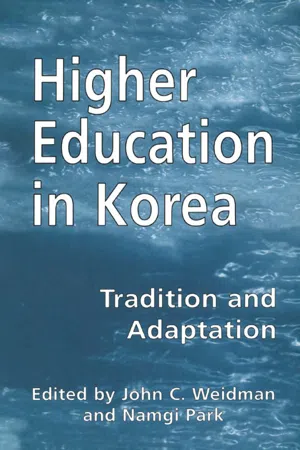
This definitive collection takes an in-depth look at the higher education system in Korea. The editors and contributors present a fundamentally Korean view of the important issues for the Korean higher education system. In systematic, well written essays, they construct theoretical perspectives to analyze the development of the higher education system in Korea's competitive society, a project never before undertaken in the English language.
Information
CHAPTER 1
Introduction
JOHN C.WEIDMAN AND NAMGI PARK
This book contains a comprehensive description of the Korean higher education system. In an effort to get a uniquely Korean point of view, the editors invited Korean scholars of higher education to write all of the book’s chapters. The book is intended for use by scholars of comparative higher education as well as by faculty and staff in higher education institutions around the world who work with Korean students and faculty. Each of the chapters includes historical background as well as more contemporary assessments of the Korean higher education system.
CONSEQUENCES OF THE 1997–98 ASIAN ECONOMIC CRISIS
It is important to reflect on the consequences for higher education of the severe economic crisis that occurred in 1997 in Korea, as well as in the entire East Asian region. The crisis was precipitated by an unexpected drop in the value of Asian currencies that posed serious threats to economies throughout the region. By early 1998, the value of the Korean won in U.S. dollars was just half of what it had been in November 1997, and interest rates in Korea were 25 percent per annum. Foreign currency problems, along with other structural issues in the banking and finance systems of many Asian countries, including Korea, led the International Monetary Fund (IMF) to intervene in an effort to stabilize the economic situation.
The Asian economic crisis has affected Korean higher education, especially the private sector, severely. Dan kook University, one of the largest (with more than 15,000 students) private higher education institutions in Seoul, went bankrupt in March 1998. According to the Korean government, at least ten other private universities have similar problems. It could be argued that the financial problems of private higher education institutions are as much the result of government policy as they are of the broader economic problems brought about by the foreign currency crisis. Specifically, the Korean government instituted an accreditation process, which all higher education institutions were required to undergo. Those institutions receiving good evaluations were eligible for government aid and administrative support. Those that did not fare as well had to invest a lot of their own money to meet the government standards. Those institutions like Dan kook University, which borrowed heavily from foreign investors to make improvements, suffered much more financially than other institutions that met the standards. Despite the financial problems, the government pressured the private higher education institutions not to raise their tuition and fees until the economic crisis had passed, even though the price index increased by 10 percent in 1998.
Because they had problems paying the costs of higher education, many male students withdrew from classes temporarily to fulfill their military service obligations. In two private universities located in the Chula Province, as many as 40 percent of the males withdrew (Chosun Daily News, 13 March 1998). Highly regarded higher education institutions can fill vacant places with transfer students, but often the students who fill the vacancies transfer from provincial universities, which are much less likely to find new students.
There are other problems on the horizon for higher education institutions. One is an anticipated decrease in the number of traditional college-age students. By the year 2003, the number of places available in higher education institutions will be the same as the number of traditional college-age students. According to enrollment projections, in 1998 there were 810,000 students in grade 11, but only 630,000 students in grade 7 (KFTA, 1996, p. 117). In other countries such as the United States, reductions in size of the traditional college-age cohorts were offset by increases in adult and female students, so that actual higher education enrollment levels did not decrease. Because females constitute only a third of the higher education students in Korea (KEDI, 1994, p. 413), there is room for an expansion of female enrollment. There is also continual discussion of the possibility of reunification with North Korea. Should this occur, it is also likely that there would be an increased demand for higher education from residents of North Korea.
To attract nontraditional students, it is important that reliance on the national examination for higher education admission be reduced. Beginning in 1999, private universities were able to set their own admissions policies without government restriction. Also, as the labor market becomes more fluid and people begin changing jobs more frequently, there is likely to be an increased demand for professional development courses in colleges and universities so that Koreans can keep up to date with knowledge and technical advances in professional fields. In response to the need for continuing education among people employed in professional and technical fields, the government has authorized two new types of higher education institutions: the college of technology and the cyber university. Colleges of technology can be founded only for the education and training of company employees. If such programs meet national accreditation standards, they can be authorized to offer both two-and four-year degree programs. This will mean increased competition with junior vocational colleges and universities of industry for students. The cyber university is a new variant of the correspondence university that will offer its program over the Internet rather than through more traditional means.
Two additional avenues for attaining higher education degrees have also been offered by the government. One is a Bachelors Examination System, which allows students to sit for subject area tests administered by the government. When students have passed enough tests at sufficiently high levels to represent learning equivalent to what would be expected for earning a bachelor’s degree, they are awarded the degree. There is also an Academic Credit Bank System, which allows students to take courses in any accredited academic program and apply them toward a degree. The Korean Educational Development Institute (KEDI) serves as the “bank” for accumulating credits. When KEDI certifies that requirements have been met and enough credits have been “banked,” the government awards the degree. Clearly, the Korean government is committed to expanding the opportunities for higher education through nontraditional means. What remains unclear is how long it will take for the national economy to stabilize and “trickle down” to the Korean higher education system.
CONTENTS OF THE BOOK
Chapter 2 contains a discussion of the historical development of higher education in Korea, tracing advanced education from its Chinese Confucian roots in the fourth century A.D. through the influence of European missionaries in the late nineteenth century and of Japanese colonials in the first half of the twentieth century into the present period, in which models drawn from the United States prevail. However, despite the adaptation of influences from several regions of the world, the Korean higher education system maintains its own unique characteristics.
Chapter 3 provides a more detailed description of the structure and functioning of contemporary higher education in Korea. It includes sections on management, finance, and curriculum. The pattern of centralized government control is assessed and critiqued. Chapter 4 describes the intense examination system for admission to higher education in Korea, showing how it has evolved over the years in response to social and political pressure. This chapter highlights the pressure on students to score well on the national higher education entrance examination.
Chapter 5 presents two areas in which there continue to be unresolved issues: providing government financial assistance to private higher education institutions and the Korean faculty tenure system. Both areas are addressed in terms of the strengths and weaknesses of various policy alternatives. Chapter 6 focuses on the distribution of female students and faculty in Korean higher education, suggesting that despite huge increases in female participation, males still significantly outnumber females.
Chapter 7 assesses the so-called 5.31 Reform, a package of reforms to higher education promulgated by the Korean government on 31 May 1995. It describes government initiatives already underway and others that are under consideration. Chapter 8 provides a summary and conceptual synthesis of the process of higher education expansion in Korea, drawing from several perspectives to build a new framework for understanding the intense competition for higher education in terms of a “war” over access to and completion of advanced education.
The book’s three appendixes provide reference information about the Korean higher education system. Appendix A contains a list (complete as of 1996) of the higher education institutions in Korea, both two-year and four-year, and includes basic institutional information (type of control, year established, number of departments, number of undergraduate students, and number of graduate students), mailing addresses, and telephone and facsimile numbers. Appendix B contains tables showing statistical trends between 1965 and 1996 in Korean higher education, including numbers of institutions by type; numbers of students by institutional type, major, and sex; numbers of faculty by institutional type and major; and expenditure patterns. Finally, Appendix C contains a list of references for additional reading on Korean higher education.
REFERENCES
Korean Educational Development Institute (KEDI). (1994). Education indicators in Korea. Seoul.
Korean Federation of Teachers’ Associations (KFTA). (1996). Trends in elementary and secondary school enrollment. Seoul.
CHAPTER 2
Historical Development
JONGCHOL KIM
Higher education in Korea can be traced to the fourth century. Its history is closely intertwined with the ebbs and flows of Korean culture and patterns of colonial domination by geographical neighbors. This chapter traces important developments in the history of Korean higher education, describing events sequentially by historical period.
DYNASTIES PERIOD
Three Kingdoms Period, 57 B.C.-A.D. 918
Two traditions form the historical roots of higher education in Korea: one is of Chinese origin and the other, of European. The first type of formal higher education in Korea appeared in A.D. 372, when Tae Hak (Great School) was established following the Chinese model of higher education at that time (Kim, P., vol. 18). This was during the second year of the reign of King Sosurim in Kokuryo, one of the three kingdoms that ruled the northern part of the Korean peninsula as well as part of Manchuria. Kokuryo was under the direct cultural influence of China and, even though the Korean language was completely different from the Chinese language, Chinese characters were used in official Kokuryo documents (Kim, P., vol. 20). Pronunciations of the Chinese characters were also different in Kokuryo. The uniquely Korean alphabet (Hangul) was not developed until the fifteenth century.
Tae Hak was established concurrently with the introduction of Buddhism from Ch’in China during a period of cultural advancement. TaeHak of Kokuryo is the second-oldest higher educational institution in the Orient, predated only by Oh Hak (Five Great Schools) of ancient Chou China, which was founded in approximately 1000 B.C. (Committee for Compilation of a Twenty-Year History of Seoul National University, 1966, p. 1). Like Oh Hak in China, Tae Hak was a nationally established educational institution dedicated to the purpose of training young men of aristocratic descent to be higher (i.e., executive level as opposed to middle management) civil servants. Little is known of the content of education in Tae Hak of Kokuryo; it is likely, however, that the curriculum included classic Chinese texts in Confucianism, history, and literature, along with military arts like archery. Military strength was particularly prized in Kokuryo, probably necessitated by a need for defense against China from the north and possible aggression from the southern states of Paikje and Silla (Lee, B., 1959, vol. 1, p. 569).
Another form of advanced educational institution, Kyung Dang, was started in Kokuryo around the fifth century (Hahn, 1963, p. 13). It was a private boarding school, in contrast to the public Tae Hak, combining secondary and higher levels of education. Kyung Dang enrolled unmarried young men of varying ages. Instruction focused on Confucian classics, Chinese history, and literature along with military skills.
Although there is no written record of its educational system, Paikje (a kingdom to the south of Kokuryo that occupied the middle and southwestern part of the Korean peninsula) is also assumed to have had some form of higher education. There are two primary reasons for this assumption. First, Paikje is well known for its highly developed system of learning, as suggested by the scholar Wang-in, who went to Japan in 285 to become a royal teacher and served as the earliest instructor of Chinese classics there (Lee, B., 1959, vol. 1, p. 13). Second, it is known that students from Paikje, Kokuryo, and the Korean kingdom of Silla were sent for study in 640 (Kim, P., vols. 20 and 27) to the capital city of Tang China, which was considered the cultural center of the Orient at that time.
Although little is known of the early period of the kingdom of Silla (located to the south of Kokuryo and to the east of Paikje in the southeastern part of the Korean peninsula), it is probable that there was some form of higher education. Historical records document the establishment in 651 of an advanced degree (Daesa), roughly equivalent to today’s master’s degree, that was offered during the reign of King Chinduk at Kook Hak, the national higher education institution of Silla (Hahn, 1963, p. 15: based on King Kojong, vol. 207, part 6).
Silla unified the three kingdoms on the Korean peninsula in 676 and established the first Kook Hak (national college) in 682 under the reign of King Shinmoon (Hahn, 1963, p. 15: based on King Kojong, vol. 207, part 6). The official name of the institution was changed for a period to Tae Hak Kam, but the original name was soon restored and remained the same for most of the Silla dynasty. Copied from Tang China’s pattern, the institution was placed under the control and supervision of Ye Bu (the Department of Education) because it was an institution for training young men from the aristocracy for higher civil service, as had been the case for Kokuryo’s Tae Hak. Kook Hak in Silla, like Tae Hak in Kokuryo, was completely modeled on the Chinese pattern (including programs, objectives, functions, administration, and control, as well as faculty and student composition). It was headed by a Kyong, or rector, under whose control three faculties or departments were established to teach Confucian classics, Chinese history, and literature using Chinese textbooks (e.g., The Confucian Analects, The Book of Changes, The Book of Rites, and The Book of History and Chinese Anthology). Portraits of Confucius and his disciples were imported from China in 717 under Queen Sunduk and dedication services were held in their honor (Lee, M., 1947, p. 69). Each faculty was headed by a scholar with a doctoral degree, and there were some teaching assistants. Later, elective courses were added in such subjects as mathematics, medicine, astronomy, and law. The early introduction of technical education on this level may be traced to 692, during the time of King Hyoso (Lee, M., 1947, p. 68).
The maximum period of study at Kook Hak was generally nine years, but exceptions were allowed. Students with promising talents were permitted to continue their studies to the status of Nama and Great Nama, the equivalents of nondegree graduate status and master’s level, respectively (Lee, B., 1959, vol. 1, p. 669). Students incapable of meeting academic standards were expelled from school. The ages of the students ranged from fifteen to thirty. Kook Hak in Silla had particularly high prestige: the king or queen attended lectures given by prominent doctoral-level scholars, a practice that was first initiated in 765 under the reign of King Hekong. Adding to the prestige of the institution was the introduction, beginning in 799 under the reign of King Sosung, of a type of scholarship grant (Nok Up, or granted land) that was actually a special provision allowing students to collect taxes in kind from allotted lands (Lee, M., 1947, p. 69).
In summary, a type of formal higher education, established in Korea by the fourth century A.D. during the Three Kingdoms period (the early Middle Age of Korea), was distinctively and overwhelmingly influenced by Chinese culture and in the tradition of the Oriental world. This did not, however, necessarily mean Chinese political control. Korean higher education in this period was basically humanistic and liberal in orientation, although the germ of technical education was to be found in Silla during the postunification period. This type of higher education was solely for the family members and close associates of the ruling dynasty, primarily to train young men for higher civil service.
Era of the Koryo Dynasty, 918–1392
In the era of the Koryo dynasty, Buddhism reigned over the spiritual world of Koreans, while Confucianism remained the dominant force regulating formal governmental organization and functions, including education. The Confucian-oriented education during this period does not, however, seem to have made any lasting impression. It was only after the reign of King Kwangjong, who, in 958, adopted the national examination system for higher civil service called Kwako, that education (as well as Confucianism) made more significant headway in Koryo (Lee, B., 1959, vol. 2; Lee, Sang-paik, 1959).
The higher education institution (Kook Ja Kam) that existed during the Koryo dynasty was first established in 992 under the reign of King Sungjong, the sixth ruler enthroned. King Sungjong worked hard for the improvement of education, issuing an Imperial Decree on Education, establishing positions for doctors in twelve local provinces of the country and, finally, as his culminating effort to promote education, establishing a higher education institution (Kook Ja Kam) in the capital city of Kaisung (or Songdo, as it was called then). A period of stagnation followed during the eleventh century, primarily due to involvement in hostilities from frequent invasions by the northern tribe of Yujin.
As the national higher education conducted at Kook Ja Kam became stagnant, ambitious young men who wanted to score high on the state examination for higher civil service began to head for private higher education institutions. There were twelve renowned private institutions of higher learning, the most famous of which was the one established in 1053 by Chung Choi, a great Confucian scholar (nicknamed Haedong Kong Ja, the “Confucius of Korea”), teacher, and statesman who had been prime minister of the country. Chung Choi’s school was known as the Kuje School, or the School of Nine Halls. Students under his guidance were called Disciples of Master Choi (Lee, B., 1959, vol. 2, pp. 228–229).
National higher education became active again with the reign of Yejong, the sixteenth king of Koryo, who established seven halls of study admitting seventy budding Confucian scholars and eight warriors in 1109. He further expanded the facilities of the national institution of higher education, Kook Ja Kam, after moving the site to the outskirts of Songdo, the capital city of Koryo, in 1117. It was under King Injong, who followed in the wake of King Yejong, that higher education in Koryo perhaps reached its peak, with student enrollment at Kook Ja Kam reaching two hundred (Lee, B., 1959, vol. 2, pp. 99–100). During the reign of King Injong, the organization of higher education was completed, together with other systems of education.
Beginning with the reign of King Uijong in 1147, higher education in Koryo became less and less active. During his reign there was a revolt by warriors in protest against his neglect of the sword in favor of the pen, and there followed a time of military supremacy and consequent instability of the government punctuated by internal strife. Many scholars took refuge in t...
Table of contents
- Cover Page
- Title Page
- Copyright Page
- Acknowledgments
- Chapter 1
- Chapter 2
- Chapter 3
- Chapter 4
- Chapter 5
- Chapter 6
- Chapter 7
- Chapter 8
- Appendix A
- Appendix B
- Appendix C
Trusted by 375,005 students
Access to over 1.5 million titles for a fair monthly price.
Study more efficiently using our study tools.
Frequently asked questions
Yes, you can cancel anytime from the Subscription tab in your account settings on the Perlego website. Your subscription will stay active until the end of your current billing period. Learn how to cancel your subscription
No, books cannot be downloaded as external files, such as PDFs, for use outside of Perlego. However, you can download books within the Perlego app for offline reading on mobile or tablet. Learn how to download books offline
Perlego offers two plans: Essential and Complete
- Essential is ideal for learners and professionals who enjoy exploring a wide range of subjects. Access the Essential Library with 800,000+ trusted titles and best-sellers across business, personal growth, and the humanities. Includes unlimited reading time and Standard Read Aloud voice.
- Complete: Perfect for advanced learners and researchers needing full, unrestricted access. Unlock 1.5M+ books across hundreds of subjects, including academic and specialized titles. The Complete Plan also includes advanced features like Premium Read Aloud and Research Assistant.
We are an online textbook subscription service, where you can get access to an entire online library for less than the price of a single book per month. With over 1.5 million books across 990+ topics, we’ve got you covered! Learn about our mission
Look out for the read-aloud symbol on your next book to see if you can listen to it. The read-aloud tool reads text aloud for you, highlighting the text as it is being read. You can pause it, speed it up and slow it down. Learn more about Read Aloud
Yes! You can use the Perlego app on both iOS and Android devices to read anytime, anywhere — even offline. Perfect for commutes or when you’re on the go.
Please note we cannot support devices running on iOS 13 and Android 7 or earlier. Learn more about using the app
Please note we cannot support devices running on iOS 13 and Android 7 or earlier. Learn more about using the app
Yes, you can access Higher Education in Korea by Namgi Park,John Weidman in PDF and/or ePUB format, as well as other popular books in Education & Education General. We have over 1.5 million books available in our catalogue for you to explore.