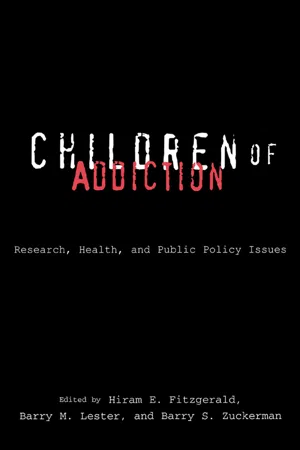
Children of Addiction reports important original research on the biological and psychological effects of addiction in children. The contributions are uniformly well written and reflect the larger social implications of the research undertaken. The book will be useful for a broad array of courses on alcoholism and/or drugs and behaviour in a variety of graduate level courses in education, medicine, psychology, psychiatry and public health and policy.
- 256 pages
- English
- ePUB (mobile friendly)
- Available on iOS & Android
eBook - ePub
Children of Addiction
About this book
Information
CHAPTER 1
Are There Dose Effects of Prenatal Cocaine Exposure on Children’s Bodies and Brains?
DEBORAH A.FRANK
MARILYN AUGUSTYN
MARK MIROCHNICK
TRIPLER PELL
BARRY S. ZUCKERMAN
Over the past decade, the study of the possible effects of prenatal cocaine exposure on child outcome has become increasingly sophisticated. The field emerged in the midst of a national controversy over “crack babies” and “pregnant addicts.” Popular opinion predicted the emergence of a “biologic underclass” of cocaine-exposed children. In large part, the public’s early apprehensions stemmed from the social associations of illicit drug use with criminality and a variety of gender and racially biased assumptions (Daniels, 1997; Neuspiel, 1996). Throughout the 20th century, cocaine use has not only been illegal, but associated in the public mind with deviancy, violence, and uncontrolled sexuality, particularly among African Americans (Neuspiel, 1996). In the scientific world, these social meanings were reflected in implicit assumptions that any amount of exposure to cocaine in pregnancy would have negative effects on the infant. In contrast, in the early literature on prenatal alcohol exposure, there was sustained controversy as to whether “social use” (i.e., level of use that is socially acceptable in nonpregnant adults) of alcohol in pregnancy—in the absence of maternal alcoholism—had negative effects on child outcomes (Forrest & Florey, 1991). The social associations of illicit drug use have continued to impact scientific research negatively through discriminatory public policies and increasingly punitive judicial law. For example, mothers are less likely to report drug use to researchers and health providers for fear of imprisonment and loss of child custody (Roberts, 1991).
In spite of ongoing public controversy, the scientific community has gradually developed a more balanced and informed approach to the study of illicit drug exposure in utero. Investigators are now addressing the problems posed by the interaction of possible drug dose effects with a variety of pharmacologic, biologic, and social variables (Frank, Augustyn, & Zuckerman, 1998). At various levels of cocaine exposure, these variables may confound, mediate, or moderate drug effects. However, despite these advances in research, there remain intrinsic methodological constraints in human studies. For example, it is still difficult to ascertain whether cocaine and other psychoactive substance exposures have occurred at all. Even more complex is the problem of determining gestational timing of exposure and the acute and cumulative doses to which the fetus was exposed. Understanding these constraints will facilitate an informed interpretation of available data and future study designs.
The goals of this chapter are twofold. First, the methodologic problems entailed in defining dose in studies of prenatal cocaine exposure in humans will be summarized. Established standards for evaluating dose of alcohol exposure will be used to illustrate the difficulties generic to the field of the effects of prenatal psychoactive substance exposure on child outcome. Second, available published data will be reviewed that link various definitions of dose of cocaine exposure with neonatal and later outcomes.
IDENTIFICATION OF COCAINE DOSE
A critical component of any study investigating the effects of prenatal drug use on infants is identification of drug-exposed and unexposed infants. An ideal method would not only identify all exposed infants but also reveal the magnitude and pattern of exposure. Unfortunately, ascertainment of drug use during pregnancy has proven to be difficult and complex in the absence of such a method. Currently, there are two classes of techniques available to ascertain exposure: maternal interview and biologic assays. Both techniques fall far short of an ideal method.
Maternal Interview
Many different methods, all with intrinsic limitations, have been used in research projects to identify human prenatal cocaine exposure. The first is ascertaining substance exposure based on maternal interviews conducted by clinicians and noted in medical records. This method has been proven to be imprecise, consistently identifying many fewer users than other methods. In two recent comparisons of maternal self-report with biologic assays, only 1/4 of mothers with positive biologic assays for illicit substances admitted prenatal drug use to obstetric clinicians (Kline, Schittini, Levin, & Susser, 1998; Ostrea, Brady, Gause, Raymundo, & Stevens, 1992).
Respondents are more likely to acknowledge cocaine use under research conditions, where trained interviewers offer stringent assurances of confidentiality (Frank et al., 1988; Richardson, Hamel, Goldschmidt, & Day, 1993). However, even under research conditions, maternal self-report is limited. Maternal self-report is lower than actual usage because of both denial (common among all substance-abusing populations) (Saitz, Mulvey, Plough, & Samet, 1997) and maternal fears of the consequences of admitting to illicit drug use, which may include the loss of child custody (Chavkin, Breitbart, Elimah, & Wise, 1998; Roberts, 1991). Hingson et al. (1986) have demonstrated that a disproportionate number of pregnant women are reluctant to admit to illicit (as compared to toxic although legal) drug use. In that study, mothers in a research project were administered a structured interview designed to determine prenatal drug use. Those mothers who were told that their urine samples would be tested for drug and alcohol use had an increased rate of reporting marijuana use but not alcohol and tobacco use. Even when aware of urine testing, significant numbers of drug-using pregnant women will deny use. Thus, reliance on self-report alone may cause enough misclassification of drug-exposed infants to obscure clinically important differences between drug exposed and unexposed infants (Zuckerman et al., 1989).
Some investigators have found that mothers respond more readily (and possibly more accurately) to questions about substance use before the recognition of pregnancy (Sampson, Bookstein, & Barr, 1994). By tacitly implying that the mothers’ substance use ceased once pregnancy was identified, this strategy obviates any possibility of using maternal report to quantify fetal substance exposure in the later stages of pregnancy, when potential detrimental effects on fetal growth are most likely to be found (Chasnoff, Griffith, MacGregor, Drikes, & Burns, 1989). Conversely, researchers in separate samples in Detroit (Jacobson et al., 1991) and Pittsburgh (Ernhart, Morrow-Tlucak, Sokol, & Martier, 1988) found that mothers acknowledge higher levels of alcohol use when questioned 1 or more years after the index pregnancy than they reported when they were asked prospectively during the pregnancy. The levels of use reported prospectively during pregnancy were more strongly associated with infant outcome in the Detroit sample (Jacobson et al., 1991). Although these findings could be due to recall bias, they may otherwise show that rank ordering of use is a more useful tool in identifying the relationship between exposure and outcome than attempting to quantify absolute amounts of exposure. Asking about use prior to recognition of pregnancy or asking well after the child’s birth may reduce the social pressure on the mothers to minimize reported substance use. Nevertheless, this approach has uncertain implications for predictive validity when compared with repeated interviews obtained during pregnancy or even single interviews conducted immediately postpartum.
Measures that were developed for quantifying alcohol use have served as the models for documenting illicit drug exposure. One measure is the Quantity- Frequency (Q-F) index of Strauss and Bacon (1953), which has been modified by Mulford and Miller (1960). This tool uses the average amount per drinking occasion as the measure of quantity but makes no distinction between patterns of drinking behavior. Thus, two people with extremely different drinking habits (for example, one binging on specific occasions and the other drinking moderately over a prolonged period) could achieve the same average quantity. These differing patterns of use could have widely disparate implications for maternal and fetal blood alcohol levels and potential fetal effects.
A second index, developed by Cahalan and Cisin (1967), is the Volume- Variability Index, which attempts to compare binge versus more frequent but less heavy drinking and holds the volume constant. The basic technique of this index entails a two-step operation: (a) to classify each respondent according to average daily volume and (b) to divide each of several daily-volume groups into subgroups according to how the daily intake varies. The latter scale is able to differentiate people who drink moderate amounts of alcoholic beverages regularly (in terms of each episode of consumption) from those who binge intermittently. This issue is further complicated when pregnant adolescents are included in the research. For adolescents, sociologic as well as physiologic criteria are used to demarcate standard measures. In one recent study (Midanik, Zahn, & Klein, 1998), pregnant adolescents younger than 20 years old were considered “at risk” if they drank five or more drinks on a single occasion at least once a month. Meanwhile, pregnant women above the age of 20 were defined as “at risk” if they drank five or more drinks on a single occasion at least twice a month. In this instance, a narrow demarcation of age significantly altered the criteria used to define “at risk” groups.
In epidemiologic studies, there are two major classification systems for rank ordering alcohol use. The first, used by the Department of Health and Human Services, defines drinking as light (up to one drink per occasion), moderate (more than one to three drinks), or heavy (more than three drinks). Frequency in this scheme is classified as light (less than 15 occasions per month), moderate (15 to 21 occasions per month), and heavy (21 or more occasions). Volume is classified as light (fewer than 21 drinks per month), moderate (22 to 29 drinks per month), and heavy (30 or more drinks per month) (Ashley et al., 1994).
A second classification system was developed for the 1988 National Health Interview Survey. This system used a weekly rather than monthly interval, defining light as fewer than 7 drinks per week, moderate as 7 to 13 drinks a week, and heavy as 14 or more drinks per week. Jacobson and Jacobson (1994), in a study of prenatal alcohol exposure, further subdivided these categories into “very light” (up to 3.49 drinks a week) and “very heavy” (28 or more drinks a week) consumption. In the Jacobson and Jacobson sample, while there was no increased incidence in functional impairments (test scores less than the 10th percentile) at levels of exposure below seven drinks a week, even “very light” exposure had statistically significant effects on mean Bayley Mental Developmental Index scores. This suggests that patterns of drinking that are not of health or functional concern for nonpregnant adults may have fetal effects. There are other measures (such as CAGE, DRUG CAGE, and TWEAK) (Russell, 1994) that do not measure frequency or quantity at all but seek only to elicit evidence of tolerance and negative health or social consequences for the adult substance user (which presumably occurs at different exposure doses for different individuals). These instruments probably detect use only at levels well above most postulated thresholds for fetal effects. A recent study (Stoler et al., 1998) demonstrated that two or more physiologic markers of alcohol use, measured in maternal blood during pregnancy, were more predictive of infant outcome than mothers’ self-report on the TWEAK (Russell et al., 1996).
The lack of standardization of potency and purity of illegal drugs further detracts from the usefulness of self-report. Even if a respondent is willing within the limits of memory to make every effort to provide an accurate account of her illicit substance use during pregnancy, the substance that she has used may vary from day to day, from place to place, or from year to year. Moreover, illicit drugs may be shared among a group of users, so that the amount ingested by any one user on a given occasion is difficult to estimate. In contrast, self-report of use of legal psychoactive substances such as ounces of wine or beer or number of cigarettes permits more accurate calculations of the average amount of alcohol or nicotine to which child and mother were exposed, regardless of where or when the substance was used. There is no such standardization for purity or potency in “lines” or “rocks” of cocaine. The composition and potency of Colombian cocaine may have changed in unpredictable ways by the time it is sold on the street in Columbus, Ohio. Moreover, respondents may be completely unaware of potential contaminants that have been introduced into illegal drugs, contaminants that may have active toxic effects of their own. Regardless of the accuracy of report of the dose ingested by the mother, the dose of substance transmitted to the fetus may be difficult to estimate accurately, depending on genetic variability in maternal and fetal metabolism of the drug and physiologic variability in placental detoxification and blood flow (Polin & Fox, 1992; Potter et al., 1994; Simone, Derewlany, Oskamp, Knie, & Koren, 1994).
Still, self-report should never be omitted from research on prenatal cocaine exposure because it also offers some unique advantages. First, clinical interviewing by a skilled interviewer is less biased than selective urine screening in clinical settings, which may be based on provider expectation of drug use rather than actual drug use (Chasnoff, Landress, & Barnett, 1990; Kline et al., 1997). Second, maternal report is the only way to ascertain lifetime use prior to conception or use in very early pregnancy before the pregnant woman presents herself to a health care setting. Self-report also identifies route of drug administration and whether the drug is used in a “binge” pattern (Ward, Haney, Fischman, & Foltin, 1997). Self-report can delineate patterns of simultaneous or sequential psychoactive substance use (e.g., cocaine and alcohol use), which also may have important physiologic implications (Perez-Reyes, 1994). Self-report is the only method that can detect use outside the time windows when biologic markers are valid. Urine reflects use only in the past 72 hours and meconium after 20 weeks of pregnancy. Furthermore, self-report instruments are cost-effective and readily available, and in medical or mental health settings they provide an opportunity for the mother to discuss with a clinician the potential benefits of and strategies for reducing or eliminating drug consumption.
There is currently no gold standard interview for estimating dose of cocaine exposure in pregnancy. Most of the standard self-report screening measures have been developed for clinical use for adult, nonchildbearing populations and are designed to identify “problem use” of alcohol or addiction to illegal drugs. These measures have been primarily validated in samples of users in advanced stages of drug or alcohol dependence who may be manifesting psychosocial or medical sequelae for the adult user. However, data on prenatal alcohol effects (Jacobson & Jacobson, 1994) suggest that negative effects of prenatal exposure to psychoactive substances may be seen on infant outcomes at levels of use far lower than those associated with DSM diagnoses of substance use disorders (Spitzer, Williams, Gibbon, & First, 1992).
Table 1.1 expands on standard interview formats for ascertaining alcohol and illicit substance use. In the study of illicit drug exposure in utero, a consensus has yet to evol...
Table of contents
- COVER PAGE
- TITLE PAGE
- COPYRIGHT PAGE
- PREFACE
- CONTRIBUTORS
- TABLES AND FIGURES
- CHAPTER 1 ARE THERE DOSE EFFECTS OF PRENATAL COCAINE EXPOSURE ON CHILDREN’S BODIES AND BRAINS?
- CHAPTER 2 PRENATAL COCAINE EXPOSURE AND CHILD OUTCOME
- CHAPTER 3 PARENTING AND PARENT-CHILD RELATIONSHIPS IN FAMILIES AFFECTED BY SUBSTANCE ABUSE
- CHAPTER 4 ASSESSING VULNERABILITY TO MODERATE LEVELS OF PRENATAL ALCOHOL EXPOSURE
- CHAPTER 5 THE TERATOLOGIC MODEL OF THE EFFECTS OF PRENATAL ALCOHOL EXPOSURE
- CHAPTER 6 THE CLINICAL AND SOCIAL ECOLOGY OF CHILDHOOD FOR CHILDREN OF ALCOHOLICS DESCRIPTION OF A STUDY AND IMPLICATIONS FOR A DIFFERENTIATED SOCIAL POLICY
- CHAPTER 7 AMERICAN INDIAN CHILDREN OF ALCOHOLICS
- CHAPTER 8 ALCOHOL AND DRUG USE AMONG AFRICAN-AMERICAN YOUTH
- CHAPTER 9 SUBSTANCE USE AND ABUSE OUTCOMES IN CHILDREN OF ALCOHOLICS FROM ADOLESCENCE TO YOUNG ADULTHOOD
Trusted by 375,005 students
Access to over 1.5 million titles for a fair monthly price.
Study more efficiently using our study tools.
Frequently asked questions
Yes, you can cancel anytime from the Subscription tab in your account settings on the Perlego website. Your subscription will stay active until the end of your current billing period. Learn how to cancel your subscription
No, books cannot be downloaded as external files, such as PDFs, for use outside of Perlego. However, you can download books within the Perlego app for offline reading on mobile or tablet. Learn how to download books offline
Perlego offers two plans: Essential and Complete
- Essential is ideal for learners and professionals who enjoy exploring a wide range of subjects. Access the Essential Library with 800,000+ trusted titles and best-sellers across business, personal growth, and the humanities. Includes unlimited reading time and Standard Read Aloud voice.
- Complete: Perfect for advanced learners and researchers needing full, unrestricted access. Unlock 1.5M+ books across hundreds of subjects, including academic and specialized titles. The Complete Plan also includes advanced features like Premium Read Aloud and Research Assistant.
We are an online textbook subscription service, where you can get access to an entire online library for less than the price of a single book per month. With over 1.5 million books across 990+ topics, we’ve got you covered! Learn about our mission
Look out for the read-aloud symbol on your next book to see if you can listen to it. The read-aloud tool reads text aloud for you, highlighting the text as it is being read. You can pause it, speed it up and slow it down. Learn more about Read Aloud
Yes! You can use the Perlego app on both iOS and Android devices to read anytime, anywhere — even offline. Perfect for commutes or when you’re on the go.
Please note we cannot support devices running on iOS 13 and Android 7 or earlier. Learn more about using the app
Please note we cannot support devices running on iOS 13 and Android 7 or earlier. Learn more about using the app
Yes, you can access Children of Addiction by Hiram E. Fitzgerald,Barry M. Lester,Barry Zuckerman in PDF and/or ePUB format, as well as other popular books in Education & Education General. We have over 1.5 million books available in our catalogue for you to explore.