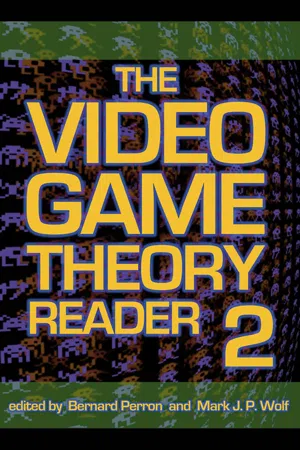
The Video Game Theory Reader 2 picks up where the first Video Game Theory Reader (Routledge, 2003) left off, with a group of leading scholars turning their attention to next-generation platforms-the Nintendo Wii, the PlayStation 3, the Xbox 360-and to new issues in the rapidly expanding field of video games studies. The contributors are some of the most renowned scholars working on video games today including Henry Jenkins, Jesper Juul, Eric Zimmerman, and Mia Consalvo. While the first volume had a strong focus on early video games, this volume also addresses more contemporary issues such as convergence and MMORPGs. The volume concludes with an appendix of nearly 40 ideas and concepts from a variety of theories and disciplines that have been usefully and insightfully applied to the study of video games.
eBook - ePub
The Video Game Theory Reader 2
- 456 pages
- English
- ePUB (mobile friendly)
- Available on iOS & Android
eBook - ePub
The Video Game Theory Reader 2
About this book
Information
CHAPTER 1
Gaming Literacy
Game Design as a Model for Literacy in the Twenty-First Century
ERIC ZIMMERMAN
Introduction: Literacy and Games from the Inside-out
Gaming literacy is an approach to literacy based on game design. My argument is that there is an emerging set of skills and competencies, a set of new ideas and practices that are going to be increasingly a part of what it means to be literate in the coming century. This essay’s proposal is that game design is a paradigm for understanding what these literacy needs are and how they might be addressed. I look at three main concepts—systems, play, and design—as key components of this new literacy.
Traditional ideas about literacy have centered on reading and writing—the ability to understand, exchange, and create meaning through text, speech, and other forms of language. A younger cousin to literacy studies, media literacy extended this thinking to diverse forms of media, from images and music to film, television, and advertising. The emphasis in media literacy as it evolved during the 1980s was an ideological critique of the hidden codes embedded in media. Media studies’ scholars ask questions like: Is a given instance of media racist or sexist? Who is creating it and with what agenda? What kinds of intended and unintended messages and meanings do media contain?
Literacy and even media literacy are necessary but not sufficient for one to be fully literate in our world today. There are emerging needs for new kinds of literacy that are simply not being addressed, needs that arise in part from a growing use of computer and communication networks (more about that below). Gaming literacy is one approach to addressing these new sorts of literacies that will become increasingly crucial for work, play, education, and citizenship in the coming century.
Gaming literacy reverses conventional ideas about what games are and how they function. A classical way of understanding games is the “magic circle,” a concept that originates with the Dutch historian and philosopher Johann Huizinga.1 The magic circle represents the idea that games take place within limits of time and space, and are self-contained systems of meaning. A chess king, for example, is just a little figurine sitting on a coffee table. But when a game of chess starts, it suddenly acquires all kinds of very specific strategic, psychological, and even narrative meanings. To consider another example, when a soccer game or Street Fighter II (Capcom, 1992) match begins, your friend suddenly becomes your opponent and bitter rival—at least for the duration of the game. While many social and cultural meanings certainly do move in and out of any game (for instance, your in-game rivalry might ultimately affect your friendship outside the game), the magic circle emphasizes those meanings that are intrinsic and interior to games.
Gaming literacy turns this inward-looking focus inside-out. Rather than addressing the meanings that only arise inside the magic circle of a game, it asks how games relate to the world outside the magic circle—how game playing and game design can be seen as models for learning and action in the real world. It asks, in other words, not What does gaming look like? but instead: What does the world look like from the point of view of gaming?
It is important to be very clear here: gaming literacy is not about just any kind of real-world impact—it is a specific form of literacy. So for the sake of specificity, here are some things that gaming literacy is not:
- Gaming literacy is not about “serious games”—games designed to teach you subject matter, such as eighth-grade algebra.
- Gaming literacy is not about “persuasive games” that are designed to impart some kind of message or social agenda to the player.
- Gaming literacy is also not about training professional game designers, or even about the idea that anyone can be a game designer.
Gaming literacy is literacy—it is the ability to understand and create specific kinds of meanings. As I describe it here, gaming literacy is based on three concepts: systems, play, and design. All three are closely tied to game design, and each represents kinds of literacies that are currently not being addressed through traditional education. Each concept also points to a new paradigm for what it will mean to become literate in the coming century. Together they stand for a new set of cognitive, creative, and social skills—a cluster of practices that I call gaming literacy.
I like the term “gaming literacy” not only because it references the way that games and game design are closely tied to the emerging literacies I identify, but also because of the mischievous double-meaning of “gaming,” which can signify exploiting or taking clever advantage of something. Gaming a system, means finding hidden shortcuts and cheats, and bending and modifying rules in order to move through the system more efficiently—perhaps to misbehave, but perhaps to change that system for the better. We can game the stock market, a university course registration process, or even just a flirtatious conversation. Gaming literacy, in other words, “games” literacy, bending and breaking rules, playing with our notions of what literacy has been and can be.
Systems
To paraphrase contemporary communication theory, a system is a set of parts that interrelates to form a whole. Almost anything can be considered a system, from biological and physical systems to social and cultural systems. Having a systems point of view (being systems literate) means understanding the world as dynamic sets of parts with complex, constantly changing interrelationships—seeing the structures that underlie our world, and comprehending how these structures function.
As a key component of gaming literacy, systems can be considered a paradigm for literacy in the coming century. Increasingly, complex information systems are part of how we socialize and date, conduct business and finance, learn and research, and conduct our working lives. Our world is increasingly defined by systems. Being able to successfully understand, navigate, modify, and design systems will become more and more inextricably linked with how we learn, work, play, and live as engaged world citizens.
Systems-based thinking is about process, not answers. It stresses the importance of dynamic relationships, not fixed facts. Getting to know a system requires understanding it on several levels, from the fixed foundational structures of the system to its emergent, unpredictable patterns of behavior. Systems thinking thereby leads to the kinds of improvisational problem-solving skills that will be critical for creative learning and work in the future. In part, the rise of systems as an integral aspect of our lives is related to the increasing prominence of digital technology and networks. But systems literacy is not intrinsically related to computers. The key to systems literacy is about a shift in attitude, not about learning technological skills.
If systems are a paradigm for an emerging form of literacy, what is the connection to games? Games are, in fact, essentially systemic. Every game has a mathematical substratum, a set of rules that lies under its surface. Other kinds of media, art, and entertainment are not so intrinsically structured. Scholars debate, for example, the essential formal core of a film—is it the script? The pattern of the editing over time? The composition of light and shadow in a frame? There is not one correct answer. But with games, there is the clarity of a formal system—the rules of the game. This formal system is the basis of the structures that constitute a game’s systems. More than other kinds of culture and media which have been the focus of literacy in the past, then, games are uniquely well-suited to teach systems literacy.
To play, understand, and—especially—design games, one ends up having to understand them as systems. Any game is a kind of miniature artificial system, bounded and defined by the game rules that create the game’s magic circle. Playing a game well to see which strategies are more effective, analyzing the game’s rules to see how they ramify into a player’s experience, and designing a game by playtesting, modifying the rules, and playtesting again, are all examples of how games naturally and powerfully lend themselves to systems literacy.
Play
Games are systems because at some level, they are mathematical systems of rules. But if games were just math, we would never have the athletic balletics of tennis, the bluffing warfare of poker, or the deep collaboration of World of Warcraft (Blizzard, 2004). Play is the human effect of rules set into motion, in its many forms transcending the systems from which it emerges. Just as games are more than their structures of rules, gaming literacy is more than the concept of systems. It is also play.
There is a curious relationship between rules and play. In the classical sense of a game as a magic circle, rules are fixed, rigid, and closed. They are logical, rational, and scientific. Rules really do not seem like much fun at all. But when rules are taken on and adopted by players who enter the magic circle and agree to follow the rules, play happens. Play in many ways is the opposite of rules: as much as rules are closed and fixed, play is improvisational and uncertain. Yet in a game, these two opposites find a common home—gameplay paradoxically occurring only because of game rules.
In Rules of Play, Katie Salen and I define play as free movement within a more rigid structure.2 Imagine play as the “free play” of a gear or steering wheel: the loose movement in an otherwise rigid structure of interlocking parts. The free play of a steering wheel is the distance it can move without engaging with the drive shaft, axle, and wheels—the more rigid utilitarian structures of the car. This free play only exists because of the more inflexible, functional structures of the automobile. Yet it also exists despite those structures. A joke, for example, is funny because of how it plays with the structures of language, creating subtle ironies, or double-meanings, or vulgar inappropriateness. The free play humor of a joke exists in opposition to the more rigid structures of earnest, ordinary language—yet is utterly dependent on these very structures for its play.
Yet, play is far more than just play within a structure. Play can play with structures. Players do not just play games; they mod them, engage in meta-play between games, and develop cultures around games. Games are not just about following rules, but also about breaking them, whether it is players creating homebrew rules for Monopoly (Charles B. Darrow, 1933), hacking into their favorite deathmatch title, or breaking social norms in classics like “spin the bottle” that create and celebrate taboo behavior.
Although play exists outside of games, games do provide one of the very best platforms for understanding play—from free play within a structure to the transformative play that reconfigures that structure. Any instance of a game is an engine designed to produce play, a miniature laboratory for studying play qua play.
So why is play an important paradigm for literacy in this century? Systems are important, but if we limit literacy to structural, systemic literacy, then we are missing part of the equation. When we move from systems to play, we shift focus from the game to the players, from structures of rules to structures of human interaction. Games as play are social ecosystems and personal experience, and these dimensions are key aspects of a well-rounded literacy.
As our lives become more networked, people are engaging more and more with structures. But they are not merely inhabiting these structures—they are playing with them. A social network like Wikipedia is not just a fixed construct like a circuit diagram. It is a fuzzy system, a dynamic system, a social system, a cultural system. Systems only become meaningful as they are inhabited, explored, and manipulated by people. In the coming century, what will become important will not be just systems, but human systems.
A literacy based on play is a literacy of innovation and invention. Just as systems literacy is about engendering a systems-based attitude, being literate in play means being playful—having a ludic attitude that sees the world’s structures as opportunities for playful engagement. What does it mean to play with institutional language, with social spaces, or with processes of learning? When these rules are bent, broken, and transformed, what new structures will arise?
Play emerges from more rigid systems, but it does not take those systems for granted. It plays with them, modifying, transgressing, and reinventing. We must learn to approach problem-solving with a spirit of playfulness; not to resist, but to embrace transformation and change. As a paradigm for innovation in the coming century, play will increasingly inform how we learn, work, and create culture.
Design
The notion of design connects powerfully to the sort of creative intelligence the best practitioners need in order to be able, continually, to redesign their activities in the very act of practice. It connects as well to the idea that learning and productivity are the results of the designs (the structures) of complex systems of people, environments, technology, beliefs, and texts.3
If gaming literacy were simply about systems and play, it would be a literacy based on games, not game design. But design, the third component of gaming literacy, is absolutely key, and in many ways helps bring the traditional idea of literacy as understanding and creating meaning back into the mix. There are many definitions of design, but in Rules of Play Katie Salen and I describe design as the process by which a designer creates a context, to be encountered by a participant, from which meaning emerges.4
Design as the creation of meaning invokes the magic circle: designers create contexts that in turn create signification. Although design comes in many forms, from architecture to industrial design, games happen to be incredibly well-suited for studying how meaning is made. Outside the game of rock/paper/scissors, a fist can mean many things. But inside the game, that gesture is assigned a highly specific significance, a defined meaning within the lexicon of the game’s language. The creation of meaning through game design is wonderfully complex. A game creates its own meanings (blue means enemy; yellow means power-up), but also traffics with meanings from the outside (horror film music in a shooter means danger is coming; poker means a fun evening with friends).
For a game designer, the creation of meaning is a second-order problem. The game designer creates structures of rules directly, but only indirectly creates the experience of play when the rules are enacted by players. As a game unfolds through play, metaplay, and transformative play, unexpected things happen, patterns that are impossible to completely predict. In this way, design is not about the creation of a fixed object. It is about creating a set of possibilities. The audience is always at least one step removed from the designer. Games embody this aspect of design in a very direct and essential way; even the most straightforward game of chess or The Sims (Maxis Software, 2000) is about players exploring the possibilities that they are given by a designed object. In a game, design mediates between structure and play; a game system is designed just so that play will occur.
Over and above game design’s affinity for the process of making meaning, it is also radically interdisciplinary. Making a game includes creating a formal system of rules, while also designing a human play experience for a particular cultural and social context. Game design involves math and logic, aesthetics and storytelling, writing and communication, visual and audio design, human psychology and behavior, and understanding culture through art, entertainment, and popular media. For video game design, computer and technological literacy become part of the equation as well.
As an exploration of process, as the rigorous creation of meaning, and as a uniquely interdisciplinary endeavor, game design represents multi-modal forms of learning that educators and literacy theorists have been talking about for years, perhaps most significantly in the publications of the New London Group (quoted at the start of this section, above). Game design, as the investigation of the possibility of meaning, truly gets at the heart of gaming literacy, and ties together systems, play, and design into a unified and integrated process.
Conclusion: A Playful World
As we arrive in the early years of the twenty-first century, the world is becoming increasingly transformed by communications, transportation, and information technology that is shrinking our globe, making it a place of cultural exchanges both constructive and destructive. Existing models of literacy simply do not fully address reality in the world today.
Gaming literacy is certainly not the only way to understand the emerging literacy needs I have identified. But games and game design are one promising approach, making use of a cultural form that is wildly popular and wildly varied, both incredibly ancient and strikingly con...
Table of contents
- Cover Page
- Title Page
- Copyright Page
- Foreword
- Acknowledgments
- Introduction
- 1. Gaming Literacy: Game Design as a Model for Literacy in the Twenty-First Century
- 2. Philosophical Game Design
- 3. The Video Game Aesthetic: Play as Form
- 4. Embodiment and Interface
- 5. Understanding Video Games as Emotional Experiences
- 6. In the Frame of the Magic Cycle: The Circle(s) of Gameplay
- 7. Understanding Digital Playability
- 8. Z-axis Development in the Video Game
- 9. Retro Reflexivity: La-Mulana, an 8-Bit Period Piece
- 10. “This is Intelligent Television”: Early Video Games and Television in the Emergence of the Personal Computer
- 11. Too Many Cooks: Media Convergence and Self-Defeating Adaptations
- 12. Fear of Failing? The Many Meanings of Difficulty in Video Games
- 13. Between Theory and Practice: The GAMBIT Experience
- 14. Synthetic Worlds as Experimental Instruments
- 15. Lag, Language, and Lingo: Theorizing Noise in Online Game Spaces
- 16. Getting into the Game: Doing Multidisciplinary Game Studies
- Appendix: Video Games through Theories and Disciplines
- Bibliography
- About the Contributors
Trusted by 375,005 students
Access to over 1.5 million titles for a fair monthly price.
Study more efficiently using our study tools.
Frequently asked questions
Yes, you can cancel anytime from the Subscription tab in your account settings on the Perlego website. Your subscription will stay active until the end of your current billing period. Learn how to cancel your subscription
No, books cannot be downloaded as external files, such as PDFs, for use outside of Perlego. However, you can download books within the Perlego app for offline reading on mobile or tablet. Learn how to download books offline
Perlego offers two plans: Essential and Complete
- Essential is ideal for learners and professionals who enjoy exploring a wide range of subjects. Access the Essential Library with 800,000+ trusted titles and best-sellers across business, personal growth, and the humanities. Includes unlimited reading time and Standard Read Aloud voice.
- Complete: Perfect for advanced learners and researchers needing full, unrestricted access. Unlock 1.5M+ books across hundreds of subjects, including academic and specialized titles. The Complete Plan also includes advanced features like Premium Read Aloud and Research Assistant.
We are an online textbook subscription service, where you can get access to an entire online library for less than the price of a single book per month. With over 1.5 million books across 990+ topics, we’ve got you covered! Learn about our mission
Look out for the read-aloud symbol on your next book to see if you can listen to it. The read-aloud tool reads text aloud for you, highlighting the text as it is being read. You can pause it, speed it up and slow it down. Learn more about Read Aloud
Yes! You can use the Perlego app on both iOS and Android devices to read anytime, anywhere — even offline. Perfect for commutes or when you’re on the go.
Please note we cannot support devices running on iOS 13 and Android 7 or earlier. Learn more about using the app
Please note we cannot support devices running on iOS 13 and Android 7 or earlier. Learn more about using the app
Yes, you can access The Video Game Theory Reader 2 by Bernard Perron, Mark J.P. Wolf, Bernard Perron,Mark J.P. Wolf in PDF and/or ePUB format, as well as other popular books in Social Sciences & Media Studies. We have over 1.5 million books available in our catalogue for you to explore.