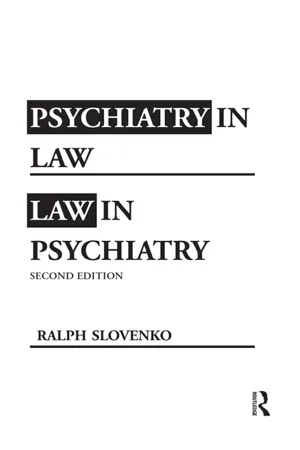
Psychiatry in Law/Law in Psychiatry, 2nd Edition, is a sweeping, up-to-date examination of the infiltration of psychiatry into law and the growing intervention of law into psychiatry. Unmatched in breadth and coverage, and thoroughly updated from the first edition, this comprehensive text and reference is an essential resource for psychiatry residents, law students, and practitioners alike.
- 816 pages
- English
- ePUB (mobile friendly)
- Available on iOS & Android
eBook - ePub
Psychiatry in Law / Law in Psychiatry, Second Edition
PART I
Expert Testimony
1
Experts in the Adversary System
The adversary system is the distinguishing characteristic of Anglo-American justice, along with the importance attached to formal rules of evidence. The continental legal procedure, on the other hand, is without the formalism found in the Anglo-American system. Objections, such as “inadmissible evidence,” “hearsay,” “opinion,” or “leading question,” customary in an Anglo-American trial, are unknown in a continental trial. In Anglo-American law, the key to a fair trial is not only the presentation of evidence according to formal rules of evidence, but also the opportunity to use cross-examination, rebuttal evidence, and argument to meet adverse evidence. A cross-examining procedure, guaranteed by the confrontation clause of the Sixth Amendment to the U.S. Constitution, is at the very heart of the adversary system.
The adversary proceeding, in an impartial and public forum, provides a mechanism by which differences can be settled in a decision-making process that people generally trust. It provides a means of making even big government and big business accountable. The ability to assert a legal right in a proceeding where an individual has reasonable equality with his opponent buttresses self-image and sense of worth. It is the modern-day scene where David may defeat Goliath. To be sure, there are critics, particularly among losers. Charlie Chaplin in his autobiography said of the paternity suit that ruled against him, “Listening to the legal abracadabra of both attorneys, it seemed to me a game they were playing and that I had little to do with it.”
Under the adversary system, the judge acts as arbiter to assure conformity to the rules of fair play that have evolved over time. The jury then decides the issues on the basis of those facts which the judge as a gatekeeper permits them to hear. Simply put, the adversary system is a process of contention in which the role of the lawyer is to initiate suit following the dispute, raise the issues, and propel the controversy. The judge does not venture forth like a Don Quixote seeking justice as he does under the inquisitorial system, which prevails in most countries. The inquisitorial judge has the responsibility to arrive at the truth by his own exertions in conjunction with those of the official prosecutor. Experimental studies lend support to the claim that an adversary form of presentation, in contrast to an inquisitorial presentation, counteracts bias in decision makers.
The physical setting of the courtroom reflects the system of justice. Under the adversary system, in civil and criminal cases, the chairs of the parties in the courtroom are situated on the same level, without benefit of elevation above the floor, and are equidistant from the judge. The parallel location of the parties is designed to indicate to judge and jury that the word of one counsel—prosecutor (plaintiff in civil cases) or defense counsel—carries no more weight than that of the other. The scales of justice are thus held evenly. In countries employing the inquisitorial system, the prosecutor has a place well above that of the defense counsel, and he carries, by virtue of that location, a certain majesty, hardly distinguishable from that of the judge. In all systems, a judge sits elevated, a position communicating dominance or superiority, representative of his symbolic authority and the finality of judgment under law.
In the Anglo-American adversary proceeding, the rules governing the action are as formal and ritualistic as those of an ancient tournament or a game of chess. Each side is charged with presenting the strongest possible case on its own behalf and expects to be countered with the strongest possible case by the adversary, creating conditions like those of an ancient tournament. The adversary proceeding requires that the lawyers, like gladiators, carry out their task in a fair or sporting manner.
The adversary system is based on the theory that truth (or viewpoints) emerges best out of the open combat of ideas. While physicians are trained to discover medical truth, lawyers are trained to represent any point of view. The theory of the adversary system, as Professor Edmund Morgan once put it, is that “each litigant is most interested and will be most effective in seeking, discovering, and presenting the materials that will reveal the strength of his own case and the weakness of his adversary’s case, so that the truth will emerge to the impartial tribunal that makes the decision.”1 Richard A. Posner, the venerable chief judge of the U.S. Court of Appeals for the Seventh Circuit, views the adversary system as relatively efficient—not ideal by any means, but better for Americans than feasible alternatives. In general, Judge Posner likes its competitiveness and the incentives it provides, and he supports the lay jury.2
The adversary system is also employed in nonlaw forums. The American Psychiatric Association at its annual meetings uses an adversary system to debate topics such as whether “depressive personality is a useful construct that should be included in DSM-IV (Diagnostic and Statistical Manual of Mental Disorders, 4th edition).” In the Roman Catholic Church, a postulator (a priest assigned to investigate the possibility that someone is a saint) goes before a church tribunal to argue the case for sainthood against another priest whose job is popularly known as “the devil’s advocate.”
The Widening Use of Expert Testimony
The potential use of expert testimony expands with wider knowledge of the world and as the world becomes more complicated. In the film Bananas, Woody Allen is a products tester trying out electrically heated toilet seats and coffins with piped-in music. As the modern age continues to become more complex, it is not surprising that modern litigation requires more expert opinion evidence than ever before. Not only is reliance on expert witnesses increasing, but new types of experts are developing.
At a time when trial by jury was not much developed, only two modes of using expert knowledge existed: first, to select as jurymen such persons as were especially fitted by experience to know the class of facts that were before them and, second, to call to the aid of the court skilled persons whose opinions it might adopt. The existence of the judge’s power to call witnesses generally included the power to call expert witnesses who were regarded originally as amici curiae (friends of the court).
Technological advances along with the liberalization of the rules of evidence have prompted the use of a wider range of experts. In complex and technical cases, the expert is often crucial because the evidence is beyond the ken of the jury, but even in a single slip-and-fall case an expert may be used to establish the way premises are usually maintained. As recent as 30 years ago, nearly all tort cases were very simple. There was virtually no medical malpractice and mass injury, which today constitutes 40% of cases. New technologies have created “high stakes” litigation calling for expert testimony. As a consequence, the use of expert witnesses in recent years has been growing rapidly, but their use in courts is far from new. A 17th century treatise numbered as experts only five: locksmiths, cutlers, peruke makers, washerwomen, and rope makers.3 Earlier courts called on physicians to help determine whether a defendant was “bewitched.”
The concept of “expert” in litigation, however, does not necessarily mean being at the top in one’s field. It includes anyone whose knowledge of a subject extends beyond that of the average juror. By legal definition, an “expert” is almost anybody who can reasonably be expected to know more about a given subject than the average person. As Rule 702 of the Federal Rules of Evidence puts it, anyone with “knowledge, skill, experience, training, or education” who can assist the trier of fact may qualify as an expert. Sometimes the choice of an expert may seem bizarre—a narcotics user has testified as an expert to the identification of a drug;4 an “expert burglar” has qualified as an expert witness.5 The court’s ruling on the competency of the expert falls within its broad discretion and is reviewed under the abuse of discretion standard. The court’s ruling is not reversed absent a showing of a clear abuse of discretion. The more complicated the expertise, the more likely the court is to be demanding about qualifications.
Along with the growing complexity of life, the liberalization of expert testimony rules in the last decade has had a prolific effect on the use of experts. Unlike an ordinary witness, an expert may now not only testify in the form of an opinion or otherwise, about the past or the future, but, in forming an opinion, rely on inadmissible evidence, such as hearsay, if “reasonably relied upon by experts in the particular field” (subject to the amendment in 2000 to Rule 703 as discussed in Chapter 2).6 Evidence though relevant may be excluded, however, if it is likely to be confusing or misleading. The test, under Rule 403, is whether the probative value of the evidence is substantially outweighed by the danger of “confusion of the issues or misleading the jury.”
A number of critics have charged that psychiatrists (and psychologists) have no useful place in the courtroom. These critics say that psychiatrists cannot answer forensic questions with reasonable accuracy, and they cannot help the fact-finder reach more accurate conclusions than would otherwise be available. In fact, they claim, the involvement of psychiatrists as expert witnesses is not only not helpful, but actually harmful as they mislead by testimony that has little scientific underpinning.7
In criminal trials, where so much controversy surrounds psychiatric testimony, we must recall that a trial is very much a morality play. A trial without a psychiatrist is usually dull—indeed, without psychiatric testimony, jurors tend to go to sleep. Psychiatric testimony makes headlines. The public wants some understanding of why the accused acted as he did. Without psychiatric testimony trials are not very interesting or satisfying. Indeed, the press even insists on obtaining and printing off-the-cuff comments by psychiatrists on any and all facets of life and behavior.
The “battle of the experts,” as it is called, heightens tension, prompting the trier of fact to pay attention. It stimulates thought; it enhances the deliberations. The evidence can serve as a guideline that the jurors can integrate with their own moral, social, philosophical, and religious backgrounds to arrive at an appropriate decision.8
Psychiatric testimony, whether or not accepted, opens options to judge and jury. It brings flexibility and an element of humanity into the law. The jury, following their conviction of Jean Harris for the killing of the Scarsdale diet doctor, Dr. Herman Tarnower, wondered why no psychiatric testimony was presented. The jury wanted some excusing evidence, though it may have been conflicting, but got none. Whether in a given case judge or jury accepts or declines evidence is for them to decide, but without some testimony they may not be able to rationalize a decision they would like to return. The scale is the symbol of justice, but measurement alone would subvert the nature of a trial as a morality play. A trial, of course, has more to do with justice than show business, but a trial (especially a criminal trial) is, in large measure, a morality play.
The Doctrine of Judicial Notice
While the parties, and not the court, are responsible under the adversary system for gathering and presenting facts, there are many facts that need to be supplemented or cannot be established by formal proof. The doctrine of judicial notice recognizes the right or the necessity of the judge to notice evidence outside the record which is “a matter of general knowledge.” The judicial notice apparatus, however, does not work well unless it is fed with information. Judge Frank of the Second Circuit once observed that judicial notice often amounts to nothing more than “cocktail hour knowledge.” He suggested that “competently to inform ourselves, we should have a staff of investigators like those supplied to administrative agencies.”9
Almost any case can be used to illustrate the need for, and the propriety of, supplying the court with information. The usual method of establishing adjudicative facts—the facts of the particular case—is through the introduction of evidence, ordinarily cons...
Table of contents
- Cover
- Halftitle
- Title
- Copyright
- In memory
- Contents
- Preface
- Introduction: The Intermix of Psychiatry and Law
- PART I. Expert Testimony
- PART II. Evidentiary Issues
- PART III. Criminal Cases
- PART IV. Sexual Deviation
- PART V. Civil Cases
- PART I. Hospitalization of the Mentally Ill
- PART II. Psychiatric Malpractice
- Case Index
- Name Index
- Subject Index
- Acknowledgments
- About the Author
Trusted by 375,005 students
Access to over 1.5 million titles for a fair monthly price.
Study more efficiently using our study tools.
Frequently asked questions
Yes, you can cancel anytime from the Subscription tab in your account settings on the Perlego website. Your subscription will stay active until the end of your current billing period. Learn how to cancel your subscription
No, books cannot be downloaded as external files, such as PDFs, for use outside of Perlego. However, you can download books within the Perlego app for offline reading on mobile or tablet. Learn how to download books offline
We are an online textbook subscription service, where you can get access to an entire online library for less than the price of a single book per month. With over 1.5 million books across 990+ topics, we’ve got you covered! Learn about our mission
Look out for the read-aloud symbol on your next book to see if you can listen to it. The read-aloud tool reads text aloud for you, highlighting the text as it is being read. You can pause it, speed it up and slow it down. Learn more about Read Aloud
Yes! You can use the Perlego app on both iOS and Android devices to read anytime, anywhere — even offline. Perfect for commutes or when you’re on the go.
Please note we cannot support devices running on iOS 13 and Android 7 or earlier. Learn more about using the app
Please note we cannot support devices running on iOS 13 and Android 7 or earlier. Learn more about using the app
Yes, you can access Psychiatry in Law / Law in Psychiatry, Second Edition by Ralph Slovenko in PDF and/or ePUB format, as well as other popular books in Law & Medical Law. We have over 1.5 million books available in our catalogue for you to explore.