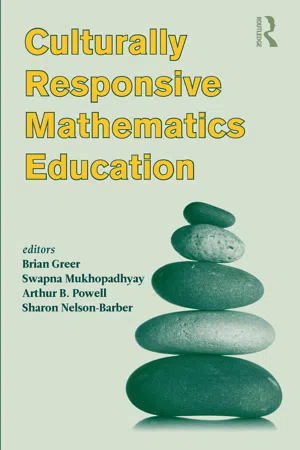
At a time of rapid demographic change and amidst the many educational challenges facing the US, this critical new collection presents mathematics education from a culturally responsive perspective. It tackles the most crucial issues of teaching mathematics to an ethnically diverse school population, including the political dimension of mathematics education within the context of governmental efforts to improve achievement in school mathematics. Culturally Responsive Mathematics Education moves beyond a point of view that is internal to mathematics education as a discipline, and instead offers a broad perspective of mathematics as a significant, liberating intellectual force in our society. The editors of this volume bring together contributions from many of the leading teachers, teacher educators, researchers, scholars, and activists who have been working to reorient mathematics education in ways that reflect mathematics education as accomplished, first and foremost, through human interactions.
eBook - ePub
Culturally Responsive Mathematics Education
- 400 pages
- English
- ePUB (mobile friendly)
- Available on iOS & Android
eBook - ePub
Culturally Responsive Mathematics Education
About this book
Information
I
Foundations and Backgrounds
1 Culture and the Development of Mathematics
An Historical Perspective
FRANK J. SWETZ
History as a record of human achievement can tell us many things. It can relate what we’ve accomplished, isolate prerequisites, and in a sense, indicate how we have arrived at our present state of being. The history of a specific intellectual activity, such as mathematics, can do the same. It can answer many questions, such as, When did this mathematics come into being? How was it used? Who was responsible for it? But history is more than a quiz game, more than merely an accumulation of facts, names, and chronologies. Any substantial investigation of the history of mathematics should also seek to reveal and understand the forces and conditions that shape, nurture, and sustain mathematical thinking: How do humans perceive mathematical reality? Why do certain mathematical concepts come into being? What factors affect the transcendence of mathematics from a purely utilitarian activity to an abstract object of speculation and conjecture? As individuals move from the realm of self to the collective embrace of larger social groups, constraints are imposed on their perceptions of reality. They are indoctrinated into the rituals, beliefs, and traditions of the group. In the case of mathematics, a child is born with certain basic inherent mathematical capacities. Research has revealed that a newborn infant has a number sense and can discriminate and identify the number of objects in a visual array up to about four and perceives space in a topological manner; that is, identifying and understanding such spatial properties as connectedness and continuity (Butterworth, 1999; Dehaene, 1997; Van Loosbrock & Smitsman, 1990). As these basic mathematical abilities evolve, they and their expressions are modified by a series of internally and externally applied filters. Personal sensory experience is shaped by particular physical environments. Certainly, a child living in a dense jungle will develop different spatial perceptions from a peer living in a desert or on a Pacific atoll (Bishop, 1979). Quite simply, they will experience and see the “world” differently as their worlds are different. An individual’s sensory perceptions are readily modified by cultural constraints imposed by the immediate family, clan, or tribe and “traditions.” Further, consuming societal constraints allow for larger, approved social interactions, which bring economic and political considerations into play. Finally, even as a pure intellectual activity abstractly manipulated, mathematics, to be officially recognized, must adhere to formal systems of analysis and expression established by the mathematics community. In this hierarchy of influences, very early on and persistently thereaft er, cultural constraints form a foundation upon which higher levels of conceptual interactions must build. It has been said that “culture makes a person what they are,” so too, with mathematics, culture has played a long role in its development (Saxe, 1991). Let us now attempt to examine this relationship between culture and mathematics.
Defining the Task
Epigraphical records of human endeavors only extend back in history for about 3,000 years, a mere fraction of the time period humans have inhabited the earth. In attempting to understand our ancestors’ actions before this time we must rely on conjecture and speculation. In their attempt to do this mathematically, historians must rely on the work of anthropologists, linguists, psychologists, educators, and sociologists and their own experience. These disciplines tell us something of how a people might have lived, functioned, and thought. Ongoing research is revealing how ancient peoples, formerly called “savage” or “primitive,” were neither. At least for the last 30 millenniums, they had well-developed brains, were efficient innovators, functioned with in complex social structures, possessed aesthetic sensibilities, and followed coherent systems of ritual and beliefs. The discovery and examination of a well-preserved Neolithic hunter on the ItalianAustrian border in 1991 further affirmed the similarities between our distant ancestors and us (Fowler, 2000). I will refer to such people who have no written history and lived or live in a preindustrial society, close to nature, as traditional people. Using the information supplied by scientific observers of today’s existing traditional peoples we are able to project back traits, practices, and beliefs that our ancestors who lived in a similar manner might have experienced. Thus, using information on the traditional societies of today, we can obtain valuable insights on the approximate behavior of our distant ancestors (Sizer, 1991). In a similar but reverse manner, knowledge of the social and cultural interactions of the contemporary world can assist in interpreting and understanding past historical movements and developments. However, such transitional retrospection must be carefully applied lest the reviewer “see” mathematics where none is being exhibited. The mathematics must not be “ours” but theirs. The manifestation of mathematics must be justified as being possessed by the subject rather than imagined by the reviewer. Of course such retrospection raises relevant and valuable questions in our case: What is mathematics? Is it the ability to weave a basket or is it the ability to purposefully decorate that basket with geometric patterns involving parallelism and the concept of similarity? For this discussion, let us define mathematical activity as a conscious, systematic effort, a demonstration of an internalized concept that deals with the quantification and partitioning of objects and space in the environment. This definition then gives rise to various specific categories of activities that can more easily be recognized and commented upon:
- Enumeration
- Measurement
- Employment of geometric forms and relationships
From each category specific phenomena can be identified and examined more closely: number words, units of measure, decorative geometric patterns, and so on.
As for the cultural dimension of mathematics, this will be considered the “natural mathematics” of a people, that is, the mathematics they evolve, in isolation from external, dominating human influences, to survive and thrive in their particular environments. Sometimes this natural mathematics has been referred to as “cultural mathematics” or “ethnomathematics.” This latter term has been coined by Ubiratan D’Ambrosio, a Brazilian mathematics educator, in his attempts to come to an understanding of the role of culture in mathematical understanding, teaching, and learning (D’Ambrosio, 1985). His conception of ethnomathematics is closely related to the natural mathematics we will examine in that it is the mathematical beliefs, practices, and traditions accumulated with in a primary human grouping such as a family, clan, or tribe bereft of the formal educational intervention of a comprehensive society. It is how a people collectively work out mathematics for themselves (Ascher, 2002). Their methods may be judged inefficient by outside standards but such judgments are irrelevant. Nor should the concept of natural mathematics be solely relegated to preliterate or preindustrial societies. Methods and concepts of natural mathematics can evolve in children’s games, work tasks, or neighborhood practices. Mathematics is a cultural phenomenon. It reflects the culture it serves and, in turn, is shaped by that culture. Cultural trends in mathematics are constantly evolving.
A Cultural Understanding of Enumeration
One of the basic mathematical activities of a people is to count, that is, to recognize cardinality as a property of a set and to communicate that cardinality with a number word or gesture. Technically, counting involves the establishment of a one-to-one correspondence between a set of objects and a sequential set of words or symbols designating numbers. These definitions are formal definitions that associate counting with enumeration—the assigning of number names (words) to a specify quantity, a sequential coding. They also allow for a use of written symbols, numerals, or physical gestures—two fingers extended to communicate “twoness.” But does counting have to involve an outward expression? Can it be a completely internalized conceptualization based on recognition of difference other that cardinality? For example, when a mother is asked how many children she has, she will frequently answer by naming them: ‘There’s Alice, Sara, and Mark.” She has answered the question in a more personal manner than by merely saying “three.” She has identified each child by name and in so doing also conveyed the sex of the child and cardinality of the set of her children. Note, in this case, she has used a one-to-one correspondence. This is an example of qualitative counting where one knows the objects of concern so personally that cardinality as a descriptor is irrelevant. This explanation may sound strange but this concept of qualitative counting provides an understanding of the development of number words and systems. Anthropologists, particularly early in the 20th century, oft en reported how “primitive people” lacked a number sense and did not know how to count. For example, A.C. Haddon, reporting on his observations among the western tribes of the Torres Straits (1890), noted they had no written language and a limited counting system. Their counting words were:
- urapun
- okosa
- okosa-urapun
- okosa-okosa
- okosa-okosa-urapun
- okosa-okosa-okosa
Everything greater than six was termed ras. This example of limited number recognition and ability was repeated well into the 20th century, oft en by noted scholars in the history of mathematics. Citing the research of Levi L. Conant (1863), David Eugene Smith, the American pioneer in the history of mathematics, made such a mistake (Smith, 1958, p. 7). However, his colleague, John Dewey (1896), found much fault with Conant’s conclusions. Such biases were perpetuated by early European ethnographic studies. Anthropology was a new field of study and its followers were attracted to Darwin’s theories of social evolution. For the Victorians, it was the time of realizing “the White man’s burden”; that is, the civilizing of the savage. In 1863, John Crawford, President of the Ethnological Society of London, devised a “scale of civilization” whereby cultures of the world were ranked according to the extent of their number vocabulary. Such a theory ignores cultural and societal priorities. Why should a people have an extensive number system? What do they wish to count? These are questions that must be considered when discussing counting abilities. In the sense that we usually understand it, counting is an abstract process dependent on pattern recognition and ordering. A systematic number sequence or code is devised and memorized. It depends on the use of a base, a convenient reference grouping. The decimal system we employ has a base 10. More perceptive research and experience has shown that traditional peoples rely on a mixture of qualitative and quantitative counting. For the most part, their world is limited in possessions—they know their possessions and the individuals around them. My own discovery of this fact came when I was living among the Iban people of Sarawak on the island of Borneo. Pigs are a source of food and a prized possession. In making polite conversation with an old woman, I asked how many pigs she owned. My query was met with a shrug. Pressing on, I counted for her in Malay, a mutually understandable language, and hoped for a corresponding sign of recognition. There was none! Aha, I thought, now I have experienced the aborigine’s inability to count. But then she brought me outside among the pigs lying around the longhouse and pointed to her particular pigs, all eight of them. She knew them as individuals and as a group. The cardinality, number of, the set was unimportant. In almost all cultures, there are words for one and two, quantities that hold particular psychological significance. One represents self, the individual, being, and existence; two represents “other,” contention, and competition. Philosophical and mystical systems have been devised on this principle of duality: male, female designation for objects, such as the Chinese cosmological worldview based on yin-yang. One is the builder of numbers, a creator; each successive number is numerically arrived at by adding one. Early cultures recognized this relationship, in fact the ancient Greeks and Chinese did not consider, one, itself, as a number but rather the builder of numbers. It is interesting that in 1889 when the Italian mathematician, Giuseppe Peano (1843–1930), formalized a theory for the mathematical construction of the counting numbers, he used one as the builder of the set. Shortly beyond the use of “one” and “two,” for the needs of higher quantification, traditional people resort to qualitative counting. Usually this vocabulary is richer and more informative than mere number names. Often the words themselves imply a cardinality whose familiarity is obtained by experience. For example, in the English language, we use the word pair to indicate a grouping of two when referring to certain objects such as shoes, socks, or bookends. But two people become “a couple,” two game birds “a brace,” and two oxen “a yoke.” Consider some available words to describe a collection of people: a gathering; a crowd; a mob; an audience; a congregation. All these words indicate cardinality greater than two but they also bear a certain nuance: a crowd is bigger than a gathering. Further, they describe the group in some manner: a mob is agitated; a congregation is a gathering for worship; and an audience is prepared to listen. So each word is a busy and multifaceted means of communication. Similar examples can be found in many cultures. Laplanders have 40 words for snow and in the Ukraine there are 20 words to describe a man’s mustache, an indicator of male vanity.
So too with our ancestors, they probably used multipurpose words that conveyed cardinality (number) and also carried a qualitative dimension. Further, traditional people oft en employ special classes of adjectival modifiers that enhance their enumerative associations. Such words are known as numerical classifiers. Vestiges of such modifiers are found in early Arabic, Greek, Hebrew, and Sanskrit and some are still used today in China, Japan, Southeast Asia, and in Oceanic languages (Denny, 1979; Omar, 1972). For example, in the Malay language, the word for long sticklike objects would be preceded by the adjective batang and small round objects by biji:
sebatang rokok se: one; batang: long, thin: rokok: cigarette
duabiji telur dua: two; biji: small, round; telur: eggs
It has been reported that the Dioi people of Southern China employ the use of 55 numerical classifiers. The addition of such modifiers in language usage results in the production of concise, efficient descriptive/enumerative phrases. Such refinements of the categorization process and the relationships obtained lend themselves to the tasks of mathematical thinking.
All evidence indicates that the human counting process proceeded from the concrete, the use of counters (pebbles, fingers, sticks, etc.), to the semiabstract, the use of tally marks, to the abstract formal systems of symbols and words to describe numbers (Flegg, 1987). The verbalization of number concepts came late in this process. But even the use of verbalization does not guarantee the existence of an abstract number sense devoid of concrete connections. For example, at the turn of the 19th century, it was discovered that the Thimshian/Tsimshian people of British Columbia possessed seven counting systems, eac...
Table of contents
- Cover Page
- Title Page
- Copyright Page
- Foreword
- Acknowledgments
- Introduction
- Part I Foundations and Backgrounds
- Part II Teaching and Learning
Trusted by 375,005 students
Access to over 1.5 million titles for a fair monthly price.
Study more efficiently using our study tools.
Frequently asked questions
Yes, you can cancel anytime from the Subscription tab in your account settings on the Perlego website. Your subscription will stay active until the end of your current billing period. Learn how to cancel your subscription
No, books cannot be downloaded as external files, such as PDFs, for use outside of Perlego. However, you can download books within the Perlego app for offline reading on mobile or tablet. Learn how to download books offline
Perlego offers two plans: Essential and Complete
- Essential is ideal for learners and professionals who enjoy exploring a wide range of subjects. Access the Essential Library with 800,000+ trusted titles and best-sellers across business, personal growth, and the humanities. Includes unlimited reading time and Standard Read Aloud voice.
- Complete: Perfect for advanced learners and researchers needing full, unrestricted access. Unlock 1.5M+ books across hundreds of subjects, including academic and specialized titles. The Complete Plan also includes advanced features like Premium Read Aloud and Research Assistant.
We are an online textbook subscription service, where you can get access to an entire online library for less than the price of a single book per month. With over 1.5 million books across 990+ topics, we’ve got you covered! Learn about our mission
Look out for the read-aloud symbol on your next book to see if you can listen to it. The read-aloud tool reads text aloud for you, highlighting the text as it is being read. You can pause it, speed it up and slow it down. Learn more about Read Aloud
Yes! You can use the Perlego app on both iOS and Android devices to read anytime, anywhere — even offline. Perfect for commutes or when you’re on the go.
Please note we cannot support devices running on iOS 13 and Android 7 or earlier. Learn more about using the app
Please note we cannot support devices running on iOS 13 and Android 7 or earlier. Learn more about using the app
Yes, you can access Culturally Responsive Mathematics Education by Brian Greer, Swapna Mukhopadhyay, Arthur B. Powell, Sharon Nelson-Barber, Brian Greer,Swapna Mukhopadhyay,Arthur B. Powell,Sharon Nelson-Barber in PDF and/or ePUB format, as well as other popular books in Education & Education General. We have over 1.5 million books available in our catalogue for you to explore.