1
INTRODUCTION
What a piece of work is man! How noble in reason! how infinite in faculties! in form and moving, how express and admirable! in action how like an angel! in apprehension, how like a god! the beauty of the world! the paragon of animals!
—William Shakespeare, from Hamlet (II, ii, 115–117)
THE AMAZING HUMAN
The preceding quote from Shakespeare eloquently describes the incredible capabilities of human beings. If you stop and think about it for moment, we really are amazing creatures. Our physical feats are quite varied. We can run, swim, and climb. But beyond this, we have the ability to perceive the world through senses like vision and audition, to think and solve problems, and to experience emotions such as joy and sadness. The list of such abilities goes on and on. How is it that we do all these things?
One gets a sense of how difficult even simple human abilities are when we try to recreate them using technology. Take the example of reaching out to pick up a pen. This seemingly simple action requires a tremendous amount of skill. You first have to look out at the world and identify the pen from a complex visual scene containing numerous other objects. You then need to guide your arm toward the pen’s location and grasp it. The grasping action alone involves a complex sensorimotor process in which tactile feedback from the fingers is used to maintain a grip and prevent the pen from slipping. Now imagine designing a machine that can do all of this. Researchers in artificial intelligence (AI) and robotics are only just now developing machines capable of such actions.
If grabbing a pen seems so hard, then you might think we are centuries away from getting machines to perform some of our other supposedly more advanced capacities. Can we ever create a machine that is creative and able to write poems or paint pictures? What about a machine that can understand what we say and talk back to us? Or a machine that is aware of itself and the world around it? The purpose of this book is to show that many of the abilities we consider to be human, even uniquely human, may be difficult but at least not in principle impossible for us to construct.
WHAT DOES IT MEAN TO BE HUMAN?
What does it mean to be human? Various philosophers throughout the ages have addressed the definition of personhood. In the 17th century, John Locke said to be human one must have the capacity for (1) reason or rationality; (2) mental states like beliefs, intentions, desires, and emotions; (3) language; (4) entering into social relationships with other persons; and (5) being considered a responsible moral agent. Do you think this list is too brief? Would you add other capacities like awareness and free will? Do you think that the essence of humanity can even be reduced to a list at all? Is it something that can’t be defined? We address each of these capacities and many others in greater detail at various points later in the book.
Dennett (1978) presents a more modern take on this issue. He identifies six necessary conditions of personhood. Some of these overlap with those proposed by Locke.
1. Persons are rational beings. We are capable of thinking rationally and logically.
2. Persons are beings to which states of consciousness are attributed, or to which psychological or mental states are ascribed.
3. A person is a being to which an attitude or stance of personhood is taken, i.e., a person is someone who is treated as a person by others.
4. The object to which the stance ascribed in number three above must be capable of reciprocating in some way. In other words, to be a person is to treat others as persons, perhaps in a moral way.
5. Persons must be capable of verbal communication or language. This excludes all nonhuman animals.
6. Persons are conscious in some special way that other species are not.
Notice that conditions 2–5 are not intrinsic properties of an individual. They require a social level of description. For number 2, mental states, because of their subjective and psychological character, cannot be proven objectively. Partly for this reason, Dennett proposes they be ascribed by others. This theme is echoed in condition 3 where we see that a person is again extrinsic, a property attributed to one by others. Condition 4 simply makes this a two-way street, that a person is someone who is not only considered by others as human but in turn treats them as if they too were people. Condition 5 is also social as the purpose of language is to exchange information between individuals.
The idea of a person being a person because someone else thinks they are is unsatisfying from a scientific perspective. Science is an objective endeavor and would like to be able to find some crucial human physical property that can be measured and detected. Imagine a “person-meter” that we could point at someone. If it detected this critical property, a green light would come on indicating personhood. If this property were absent and not detected, a red light would appear indicating the absence of personhood. Unfortunately, no such device exists and we are stuck with the subjectivity problem of mental states. This issue is
Table 1.1 Different definitions of personhood according to Foerst (2004).
dealt with in more depth in the chapter on consciousness. For more on stances, intentionality and attribution, we refer the reader to the chapter on thinking. For additional conceptions of personhood, see Table 1.1.
An important issue concerning what it means to be a person centers on the body. Is a body necessary in order to be human? Nowhere in any of the definitions given above do we see that having arms, legs, internal organs, or for that matter, even a brain, as necessary. There is no mention of what exact physical form a person needs to take. Instead, it is the capacity to have mental states that is emphasized. If this were the case, then a being with the right sorts of mental states would be human regardless of their underlying physical structure. People could be made of bricks, toothpicks, or any other component parts as long as the system as a whole was capable of supporting the appropriate mental states.
VARIETIES OF MAN MACHINE
Before continuing, it is worth defining several important terms that we will be using repeatedly throughout this text. We start with the most general and farthest removed from what might be considered human and work our way toward the concept of an artificial person.
A machine is any mechanical or organic device that transmits or modifies energy to perform or assist in the execution of tasks. Machines typically require some energy as input and accomplish some sort of work. People have designed and used mechanisms and machines throughout much of recent human history to facilitate the performance of jobs. Note that work in this sense can be physical, as is the case with an elevator that can liff loads, or purely computational, as is the case with a calculator that is used to add a list of numbers. Note also that according to this definition, a machine can be mechanical, made of fabricated or synthetic parts like gears or circuits, or biological, consisting of organic molecules.
A computer in the most general sense is a device designed to represent and compute information. The hallmark of a computer is that it is incapable of interacting with the physical world. A computer can pass information back and forth through space with other computers via a network, but unless connected to some sort of actuator, like an artificial limb, is incapable of acting on objects in the world. A computer can therefore manipulate information but not material objects.
A robot on the other hand is a construct that is capable of moving around and/or interacting with the physical world. Some robots are in a fixed position but can move objects using arms or other effectors. Others are capable of moving about under their own power and are called mobile robots. Likewise human operators control some robots while others have autonomous control over their own actions. Robots can but need not look like people.
A cyborg or cybernetic organism is a creature that is a mix of organic and mechanical parts. By the stricter definition of the term, a human cyborg is someone who has had some basic physiological function replaced by an embedded machine part. A person with a pacemaker thus qualifies but someone wearing contact lenses or using a mobile phone does not. Cyborgs bring up many interesting questions. Imagine a cybernetic person named John who is continually augmented with technology. At some point, does John stop becoming a person? If more than half of John were mechanical would you say he is no longer human? What if all of John’s body but not his brain were mechanical? If we gradually replaced more and more of John’s brain with functionally equivalent computer parts, would he at some point cease to be human?
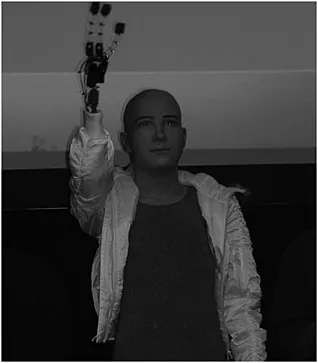
An android is an artificially created being that resembles a human being (see Figure 1.1). In literature and other media an android is loosely defined in the sense that it can
be entirely mechanical, entirely organic, or some combination thereof. Thus, a robot or a cyborg that looks human can be considered an android. Androids as they are customarily treated in the literature, although resembling people, need not act or be exactly like people.
In this book, we will be discussing the creation of an artificial person. An artificial person is an artificially created being that is by its nature and actions indistinguishable from a human, but need not look exactly like one. An artificial person is functionally no different from a real person. Their behavior in any given situation or test could not be reliably differentiated from that of an actual person. Although an artificial person may look different on the inside or the outside, from a behavioral standpoint they are identical in every respect to people. Like an android, an artificial person may be mechanical, organic, or some combination of the two.
THE ARTIFICIAL PERSON IN MYTHOLOGY AND LITERATURE
The history of storytelling is replete with human attempts to construct an artificial person. Perhaps the earliest of these comes from ancient Greece. Hephaestus was a god born as the son of the goddess Hera, wife of Zeus. He became the god’s “handyman,” creating various contraptions for them with his forge. These included Achilles’ shield and Apollo’s chariot. His most complex creation was Talos, a bronze robot that guarded the island of Crete. Talos roamed the island and could throw large rocks at passing ships.
During the Middle Ages, the alchemist Paracelsus is attributed with first using the term homunculus, which literally translated from the Latin means “little man.” He reports having made a one-foot tall homunculus using bones, sperm, pieces of skin and animal hair. This was then laid in the ground and surrounded by horse manure. Affer 40 days, an embryonic version would form. Another equally ludicrous recipe involves poking a hole in the shell of an egg laid by a black hen, inserting human sperm and sealing the opening with parchment. Thirty days affer burial in the ground, a small person would emerge who would serve their creator in exchange for being fed lavender seeds and earthworms!
Later in Europe we find the golem, an animated being craffed from inanimate material. The story of the golem originates from Jewish folklore. According to these tales, golems are craffed from mud. They are unintelligent, usually lacking the ability to speak and used primarily for menial labor, where they are assigned to perform some simple task repetitively. Only a holy person such as a rabbi is capable of creating a golem. Because rabbis were close to God, they gained some of God’s power and were able to create limited versions of people. One of the better-known golem stories is of rabbi Judah Low ben Bezalel, who, in the 16th century, produced a golem to defend the Prague ghetto against Anti-Semitic assaults (Bloch, 1972).
Frankenstein is a novel written by Mary Wollstonecraff Shelley and was first published in 1818. It is the story of Victor Fran kenstein, a proto-scientist who creates a manlike creature from corpses. Horrified at its appearance, he runs away, whereupon the creature itself also disappears. Later events find the creature asking Frankenstein to build him a female partner. Affer Frankenstein destroys the partially made female in disgust, the creature seeks revenge and kills Frankenstein’s wife. Frankenstein himself now hunts the creature down, pursuing him through the artic wastes and ultimately perishing in the attempt. A prominent theme in this classic is the loneliness and isolation of the creature that wants companionship from humanity and from a kindred creature like itself.
The first use of the word robot comes from a play by the Czech Karel Capek called Rossum’s Universal Robots, first performed in 1921. Capek tells the story of beings who are manufactured for the sole purpose of work. These creatures are created in a large factory out of organic materials. They both look and act like people but have no feelings. The wife of the factory owner takes pity on them and asks the factory manager to instill feelings in them so that they will be happier and can get along better with their human counterparts. He agrees, but the robots, now realizing their superiority, revolt and massacre almost everyone. The play ends with a truce between the robots and humankind and a hope for a better future.
Modern science fiction of course offers us many instances of artificial persons along with morality tales warning us of the consequences. In Arthur C. Clarke’s 2001: A Space Odyssey, the computer HAL suffers a breakdown and murders the crew of a spaceship because of an inability to resolve conflicting mission instructions. In The Terminator movies, intelligent machines designed for national defense fulfill their duty too well by deciding to wipe out the human race. A similar theme is echoed in The Matrix films where computers win a war against people by imprisoning them in an artificial virtual reality.
The apocalyptic visions portrayed in these stories reflect our fear that in constructing an artificial person we will also bring about our own demise. In other words, our mechanical reproductions will not only possess what makes us great, but contain our flaws as well. There is also the lurking anxiety that they may become smarter or better than we are, deciding to ignore or do away with us entirely. The q...