Introduction
There is perhaps no more graphic illustration of the centrality of water to human existence than the emphasis placed on the search for water on Mars. The confirmation by NASA in July 2008 that its Phoenix lander on Mars had identified ice in a soil sample analysed in its onboard laboratory prompted a newspaper opinion poll in which 92 per cent of respondents said they believed there was life elsewhere in the universe (Guardian, 2008). Beyond this fundamental association of water with ‘life’, however, water plays a major role in humanity’s social and economic existence. Not only is the management of water needed to enable almost all productive activity, but the need to manage water has historically imposed organisational requirements on human society.
Viewed from a perspective of aggregate water use, however, this imperative to manage water resources seems unwarranted, since human activity withdraws less than 10 per cent per cent of the available water resources on the planet (Table 1.1 and Figure 1.1). ‘Available water’ means here the water in streams, lakes and groundwater – sometimes referred to as ‘blue’ water – after discounting the 99 per cent of the world’s water as ‘unavailable’ because it is contained in the oceans or polar ice, or falls as rain but is absorbed by vegetation and returned to the atmosphere (transpiration – ‘green’ water) before it can drain into aquifers or streams (see Box 1.1 for a fuller account of such water classifications).
Table 1.1 Water availability and use
Even within the less than 1 per cent of water that is ‘available’, it appears that water is so abundant relative to human needs that little effort should be needed to manage it. Across Europe total rainfall (precipitation) is ten times the amount withdrawn for human activities (EEA 2005, cited by Carter 2007). However, as Table 1.1 and Figure 1.1 suggest, the availability of water is not uniform across all parts of the globe. Moreover, the intensity of human activity and settlement is not governed
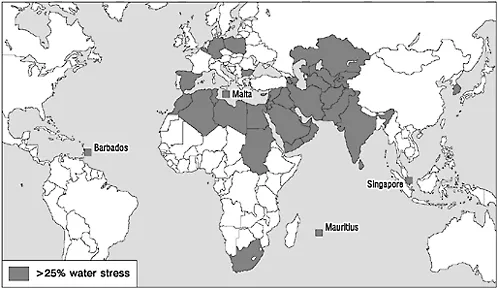
solely by water availability, so that ‘demand’ is much higher relative to available supply in, say, Asia than in Latin America. Figure 1.2 displays regions of high water stress as measured by rates of water withdrawal compared to annually renewable resources. The top quartile of countries have been selected in this figure and this corresponds to at least 25 per cent of renewable resources being consumed annually, (note that data was unavailable for some parts of Eastern Europe and many island states). At a more local scale still, this unevenness is even more marked, so that in particular locations the intensity of water demand may exceed the local supply (see Box 1.2. concerning magnitudes of available water resources and levels of consumption).
For many countries, especially those in the tropics, water withdrawals for irrigated agriculture dominate consumption, with values of 70 per cent typical but rising to over 80 per cent in places. For example, 70 per cent of Australia’s water is used in rural areas but almost all for irrigation, compared to 21 per cent consumed in urban areas for domestic and industrial uses (Environment Australia, 2003). Table 1.1 shows that in North America and Europe demand from industry and energy generation is significant (48 and 53 per cent respectively) with municipal supplies accounting for much less (13 per cent and 15 per cent), although much of this is available for recycling. Globally, industrial water withdrawal accounts for only 20 per cent and domestic water accounts for 10 per cent (see Figure 1.3 for examples from the Middle East).
Although agriculture dominates total water abstraction across the globe, it is the local intensity of demand for potable supplies from urban areas that has stimulated past development of water resources (see Chapter 2) and that has focused much of water-management effort. Thus, although ‘domestic consumption’ is much less significant in terms of the overall water budget, it has received priority due to the immediacy and relative inflexibility of demand for potable supplies. Furthermore, providing household water supplies can have much wider social and economic benefits, as exemplified by the following list of relationships charted by Moriarty and Butterworth (2003: 12) between water development and human livelihoods:
• Health (hygiene improvements, disease reduction)
• Labour availability (health and less effort required to collect water)
• Cheaper water (compared to commercial vendors)
• Improved well-being (more security, less stress)
• Education (more time, especially for children)
• Empowerment (through greater community decision making)
• Community capacity (strengthened through water-project engagement)
• Income (health and labour improvements raise other opportunities)
• Food security and nutrition (household-production opportunities)
• Investment (other improvements increase expenditure in other areas)
Nonetheless, it seems clear that, despite some two hundred years of rapid growth in economic and scientific capacity, there is widespread concern that humanity is falling short of what is needed to manage water effectively. This failure, most often characterised in terms of the 1.1 billion people who do not have access to clean water and the 2.6 billion who live without adequate sanitation, has particular resonance for many because of the centrality of water to human health and dignity: ‘ “Not having access” to water and sanitation is a polite euphemism for a form of deprivation that threatens life, destroys opportunity and undermines human dignity’ (HDR, 2006: 5). It is therefore unsurprising that aggregate statistics showing an abundance of water at regional or global scales belie an intensity and violence in local struggles whose trigger or pretext is water. Water thus plays an emblematic role in contestation over inequality in human society.
While mindful of this dimension to water-resource management, in this book our intention is to step back and take a broader view. In particular, we seek to consider the status of ‘best practice’ in managing water
resources in order to meet development goals. In doing so we will need to interrogate the specific meanings of ‘scarcity’ of water in particular contexts, and the extent to which these constitute constraints to the future content and direction of development.
In this chapter we will review the emergence of a water ‘sector’ within development thinking, and how current ideas of international best practice have come to be formulated and adopted by development agencies. We will draw upon these recent debates to set out a framework for the more detailed discussions in the remainder of the book. First, however, we will review the ways in which water su...