eBook - ePub
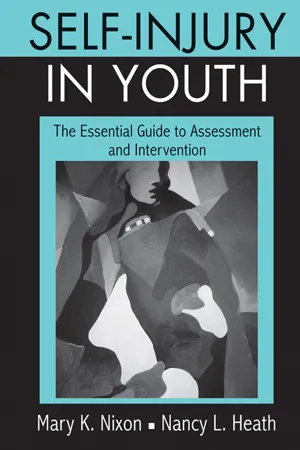
Self-Injury in Youth
The Essential Guide to Assessment and Intervention
- 368 pages
- English
- ePUB (mobile friendly)
- Available on iOS & Android
eBook - ePub
Self-Injury in Youth
The Essential Guide to Assessment and Intervention
About this book
This edited volume features evidence-based reviews and practical approaches for the professional in the hospital, clinic, community and school, with case examples throughout. Divided into five major sections, the book offers background historical and cultural information, discussion of self-injury etiology, assessment and intervention/prevention issues, and relevant resources for those working with youths who self-injure.
Information
CHAPTER
1
Introduction to Nonsuicidal Self-Injury in Adolescents
B.J., a 15-year-old young man, presented to emergency at his local hospital for the third time in the past two months. The first occasion was when he was seen at school with multiple scratches on his forearms and sent to the local mental health emergency service, as he refused to speak to the school counselor and appeared distressed. B.J. was angry about the need to be assessed, indicating to the emergency mental health clinician that, although he had scratched himself purposefully, it meant nothing to him other than a “test to see how it felt.” He gave no history, nor did his parents, of any precipitating or contributing events and reluctantly agreed to see his school counselor “to touch base.” The second encounter occurred the day after his girlfriend broke up with him. He took liquor from his parents’ cupboard, became intoxicated, and did not realize until after he became sober that he had sliced his forearm many times with an old pocket knife in his room. His mother, unaware of the breakup and his drinking, checked in on him later that evening and noticed blood stains on his clothing and the smell of liquor. Both parents sat with B.J. that evening to attempt to understand what was going on. It was agreed that B.J. would see his family doctor, whom he had known for many years, and take the next day off school. Both parents were quite distressed by this event, as they had not had any sense that B.J. was having such difficulty. B.J assured his parents that it was not a suicide attempt and revealed the recent breakup as a major stress.
The next day, his doctor interviewed B.J. alone, and he revealed that he was feeling angry and upset over the breakup with his girlfriend (they had been dating for seven months and had been arguing recently, as she disapproved of his recent episodes of alcohol abuse and his increasing moodiness). The doctor assessed that there were adjustment issues related to the breakup and that B.J. should seek some counseling regarding stress management and coping. A referral was made to the local community mental health center and, although he agreed to see his school counselor, he did not show for his appointment, and the counselor had to seek him out. On his third presentation, a month later, this time to emergency, the emergency physician had to steri-strip two cuts on his forearm that he had inflicted several hours before with a woodcarving knife. He was found in the bathroom by his sister, who became concerned when she saw blood in the sink and his forearm covered in towels and called her parents.
Working with youth who self-injure often means that clinicians, mental health professionals, school counselors, teachers, and youth workers alike are faced with the challenge of how best to understand the behavior and intervene. The case of B.J. illustrates that these youth can be difficult to engage and that contact and potential interventions may take place at a number of levels. Studies have shown that many professionals who work with youth who self-injure find it one of the most challenging behaviors to contend with. Teachers indicate that self-injury is increasing in the schools, that it provokes strong and negative reactions, and that they are often ill equipped to know what to do when encountering the behavior and often feel a sense of horror (Heath, Toste, & Beettam, 2006). High school counselors also identified an overwhelming need for more information and practice guidelines to deal with self-injury in the schools (Heath, Toste, & White Kress, 2007; McAllister, 2003). Mental health and medical professionals state that nonsuicidal self-injury (NSSI) is one of the most difficult behaviors to encounter in a client (Rayner & Warner, 2003).
Historical and Social–Cultural Considerations of Self-Injury
The act of self-injury has been documented from the beginning of recorded history, with the earliest reports found in ancient Hebrew, Greek, Roman, and Japanese texts (Bennum, 1984). Favazza (1989, 1998), in his cross-historical and cross-cultural examination of self-mutilative behavior, described “body modification” rituals that occurred in ancient Aztecs, Mayans, and Olmecs religions. Certain passages in the Bible invoke sinners to remove offending eyes or limbs to purify themselves (Favazza, 1989). In the 21st century, forms of self-injury continue to be performed as a rite of passage or a form of spiritual healing. Armando Favazza’s classic text (first published in 1987 and with a second edition in 1998), Bodies Under Siege: Self Mutilation and Body Modification in Culture and Psychiatry, remains an excellent comprehensive review and discussion of the full range of self-mutilative practices and behaviors over time and across cultures. The second edition contains an epilogue written by Fakir Musafar, a leader of modern primitivism, who describes the practice of “body play” including body tattooing, scarification, and piercing, practices that appears to be gaining more popularity in Western culture.
Favazza defined self-mutilation as “the deliberate destruction or alteration of one’s body tissue without conscious suicidal intent.” He then distinguished culturally sanctioned self-mutilation, such as rituals (e.g., facial or body scarification in certain tribal cultures to mark initiation and passage into manhood) and practices (e.g., self-flagellation as a religious act of penitence during the Middle Ages) from deviant self-mutilation, where the behavior is “a product of a mental disorder and anguish.” This distinction between “socially sanctioned” self-injury or mutilation and nonsocially sanctioned self-injury has been an important concept in working toward a more specific understanding of the range and classification of self-injuring behaviors.
The conceptualization of nonsocially sanctioned self-injury has changed by the era. Himber (1994) observed that the earliest writers described self-injury as acting out castration fears and as an expression of a repressed death wish. However, as psychodynamic influence grew, individuals who engaged in self-injury were viewed as struggling with separation-individuation and dependency issues. In the 1960s, new attention was given to a particular subtype of self-injurers, designated the “wrist-cutter syndrome” (Favazza, 1998). The case of a young unmarried woman was described, who suffered from problems with sexuality, addiction, and interpersonal interactions and repeatedly and superficially cut her wrist.
Ross and McKay, in their 1979 book, Self Mutilation, represented some of only a few authors to write on this subject in the postmodern era, followed shortly by Pattison and Kahan’s (1983) frequently cited article on “deliberate self harm.” The latter paper offered a profile of repetitive self-injurers who had onset of this behavior during adolescence that was of low lethality types (excluding self-poisoning) and without conscious suicidal intent. They suggested that persons engaging in self-injury presented with psychological symptoms such as anxiety, anger, despair, and cognitive constriction, with possible associated depression or psychosis. The combined efforts of Ross and McKay, as well as Pattison and Kahan, set the stage for the beginning of more intensive study of this behavior.
Definitions and Self-Injury
Over the years, the concept of the wrist-cutter syndrome and terms such as self-mutilation have lost favor, both to find less suggestive terminology as well as the need to clearly distinguish types of self-injuring behaviors, in particular, differentiating those related to suicide intent versus those that not associated with suicidal intent. The lack of standardized definitions has led to difficulties in terms of comparisons of prevalence rates for self-injury, understanding specific correlates and predictors as well as planning and evaluating effective interventions. Additional terms such as self-injurious behavior, parasuicide, deliberate self-harm, self-carving, and self-cutting have all been used to describe all or some aspects of self-injury. Favazza and Rosenthal (1993) and Favazza and Simeon (1995) made several preliminary distinctions regarding how nonculturally sanctioned self-injury may present by differentiating major (e.g., castration, eye nucleation) from superficial to moderate self-injury (such as scratching or cutting). Minor to moderate forms could be impulsive or compulsive (responding to ego dystonic urges) and episodic or repetitive in nature, with the mild to moderate impulsive type identified as providing a form of release or relief from tension that could then be reinforcing of the behavior.
Certain standard terminology has been used among researchers in the study of self-injury. Deliberate self-harm includes a broad range of self-harm behaviors (e.g., self-injury, self-poisoning, and the deliberate abuse of substances and alcohol to harm oneself) and does not distinguish whether suicidal intent is present or not (Hawton, Haw, Houston, & Townsend, 2002). An act of deliberate self-harm, by definition, can therefore include a serious suicide attempt such as hanging or jumping from a height or superficial wrist cutting with no suicidal intent. Whereas a broader definition ensures that all behaviors are considered, for example, from the assessment perspective, it is limiting in that one cannot directly infer that all deliberate self-harm behaviors are similar regarding motivation and that a specific approach to assessment or treatment would be effective for all types.
NSSI exists within the range of deliberate self-harming behaviors. It can be defined as purposely inflicting injury that results in immediate tissue damage, done without suicidal intent and not socially sanctioned within one’s culture nor for display. It therefore excludes extreme tattooing or body piercing, body modification, and culturally sanctioned ritualistic injury or mutilation. NSSI includes, but is not limited to, cutting, pin-scratching, carving, burning, and self-hitting. The most common types are cutting and scratching, most typically done on the inner aspect of the forearm, although not necessarily restricted to that location (Laye-Gindhu & Schonert-Reichl, 2005; Nixon, Cloutier, & Aggarwal, 2002). It is perhaps most closely related to the original distinction of the superficial to moderate form of “impulsive” self-injury to which previous authors referred. Self-injury can occur in individuals with cognitive impairment and pervasive developmental disorders such as autism and is typically termed “self-injurious behavior” (SIB) and will be used in this book, for example, when discussing neurobiology studies and psychopharmacologic treatments, where the literature examining self-injurious behavior among individuals with developmental delays is discussed.
The focus of this text remains on NSSI as it presents in noncognitively impaired youth. Whereas the aim is to specifically address the assessment and treatment of NSSI in youth, this does not in any way suggest that other self-harming behaviors may not co-occur. Therefore, screening for other self-harming behaviors is one aspect of assessment, which is further discussed in Chapters 7 and 8 on measurement and assessment, respectively.
NSSI in Adolescents
The need to provide a comprehensive text that specifically focuses on a youth-centered approach to NSSI is important for a number of reasons. Practitioners often fail in their understanding and interventions with youth when a “top-down” adult-oriented approach is taken. This is often because limited evidence exists regarding effective interventions in this age group, and most of the studies are on adult populations. The age of onset of NSSI is typically during the adolescent period (Lloyd Richardson, Perrine, Dierker, & Kelley, 2007; Nixon, Cloutier, & Jansson, 2008). As will be discussed in Chapter 9, “Community Interventions and Prevention,” this period is marked with tasks and challenges associated with this important phase of development. Youth and families must work through issues related to such tasks as separation and individuation while the adolescent brain and its neuronal networks continue to develop and mature. Although some risk taking during this period may be considered within normal limits, it is important that those who work closely with youth examine what is socially or culturally accepted and what constitutes behavior that goes beyond this framework.
Practitioners are encountering and attempting to deal with this behavior in youth, with little or no training or evidence-based information. Misinformation may also hinder professionals from responding appropriately. This book is the first to provide a practical guide for a range of practitioners in a variety of settings who are encountering youth with NSSI, for example, for the teacher who is unsure what to say when it is apparent that a student is self-injuring, for the social worker in the community clinic who needs to decide how and whether to make a referral, for the therapist in private practice who needs to know when and how best to intervene, for the family doctor who has limited time and requires information that targets how best to use his or her skills and training, and for the child and adolescent psychiatrist and psychologist who is looking for an evidence-based-oriented text that provides a comprehensive review of NSSI. We hope the information offered in this book will assist a range of professionals, all with important roles in working with youth, in having a set of tools and a guide to the various steps associated with assessing and intervening in the care of youth who present with NSSI. There has been considerable need for an evidence-based text that synthesizes such information, albeit limited at this time, with the intention to guide best practice, with youth and their families being the ultimate beneficiaries.
References
Bennum, I. (1984). Psychological models of self-mutilation. Suicide and Life Threatening Behavior, 14, 166–186.
Favazza, A. R. (1989). Why patients mutilate themselves. Hospital and Community Psychiatry, 40(2), 137–145.
Favazza, A. R., & Rosenthal, R. J. (1993). Diagnostic issues in self-mutilation. Hospital and Community Psychiatry, 44(2), 134–140.
Favazza, A., & Simeon, D. (1995). Self-mutilation. In E. Hollander & E. J. Stein (Eds.), Impulsivity and aggression (pp. 185–200). Chichester, UK: John Wiley and Sons.
Favazza, A. R. (1998). The coming age of self-mutilation. Journal of Nervous & Mental Disease, 186(5), 259–268.
Favazza, A. R. (1987). Bodies under siege: Self-mutilation and body modification in culture and psychiatry (2nd ed.). London: John Hopkins University Press.
Hawton, K., Haw, C., Houston, K., & Townsend, E. (2002). Family history of suicidal behaviour: Prevalence and significance in deliberate self-harm patients. Acta Psychiatrica Scandinavica, 106, 387–393.
Heath, N. L., Toste, J. R., & Beettam, E. (2006). “I am not well-equipped”: High school teachers’ perceptions of self-injury. Canadian Journal of School Psychology, 21(1), 73–92.
Heath, N. L., Toste, J. R., & White Kress, V. (2007). [School counselors’ experiences with non-suicidal self-injury]. Unpublished raw data.
Himber, J. (1994). Blood rituals: Self-cutting in female psychiatric patients. Psychotherapy, 31, 620–631.
Laye-Gindhu, A., & Schonert-Reichl, K. A. (2005). Nonsuicidal self-harm among community adolescents: Understanding the “whats” and “whys” of self-harm. Journal of Youth and Adolescence, 34, 445–457.
Lloyd-Richardson, E. E., Perrine, N., Dierker, L., & Kelley, M. L. (2007). Characteristics and functions of non-suicidal self-injury in a community sample of adolescents. Psychological Medicine, 37(8), 1183–1192.
McAllister, M. (2003). Multiple meanings of self-harm: A critical review. International Journal of Mental Health Nursing, 12, 177–185.
Nixon, M. K., Cloutier, P. F., & Aggarwal, S. (2002). Affect regulation and addictive aspects of repetitive self-injury in hospitalized adolescents. Journal of the American Academy of Child & Adolescent Psychiatry, 41(11), 1333–1341.
Nixon, M. K., Cloutier, P., & Jansson, S. M. (2008). Nonsuicidal self-harm in youth: A population-based survey. Canadian Medical Association Journal, 178, 306–312.
Pattison, E. M., & Kahan, J. (1983). The deliberate self-harm syndrome. American Journal of Psychiatry, 140(7), 867–872.
Rayner, G. A., & Warner, S. (2003). Self-harming behavior: From lay perceptions to clinical practice. Counselling Psychology Quarterly, 16, 305–329.
Ross, R. R., ...
Table of contents
- Cover
- Half Title
- Title Page
- Copyright
- Dedication
- Contents
- Preface by Mary K. Nixon
- Preface by Nancy L. Heath
- Acknowledgments
- About the Editors
- Contributors
- 1. Introduction to Nonsuicidal Self-Injury in Adolescents
- Section I: Background Information: Who Self-Injures and Why?
- Section II: Etiology of Self-Injury
- Section III: Effective Practice for Self-Injury in Youth
- Index
Trusted by 375,005 students
Access to over 1.5 million titles for a fair monthly price.
Study more efficiently using our study tools.
Frequently asked questions
Yes, you can cancel anytime from the Subscription tab in your account settings on the Perlego website. Your subscription will stay active until the end of your current billing period. Learn how to cancel your subscription
No, books cannot be downloaded as external files, such as PDFs, for use outside of Perlego. However, you can download books within the Perlego app for offline reading on mobile or tablet. Learn how to download books offline
Perlego offers two plans: Essential and Complete
- Essential is ideal for learners and professionals who enjoy exploring a wide range of subjects. Access the Essential Library with 800,000+ trusted titles and best-sellers across business, personal growth, and the humanities. Includes unlimited reading time and Standard Read Aloud voice.
- Complete: Perfect for advanced learners and researchers needing full, unrestricted access. Unlock 1.5M+ books across hundreds of subjects, including academic and specialized titles. The Complete Plan also includes advanced features like Premium Read Aloud and Research Assistant.
We are an online textbook subscription service, where you can get access to an entire online library for less than the price of a single book per month. With over 1.5 million books across 990+ topics, we’ve got you covered! Learn about our mission
Look out for the read-aloud symbol on your next book to see if you can listen to it. The read-aloud tool reads text aloud for you, highlighting the text as it is being read. You can pause it, speed it up and slow it down. Learn more about Read Aloud
Yes! You can use the Perlego app on both iOS and Android devices to read anytime, anywhere — even offline. Perfect for commutes or when you’re on the go.
Please note we cannot support devices running on iOS 13 and Android 7 or earlier. Learn more about using the app
Please note we cannot support devices running on iOS 13 and Android 7 or earlier. Learn more about using the app
Yes, you can access Self-Injury in Youth by Mary K. Nixon, Nancy L. Heath, Mary K. Nixon,Nancy L. Heath in PDF and/or ePUB format, as well as other popular books in Psychology & Mental Health in Psychology. We have over 1.5 million books available in our catalogue for you to explore.