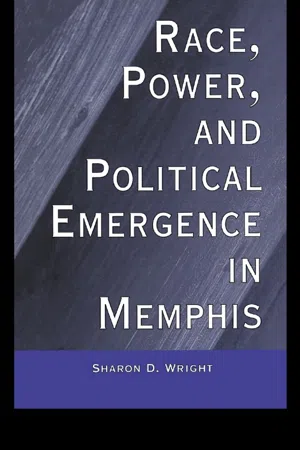
Race, Power, and Political Emergence in Memphis examines black political behavior and empowerment strategies in the city of Memphis. Each chapter of the text focuses on three themes-mobilization, emergence, and incorporation. By analyzing the effects of race on black political development in Memphis, scholars will be able to examine broader questions about its effects in other cities. How do political machines use substantial black electorates to their advantage? What forms of protest do black communities conduct to rebel against machine rule? What primary mobilization tactics have black citizens used during the different periods of their political development? Why do blacks mobilize more quickly in some cities? In cities with large and predominantly black populations, what elements prevent black candidates from winning citywide races? What constraints do newly elected black mayors face? What benefits do black citizens gain from their representation? After a predominantly black governing coalition is elected, what obstacles remain? Can black citizens translate proportional representation into strong political incorporation? How much power can African Americans realistic expect to gain in cities? This book is the most comprehensive case study of the city's political scene written to date. The text primarily shows that white racism is not the only obstacle to black political development. Black citizens can have population majorities, but lose elections for other reasons. Their ability to win elections and gain full incorporation depends heavily on whether they minimize internal conflict and establish coalitions with middle-class citizens and the business establishment.
- 350 pages
- English
- ePUB (mobile friendly)
- Available on iOS & Android
eBook - ePub
Race, Power, and Political Emergence in Memphis
About this book
Trusted by 375,005 students
Access to over 1.5 million titles for a fair monthly price.
Study more efficiently using our study tools.
Information
CHAPTER 1
The Role of Race in Local Electoral Politics
RACE, POWER, AND POLITICAL EMERGENCE IN AMERICA
The issue of race has always been an important one in American politics. It continues to affect the amount of economic and political power that blacks and other minority groups receive in their respective cities. In this text, black political emergence refers to the black community’s efforts to elect representation in proportion to their numbers in the population. After achieving proportional representation, black electorates seek political incorporation—“an equal or leading role in a dominant coalition that is strongly committed to minority interests”.1
Three primary factors have hampered black power and political emergence. First, disfranchisement and political machines prevented the elections of black political figures and diluted the black vote. During the mid-1860s, the Fifteenth Amendment granted the right of suffrage to African Americans who then elected the first black political figures in the nation. Laws were implemented, however, to disfranchise black voters for decades. Also, whites used economic and physical intimidation to “keep blacks in their place.” In the majority of Southern and some Northern cities, blacks could neither vote nor elect representation after the Reconstruction years.
In cities like Baltimore, Chicago, and Memphis, blacks voted but lacked power and political emergence primarily because of machine politics. Black bosses of “submachines” mobilized the black vote for the machine’s candidates; yet, the black community received few incentives.2 Congressman William Dawson of Chicago stated the accommodating yet realistic view of many black politicians in machine-dominated cities, “We must play the game according to the rules. I always play it that way and I play with my team. If you are on a baseball team, you stick with your team or you may not be able to play much longer.”3 Black citizens realized that the only way to have a voice in local politics was through support of the machine. Some individuals and groups conducted independent political efforts to rebel against the machine’s stronghold, but were usually unsuccessful.
Other obstacles to black power and political emergence were enacted after the ratification of the Voting Rights Act of 1965. At-large election systems, gerrymanders, majority vote requirements, and other measures were implemented to dilute the black vote. As a result of these vote dilution tactics, cities with large black populations failed to elect black representatives, especially in at-large or city wide races.
Finally, the use of racial appeals and racially polarized voting blocs continues to hamper black political development. A racial appeal is one in which a candidate attacks his opponent because of his race and/or when the media exploits racial issues.4 Racial polarization occurs when black and white voters support candidates from their racial group.5 According to the U.S. Supreme Court case, Thornburg v. Gingles, white bloc voting is “legally significant” and thus suspect when it results in the defeat of “minority-preferred” candidates.6 The Court also found that no discrimination occurs if the candidates favored by minorities usually win. Blacks and whites establish blocs when their voting patterns indicate that they have a “distinct group interest” and when the majority of each group’s members will probably support the same candidate.7
After an increasing number of blacks became viable contenders, voters supported candidates on the basis of race rather than class, as well as ideological, and partisan reasons. Blacks and whites became competing groups which perceived the other’s political successes as a threat to their group’s welfare. Thus, both black and white candidates used racial appeals to mobilize their constituencies.
According to Katherine L.Tate (1995), black candidates used racial appeals in order to encourage a large turnout because of the refusal of many whites to vote for them.8 Whites used these appeals to exploit white fears of black governance. They were less concerned with turnout because whites constituted the majority of the voting-age population in cities. Today’s white candidate appeals seem more coded than previous ones. Few would openly state former Alabama Governor George Wallace’s view that he had been “out-nigguhed” by an opponent or ask voters to “Vote White,” as did former Philadelphia Mayor Frank Rizzo.9 Instead, the platforms of today’s white conservative or “Rainbow II” politicians promise law and order, ending quotas, and welfare reform.10 Although these issues appear to be racially neutral, they highlight race in a more covert way. The majority of black candidates still have difficulty in winning elections because of racially polarized voting.
MEMPHIS AS A CASE STUDY: AN OVERVIEW OF THE CHAPTERS
Race, Power and Political Emergence in Memphis examines black political behavior and empowerment strategies in the city of Memphis. Each chapter of the text focuses on three themes—mobilization, emergence, and incorporation. From the late 1800s to the 1990s, blacks in Memphis used various strategies to mobilize the black electorate and elect representatives. During the Reconstruction years, the Jim Crow system of legalized segregation inhibited black political development. From the early 1900s to the mid 1950s, E.H. Crump used the large black voting bloc to elect his machine’s candidates, but refused to allow the black community to elect black candidates. In the Southern cities of Atlanta, Baltimore, and New Orleans, the traditional mobilization tactic involved organizing blacks and liberal whites in coalitions to elect black representatives during the 1960s. Blacks in Memphis, however, were unable to transform the interracial groups that supported and negotiated the desegregation agreements of the 1960s into coalitions to elect black representatives. With few exceptions, most of the black elected officials in local races received less than 10 percent of the white vote and at least 80 percent of the black vote.
After black candidates won an increasing number of political offices during the 1980s and 1990s, the black community experienced political emergence. In the early 1990s, the local political scene experienced a transition from a white-dominated to a black-dominated governing coalition. The experience of cities like Detroit, Gary, Newark, and others, however, shows that electing black officials is not enough. Blacks who control the political base are not able to aid the underclass if their cities lack overall economic development. Without additional economic resources, very little change will take place. Good working relationships with the business community are essential for economic development. If this does not happen, despite their political emergence, blacks will lack strong political incorporation.
Black political development in Memphis has undergone four periods— the eras of access, machine rule, civil rights struggle, and racial politics. Racism was one of the primary obstacles to black political development during each of these periods. Chapter 2 shows that African Americans gained rights of citizenship and suffrage and thus mobilized their communities for participation in the political system for the first time during the era of access. Within four decades, blacks advanced their status from that of slaves in the 1860s to black elected officials in the 1870s and 1880s to less than half of the electorate by 1900. Chapter 3 discusses the Crump machine and its relationship with the black community. For approximately fifty years, E.H.Crump used both the black and white vote to power his political machine. Despite the machine’s domination, black businessmen and political organizations sought political emergence by endorsing nonmachine candidates, forming political organizations, and opening businesses on Beale Street. The Crump machine taught the black community a valuable lesson—the importance of bloc voting and mobilization. After Crump’s death, a unified black voting bloc would support black and white liberals rather than machine candidates.
Chapter 4 examines activities during the era of civil rights struggle. In the 1960s, individual plaintiffs and the National Association for the Advancement of Colored People (N.A.A.C.P.) filed federal and state lawsuits and the sit-in movement began. Interracial groups negotiated voluntary desegregation of public facilities before passage of the Civil Rights Act of 1964. Because of desegregation, African Americans gained a sense of confidence that they could elect black representatives. As a result, the first black elected officials since Reconstruction won political offices. Racial polarization worsened after the 1968 Sanitation Strike, 1969 Black Monday protests, and 1971 Elton Hayes riot.
Chapters 5 and 6 examine the role race played in local political elections during the era of racial politics. Chapter 5 discusses the role of the Ford brothers in Memphis politics and the black community’s unsuccessful efforts to elect a black mayor in the city’s nonpartisan elections and atlarge Memphis City Council members. In Chapter 6, I examine the main components of W.W.Herenton’s successful mayoral campaign. In Chapter 7, the challenges Herenton faced during his first term as he attempted to govern a racially polarized city and faced opposition from both black and white Council members are discussed.
The final chapter analyzes the future of black politics in Memphis. Black citizens will remain concerned about crime, economic development, poverty, the quality of public schools, and racial polarization. Other issues such as criminal disfranchisement may affect the ability of black political figures to win elections. Moreover, a new generation of black political leaders is emerging in Memphis politics. In 1996, Harold E.Ford Sr., who retired after twenty-two years in Congress, was succeeded by his son Harold E.Ford Jr. The Harold Jr. election raised the issue of whether Harold Sr. had transferred his “mini-Crump machine” to his son.
IMPLICATIONS OF THE MEMPHIS CASE STUDY FOR NATIONAL POLITICS AND RACE
By analyzing the effects of race on black political emergence in Memphis, scholars will be able to examine broader questions about its effects in other cities. How do political machines use substantial black electorates to their advantage? What forms of protest do black communities conduct to rebel against machine rule? What primary mobilization tactics have black citizens used during the different periods of their political development? Why do blacks mobilize more quickly in some cities? In cities with large and predominantly black populations, what elements prevent black candidates from winning citywide races? What constraints do newly elected black mayors face? What benefits do black citizens gain from their representation? After a predominantly black governing coalition is elected, what obstacles remain? Can black citizens translate proportional representation into strong political incorporation? How much power can African Americans realistically expect to gain in cities?
The Memphis case study shows that white racism is not the only obstacle to black political development. Black citizens can have population majorities, but lose elections for other reasons. Their ability to win elections and gain full incorporation depends heavily on whether they minimize internal conflict, establish coalitions with middle-class citizens, and with the business establishment.
NOTES
1 Rufus P.Browning, Dale Rogers Marshall, and David H.Tabb, eds.,“Can Blacks and Latins Achieve Power in City Government? The Setting and the Issues,” Racial Politics in American Cities: First Edition (New York: Longman, 1990), 9.
2 William J.Grimshaw, Bitter Fruit: Black Politics and the Chicago Machine, 1931–1991 (Chicago: University of Chicago Press, 1992), 91–114.
3 Edward T.Clayton, The Negro Politician (Chicago: Johnson Publishing Co., 1964), 73.
4 Bernard Grofman, “Throwing Darts at Double Regression—and Missing the Target,” Social Science Quarterly 74, 3(September 1993):480–487.
5 Bernard Grofman, Lisa Handley, and Richard G.Niemi, Minority Representation and the Quest for Voting Equality (Cambridge: Cambridge University Press, 1992), 73.
6 Thornburg v. Gingles, 478 U.S. 30 (1986).
7 Bernard Grofman, Lisa Handley and Richard G.Niemi, Minority Representation and the Quest for Voting Equality (Cambridge: Cambridge University Press, 1992), 67.
8 Katherine L.Tate, “The Politics of Race in American Cities” (Paper presented at the Annual Meeting of the Southern Political Science Association, Tampa, Florid...
Table of contents
- COVER PAGE
- TITLE PAGE
- COPYRIGHT PAGE
- PREFACE AND ACKNOWLEDGMENTS
- FOREWORD
- LIST OF TABLES
- LIST OF ILLUSTRATIONS
- CHAPTER 1: THE ROLE OF RACE IN LOCAL ELECTORAL POLITICS
- CHAPTER 2: BLACK POLITICS AND RACE RELATIONS IN MEMPHIS DURING RECONSTRUCTION
- CHAPTER 3: THE CRUMP MACHINE AND BLACK MEMPHIS
- CHAPTER 4: THE CIVIL RIGHTS MOVEMENT IN MEMPHIS
- CHAPTER 5: RACIAL POLARIZATION AND ELECTORAL BEHAVIOR, 1975–1987
- CHAPTER 6: THE 1991 MEMPHIS MAYORAL ELECTION: W.W.HERENTON TARGETS BLACK MOBILIZATION
- CHAPTER 7: THE LIMITS OF MAYORAL POWER AND THE ETHNORACIAL TRANSITION IN MEMPHIS
- CHAPTER 8: THE CONTINUING SEARCH FOR FULL INCORPORATION IN MEMPHIS
- BIBLIOGRAPHY
- ABOUT THE AUTHOR
Frequently asked questions
Yes, you can cancel anytime from the Subscription tab in your account settings on the Perlego website. Your subscription will stay active until the end of your current billing period. Learn how to cancel your subscription
No, books cannot be downloaded as external files, such as PDFs, for use outside of Perlego. However, you can download books within the Perlego app for offline reading on mobile or tablet. Learn how to download books offline
Perlego offers two plans: Essential and Complete
- Essential is ideal for learners and professionals who enjoy exploring a wide range of subjects. Access the Essential Library with 800,000+ trusted titles and best-sellers across business, personal growth, and the humanities. Includes unlimited reading time and Standard Read Aloud voice.
- Complete: Perfect for advanced learners and researchers needing full, unrestricted access. Unlock 1.5M+ books across hundreds of subjects, including academic and specialized titles. The Complete Plan also includes advanced features like Premium Read Aloud and Research Assistant.
We are an online textbook subscription service, where you can get access to an entire online library for less than the price of a single book per month. With over 1.5 million books across 990+ topics, we’ve got you covered! Learn about our mission
Look out for the read-aloud symbol on your next book to see if you can listen to it. The read-aloud tool reads text aloud for you, highlighting the text as it is being read. You can pause it, speed it up and slow it down. Learn more about Read Aloud
Yes! You can use the Perlego app on both iOS and Android devices to read anytime, anywhere — even offline. Perfect for commutes or when you’re on the go.
Please note we cannot support devices running on iOS 13 and Android 7 or earlier. Learn more about using the app
Please note we cannot support devices running on iOS 13 and Android 7 or earlier. Learn more about using the app
Yes, you can access Race, Power, and Political Emergence in Memphis by Sharon D. Wright in PDF and/or ePUB format, as well as other popular books in Politics & International Relations & Politics. We have over 1.5 million books available in our catalogue for you to explore.