1 Biotechnology and agricultural development
Robert Tripp
Introduction
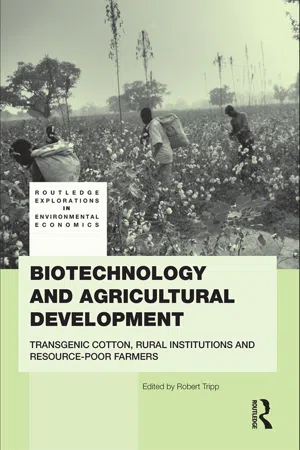
Under a clear November sky, a group of West African farmers takes a break from harvesting their cotton. The men survey the crop and dare to hope that the harvest will be better than last year, when a drought meant they were barely able to repay their loans for the expensive inputs used to produce cotton. The women participate in the harvest even though some of their own food crop fields still need attention and there are scores of tasks to be done at home. They need a good harvest, because cotton offers one of the few possibilities for earning the cash that is used to pay school fees and buy medicine and other essentials. In addition to their concerns about the harvest and the price they will receive, these farmers now find themselves at the centre of a worldwide controversy about agricultural biotechnology. The news they get on the radio and in discussions with other farmers is difficult to interpret, and the debates mostly take place far away, but the farmers hear there is a new type of cotton that resists some insects and lowers their need to buy insecticides. Some people argue that this will help them save money and keep up with other cotton-producing countries, while others say that it will put them at the mercy of powerful foreign companies and untested technologies.
The controversy goes well beyond genetically modified (GM) cotton and West Africa, and it has fundamental implications for the role of agricultural technology in poverty reduction. This book examines the experience of GM cotton in developing countries and draws lessons about the relevance of agricultural biotechnology for resource-poor farmers.
The term biotechnology can refer to a wide range of techniques that use biological processes for practical ends, including such long-standing practices as fermentation. But the more common references to biotechnology are often limited to a series of recent advances in molecular biology. The capacity to understand and describe the genetic makeup of an organism and, increasingly, to be able to manipulate genetic material has tremendous implications for medicine, industry and agriculture. The discoveries of this rapidly growing field have elicited a mixture of wonder, hope and apprehension, ensuring that biotechnology will be a subject of discussion and debate for the foreseeable future. While some aspects of modern biotechnology are relatively uncontroversial, the techniques of genetic engineering, and particularly the transfer of genetic material from one organism to another, have been the focus of considerable contention. The breadth of opinion surrounding these techniques is exceptionally great (Box 1.1).
Box 1.1 Conflicting visions of genetic engineering
Traditional farming has always been based on genetic engineering. Every major crop plant and farm animal has been genetically engineered by selective breeding until it barely resembles the wild species from which it originated. Genetic engineering as the basis of the world economy is nothing new. What is new is the speed of the development…Before long we will have sequenced the genomes of the major crop plants, wheat and maize and rice, and after that will come trees. Within a few decades we will have achieved a deep understanding of the genome, an understanding that will allow us to breed trees that will turn sunlight into fuel and still preserve the diversity that makes natural forests beautiful…While we are genetically engineering trees to use sunlight efficiently to make fuel, we shall also be breeding trees that use sunlight to make other useful products, such as silicon chips for computers and silicon film for photovoltaic collectors. Economic forces will then move industries from cities to the country. Mining and manufacturing could be economically based on locally available solar energy, with genetically engineered creatures consuming and recycling the waste products.
Freeman Dyson (1999) The Sun, the Genome, and the Internet, pp. 70–71.
[W]e are undergoing a revolutionary transformation in our resource base, our mode of technology, and the way we organize economic and social activity. Not surprisingly, these changes are accompanied by a revised cosmological narrative. New theories about evolution, steeped in information theory and borrowing heavily from cutting-edge ideas in physics, chemistry and mathematics, are beginning to exert an increasing influence on the fields of evolutionary and developmental biology. Like Darwin’s theory, the new ideas about evolution are already beginning to provide an account of nature’s operating design that is remarkably compatible with the operational principles of the new technologies and the emerging new global order. … [I]t is essential that the new cosmological narrative be closely examined. Our failure to do so might effectively shut the window to any possible future debate on the particulars of the Biotech Century. That’s because…once the revised ideas about evolution become gospel, debate becomes futile, as people will be convinced that genetic engineering technologies, practices and products are simply an amplification of nature’s own operating principles and therefore both justifiable and inevitable.
Jeremy Rifkin (1998) The Biotech Century, p. 207.
Many people in industrialized countries are sufficiently familiar with the concept of genetically modified organisms (GMOs) to at least offer an opinion on this complex subject. The degree of concern and attention is variable, however. Applications in medicine seem relatively well accepted. Several therapeutic proteins such as insulin and interferon are now regularly produced by GM bacteria, and vaccine for hepatitis B is manufactured using GM yeast cells (Han 2004). Applications in the food industry are also becoming commonplace; in cheese making, the enzyme chymosin produced by GM microorganisms is increasingly utilized in place of the traditional rennet (Adams and Moss 2008). News reports of the genetic manipulation of insects, trees, fish and mammals appear with increasing frequency, describing discoveries that are potentially life saving (mosquitoes unable to transmit the malaria parasite), profitable (trees that provide better pulp for paper making), frivolous (fluorescent tropical fish) and bewildering (goats whose milk contains spider silk), and these are usually met with relatively muted reaction. But no such complacency is evident when it comes to GM crops, which have always been at the centre of the controversy surrounding biotechnology.
It is not difficult to understand why transgenic crops attract considerable opposition. In North America and Europe, an increasingly urbanized population takes advantage of low food prices that are the result of industrial agriculture, but feels anxious about the demise of the family farm. In these circumstances, opportunities to defend the virtues of traditional farming are welcome, and the countryside offers strong symbolism in battles over globalization. In addition, there is measurable evidence of environmental damage caused by some modern farming techniques, compounded by several high-profile food scares, making consumers nervous about their industrialized food supply. The appearance of technology based on genetic manipulation and promoted by large chemical companies is not likely to make them feel any more confident, especially when the innovations (such as herbicide-tolerant varieties) are difficult to interpret or to recognize on the dinner table. And when the multinational corporations appear to be moving towards control of seed supply, concern can only grow.
But transgenic crops have also received considerable support. The majority of agricultural researchers and educators are favourably disposed to transgenic crops, although there are significant differences of opinion among them. Even though the current transgenic varieties are essentially confined to a few traits (particularly those expressing insect resistance or herbicide tolerance), there is evidence of positive environmental benefit, and agriculturalists look forward to a greatly expanded range of crop varieties that address some of farming’s toughest problems, such as drought, as well as offering important consumer qualities such as nutritional content. The majority of farmers who have had access to transgenic crops have taken them up with enthusiasm. It is estimated that in 2007, 12 million farmers in 23 countries grew 114.3 million hectares of GM crops (James 2007).
Both sides battle for public opinion, and although the early examples of transgenic crops were those designed for, and grown in, industrialized countries, the debate quickly involved the implications for farmers in developing countries. At times the battle has taken on moralistic dimensions. Monsanto’s slogan for a while was the pious ‘Food, Health, Hope’; non-governmental organizations (NGOs) countered with campaigns such as Christian Aid’s (1999) ‘Selling Suicide’. Of course not everyone has seen the issue in such confrontational terms; more balanced reviews expressing varying degrees of support and caution about the new technology were produced by a number of organizations, including Oxfam (1999), The Nuffield Council on Bioethics (1999) and The Royal Society (2000). But the struggle to win public support is not likely to depend merely on the strength of evidence; the debate over GM crops obviously draws on much broader concerns than mere agricultural technology. A number of recent publications examine the way that the arguments in the debate over GM crops are constructed (Cook 2004; Panos 2005; Pearson 2006).
Despite the considerable emotion generated by the controversy, policymakers have to weigh the evidence (and the public’s reaction to it) to make decisions about a nation’s strategies towards GM crops. This is particularly challenging for developing countries, with diverse agricultural systems, pressing production needs, uneven records of serving their farming populations and often considerable susceptibility to the pressures of multinational corporations and international NGOs. Of course the circumstances vary greatly, and some countries such as India, China or Brazil have advanced technological capacity of their own and corresponding policy independence. But even here, the choices are not clear-cut; a recent study in India describes the commercial, political and technical forces that influence the intricate, and sometimes contradictory, policies at both state and national level that govern the promotion of transgenic crops (Scoones 2006). But as experience grows with transgenic crops in both developing and industrialized countries, there are increasing opportunities for assembling evidence that will be useful for the policy process.
There are at least two important types of evidence that policymakers need to consider in making decisions about transgenic crops. One set of information is the data available on what might be called the externalities of transgenic crops—their effects on the environment and human health and the status of corporate control of agricultural technology. The second set of information is the impact that transgenic crops have on farmers and the agricultural economy. Although we will see that there is a significant area of intersection between the two concerns, it is the second that occupies most of the attention of the present book, which is specifically focused on the experience of resource-poor farmers in developing countries with this new technology.
The book examines one example of agricultural biotechnology: transgenic, insect-resistant cotton. (The technology is introduced at the end of Chapter 2 and described more fully in Chapter 3.) It focuses on the performance of this technology in developing countries. Given the breadth of issues related to biotechnology and the depth of the controversy that the subject engenders, it is important to provide the reader with a clear view of the assumptions that motivate the presentation that follows. The study has been conducted with an appreciation that biotechnology may be able to make significant and positive contributions to agriculture, but with a willingness to incorporate new evidence and to examine the priority currently assigned to transgenic crops. The narrow focus will not allow sweeping judgements certifying that transgenic crops are good or bad, appropriate or inappropriate. Given the complex nature of the arguments surrounding biotechnology, decisions about its future must ultimately be made by well-informed citizens in appropriate political forums.
Moreover, in focusing on developing countries and resource-poor farmers we are compelled to recognize the many factors that contribute to promoting equitable agricultural development. In that context, it is worth asking whether the introduction of a technology (no matter how ground breaking) would bring about meaningful improvements unless appropriate policies and institutions are also in place. Although it is certainly legitimate to promote specific policies that directly affect the introduction of biotechnology (Paarlberg 2001, 2008; Fukuda-Parr 2007), our conviction is that a much broader set of considerations must be addressed if this, or any, agricultural technology is to realize its full potential. This is especially the case if we are concerned about the fate of resource-poor farmers and the reduction of rural poverty. Simplistic support or opposition for a technology can mislead policymakers and donors by promising straightforward solutions to complex problems. Hence the analysis in this book emphasizes that expectations and apprehensions about biotechnology’s relation to agricultural growth should be examined in a broad context that includes factors such as the organization of small-scale farming, the conduct of agricultural input and output markets, and the governance of technology generation.
With those considerations in mind, the rest of this chapter reviews three elements that contribute to the context of decision making about agricultural biotechnology. First, we briefly consider the ways in which technology can be seen as a driver of agricultural change and the extent to which a ‘revolutionary’ idiom is useful. Second, we examine some of the major concerns about the relationship between transgenic crops and the environment, human health and corporate control. These are not issues that the book’s country case studies can address in any detail, but it is useful to examine them in relation to other instances of technological change and the nature of the agricultural institutions that are the book’s concern. Third, we set the scene for the focus of the rest of the book by outlining the issues that should be taken into account in assessing the impact of a technology on resource-poor farmers and the agricultural economy. That discussion will help steer a course for the remaining chapters that avoids the temptation to make broad judgements about biotechnology, but attempts to use an analysis of how technology performance is shaped by local institutions in order to identify practical implications for agricultural policy.
Are there agricultural technology revolutions?
By far the most familiar instance of recent agricultural change in developing countries is the Green Revolution, understandably leading to speculation about a possible ‘gene revolution’ with the introduction of transgenic crops (e.g. Wu and Butz 2004). But it is worth questioning the utility of seeing agricultural change in revolutionary terms and, to the extent that the Green Revolution is taken as a model for agricultural development, looking at some of its lessons.
Agricultural change
Historians argue about the extent to which major shifts in agricultural technology can be described as revolutions. Mokyr’s (1990) extensive review of technological change and economic growth recognizes that progress can come from both sudden ‘macroinventions’ and sequences of ‘microinventions’, but that in the case of agriculture, ‘undramatic, cumulative, barely perceptible improvements led to increased productivity’ (ibid: 294). This is neither to say that the pattern of growth in agricultural production has been a smooth, gentle curve, nor that particularly important innovations cannot be identified. For instance, the emergence of the three field system, the inclusion of legumes in rotations and the development of stronger ploughs all contributed to agricultural growth in medieval Europe. But as Grigg (1982) points out, attempts to define historical agricultural revolutions often suffer from disagreement on the most appropriate measures and a dearth of accurate data.
Even with evidence of increases in output or productivity over a given period, attribution to particular technologies is often made difficult by the relatively slow and uneven spread of many agricultural innovations, the fact that the efficacy of a new input often depends on the availability of other technologies or skills and the role of institutions in providing access to an innovation or incentives for its use. Overton (1996) discusses the problems in defining the periods and contributors to agricultural revolution in England. His analysis emphasizes that although the strongest period of growth (roughly 1750–1850) benefited significantly from technologies such as turnips and clover (contributing to soil fertility management) and mechanical innovations such as the seed drill, these were known and used before that period and their adoption was not, as legends insist, in response to proselytizing innovators such as ‘Turnip’ Townshend and Jethro Tull. In addition, the analysis shows the close link between technical change and institutional transformation, particularly in markets and land tenure.
The use of artificial fertilizer is a good example of the complex sources of innovation and the nature of diffusion. In nineteenth-century Europe the maintenance of soil fertility by rotations and manures was increasingly supplemented by imports of guano and mineral nitrates, but the major breakthrough came with the development of an industrial process to fix atmospheric nitrogen. The discovery of the Haber– Bosch process in the early twentieth century facilitated both increased agricultural yields and the production of explosives for war-time Germany (Leigh 2004). The discovery stimulated the expansion of the fertilizer industry after the First World War, but its growth was relatively slow, with four million tons of artificial fertilizer produced in 1940. The following decades saw a stronger expansion, with 40 million tons in use by 1965 and 140 million tons by 1990 (McNeill 2000).
Plant breeding is a technology of more ancient vintage, and farmers have been selecting superior plants as a source of next season’s seed since the beginning of agriculture. Even before the rediscovery of Mendel’s work on plant genetics in the early twentieth century, the development of improved plant varieties played an important role in agricultural advance. Olmstead and Rhode (2002) show how the continual selection and adaptation of new wheat varieties in the nineteenth-century USA, combined with crop management innovations to keep pests and weeds at bay, made as important a contribution to productivity growth as the much more visible advances in farm mechanization. Certainly the most revolutionary breakthrough in plant breeding (before biotechnology) was the discovery of hybrid vigour and the development of hybrid maize in the 1930s. The adoption of hybrid maize in the USA is the textbook case of rapid and sustained technology uptake, but the speed and extent of adoption varied significantly across regions of the country because of relative profitability and the presence of institutions (public research stations and private seed enterprises) that were needed to adapt and deliver the innovation (Griliches 1957). The steady growth in US maize yields from the 1930s into the 1980s can be linked not only to hybrid adoption but also to increased fertilizer use, the widespread adoption of herbicides and the fact that maize growing was curtailed in many less productive environments (Evans 1993). In addition, maize breeding continued to deliver consistent, year-to-year improvement...