- 304 pages
- English
- ePUB (mobile friendly)
- Available on iOS & Android
eBook - ePub
About this book
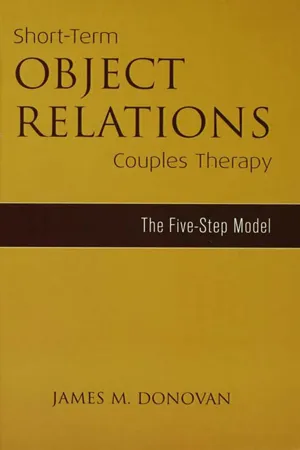
Brief therapies have become popular-indeed a necessity-in today's managed care environment. Perhaps because it is one of the more complex psychoanalytical models, object relations theory for couples has not been adapted to a short-term model until now. In this volume, James Donovan provides a model for short-term object relations couples therapy, while at the same time offering an easy-to-read primer on object relations that gives the practitioner a step-by-step model replete with examples for using object relations in practice. The goal of this short-term therapy is that couples emerge with an awareness of these internalized object relations and their significance. This book builds on previously successful couples work by advising the therapist to focus on the core, recurring impasse that threatens the couples relationship and stirs old wounds, and gives detailed intervention strategies that focus on the mediation and resolution of the core fight. The five-step model outlines the ways to dismantle the conflict at the levels of the individual and the couple. Donovan integrates aspects of other successful couples therapies into his model in order to broaden its applicability to a greater diversity of treatment situations.
Information
CHAPTER 1
Step 1: Study the Fight: Implementing the Five-Step Model
Couples have only one fight. The problem is
they have it hundreds of times.
they have it hundreds of times.
Over 40% of mental health referrals involve a marital problem (Budman & Gurman, 1988), yet, curiously, we often do not seem able, or willing, to treat those couples. Each outpatient department appears to have either one or no couple specialist. We have some books to read, a conference here or there to attend, but little outcome or process data to rely upon and few unified systems of couple therapy to follow. The administrative hurdles to arrange for the therapist and the pair to meet regularly, at the same time and place, can loom large. Medical insurance may require gerrymandering to support the treatment as well, but I think the real reasons that clinicians shy away from couple therapy lie elsewhere. Oedipal inhibitions about prying into someone else's marital and sexual relationship may well visit unconscious conflict upon the clinician, and many therapists also find it difficult to sort out and to maintain an alliance with two warring parties simultaneously.
Couple treatment can erupt into flames as well.
Broad-shouldered, pulsating, 50-year-old Jane leans into the face of her husband, gigantic Frank, age 52, a former heavyweight boxer, with biceps actually the size of my thigh. In a booming voice, Jane offers the following lay interpretation. “You're nothing but an alcoholic, Frank, a stinking alcoholic.” As Frank's face purples, I am frightened that he will punch her at any second and can only stammer, “Jane, maybe another tone would be more helpful.” The phone rings and my next-door colleague, overhearing the ruckus, asks if I'm okay. I'm not sure.
The outbursts in my office that I recall most vividly are like this one; nearly all were couple sessions, rarely group or individual meetings. Who would voluntarily seek out such experiences?
We do not know how frequently clinicians attempt couples therapy, but given the preponderance of marital problems, we can estimate that marital treatment remains a severely underutilized modality. Because clinicians and their training programs have underemphasized the field, for some of the reasons I've just pursued, we've found ourselves slow to construct a theoretical framework to support couple work. Clinicians can rest individual therapy on the psychodynamic, cognitive-behavioral, narrative, or solution-focused schools, all of which seem well thought out, thoroughly published, and frequently taught. Group therapy (Yalom, 1994) and family treatment (Nichols & Schwartz, 1998), though not as conceptually developed and historically refined as individual therapy, also can boast definitive, broadly accepted schools of approach, but couple work lags behind.
We can point to no generic model of couple dysfunction and its treatment to which a large number of practitioners more or less ascribe, and which has been widely studied and described. Equally distressing, we know that couple treatment, two-thirds of the time, lasts less than 20 sessions (Budman & Gurman, 1988), but we've only begun to articulate couple therapy models that directly address themselves to basic short-term treatment issues, such as finding the focus and planning the treatment (Dattilio, 1998a; Donovan, 1999).
The conceptual problem of couple treatment comes in delimiting the area of intervention. Each of the pair brings a complicated family history that clearly directly contributes to his or her central conflict, but the couple, just as plainly, suffers from present-day interactional difficulties. With each move, therapists may feel they've put the stress in the wrong place or on the wrong time period. Given these pressures, the treatment can easily wander, and if we're trying to work short term, we don't have much time. We need a model that can help us grasp both the present and the past simultaneously, or at least sequentially, in a manner that seems affectively genuine to all three participants. As we'll soon observe in this chapter, we have sections of that model now but, so far, no comprehensive format emphasizing both past and present.
No one book can, or should, attempt to fill this gap in one fell swoop, nor is that my purpose here. In this chapter I'll offer you an overview of the major current approaches to time-managed couple treatment and then, in the balance of the book, present my approach as one response to what's missing so far. I do not aim to complete the entire conceptual and clinical puzzle, but I do promise to insert a few pieces in what I think their proper place, so that we will gain a more complete picture of the kinds of couple therapy models the field requires.
For example, these should be applicable in less than 20 sessions per treatment episode and should be useful in most settings. Mine represents a self-professed, short-term approach, because I developed it during nearly 30 years of work in an HMO setting. It captures a focus and proceeds in five definable, teachable steps. The model's conceptual underpinning ties it to mainstream psychodynamic and object relations theory. The clinician does not need to learn a whole new metapsychological language and orientation to try it out. Furthermore, because the object relations approach attempts to explain present interaction in terms of past internalizations, this model may allow us to meld a focus emphasizing both time periods. But first, let's observe how other short-term therapists have confronted the substantial challenges of couple work.
THE SHORT-TERM COUPLE THERAPY SPECTRUM
Fortunately, in the last 3 or 4 years, Dattilio (1998a) and Donovan (1999) have published case books on brief couple treatment that, if we study them carefully, offer us a summary of the most recent and solid approaches. We can use the array of models offered by these two books as our primary resources to ascertain the current position of the couple treatment field and to define the directions we need to follow next.
As we read the Dattilio and Donovan anthologies, what do we notice first? We realize that all the authors seem preoccupied with one problem and that the array of chapters represents the different tacts taken by each writer toward that one issue. They all focus on the fight, the pair's recurrent conflict. Each couple appears to have only one fight but has it hundreds of times. Later I'll investigate the reasons behind this oddity, but, for now, let's go back to the different stances the authors take to the “fight”—my colloquialism, not theirs.
At its height, the fight can assume a multitude of forms, from cold distancing, to passive-aggressive lack of cooperation, to mutual sniping, to sneering disengagement, to screaming accusation, on to character assassination, and, finally, in some cases, to physical threats or overt violence. The content, though not the general form of the fight, differs from couple to couple. Almost like a Kabuki play, each member rigidly assumes the same role each time, as step by step, with the affect building, the pair locks in combat. The members listen to each other but selectively. They hear only what provokes, not what soothes or creates new meaning. The fight has two possible endings, both destructive. Either combatants will withdraw in an exchange of icy glares or demoralized resignation, or one or both will explode into shouts of frustration and recrimination.
As Gottman's (1994) pioneering direct observations of couples have taught us, when the fight repeatedly descends into overt disrespect and stone-walling, the partners find themselves sucked into dangerous waters that often propel them toward divorce. We can see that the fight represents the core of any couple conflict, but the standoff can take a “hot” form, replete with screaming and yelling, a cold pattern of distancing and alienation, or any mixture of both extremes. Paraphrasing T. S. Eliot, the fight can end with a bang, a whimper, or both.
The fight represents a cruelly ironic twist in human affairs but a near universal one. All couples I've encountered, in or out of the office, report some rendition of the fight. No matter how much effort and feeling the couple expends in attempting to avoid it or in having it out, resolution usually escapes the partners. They end where they began, just more frustrated and hopeless. The staggering number of marital problems among our referrals now seems less baffling. When the fight becomes intolerably painful for one or both of the pair, they often seek our services.
Well before any therapist attempted a couple session, the great writers seemed fully aware of the fight and struggled to portray and understand it. Dostoyevsky's The Brothers Karamazov, Faulkner's The Sound and the Fury, and Shakespeare's King Lear all took fights, of different configurations, as their principal subject matter. Later I will offer an object relations model of the fight and try to explain its central place in human affairs, but now I want to return to how other authors have chosen to approach it within their systems of treatment.
Couple therapists, from whatever school, must confront this same vexing, complicated problem with every pair they treat. The fight represents a rigid, stereotyped, upsetting, seemingly counterproductive exchange into which the couple readily slips or sometimes rushes pell mell. The fight appears daunting, if not downright frightening, to all three participants in the office, but it requires our primary focus.
As we study the fight, its defensive nature strikes us first. The partners repeat themselves, accuse, exaggerate, and misperceive the opposing argument, while stubbornly cleaving to their own. The schools of couple therapy define themselves by their characteristic response to this defensiveness: (1) the narrative and solution-focused camps attempt to circumvent the deadlock; (2) the systemic school stands above and repositions the parties in the conflict; (3) the behavioral and cognitive-behavioral practitioners directly coach the couple in alternatives to the fight; and (4) the dynamic group delves into the conflict to its affective roots. Using these positional metaphors of therapeutic intent, I can name the major players and summarize the contribution of each school. Of course, any couple therapist may borrow from more than one model at a given moment, which makes establishing that writer's place in the taxonomy a bit more challenging, but we can characterize each school by the extent to which it makes use of these four, almost topographical, basic approaches to the fight.
1. Narrative and Solution-Focused Models– Circumnavigate the Conflict
Steven Friedman and Eve Lipchick (1999), fine representatives of the solution-focused school, steer the boat around the typhoon by helping the couple to seek “exceptions” to the recurrent, destructive conflict. On what occasions did Sally and Howard not fight about his mother? How were they able to do this, when she appears so troubling a presence in their lives? The therapist can ask “The Miracle Question.” What if they woke up one morning and Howard's mother were no longer a problem to them? If they can solve the issue of the mother-in-law, could they resolve other marital difficulties with the same methods? Just in this one, hypothetical, single case snippet, we can see how the solution-focused therapists try to skillfully move around the conflict. Emphasize the positive; identify solutions, not problems; find exceptions to the bad news; practice what works; and don't repeat what doesn't. Outcome, outcome, outcome! (solutions) Rate your success today on solving the mother-in-law conflict from 1 to 10.
Joseph Eron and Thomas Lund (1998, 1999) have founded a new hybrid school, the narrative-solution-focused approach. They use their model to move ingeniously around the fight in their new, noncouple, couple therapy. Eron and Lund, working with each member of the pair individually, sometimes with the partner present and often not, try to define a “preferred view of self.” The clients can then perceive the unproductive aspects of their behavior in the fight and shift toward a stance more in concert with their positive self-image. For example, how does Jim (1999), a man who respects himself and others, and who has courageously faced and mastered his alcoholism, find himself snarling at his wife when she seeks more independence in their marriage?
This appeal to the client's positive ideal has many advantages. The approach clearly builds on the lifelong strengths and mature values of each client and experts, like Eron and Lund, can quickly turn these to treatment leverage. The positive outcome represents the “solution” in the designation “narrative-solutions therapy” and the search for the “preferred view of self” through the life history represents the “narrative” influence in the model. Later we'll see that this deceptively simple concept of the “preferred view of self” becomes a major contribution to our understanding of how people shed defensiveness.
2. Systemic Models–Stand Above the Fight
These approaches to couple treatment instruct the therapist to stand above the conflict and to attempt change by repositioning the boundaries between the participants. For this reason we call these schools systemic. Phillip Guerin's Bowenian format (Guerin, Fay, Fogarty, & Kautto, 1999) and Salvador Minuchin's and Michael Nichols's structural model (1998, 1999) stand as the major proponents of this tact.
Guerin and his coworkers study triadic relationships. They observe that when trouble brews within any dyad—husband-wife, parent-child, wife-mother-in-law—the twosome will likely attempt to solve the problem by involving a third party, creating a psychological triangle that unfortunately interdicts any real work on the original issue. Guerin finds that the couple or the family that comes to his office frequently presents him with these enmeshed triads to unravel.
For example, an eligible young man falls in love with an appropriate woman but develops terrifying panic attacks just after they become engaged. In the first interview Guerin discovers that this dutiful son has served as a confidante to his lonely mother, a lady apparently emotionally unsupported by her distant husband. Most therapists would treat the young man individually or maybe in conjunction with his fiancée, but Guerin wants to involve the whole system and asks the mother, the third member of the triangle, to join her son in the office. Guerin begins to separate the mother from the son so that he, more free, can move closer to his fiancee with less guilt. Guerin supports the mother to initiate more intimacy with her husband, lest she, abandoned, grasp her son more tightly.
Guerin clearly believes that all the relevant members of the system must join the treatment, or else change between any two will wash away, as they interact with numbers three and four. These attempts to reposition the members of the triangle represent the one-two-three of psychotherapy for Guerin, his signature technique, and, as we'll observe later in the book, a powerful intervention readily incorporated, in different forms, within many couple therapies.
Minuchin and Nichols (Minuchin & Nichols, 1998; Nichols & Minuchin, 1999) practice structural family therapy. They focus on the boundaries between partners or between multiple family members. Minuchin and Nichols usually discover that these boundaries have become too enmeshed or too rigid, a circumstance that leads to automatic stifling interactions. The participants fight when they thrash about in an unconscious attempt to renegotiate these boundaries. For instance, the exasperated father (Nichols & Minuchin, 1999) angrily demands that his 13-year-old stepson act more responsibility and cooperatively at home and at school. But the son can afford to ignore these directives because he's shielded by the relationship with his mother, who has retreated into closeness with her son as a refuge from her exacting husband. She clings to the boy and defends his inactivity, as she cannot defend herself toward her demanding mate. Mother and son passive-aggressively defeat the husband at every turn. The battle is joined, and the family repairs to the therapist's office. The wife feels lonely, the husband scapegoated, and the dependent boy too anxious to successfully enter adolescence—a fine state of affairs.
Minuchin and Nichols will work to solidify the boundary between mother and son and to soften the rigid wall between husband and wife. The son, more free of his mother's apron strings, can then recapture the path of his independent development, and the father can enjoy his wife again, and she him. It's all about renegotiating the boundaries.
3. The Behavioral, Collaborative, Cognitive-Behavioral, and Strategic Schools—Coach the Couple in Alternatives to the Fight
The late Neil Jacobson and his colleagues offer us the most comprehensive behavioral learning approach to couple treatment, integrative couple therapy (Lawrence, Eldridge, Christensen, & Jacobson, 1999). In this system the therapist coaches the partners as they acquire skills in emotional acceptance, behavioral exchange, and problem solving. The Jacobson-Christensen group explicitly defines and teaches various aspects of nondefensive communication. For example, the therapists encourage the couple to voice more tolerance, to express more vulnerability and...
Table of contents
- Front Cover
- Half Title
- Title Page
- Copyright
- Dedication
- Contents
- Foreword
- Preface
- Chapter 1 Step 1: Study the Fight: Implementing the Five-Step Model
- Chapter 2 Object Relations Theory: Its Application to Understanding Marital Choice and Couple Therapy — The Contributions of Henry Dicks and David and Jill Scharff
- Chapter 3 Step 2: Investigate the Triangle of Focus
- Chapter 4 Step 3: Explore the Triangle of Conflict
- Chapter 5 Short-Term Couple Group Psychotherapy: A Tale of Four Fights
- Chapter 6 Steps 4 and 5: How Do Couples Change in Brief Therapy?
- Chapter 7 Completing the Couple Therapy Puzzle: A Hybrid Approach, a Generic Model, and Closing Thoughts on the Mechanisms of Change
- References
- Index
Trusted by 375,005 students
Access to over 1.5 million titles for a fair monthly price.
Study more efficiently using our study tools.
Frequently asked questions
Yes, you can cancel anytime from the Subscription tab in your account settings on the Perlego website. Your subscription will stay active until the end of your current billing period. Learn how to cancel your subscription
No, books cannot be downloaded as external files, such as PDFs, for use outside of Perlego. However, you can download books within the Perlego app for offline reading on mobile or tablet. Learn how to download books offline
Perlego offers two plans: Essential and Complete
- Essential is ideal for learners and professionals who enjoy exploring a wide range of subjects. Access the Essential Library with 800,000+ trusted titles and best-sellers across business, personal growth, and the humanities. Includes unlimited reading time and Standard Read Aloud voice.
- Complete: Perfect for advanced learners and researchers needing full, unrestricted access. Unlock 1.5M+ books across hundreds of subjects, including academic and specialized titles. The Complete Plan also includes advanced features like Premium Read Aloud and Research Assistant.
We are an online textbook subscription service, where you can get access to an entire online library for less than the price of a single book per month. With over 1.5 million books across 990+ topics, we’ve got you covered! Learn about our mission
Look out for the read-aloud symbol on your next book to see if you can listen to it. The read-aloud tool reads text aloud for you, highlighting the text as it is being read. You can pause it, speed it up and slow it down. Learn more about Read Aloud
Yes! You can use the Perlego app on both iOS and Android devices to read anytime, anywhere — even offline. Perfect for commutes or when you’re on the go.
Please note we cannot support devices running on iOS 13 and Android 7 or earlier. Learn more about using the app
Please note we cannot support devices running on iOS 13 and Android 7 or earlier. Learn more about using the app
Yes, you can access Short-Term Object Relations Couples Therapy by James M. Donovan in PDF and/or ePUB format, as well as other popular books in Psychology & Mental Health in Psychology. We have over 1.5 million books available in our catalogue for you to explore.