- 256 pages
- English
- ePUB (mobile friendly)
- Available on iOS & Android
eBook - ePub
About this book
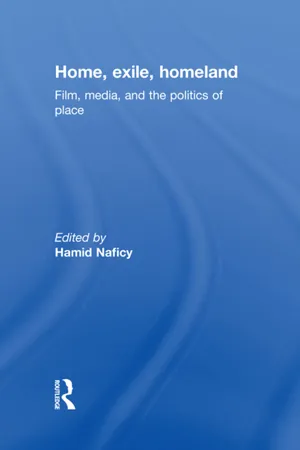
Global changes in capital, power, technology and the media have caused massive shifts in how we define home and community, leaving redrawn territories and globalized contexts. This interdisciplinary study of the media brings together essays by accomplished critics to discuss the way film, television, music, and computer and electronic media are shaping identities and cultures in an increasingly globalized world. Ranging from intensely personal to highly theoretical, the contributors explore our complex negotiation of home and homeland in a postmodern world. Contributors: Homi Bhabha, Thomas Elsaesser, Rosa Linda Fregoso, Teshome H. Gabriel, George Lipsitz, Margaret Morse, David Morley, John Peters, Patricia Seed, Ella Shohat, and Vivian Sobchack.
Information
Chapter one
introduction
framing exile
From homeland to homepage
As I began thinking about this introduction, I began wondering not only what to say but also what to call it. Introduction, opening, framing remarks …? Finally I decided on the last of these, “Framing Remarks.” But as I began writing, the title gradually became “Framing Exile.” Why? Framing, of course, means bracketing, structuring, constructing, or laying out the terrain of a topic—as in “providing a framework.” This helps to define and differentiate one topic from another; it helps each topic stake a claim to its existence—an important strategy in alternative discursive formations. Framing also means delimiting the topic, boxing it in, predetermining it—as in “encasing the topic.” This is something that my Ph.D. advisor, Teshome Gabriel, who has contributed an essay to this volume, had long ago warned me against doing. He’d say something like: “Don’t clearly define concepts like ‘third cinema’ because then they’ll be appropriated and dismissed.” By that definition, framing can become a means of control and domestication, and the refusal to frame becomes an oppositional strategy. Further, as the dictionary tells us, framing could also mean prearranging or concocting with a sinister intent—as in a frame-up.
In some ways, all of these modalities of framing are involved in this introduction and in the anthology itself, in the form of three interlocking conceptual frames of exile, consisting of house, home, and homeland. These are among the key concepts, symbols, and empirical entities that are most in dispute and under erasure today, and in what follows I will only sketch them in suggestively, not definitively. The diverse range of the contributing scholars also works against solidifying these and related key terms into conceptual edifices, for they hold divergent theoretical orientations, different departmental affiliations (or “homes”), and varying national, racial, ethnic, and gender identities. Among them are postcolonial critics and theorists (“poco”), but there are also those who have never identified themselves as such, and were even a bit wary of participating in a book project—which first began as a symposium at Rice University—whose topics have largely been relegated to that philosophical orientation.1 In fact, non-poco scholars have been invited to contribute to this anthology as a way of intervening in the exile discourse—breaking the usual orientational framework. This has resulted in the felicitous situation of the anthology containing citations from a wide range of scholars rather than being limited to frequent citation of a few canonical works. I happen not to agree fully with the kind of general attack leveled against postcolonial studies scholars recently—as being elitists and lacking a commitment to home—but I think the “field,” if that is a proper term for it, is in need of new blood, not only from younger and more divergent postcolonial critics but also from outsiders. Likewise, although the anthology is centrally concerned with media’s work on exilic issues and identities, not every contributor belongs to a film, media, or communications arts department. However, they have all been asked to cross the threshold, to enter the room of media studies, and to bring their expertise to bear on the media and the mediations that both express and constitute exile. This is an aspect of exile and exile discourse that has not received the kind of detailed and rigorous attention that it deserves. This is surprising because of the undeniable significant and signifying role of the media in creating, maintaining, and disrupting individual, communal, ethnic, national, and postnational identities in today’s technologized and diasporized world. David Morley’s chapter, “Bonded Realms; Household, Family, Community, and Nation,” addresses these issues.
While technology, media, and capital are globalized and cross geographical boundaries of nation-states with ease, national governments everywhere appear to be tightening and guarding their physical borders more vigilantly than ever by enacting and enforcing narrowly defined and sometimes highly intolerant immigration laws and by militarizing their border spaces. Despite, or perhaps because of, these official measures, borders, particularly the two-thousand-mile border that links Mexico and the United States, have become sites of not only physical and political but also discursive and artistic struggles, where exilic and émigré subjects are turning to the global media and entertainment industries to situate themselves historically, creating locally situated syncretic communities of address and socially engaged historical and political agency. Rosa Linda Fregoso, in “Recycling Colonialist Fantasies on the Texas Borderlands,” brings these issues into focus.
We have attempted to include a range of academic writing in order to represent more fully the variety of registers, experiences, and nuances of exilic conditions. As a result, there are chapters that are in different degrees autobiographical, essayistic, novelistic, and academic in style.
Exile is inexorably tied to homeland and to the possibility of return. However, the frustrating elusiveness of return makes it magically potent. Teshome Gabriel’s “Intolerable Gift” is a moving meditation inspired by his own return. Today, it is possible to be exiled in place, that is, to be at home and to long for other places and other times so vividly portrayed in the media. It is possible to be in internal exile and yet be at home. It is possible to be forced into external exile and be unable to, or wish not to, return home. It is possible to return and to find that one’s house is not the home that one had hoped for, that it is not the structure that memory built. It is possible to go into exile voluntarily and then return, yet still not fully arrive. It is possible to be able to return and choose not to do so, but instead continue to dream of and imagine a glorious return. It is also possible to transit back and forth, be in and out, go here and there—to be a nomad and yet be in exile everywhere. All these modalities of placement and displacement are mediated by one or another of the media, from the epistolary technologies of letters, telephone, fax, and e-mail to the audiovisual media of photos, cassettes, films, and video, to print, electronic, and cyberspace journalism. Thanks to the globalization of travel, media, and capital, exile appears to have become a postmodern condition. But exile must not be thought of as a generalized condition of alienation and difference, or as one of the items on the diversity-chic menu. All displaced people do not experience exile equally or uniformly. Exile discourse thrives on detail, specificity, and locality. There is a there there in exile.
Because of the prominence and prevalence of the exile populations and of exilic conditions worldwide, however, exile and its allied concepts have become popular enough to be in danger of overexposure—of becoming de-fused by means of diffusion. Academic and popular periodicals have devoted whole issues or lead articles to them.2 Shelter magazines, a popular genre of mass-marketed periodicals devoted to house and home affairs, are now available not only in hard copy but also on the World Wide Web. Although the move to the Internet is seen as an effective strategy for enhancing the marketing, subscription, and advertising impact of these periodicals (Trucco 1997:B4), it also signifies public interest in issues related to house and home. Likewise, television’s foray into shelter programming has gone beyond providing specific shows to offering the first twenty-four-hour, full-service shelter magazine of the air, Home and Garden Television (HGTV), which began airing in early 1995 (Owens 1995:B5).
For many cosmopolitan “homeless” exiles who are physically displaced, an Internet homepage is an attractive method for becoming discursively emplaced. Like all acts of psychic displacement and condensation, however, homepage creation and cyber-community formations involve highly complex and cathected psychological and political economies that are, on one hand, fraught with anxieties, affects, associations, and politics of all kinds, and with intriguing possibilities for liberatory diasporic and feminist multicultural practices, on the other. Ella Shohat’s “By the Bit-stream of Babylon: Cyberfrontiers and Diasporic Vistas” explores some of these.
Academic film conferences and research projects on émigré, exile, and diaspora cinema have also been on the rise, yielding new insight into the significant impact that the émigré and exilic status of the European directors of the classical period has had on their films and the “classical cinema.” Thomas Elsaesser’s “Ethnicity, Authenticity, and Exile: A Counterfeit Trade? German Filmmakers and Hollywood,” provides an engaging account of this period. Likewise, the study of the contemporary postcolonial exilic and diaspora filmmakers, chiefly from the third world, has led to, among other things, the conception of what I have called a postclassical “accented cinema” that is being produced in the interstices of dominant culture industries and social formations and is showcased in a variety of independent, alternative, artisanal, and collective venues. My chapter, “Between Rocks and Hard Places: The Interstitial Mode of Production in Exilic Cinema,” explores this world.
Since the 1980s, film curators have put together festivals, series, and touring programs of films that deal with exilic issues.3 In the meantime, the presence of exilic, ethnic, diasporic, and transnational broadcasting and music industries worldwide has dramatically increased the local and transnational impact of the displaced local communities and their hybridized musical and cultural formations. See George Lipsitz’s chapter, “’Home Is Where the Hatred Is’: Work, Music, and the Transnational Economy,” for a study of this milieu, particularly of banda music among mexican immigrants in California. It now appears that one’s relation to “home” and “homeland” is based as much on actual material access as on the symbolic imaginings and national longings that produce and reproduce them. Such mediations can generate intense utopian longings, dystopian imaginings, and often violence—particularly when they are associated with territorial struggles.
It is these multifaceted, multisited, and multimedia expressions of and exposures to exilic issues that have brought exile to the forefront of public consciousness, and has opened it to market forces and media manipulations. They have also led to the formation of what might be called an an “exilic unconscious”. Such an unconscious necessitates theorization of an exilic optic and an exilic ethics, as Homi Bhabha initiates in his contribution “Arrivals and Departures.”
The anthology is framed by exile and three of its allied key concepts: house, home, and homeland—a framing that moves from the literal to the abstract. House is the literal object, the material place in which one lives, and it involves legal categories of rights, property, and possession and their opposites. Home is anyplace; it is temporary and it is moveable; it can be built, rebuilt, and carried in memory and by acts of imagination. Exiles locate themselves vis-à-vis their houses and homes synesthetically and synecdochically. Sometimes a small gesture or body posture, a particular gleam in the eye, or a smell, a sound, or a taste suddenly and directly sutures one to a former house or home and to cherished memories of childhood. Margaret Morse’s “Home: Smell, Taste, Posture, Gleam,” studies such evocations. Sometimes a small, insignificant object taken into exile (such as a key to the house) becomes a powerful synecdoche for the lost house and the unreachable home, feeding the memories of the past and the narratives of exile. Patricia Seed’s “The Key to the House” explores this phenomenon. Homeland has been the most absolute, abstract, mythical, and fought for of the three notions. However, today more than ever, the empirical and metaphorical house, home, and homeland are in crisis. Millions of people do not or cannot live in their own homeland, many others are homeless within their native lands, and many of those who own houses are so afraid of what lies beyond that they have turned their dwellings into fortresses.
Walking through the neighborhoods of any major American city one comes across a range of community formations that are often based on fear and panic. The houses of some of the poor have metal bars on the windows that keep robbers out and at times trap the inhabitants inside, resulting in deaths by fire and other means. The operating sentiment is fear of what lies beyond the house. The heat wave of August 1995 in Chicago caused an unusually high number of deaths, 591 of them were attributed to lonely, elderly residents’ inability or unwillingness to leave their non-airconditioned rooms because they feared being robbed or their place being broken into if they were away.4 Paralyzed by fear and trapped in their overheated rooms, they perished. In the tony neighborhoods, too, fear of the outside has turned homes into “stealth houses,” characterized by no windows or only small and high windows facing the streets. Security measures including motion sensors, smoke detectors, guard dogs, roving security officers, and remote-controlled garage doors, locks, and lights guard the perimeters and protect the cocoon. Once inside, windows open to verdant yards, which are turned into oases of privacy, leisure, and isolation. Often these stealth houses are located in gated communities, in which an estimated four million Americans now live, where public space has become entirely privatized, involving private community government, schools, and police. These privatized communities are increasingly popular across the nation, especially in Arizona, Florida, Texas, California, and Washington, D.C. According to real estate agents, a third of new developments built in southern California in the past five years were gated and are regulated by private governments (Egan 1995). Whether they are called “bucolic villages,” “green fortresses,” or “stealth communities,” they appear to be part of a national fear-driven trend toward balkanization and militarization of public spaces. The emergence of private communities that strictly enforce regulations on access, behavior, and association and eliminate random encounters and diversity is very different from the rise of ethnic “ghettos” and “enclaves,” which, despite their oppressive and claustrophobic tendencies, have historically provided a measure of security and safety to a variety of immigrant families and businesses.
A similar to-and-fro movement at the level of nation-states has been taking place in this decade, involving expulsion, exclusion, and repatriation of massive numbers of people from their home places. Mass violence, massive cruelty, and destruction of houses and villages have occurred on an unprecedented scale. The most recent, intense, and enduring example of such atrocities over house, home, and homeland is the former Yugoslavia, now divided into half a dozen competing nation-states and nationalistic formations. The Bosnian Serbs’ campaign of “ethnic cleansing” since the early 1990s has involved forced expulsion of large populations of others, particularly of Muslims, and to a lesser degree, of Roman Catholic Croats, from their houses, villages, and farms; destruction of their houses and properties; relocation of Serbs into the abandoned houses; systematic raping of girls and women as a weapon of war; maintenance of concentration camps for the detained male population; torture and summary execution of the detainees, and mass burial of the others—all in the name of a venal brand of ethnoreligious nationalism. As a result, some 800,000 Muslims were forced to become refugees abroad, many of them in Germany. Atrocities of a smaller scale were in turn perpetrated by the Croats and Muslims, who either took over the houses of the Serbs they had displaced or destroyed and burned them altogether (Hedges 1995a, 1995b; Bonner 1995a, 1995b). When the Dayton peace accord and NATO guaranteed the return of all refugees, often those refugees became tragic pawns in the power games of the various local, regional, national, and international factions. For example, the Serbs either refused to allow the Muslims to return to their former homes in the Serb territory (Hedges 1997a) or just blew the houses up; 191 homes were demolished in a two-month period in late 1996 (O’Connor 1996a). In other cases, the displaced and exiled Muslims stormed their former villages to reclaim the homes they had lost to the Serbs, causing further fighting an...
Table of contents
- Cover Page
- Half Title page
- Series Page
- Title Page
- Copyright Page
- Contents
- Preface: arrivals and departures
- Acknowledgments
- Introduction
- One Raming exile From homeland to homepage
- Part One Traveling concepts
- Two Exile, nomadism, and diaspora The stakes of mobility in the western canon
- Part Two Synesthetic homing
- Three “Is any body home?” Embodied imagination and visible evictions
- Four Home Smell, taste, posture, gleam
- Five The intolerable gift Residues and traces of a journey
- Six The key to the house
- Part Three Cinematic modes of production
- Seven Ethnicity, authenticity, and exile A counterfeit trade? german filmmakers and hollywood
- Eight Between rocks and hard places The interstitial mode of production in exilic cinema
- Part Four Mediated collective formations
- Nine Bounded realms Household, family, community, and nation
- Ten Recycling colonialist fantasies on the texas borderlands
- Eleven “Home is where the hatred is” Work, music, and the transnational economy
- Twelve By the bitstream of babylon Cyberfrontiers and diasporic vistas
- List of Contributors
- Index
Trusted by 375,005 students
Access to over 1.5 million titles for a fair monthly price.
Study more efficiently using our study tools.
Frequently asked questions
Yes, you can cancel anytime from the Subscription tab in your account settings on the Perlego website. Your subscription will stay active until the end of your current billing period. Learn how to cancel your subscription
No, books cannot be downloaded as external files, such as PDFs, for use outside of Perlego. However, you can download books within the Perlego app for offline reading on mobile or tablet. Learn how to download books offline
Perlego offers two plans: Essential and Complete
- Essential is ideal for learners and professionals who enjoy exploring a wide range of subjects. Access the Essential Library with 800,000+ trusted titles and best-sellers across business, personal growth, and the humanities. Includes unlimited reading time and Standard Read Aloud voice.
- Complete: Perfect for advanced learners and researchers needing full, unrestricted access. Unlock 1.5M+ books across hundreds of subjects, including academic and specialized titles. The Complete Plan also includes advanced features like Premium Read Aloud and Research Assistant.
We are an online textbook subscription service, where you can get access to an entire online library for less than the price of a single book per month. With over 1.5 million books across 990+ topics, we’ve got you covered! Learn about our mission
Look out for the read-aloud symbol on your next book to see if you can listen to it. The read-aloud tool reads text aloud for you, highlighting the text as it is being read. You can pause it, speed it up and slow it down. Learn more about Read Aloud
Yes! You can use the Perlego app on both iOS and Android devices to read anytime, anywhere — even offline. Perfect for commutes or when you’re on the go.
Please note we cannot support devices running on iOS 13 and Android 7 or earlier. Learn more about using the app
Please note we cannot support devices running on iOS 13 and Android 7 or earlier. Learn more about using the app
Yes, you can access Home, Exile, Homeland by Hamid Naficy in PDF and/or ePUB format, as well as other popular books in Social Sciences & Popular Culture in Art. We have over 1.5 million books available in our catalogue for you to explore.