- 240 pages
- English
- ePUB (mobile friendly)
- Available on iOS & Android
eBook - ePub
About this book
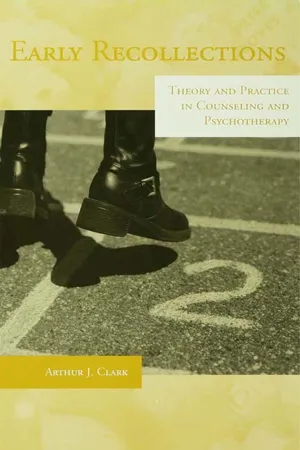
This book reviews the extensive literature on early recollections and organizes various interpretive systems of evaluating early memories. The practitioner will find specific and detailed guidelines for administering and interpreting early recollections to help integrate these memories into counseling and psychotherapy. Following a carefully articulated contextual approach to early recollections, which synthesizes three perspectives - subjective, interpersonal and objective - come suggestions for using early recollections in the counseling process and a full-length case study to explicate the model and demonstrate the utility of using this approach.
Information
II EARLY RECOLLECTIONS
SCORING SYSTEMS, ADMINISTRATION, AND INTERPRETATION
5
SCORING SYSTEMS OF EARLY RECOLLECTIONS
“I think, myself, that one's memories represent those moments which, insignificant as they may seem, nevertheless represent the inner self and oneself as most really oneself.”—Agatha Christie (1977, p. xiii)
INTRODUCTION
FOLLOWING AN EXAMINATION OF THEORETICAL PERSPECTIVES AND broad-based research up to this point, the next major section of the text focuses on specific aspects of the assessment function of early recollections. When practitioners employ first memories as a projective technique they customarily base their conclusions on their particular theoretical orientations and clinical and intuitive impressions. This subjective approach provides a variety and richness of client material and yields a virtually unlimited range and depth of idiosyncratic meanings (Sargent, 1945). At the same time, the possibility becomes remote for determining precise quantitative findings from evaluations subject to interpretation bias and a lack of normative data. Questionable psychometric properties have resulted in adverse reactions by a number of professionals on the use of early memories as a projective device, particularly by those individuals who prefer a more empirically based approach that is comparable to many other personality assessment procedures (Bishop, 1993; Malinoski et al., 1998). In response to this acknowledged preference or demand, researchers have attempted to devise more systematic methods for classifying and interpreting early recollections (Watkins & Schatman, 1986). Although numerous innovative approaches have been pursued to develop viable scoring procedures for early recollections, none of the methods have been widely used in counseling and psychotherapy. The various systems are most often based on the presence or absence of particular variables and the identification of relevant thematic content. Scoring does not actually involve normative data and statistical criteria, but instead focuses on the assignment of first memories inferential material to predetermined categories or designations (Olson, 1979d). The high number of potential scoring variables and diverse theoretical orientations have limited the development of more widely accepted assessment procedures for early recollections. Kal (1994) cautioned, however, that a single-minded pursuit of standardized psychometric properties may actually detract from the essential clinical message of early recollections and ultimately may be worse than relying on subjective and intuitive evaluation procedures.
SCORING SYSTEMS
In a biography of Alfred Adler, Orgler (1939/1965) wrote, “The realisation that first memories allow a deep insight into the human soul is one of Adler's greatest discoveries” (p. 29). Adler's original and routine use of early recollections as a projective technique involved an impressionistic and intuitive assessment approach. Although Adler did not establish an early recollections scoring system per se, he did suggest several key formulations that subsequently contributed to more systematic methods. In this regard, Munroe (1955) thought that “Adler's notion of comparing people on the basis of their spontaneous ‘conscious’ reaction to a fairly simple but dynamic question is the very core of contemporary projective techniques” (p. 429). Researchers after Adler largely followed the theoretical frameworks of Individual Psychology or the psychoanalytic schools of ego psychology and object relations in the assessment and therapeutic applications of early memories. Considering the divergent quality of Adlerian and Freudian viewpoints, it is understandable that theoretically related scoring approaches subsequently resulted in disparate models. In general, selected Adlerian theoretical factors have been augmented by the addition of other psychological dimensions, resulting in more lengthy and conceptually diverse appraisal procedures. The coding schemes of the psychoanalytic tradition typically reflect the complexities of the theory, and do so in a format that is often cumbersome and difficult to score (Kihlstrom & Harackiewicz, 1982). A unique theoretical method involves a cognitive-perceptual theory of personality for evaluating early memories and other memories over the course of the life span (Bruhn, 1990b, 1992a, 1992b). It is possible to identify significant features from the various theoretical approaches and procedures in order to formulate a practical, coherent, and comprehensive system. In this respect, a new contextural assessment approach integrates salient features from the work of previous researchers of early recollections with contemporary aspects of counseling and psychotherapy.
ADLER
When Adler wrote about the purpose and meaning of early recollections he was clear and descriptive. Adler (1931/1958) stated,
There are no “chance memories”: out of the incalculable number of impressions which meet an individual, he chooses to remember only those which he feels, however darkly, to have a bearing on his situation. Thus, his memories represent his “Story of My Life”; a story he repeats to himself to warn him or comfort him, to keep him concentrated on his goal, to prepare him, by means of past experiences, to meet the future with an already tested style of action, (p. 73)
It is evident that Adler emphasized the instrumental function of early memories to justify or fortify an individual's goal structure and outlook on life (Bach, 1952). As eloquent as Adler could be in his commentary on early recollections, however, he was less clear in describing practical and systematic procedures for evaluating first memories. Most often, Adler provided a description or a verbatim account of a person's early recollections as a part of a broader discussion in the context of a detailed case study (Adler, 1929, 1929/1969, 1930/1982, 1931/1958). As an example, Adler (1930/1982) made reference to two brief early recollections of a rebellious boy whom he was treating: “He remembers his father chasing him around the table when he asked for a penny, and seeing his older sister fighting with another girl in the street” (p. 162).
In another case, Adler described the dysfunctional background of a 35-year-old male with a diagnosis of anxiety neurosis. The man experienced in-tense anxiety when he was away from home. On the relatively few occasions when he did attempt to leave home and go to work, the client cried during the day until he was able to go home to be with his mother. In this particular instance, Adler (1931/1958) provided a report of the man's early recollection: “I remember at four years of age staying at home close by the window, looking out on the street being interested to see the people working there” (p. 85). Adler thought that the client believed that the only way to live was to be supported by others in the secure setting of his home. As a treatment goal, Adler felt that it was necessary to change the individual's whole outlook on life. As therapy proceeded, over a period of time the client came to believe that he was capable of cooperating and becoming involved with others, and he eventually opened an art shop. In this capacity, the man maintained his observer status while making a socially useful vocational contribution (Ewen, 1998).
It is also possible to analyze Adler's various references to early recollections beyond his case material in order to identify particular points that are potentially relevant to comprehensive assessment procedures. Regarding the receptivity and cooperativeness of individuals in relating their early recollections, Adler (1931/1958) wrote: “In the main people are perfectly willing to discuss their first memories. They take them as mere facts, and do not realize the meaning hidden in them” (p. 75). In counseling, Adler (1929/1969) emphasized the importance of therapists being genuinely interested in the other person and employing a high degree of empathy in order to understand individuals, including their early recollections. With Adler's acknowledged assumption of holism and the unity of personality, he thought that childhood memories are inherently consistent and produce a coherent story when accurately interpreted (Slavik, 1991). In this regard it should be possible to formulate multiple early recollections of an individual into a cohesive whole that reflects unified personality characteristics. Employing the same line of reasoning, Adler did not distinguish between the interpretive importance of a person's first early memory report and the recall of subsequent early memories. Reflec...
Table of contents
- Cover
- Half Title
- Full Title
- Copyright
- Dedication
- CONTENTS
- ACKNOWLEDGMENTS
- PREFACE
- I EARLY RECOLLECTIONS: INTRODUCTION, THEORETICAL PERSPECTIVES, AND RESEARCH
- II EARLY RECOLLECTIONS: SCORING SYSTEMS, ADMINISTRATION, AND INTERPRETATION
- III EARLY RECOLLECTIONS: APPLICATIONS IN COUNSELING AND PSYCHOTHERAPY
- REFERENCES
- ABOUT THE AUTHOR
- INDEX
Trusted by 375,005 students
Access to over 1.5 million titles for a fair monthly price.
Study more efficiently using our study tools.
Frequently asked questions
Yes, you can cancel anytime from the Subscription tab in your account settings on the Perlego website. Your subscription will stay active until the end of your current billing period. Learn how to cancel your subscription
No, books cannot be downloaded as external files, such as PDFs, for use outside of Perlego. However, you can download books within the Perlego app for offline reading on mobile or tablet. Learn how to download books offline
Perlego offers two plans: Essential and Complete
- Essential is ideal for learners and professionals who enjoy exploring a wide range of subjects. Access the Essential Library with 800,000+ trusted titles and best-sellers across business, personal growth, and the humanities. Includes unlimited reading time and Standard Read Aloud voice.
- Complete: Perfect for advanced learners and researchers needing full, unrestricted access. Unlock 1.5M+ books across hundreds of subjects, including academic and specialized titles. The Complete Plan also includes advanced features like Premium Read Aloud and Research Assistant.
We are an online textbook subscription service, where you can get access to an entire online library for less than the price of a single book per month. With over 1.5 million books across 990+ topics, we’ve got you covered! Learn about our mission
Look out for the read-aloud symbol on your next book to see if you can listen to it. The read-aloud tool reads text aloud for you, highlighting the text as it is being read. You can pause it, speed it up and slow it down. Learn more about Read Aloud
Yes! You can use the Perlego app on both iOS and Android devices to read anytime, anywhere — even offline. Perfect for commutes or when you’re on the go.
Please note we cannot support devices running on iOS 13 and Android 7 or earlier. Learn more about using the app
Please note we cannot support devices running on iOS 13 and Android 7 or earlier. Learn more about using the app
Yes, you can access Early Recollections by Arthur Clark in PDF and/or ePUB format, as well as other popular books in Psychology & Clinical Psychology. We have over 1.5 million books available in our catalogue for you to explore.