This text is a valuable resource for clinicians who work with clients dealing with non-death, nonfinite, and ambiguous losses in their lives. It explores adjustment to change, transition, and loss from the perspective of the latest thinking in bereavement theory and research. The specific and unique aspects of different types of loss are discussed, such as infertility, aging, chronic illnesses and degenerative conditions, divorce and separation, immigration, adoption, loss of beliefs, and loss of employment. Harris and the contributing authors consider these from an experiential perspective, rather than a developmental one, in order to focus on the key elements of each loss as it may be experienced at any point in the lifespan. Concepts related to adaptation and coping with loss, such as resilience, hardiness, meaning making and the assumptive world, transcendence, and post traumatic growth are considered as part of the integration of loss into everyday life experience.
eBook - ePub
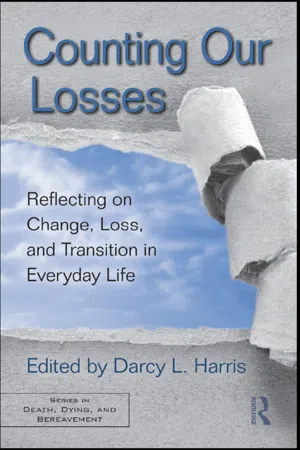
Counting Our Losses
Reflecting on Change, Loss, and Transition in Everyday Life
- 296 pages
- English
- ePUB (mobile friendly)
- Available on iOS & Android
eBook - ePub
About this book
Information
1
Grief From a Broader Perspective
Nonfinite Loss, Ambiguous Loss, and Chronic Sorrow
DARCY L. HARRIS and EUNICE GORMAN
Sorrows are our best education. A person can see farther through a tear than a telescope.
Lord Byron
BACKGROUND
In the bereavement theory classes that we teach, we ask students to complete an assignment where they take an inventory of the losses that they have experienced in their lives and then relate these losses to the course content. It is not uncommon to have our younger students approach us on receipt of this assignment and tell us that they have not experienced any losses and that they are concerned about their ability to complete this project as a result. The “light bulb” usually goes on when we ask them about things like moving, losing friends as a result of a move to a new school or home, having to discontinue participation in a sport they love due to a career-ending injury, the ending of their first romantic relationship, or if their parents separated. Many of the students reply that they had never considered these events as losses in their lives because they did not involve a death but that on reflection they can see how their view of themselves and their world had to be adjusted or changed as a result of these or similar experiences. These adjustments occurred with the initiation of a process that helped them to integrate what had happened into the course of their lives—the grieving process.
In the process of living our lives, we do encounter losses on a regular basis, but we often do not recognize their significance because we tend to think of loss in finite terms, mainly associated with death and dying, and not in terms of adaptation to life-altering change. In the exercise described in the previous paragraph, our students create a “loss line,” where they draw a line on a piece of paper, with their birth at the left side of the paper and the present time on the right side. All along this line on the paper, we suggest they place tick marks at specific ages to indicate when they experienced significant loss events in their lives. Once students are able to grasp the broader sense of loss as something that caused their lives to change in a significant way or that required them to make a significant adaptation in some way, the line is filled quickly with tick marks. Frequent examples include those already given, and often there are losses involving hopes and dreams, such as when they had planned that their lives would go in one direction and they realized that what they had hoped for was not going to be as they had anticipated. Some students realize at this time that, while the losses they have experienced are very real, they may also be intangible and difficult to describe concretely. Further examples of these losses may be lost beliefs that they once held about how the world should work or their ability to trust others. Or they may have somehow lost themselves. In our clinical practice, we hear many stories of individuals who have either been diagnosed with or must take care of family members who have degenerative physical or mental conditions, of intimate relationships that end with an aftermath that continues long after the relationship does, and of individuals who are attempting to rebuild their lives after losing their employment. Many of these descriptions can be identified as nonfinite losses or ambiguous losses, which we will explore in greater detail in this chapter.
NONFINITE LOSS AND CHRONIC SORROW
Nonfinite loss is defined as an enduring loss that is usually precipitated by a negative life event or episode that retains a physical or psychological presence with an individual in an ongoing manner (Bruce & Schultz, 2002). Some forms of nonfinite loss may be less clearly defined in onset, but they tend to be identified by a sense of ongoing uncertainty and repeated adjustment or accommodation. Three main factors separate this experience from the experience of a loss due to a death event:
- The loss (and grief) is continuous, although it may follow a specific event such as an accident or diagnosis.
- The loss prevents normal developmental expectations from being met in some aspect of life, and the inability to meet these expectations may be due to physical, cognitive, social, emotional, or spiritual losses.
- The inclusion of intangible losses, such as the loss of one’s hopes or ideals related to what a person believes should have been, could have been, or might have been (Bruce & Schultz, 2001).
In their writings, Bruce and Schultz (2001) go on to describe several cardinal features of the experience of nonfinite losses:
- There is ongoing uncertainty regarding what will happen next.
- There is often a sense of disconnection from the mainstream and what is generally viewed as “normal” in human experience.
- The magnitude of the loss is frequently unrecognized or not acknowledged by others.
- There is an ongoing sense of helplessness and powerlessness associated with the loss.
Jones and Beck (2007) further add to this list a sense of chronic despair and a sense of ongoing dread, as individuals try to reconcile themselves between the world that is now known through this experience and the world in the future that is now anticipated.
In short, the person who experiences a nonfinite loss is repeatedly asked to adjust and accommodate to the loss. At the same time, because nonfinite loss is often not well understood, the experience may go unrecognized or unacknowledged by others. Support systems may tire of attempting to provide a shoulder to lean on when they also see potential joy, as well as sorrow, in a situation. For instance, partners who have had ongoing problems with infertility finally are able to have a baby. However, the baby is born prematurely and with some health concerns. The couple is at once ecstatic but worried about the future and sad because of the potential roadblocks and concerns that may arise over the course of the new baby’s life. Well-wishers will stress the joy at having a new baby in the couple’s life and may not recognize, or perhaps even tolerate, any discussion of the mixed emotions of sadness and disappointment that the baby was not “perfect” and that the delivery did not occur after a full-term pregnancy.
A related concept to nonfinite loss is that of chronic sorrow, a term first proposed by Olshansky (1962) after his observations of parents whose children were born with disabilities. He noticed that these parents experienced a unique form of grieving that never ended as their children continued to live and that the hopes they had for these children were repeatedly dashed as time went on. Shortly after the introduction of the concept by Olshansky, a few articles were written about the adjustment and coping in parents of children with various developmental disabilities. Since then, most of the research associated with the concept of chronic sorrow has been reported in the nursing literature. In 1989, the Nursing Consortium for Research on Chronic Sorrow was formed to further investigate the phenomenon in individuals with chronic or life-threatening conditions as well as the caregivers of these individuals (Burke, Eakes, & Hainsworth, 1999). The concept has been empirically proven in multiple sclerosis (Ahlstrom, Gunnarsson, & Isaksson, 2007; Liedstrom, Isaksson, & Ahlstrom, 2008), parenting a child with a mental health problem (Angold, Messer, & Stangl, 1998; Corrigan & Miller, 2004; Godress, Ozgul, Owen, & Foley-Evans, 2005; Hinshaws, 2005), Alzheimer’s disease (Mayer, 2001), autism (O’Brien, 2007), mental illness (Jones, 2004), and caring for a child with disabilities (Berube, 1996; Green, 2007; Langridge, 2002). Chronic sorrow has also been linked to Parkinson’s disease, mental retardation, neural tube defects, spinal cord injury, schizophrenia, and chronic major depression (Roos, 2002). Chronic sorrow is found in situations involving long-term care giving. It has also been recently associated with loss of homeland, language, culture, and customs in immigrants (Melvin, 2005). Samuels (2009) shed light on chronic sorrow in young adults who have moved through the foster home system and now live in homes outside the social service network. These young people mourn the loss of a sense of home that would have grounded them as children.
Chronic sorrow is defined by Roos (2002) as:
a set of pervasive, profound, continuing, and recurring grief responses resulting from a significant loss or absence of crucial aspects of oneself (self-loss) or another living person (other-loss) to whom there is a deep attachment. The way in which the loss is perceived determines the existence of chronic sorrow. The essence of chronic sorrow is a painful discrepancy between what is perceived as reality and what continues to be dreamed of. The loss is ongoing since the source of the loss continues to be present. The loss is experienced as a living loss. (p. 26)
Chronic sorrow remains largely disenfranchised and often escalates in intensity or is progressive in nature (Roos & Neimeyer, 2007). While chronic sorrow is often linked to a defining moment, a critical event, or a seismic occurrence, it can just as easily be the hallmark of the slow insidious realization of what a diagnosis means over time and how it has caused change for the lives in its wake. In this book, the term nonfinite loss will refer to the loss or event itself, and chronic sorrow will refer to the response to ongoing, nonfinite losses.
Burke et al. (1999) define chronic sorrow as “grief-related feelings that emerge in response to an ongoing disparity resulting from the loss of the anticipated ‘normal’ lifestyle of these persons” (p. 374). Teel (1991) states that, in addition to the disparity that exists between what is expected or hoped for and what actually is in reality, the chronicity of the feelings and the ongoing nature of the loss separate chronic sorrow apart from other forms of grief. According to this author, chronic sorrow can be precipitated by the permanent loss of a significant relationship, functionality, or self-identity. Delp (1992) links living loss experiences to mental suffering, lamentation, sadness, regret, and the sense of emotional heaviness.
Lindgren (1992) defines the characteristics of chronic sorrow to include the following: (1) a perception of sadness or sorrow over time in a situation with no predictable end; (2) sadness or sorrow that is cyclic or recurrent; (3) sadness or sorrow that is triggered internally or externally; and (4) sadness or sorrow that is progressive and can intensify. Chronic sorrow is differentiated from the grief response after a death in that the loss itself is ongoing, and thus the grief does not end. Lindgren goes on to stress the peaks and valleys, resurgence of feelings, or periods of high and low intensity that distinguish chronic sorrow from other types of grief responses. An individual’s emotions might swing between flooding of emotion and numbness at the two extremes of an emotional pendulum. Most people who experience chronic sorrow reside somewhere between these two end points.
Roos (2002) also states that the loss involved in chronic sorrow is a lifetime loss and remains largely unrecognized for its significance. She also notes that the first realization of the loss is the trauma that launches chronic sorrow. One’s assumptive world is shattered, and there is no foreseeable end, with constant reminders of the loss. She states that an undercurrent of anxiety and trauma also separates this construct from grief after a death and that the person usually continues to function, separating it from primary clinical depression. Chronic sorrow differs from posttraumatic stress disorder (PTSD) because of the ongoing nature of the loss and because it is not a reaction to an event that has occurred, even though there may be an event that defines when the loss began. The traumatic material in nonfinite loss is related to the degree of helplessness and powerlessness that is felt in light of a situation that has profound, ongoing, and life-altering implications for the individual.
Roos (2002) makes the point that chronic sorrow may apply more to those who are caregivers, as the affected individual may not be able to internalize the world to be able to have dreams or life goals, and the intensity of the experience of chronic sorrow is related to the potency and magnitude of the disparity between the reality of the situation and the dream to which a person may cling. The outcome is really unknown, or the progression of what will unfold is unknown, so unpredictability complicates the process. The ongoing presence of the person or the loss inhibits reinvestment into other aspects of life, and there are “surges” of loss that are often triggered by various events, as might occur in individuals whose loss was related to the death of another individual (Teel, 1991).
It is important to stress the cyclical nature of chronic sorrow. Peterson and Bredow (2004) remind us that tipping points, triggers, or milestones can cause an upsurge of sorrow. These can be either externally or internally driven. Something as simple as a touch, smell, or sound might bring feelings of sadness rushing to the forefront of a person’s day-to-day experience. Triggers might be anniversary dates or reminders sparked by a happy or sad event in another person’s life, such as a wedding or baby shower. Fears, disappointments, and sorrow can be brought to mind easily. However, it is important to note that it is a disservice to the individuals struggling with chronic sorrow if we view the experience as permanent despair. It is not. Instead, there is mounting evidence that sorrow occurs periodically throughout day-to-day life, and there are also moments of joy. Johnsonius (1996) describes this as cycles of withdrawal, or loss of connectedness with an outward appearance of happiness, or real happiness, despite continued pain in an environment that is never free of the reminders of what has been lost.
AMBIGUOUS LOSS
Many of the nondeath losses experienced by individuals are very difficult to name, describe, or validate. As stated previously, many losses are not clearly defined because there is no identifiable “death.” For many individuals, it may be unclear exactly what has been lost. The loss may or may not involve a person, and there may not be a defining experience to denote where the loss actually originates. In her development and exploration of loss experiences where there was significant ambiguity, Boss (1999) first used the term ambiguous loss. She described two situations where ambiguous loss occurs. In the first scenario, the person is perceived as physically absent but psychologically present. Examples may be when a person is missing, such as in divorced families when the noncustodial parent is absent but very much present in the minds of the children. Prisoners, kidnapping victims, relatives serving their country overseas, adoptive families, and situations when a person is absent or missing but very much present in the minds or awareness of their loved ones also may also fit this description. Another frequent example would be grandparents who lose contact with their grandchildren after the parents of these children divorce. In the second scenario described by Boss, ambiguous loss may be identified when the person is physically present but perceived as psychologically absent. Examples of this type of loss may be when a family member has Alzheimer’s disease, acquired brain injury, autism, or a chronic mental illness or is psychologically unavailable due to addictions or some type of ongoing distraction or obsession. Each of these scenarios leaves individuals feeling as if they are “in limbo” (Boss & Couden, 2002) as they struggle to learn to live with ambiguity (Boss, 1999, 2006, 2007; Tubbs & Boss, 2000).
Boss’s first observations of this phenomenon occurred when she engaged with families in a therapeutic setting, where the family system was outwardly intact, but one of the members was absent psychologically from the family through obsessive workaholism or addiction.
Key aspects of ambiguous loss include (Boss, 2007) the following:
- The loss is confusing, and it is very difficult to make sense of the loss experience (as when a person is physically present but emotionally unavailable).
- Because the situation is indeterminate, the experience may feel like a loss but not be readily identified as one. Hope can be raised and destroyed so many times that individuals may become psychically numb and unable to react.
- Because of ongoing confusion about the loss, there are frequent conflicting thoughts and emotions, such as dread and then relief, hope and hopelessness, wanting to take action and then profound paralysis. People are often “frozen” in place in their reactions and unable to move forward in their lives.
- Difficulty problem solving because the loss may be temporary (as in a missing person) or permanent (as in an acquired head injury).
- There are no associated rituals and very little validation of the loss (as opposed to a death where there is official certification of the death and prescribed rituals for funeral and disposition of a body).
- There is still hope that things may return to the way...
Table of contents
- Cover Page
- Title Page
- Copyright Page
- Series Editor’s Foreword
- Acknowledgments
- Introduction
- About the Editor
- About the Contributors
- 1
- 2
- Section I
- Section IA
- 3
- 4
- 5
- Section IB
- 6
- 7
- 8
- 9
- Section II
- 10
- 11
- 12
- Section III
- Section IIIA
- 13
- 14
- 15
- 16
- 17
- Section IIIB
- 18
- 19
- 20
- Section IV
- 21
- 22
- 23
Trusted by 375,005 students
Access to over 1.5 million titles for a fair monthly price.
Study more efficiently using our study tools.
Frequently asked questions
Yes, you can cancel anytime from the Subscription tab in your account settings on the Perlego website. Your subscription will stay active until the end of your current billing period. Learn how to cancel your subscription
No, books cannot be downloaded as external files, such as PDFs, for use outside of Perlego. However, you can download books within the Perlego app for offline reading on mobile or tablet. Learn how to download books offline
Perlego offers two plans: Essential and Complete
- Essential is ideal for learners and professionals who enjoy exploring a wide range of subjects. Access the Essential Library with 800,000+ trusted titles and best-sellers across business, personal growth, and the humanities. Includes unlimited reading time and Standard Read Aloud voice.
- Complete: Perfect for advanced learners and researchers needing full, unrestricted access. Unlock 1.5M+ books across hundreds of subjects, including academic and specialized titles. The Complete Plan also includes advanced features like Premium Read Aloud and Research Assistant.
We are an online textbook subscription service, where you can get access to an entire online library for less than the price of a single book per month. With over 1.5 million books across 990+ topics, we’ve got you covered! Learn about our mission
Look out for the read-aloud symbol on your next book to see if you can listen to it. The read-aloud tool reads text aloud for you, highlighting the text as it is being read. You can pause it, speed it up and slow it down. Learn more about Read Aloud
Yes! You can use the Perlego app on both iOS and Android devices to read anytime, anywhere — even offline. Perfect for commutes or when you’re on the go.
Please note we cannot support devices running on iOS 13 and Android 7 or earlier. Learn more about using the app
Please note we cannot support devices running on iOS 13 and Android 7 or earlier. Learn more about using the app
Yes, you can access Counting Our Losses by Darcy L. Harris in PDF and/or ePUB format, as well as other popular books in Psychology & Mental Health in Psychology. We have over 1.5 million books available in our catalogue for you to explore.