- 476 pages
- English
- ePUB (mobile friendly)
- Available on iOS & Android
eBook - ePub
About this book
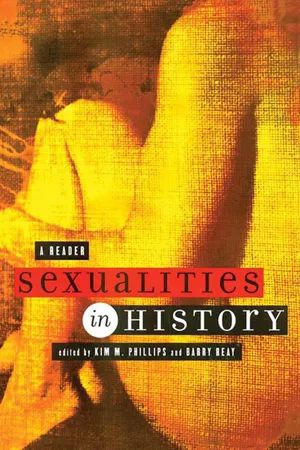
Over the past twenty years, historians have overturned nearly everything we once took for granted about human sexuality. Gender, sexual orientation, "deviance," and even the biology of sex have been unmasked for what they are-historically specific, culturally contested, and above all, unstable constructions.
PART 1
RETHINKING SEX
SEXUALITY AND HISTORY REVISITED
WRITING ABOUT SEX
Writing about sex can be dangerous. It makes you, as Ken Plummer put it, “morally suspect.”1 Until recently, in the academic world at least, it marked you also as marginal to the central intellectual preoccupations of the major disciplines.
Nearly forty years ago, the young William Masters felt sufficiently inspired by the example of Alfred Kinsey to want to pursue a career in sex research. He was advised by his obviously more worldly wise supervisor to do three things first: to complete his medical qualifications; to establish his reputation in another field; and to wait until he was forty before venturing into these treacherous waters.
This little anecdote tells us quite a lot about the moral climate in postwar America, and probably about the present too. Here we find, for example, the hegemony of medicine which has dominated most “respectable” discussions of sex over the past century. Then there is the emphasis on reputation and credentials, a positive underlining of the importance of a student in this field demonstrating his or her objective, scholarly interest in the subject before venturing into it. And, of course, reputation, credentials, respectability and objectivity are assumed to come with age.
It has always been possible to write about sexuality. But, to do so and be listened to, it has usually been necessary to work within the confines of an acceptable discourse. The authorized voices have been religious, medical, medico-moral, legal, psychological, pedagogical, and certainly “official.” They have rarely been sensitive to the nuances of history or social variability. It is striking that the only social scientific research initiative with a direct relationship to sexual behaviour spontaneously launched by the (British) Economic and Social Research Council has to do with yet another medico-moral problem, that associated with the tragic spread of AIDS.
Needless to say, quite a lot of writing about sexuality has gone on outside these parameters. But it is noticeable how, even today many of us who venture into this field still feel the need to stress our academic credentials for doing so. If you look at any journal whose main concern is sexuality in some form you will find the title page full of the names of Impeccably scholarly advisers, complete with a long list of their academic qualifications, from M.D. to Ph.D. (Candidate). Academic awards permit us to speak with authority; and to make what we say acceptable.
To get back to my anecdote: the young William Masters followed the advice of his mentor absolutely. And who can say he was wrong? Alongside his partner and future wife Virginia he was to become half of the world-famous sex-research and sex-therapy duo, Masters and Johnson. Their popular success has always been underpinned by their “scientific” reputation. The very turgidity of their writing style may be seen as a simulacrum of the scientific text.
Some things at least have changed. Since the early 1970s there has been a major expansion in the study of sexuality in general, and of sexual history in particular. We now know a good deal about marriage and the family, Illegitimacy and birth control, prostitution and homosexuality, changing patterns of moral, legal and medical regulation, rape and sexual violence, sexual identities and sexual communities, and oppositional cultures. Historians have interrogated old and discovered new documentary evidence; they have deployed extensive oral history sources; and all but exhausted the records of births, marriages and deaths.2
Major scholars, whose reputations were, significantly, made elsewhere, have entered the field. To name just some of the best known: Lawrence Stone has exhaustively chronicled the (largely upper-class) family, sex and marriage in pre-modern England.3 Peter Gay is venturing into the complexities of the “bourgeois experience.”4 Most influentially of all, Michel Foucault has essayed a genealogy of the Western apparatus of sexuality.5 The subject has achieved an unprecedented range, depth and, dare I say it, respectability.
This signals an important and welcome shift. But it is vital that we understand its real significance, which lies not in who writes but what they write about. The really noteworthy point about the new sexual history lies in the fact that increasingly it is being recognized that far from being a minor adjunct to the mainstream of history, sexuality in its broadest sense has been at the heart of moral, social and political discourse. We cannot properly understand the past, let alone the present, unless we grasp that simple fact.
Two lessons for the historical enterprise flow from this. First, it is imperative to recognize not only the desirability but the absolute necessity of inter-, multi-and cross-disciplinary approaches to the subject. The new sexual history has in fact been fed not only by new sources and new topics, but also by a multitude of approaches, from psychoanalysis to poststructuralism and semiology, and nurtured by a number of disciplines, from the “new social history” to sociology, philosophy and literature. They go far beyond the conventional intellectual tools of the traditional empirical historian. I would go so far as to say that the study of sexuality as a historical phenomenon fundamentally challenges the existing disciplinary boundaries, illustrating perhaps better than any other topic their contingent natures. Traditional historical methods have proved inadequate to the understanding of sexuality The history of sexuality should not be studied by historians alone.
The second factor is that sexual history is to a high degree a politicized history, underlined by an energetic grassroots input into the study of sexuality. To an extraordinary degree, much of the most innovative historical work in this field has come from women and men whose initial concern was as much “political” as purely “academic.” Many of the pioneering feminist writers about sexuality in the early 1970s are now in often senior academic positions; their work has grown in empirical richness and theoretical sophistication. But their publications, while achieving the highest scholarly standards, are still clearly within a developing tradition of feminist writing.6 Similarly, within the area of lesbian and gay studies, important historical works have appeared which, though initially stimulated by the moral and political preoccupations of the authors, have begun to transform the wider intellectual debate.7 In the study of sexuality, it seems, scholarship and politics, broadly defined, are inextricably intertwined.
I want to devote much of the rest of this chapter to exploring the implications of these factors, concentrating on several interrelated questions. What, for example, is the impact of the new sexual history on our understanding of sexuality? Or, to put it another way, what is it we study when we say we are exploring the history of sexuality? What do our studies tell us about the relationship of the sexual to the social, to power and politics? In what ways do they illuminate our understanding of social and moral regulation, and the role of the state? How, in turn, does this affect our perception of the historic present in which we live? Why, in particular, has sexuality become so important in the contemporary political discourse of both left and right? My aim is not to supply the answers, but to sharpen the questions we must ask if we are to rethink the history of sexuality.
THE SUBJECT OF SEXUAL HISTORY
At the heart of the new sexual history is the assumption that sexuality is a social and historical construct. In the famous words of Foucault, “Sexuality must not be thought of as a kind of natural given which power tries to hold in check, or as an obscure domain which knowledge tries gradually to uncover. It is the name that can be given to a historical construct.”8
Leaving aside the ambiguities of and problems with this statement, I want to emphasize the revolution in the approach to sexuality that this symbolized. Of all social phenomena, sex has been most resistant to social and historical explanations. It seems the most basic, the most natural thing about us, the truth at the heart of our being. This has been reflected until very recently in even the most sophisticated studies of sexuality. As pioneering sexual theorists sought to chronicle the varieties of sexual experience throughout different periods and different cultures they assumed that beating at the centre of all this was a core of natural sexuality, varying in incidence and power, no doubt, as a result of chance historical factors, the weight of moral and physical repression, the patterns of kinship, and so on, but nevertheless basically unchanging in biological and psychological essence.
Such an assumption governed equally the naturalist approaches of the early sexologists and the metatheoretical approaches of such Freudo-Marxists as Reich and Marcuse. It dominated the thoughts of functionalist anthropologists with their commitment to cultural relativism as much as the evolutionists they displaced. It lurked as effortlessly behind the sexual writings of cultural radicals as behind the work of moral conservatives. It was the taken-for-granted of sexual studies.9
The new sexual history has changed that. Its origins are disparate, owing, as I have already indicated, something to sociology and anthropology (their emphasis on cultural relativism, social organization and micro-studies),10 something to psychoanalysis (especially the challenge offered by the theory of the unconscious to fixed gender and sexual positions),11 something to the new sexual movements of the early 1970s (their critique of existing social and sexual categories),12 something to the new social history (in as far as these diverse strands can be disentangled from the new history). Foucault's work made such an impact in the early 1980s because, in part at least, it complemented and helped to systematize work already going on. Unifying the new approach were several common themes.
First, there was a general rejection of sex as an autonomous realm, a natural domain with specific effects, a rebellious energy that the social controls.
Once you begin to see sexuality as a “construct,” as a series of representations, as an “apparatus” with a history of its own, many of the older certainties dissolve. It is no longer appropriate to state, as Malinowski did, that “Sex really is dangerous,” the source of most human trouble from Adam and Eve on.13 Instead, we are forced to ask: Why is it that sex is regarded as dangerous? We can no longer speculate about the inevitable conflict between the powerful instinct of sex and the demands of culture. Instead, we need to ask why our culture has conceived of sexuality in this way.
Second, it followed that the new sexual history assumed the social variability of sexual forms, beliefs, ideologies and behaviours. Sexuality has not only a history, but many histories, each of which needs to be understood both in its uniqueness and as part of an intricate pattern.
Third, it became necessary to abandon the idea that the history of sexuality can usefully be understood in terms of a dichotomy of pressure and release, repression and liberation. “Sexuality” as a domain of social interest and concern is produced by society in complex ways. It is a result of diverse social practices that give meaning to human activities, of social definitions and self-definitions, of struggles between those who have the power to define, and those who resist. Sexuality is not a given. It is a product of negotiation, struggle and human agency.
The most important outcome of the resulting historical approach to sexuality is that it opens up the whole field to critical analysis and assessment. It becomes possible to relate sexuality to other social phenomena and to ask new types of questions (new at least to the field of sex research). Questions such as the following: How is sexuality shaped, and how is it articulated with economic, social and political structures—in a word, how is it “socially constructed”? Why and how has the domain of sexuality achieved such a critical organizing and symbolic significance? Why do we think it so important? If sexuality is constructed by human agency, to what extent can it be changed?
Questions such as these have produced an impressive flood of new work— and new questions—across a range of issues from the shaping of reproduction14 to the social organization of disease,15 from the pre-Christian origins of the Western preoccupation with the association between sex and truth16 to the making of the modern body.17
I'll take a further example from an area which I myself have been particularly interested in—the history of homosexuality. Fifteen years ago there was virtually nothing in the way of serious historical studies of same-sex activity. Such writings as existed assumed an unchanging...
Table of contents
- Cover Page
- Half Title page
- Title Page
- Copyright Page
- Contents
- Introduction
- Part 1 Rethinking Sex
- Part 2 Sexing the Body
- Part 3 Controlling Sex
- Part 4 Redefining Sex
- Part 5 Constructing Sex
- Part 6 Punishing Sex
- Part 7 Unsettling Sex
- Notes on the Contributors
- Permissions Acknowledgments
- Index
Trusted by 375,005 students
Access to over 1.5 million titles for a fair monthly price.
Study more efficiently using our study tools.
Frequently asked questions
Yes, you can cancel anytime from the Subscription tab in your account settings on the Perlego website. Your subscription will stay active until the end of your current billing period. Learn how to cancel your subscription
No, books cannot be downloaded as external files, such as PDFs, for use outside of Perlego. However, you can download books within the Perlego app for offline reading on mobile or tablet. Learn how to download books offline
Perlego offers two plans: Essential and Complete
- Essential is ideal for learners and professionals who enjoy exploring a wide range of subjects. Access the Essential Library with 800,000+ trusted titles and best-sellers across business, personal growth, and the humanities. Includes unlimited reading time and Standard Read Aloud voice.
- Complete: Perfect for advanced learners and researchers needing full, unrestricted access. Unlock 1.5M+ books across hundreds of subjects, including academic and specialized titles. The Complete Plan also includes advanced features like Premium Read Aloud and Research Assistant.
We are an online textbook subscription service, where you can get access to an entire online library for less than the price of a single book per month. With over 1.5 million books across 990+ topics, we’ve got you covered! Learn about our mission
Look out for the read-aloud symbol on your next book to see if you can listen to it. The read-aloud tool reads text aloud for you, highlighting the text as it is being read. You can pause it, speed it up and slow it down. Learn more about Read Aloud
Yes! You can use the Perlego app on both iOS and Android devices to read anytime, anywhere — even offline. Perfect for commutes or when you’re on the go.
Please note we cannot support devices running on iOS 13 and Android 7 or earlier. Learn more about using the app
Please note we cannot support devices running on iOS 13 and Android 7 or earlier. Learn more about using the app
Yes, you can access Sexualities in History by Kim M. Phillips,Barry Reay in PDF and/or ePUB format, as well as other popular books in History & Social History. We have over 1.5 million books available in our catalogue for you to explore.