Welfare Racism analyzes the impact of racism on US welfare policy. Through historical and present-day analysis, the authors show how race-based attitudes, policy making, and administrative policies have long had a negative impact on public assistance programs. The book adds an important and controversial voice to the current welfare debates surrounding the recent legilation that abolished the AFDC.
eBook - ePub
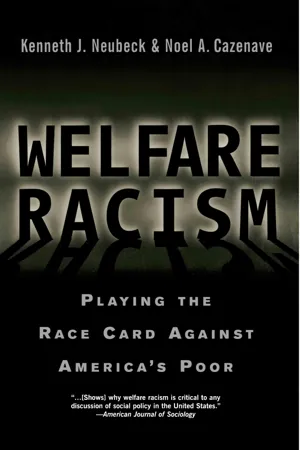
Welfare Racism
Playing the Race Card Against America's Poor
- 304 pages
- English
- ePUB (mobile friendly)
- Available on iOS & Android
eBook - ePub
About this book
Information
1
Seeing Welfare Racism
It’s like we’re all in the same room, and there’s this huge pink elephant in the middle of the room. That pink elephant is racism. But nobody wants to look at it; people walk around it; they don’t want to see it. But we can’t begin to move forward until we name it and get other folks to actually see it. Until we can do that, we can’t really change anything, we can’t get the pink elephant out of the room.
Janet Robideau, coordinator,
Indian People’s Action,
Montana, summer 2000
In recent decades, in the mass media
and in everyday conversation, mothers and their children who rely on welfare in the United States have overwhelmingly and erroneously been depicted as “black.”1 African-American women of all socioeconomic statuses have found themselves stereotyped with the negative qualities associated with so-called welfare queens. Today, the words welfare mothers evoke one of the most powerful racialized cultural icons in contemporary U.S. society.2
The following “joke,” from an early 1990s calendar sold by Waldenbooks, is indicative of how prevalent the racist stereotype of African Americans as welfare recipients has become:
How come you never see an African-American family portrait? Because when the photographer says, “Say cheese,” they all run to the welfare center and form a straight line.3
The racialization of welfare did not happen overnight. For decades, well-known U.S. politicians like Barry Goldwater, George Wallace, Robert Byrd, Richard Nixon, Ronald Reagan, David Duke, Newt Gingrich, and Bill Clinton forged and exploited the link between “race” and “welfare” to such a degree that the two terms are now politically and culturally inextricable. Today, whenever politicians want to exploit white racist animus for political gain they need not say the words Niggers or Nigras, as did white southern segregationists. They now need only mention the word welfare.
Politicians have blamed black mothers who must rely on welfare for nearly every social problem in the United States, including violent crime; the illegal drug epidemic; the decline of families, communities, and schools; the growth of rampant immorality; and even poverty itself. Black mothers receiving welfare have been cast not simply as prototypical villains, but as a collective internal enemy that threatens the very foundation of U.S. society. They are portrayed as dishonest and irresponsible individuals who purchase bottles of vodka with food stamps intended to help feed their children, or as immoral and promiscuous individuals who are said to breed children to rip off the welfare system for more benefits.
As a result of the racialization of welfare and its recipients, all mothers who must rely on welfare, regardless of their color or ethnicity, are now being dealt with in a way consistent with the hostility evoked by the racist image of the so-called welfare-dependent black mother. To understand how U.S. society has reached such a point it is essential to take a close look at what we call welfare racism.
Playing the Welfare “Race Card”
The belief that African Americans are welfare-prone is not found only in such crude efforts at humor as the calendar joke mentioned above. Throughout U.S. society those on the nation’s welfare rolls are stereotypically depicted as consisting primarily of an African-American urban underclass. Indeed, as we will see, national surveys reveal that many whites believe that African Americans prefer remaining on welfare to being self-supporting. Public opinion surveys also show that the perceived race of welfare recipients matters mightily in determining how recipients are viewed. When welfare recipients are seen as being mostly white they are likely to be thought of with compassion; when they are seen as being mostly black they are viewed with contempt.
Politicians and policy analysts often exploit and reinforce these stereotypes. For example, in 1996, President Clinton kept his 1992 campaign promise to “end welfare as we know it” by signing legislation that abolished Aid to Families with Dependent Children and instituted the Personal Responsibility and Work Opportunity Reconciliation Act. As if his racial message was not clear enough, President Clinton had African-American mothers at his side in press photographs of the White House ceremony in which he signed the welfare reform bill.
Why might Bill Clinton make such a promise? Survey data reveal that many European Americans believe that most people on welfare are black, when in reality African Americans and whites have been about equally represented on the welfare rolls for many years.4 Those European Americans who view welfare as a “black program” have been found to have the most hostile attitudes toward welfare recipients. They tend to stereotype African Americans as lazy, unwilling to make the effort to take advantage of opportunities open to them, and thus undeserving of public assistance.5 As we have noted, politicians have fueled and exploited such racial sentiments for their own political gain.
Prior to the passage of the PRWORA, politicians and other policy elites routinely linked race and welfare. This was done by employing code terms that thinly camouflaged overt racism. Terms like welfare queens, welfare chiselers, generations of welfare dependency, and children having children were commonplace in 1990s discussions of the need for welfare reform. Political discourse using such terms routinely conjured up images of an inner-city, largely African-American welfare population, notable for its allegedly deficient group values and pathological behaviors.6
In this highly racialized political environment neither voluminous government statistical data nor scholarly research findings on the widely diverse characteristics and the unmet needs of the nation’s poor have had much influence on the direction and outcome of recent welfare reform debates. The unusually harsh and punitive character of the “welfare reform” policies that have been proposed or implemented in the wake of such debates has often reflected a preoccupation with controlling the alleged sexual immorality and supposed preference for welfare over work of one group: African-American females.
Congressional discourse preceding the passage of the Personal Responsibility and Work Opportunity Reconciliation Act largely reflected concern with young, single, inner-city mothers. The act’s proponents argued that such mothers need the incentive of restricted benefits and strict time limits on welfare eligibility to motivate them to avoid out-of-wedlock pregnancies and establish economic self-sufficiency. A stereotype that women on welfare were typically inner-city “children having children” to get on the dole has long endured despite the fact that African-American teenage girls made up a tiny percentage of all mothers receiving welfare.7 Given the racially charged discourse that culminated in the abolition of AFDC, it should not be surprising that mothers and children of color are disproportionately affected by welfare reform. Such families are much more likely than European-American families to be extremely poor (living below 50 percent of the poverty line)8 and to have little alternative but to turn to the state for cash welfare assistance.
In the 1990s there was a great deal of welfare racist sentiment among members of the public for politicians to exploit. While the percentage of families receiving welfare in 1996 who were African American was almost identical to that for whites (37 versus 36 percent),9 survey research in the first half of the 1990s revealed that many European Americans had come to view AFDC as a “black program.” Moreover, many believed that African Americans as a group preferred to live off welfare instead of working. One survey, commissioned by the Anti-Defamation League, found that 35 percent of those who identified themselves as white believed African Americans preferred welfare to work.10 Data from the National Opinion Research Center showed that, when asked to directly compare themselves with African Americans, fully three-fourths of white respondents rated African Americans as less likely than whites to prefer to be self-supporting.11
Yet another survey found that almost half of the respondents, the vast majority of whom were white, held erroneous beliefs that most people who are poor are black, and that most people who are on welfare are black.12 Most of those polled believed that lack of effort was to blame for people being on welfare and that most welfare recipients really did not want to work. These beliefs were most likely to be found among poll respondents who believed that most people on welfare are black. Political scientist Martin Gilens, analyzing still other survey data, has argued that the most important source of European Americans’ hostility toward public assistance is their stereotypical beliefs about African Americans, especially the belief that they are lazy.13
It might be expected that public attitudes reflecting racist stereotypes about and hostility toward welfare recipients, the racialized tenor of the political discourse surrounding welfare reform legislation, and the fact that the PRWORA strips the safety net away from so many poor families of color would at least raise the question among policy analysts and social scientists: Is U.S. welfare policy racist? Unfortunately, the political and intellectual climate that has come to prevail in the United States discourages even asking this question. Broad-based insensitivity to the existence and significance of systemic racism, and even the denial of the salience of racism as a modern-day social force, are common.14
While perhaps more immediately visible in political elites’ discourse than in academic writings, insensitivity to racism as a systemic social problem, and blindness to the race-based privileges possessed by all whites, extends to the work of all but a small number of social scientists and policy analysts.15 Most European Americans today view the “race problem” as having been somehow solved by legislation passed during the 1960s, and simply do not believe that African Americans and other people of color continue to be deprived of “the dignity, opportunities, freedoms, and rewards that this nation offers white Americans.”16
In stark contrast to this general insensitivity to the existence and significance of racism among European Americans, undeniably racist events and episodes do occur in U.S. society, sometimes taking horrific and violent forms. These are typically framed by European-American political elites as unfortunate aberrations and ignorant acts by a racially bigoted few.17 This is the case even though it is difficult to open a daily newspaper or watch television news programs without coming across yet another example of white racism directed at people of color.
The larger social context of racist acts is ignored even though they are prevalent in every institutional and organizational setting in U.S. society. Those reported upon in the news include racially bigoted acts by European-American police officers, corporate executives, high school and college students, public officials, members of the military, athletes, and media figures. The fact that this behavior is ubiquitous and acted out by people from a wide cross section of the U.S. population tends not to be taken by European-American political elites as evidence that racial bigotry and systemic racism are serious matters in the United States with which we must contend. On this issue, the European-American public is generally in accord.
The majority of European Americans have difficulty seeing even blatant expressions of racial bigotry as indicative of a larger social problem. Not surprisingly, they are virtually blind to the often more subtle, systemic forms of racism that affect virtually every arena of social life. It is these systemic forms of racism that provide European Americans with their greatest present-day and cumulative advantages over African Americans and other people of color.18
In social arenas ranging from employment to housing, from education to politics and from law enforcement to health care, African Americans and others suffer collective disadvantages associated with highly systemic, albeit often subtle, institutionalized discrimination.19 The absence of racism in welfare policy—given its presence in these other arenas—would be an exceptional situation indeed.
Seeing Welfare Racism
“Seeing is believing” is a popular expression in the United States. Clearly, welfare racism exists. It pervades this nation’s politics and culture. And it is devastating in its consequences for all poor people. That something is obvious, however, does not mean that it will be seen or believed, much less acknowledged; people possess a remarkable ability to remain blind to what they choose not to see. At the opening of this chapter, we presented what we think is a powerful quote by a Native American community activist who compares racism to a big pink elephant in the middle of the room that no one sees. Metaphorically, welfare racism is that big, but apparently invisible, pink elephant.
Welfare racism is so pervasive in U.S. society that it is manifested in countless racist jokes and stories. While in U.S. public policy and social science welfare racism is a well-kept national secret, in U.S. society as a whole it is one of its worst-kept secrets. Most people have heard jokes like the one at the beginning of this chapter. When white politicians talk about welfare they know what part of their constituency they are appealing to and how. Unfortunately, as a society the United States, publicly at least, has closed its eyes and pretended not to see the gigantic pachyderm in its midst.
It is as if some time ago the nation’s “welfare racism files” were classified “Top Secret.” As we will show, this pretense is central to both U.S. public policy and its social science research on that policy. Unless those files are found, opened, read, and thoroughly understood—unless welfare racism is seen—it will be impossible to confront. In this book those files are presented for your inspection.
European-American insensitivity to and denial of racism as a social force— especially the systemic racism to which we have alluded—has been helped along and legitimized by a “scholarship of backlash” that emerged in the post-civil rights era.20 This scholarship reflects and reinforces many European Americans’ unwillingness to entertain the notion that racism is alive and well today. The “politics of denial”21 regarding the present-day salience of racism make our current political and intellectual climate inhospitable to expressions of concern over the plight of poor African-American mothers and other impoverished people of color. Denial politics function to force the topic of welfare racism off the radar screen and thus eliminate it from disco...
Table of contents
- Cover
- Title Page
- Dedication
- Copyright
- Contents
- Preface and Acknowledgments
- 1. Seeing Welfare Racism
- 2. Conceptualizing “Welfare Racism”
- 3. Welfare Racism in the Early Years of Public Assistance
- 4. Welfare Racism as a Defense Against Challenges to White Supremacy
- 5. The Demise of AFDC as a Legacy of White Racial Backlash
- 6. Welfare Reform as Race Population Control
- 7. After AFDC and the Return of States’ Rights-Era Welfare Racism
- 8. Confronting Welfare Racism
- Notes
- Index
Trusted by 375,005 students
Access to over 1.5 million titles for a fair monthly price.
Study more efficiently using our study tools.
Frequently asked questions
Yes, you can cancel anytime from the Subscription tab in your account settings on the Perlego website. Your subscription will stay active until the end of your current billing period. Learn how to cancel your subscription
No, books cannot be downloaded as external files, such as PDFs, for use outside of Perlego. However, you can download books within the Perlego app for offline reading on mobile or tablet. Learn how to download books offline
Perlego offers two plans: Essential and Complete
- Essential is ideal for learners and professionals who enjoy exploring a wide range of subjects. Access the Essential Library with 800,000+ trusted titles and best-sellers across business, personal growth, and the humanities. Includes unlimited reading time and Standard Read Aloud voice.
- Complete: Perfect for advanced learners and researchers needing full, unrestricted access. Unlock 1.5M+ books across hundreds of subjects, including academic and specialized titles. The Complete Plan also includes advanced features like Premium Read Aloud and Research Assistant.
We are an online textbook subscription service, where you can get access to an entire online library for less than the price of a single book per month. With over 1.5 million books across 990+ topics, we’ve got you covered! Learn about our mission
Look out for the read-aloud symbol on your next book to see if you can listen to it. The read-aloud tool reads text aloud for you, highlighting the text as it is being read. You can pause it, speed it up and slow it down. Learn more about Read Aloud
Yes! You can use the Perlego app on both iOS and Android devices to read anytime, anywhere — even offline. Perfect for commutes or when you’re on the go.
Please note we cannot support devices running on iOS 13 and Android 7 or earlier. Learn more about using the app
Please note we cannot support devices running on iOS 13 and Android 7 or earlier. Learn more about using the app
Yes, you can access Welfare Racism by Kenneth J. Neubeck,Noel A. Cazenave in PDF and/or ePUB format, as well as other popular books in Politics & International Relations & Social Policy. We have over 1.5 million books available in our catalogue for you to explore.