The great stoic philosopher, playwright and Roman statesman of the first century, Lucius Annaeus Seneca, exercised enormous influence for nearly fifteen years as tutor and political advisor to the Emperor Nero until forced to commit suicide by his former pupil. In the hands of Annales School historian Paul Veyne, the dramatic story of his life - one of power, politics and intrigue - becomes a mirror of the time in which he lived.
Seneca's philosophical writings remain our core source for stoic thought, and their immense influence continues to be felt. Veyne's authoritative exposition of stoicism and the interconnections between Seneca's life and thought, make this book ideal reading for anyone interested in Roman history and philosophy. This compact and compelling book is a brilliant introduction to the life and philosophy of one of the ancient world's greatest thinkers by one of the great historians of our own time.
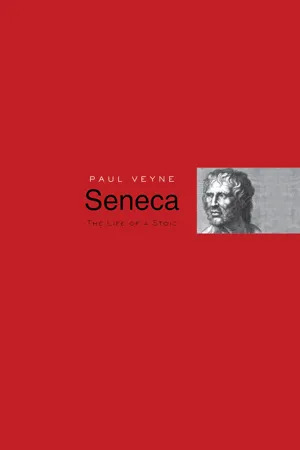
- 204 pages
- English
- ePUB (mobile friendly)
- Available on iOS & Android
eBook - ePub
About this book
Information
Chapter 1
Prologue: Seneca from Birth to Final Disillusion (1—65 C.E.)
Seneca's social trajectory was quite exceptional: a rich citizen from the imperial province of Andalusia, he rose to the Senate and indeed to the rank of consul. As far as we know, he was among the first four or five provincials to rise to this supreme honor, one generally reserved for native Italians.1 His career reminds us of the upstart Cicero's a century earlier. In both cases, literary celebrity played a major role: the Roman Empire prided itself on its culture.
"I, a simple Roman knight from the provinces, find myself among the greatest figures of the state!" he is supposed to have said one day.2 He could apparently poke fun at his petty nobility and his non-Italian origin, but in return, no one dreamed of questioning whether he was a descendant of Italian colonists who had emigrated to Spain rather than of native Spaniards, nor whether Roman rather than Hispanic blood flowed in his veins—ancient racism was different from ours. The odds slightly favor Spanish descent, for in the imperial provinces, most Roman citizens were members of powerful local families made political allies by the Romans through the granting of citizenship.3 Whether he was the descendant of an Italian veteran or of an Iberian princeling, the distinction was moot, and no one inquired further. Seneca was quite simply a Roman.
The Guadalquivir Valley and southern Spain had been the earliest territories to be Romanized under the empire, a good fifty years prior to southern France. Romanization was not planned: the native elite spontaneously adopted what we call Roman civilization. This was simply the universal culture of the time: Hellenistic civilization translated into Latin. Italy, civilized, had become the conduit of Greek civilization to the Western barbarians. Seneca's father (known as Seneca the Elder) was a member of Corduba's municipal elite; his mother came from a distinguished family from a nearby village.4 Around 1 C.E., Seneca was born in Corduba itself, the chief town of the region, residence of the governor, and a Roman city for a century and a half. If there was no lack of cultural life in Corduba, there was equally no lack in Rome, fifty years before Seneca's birth, of ironic smiles for Corduba's Latin poets, Iberians who had become Roman citizens.5 To be regarded as a Roman, it was enough to live as one. Seneca the Elder was passionately fond of culture, and went to live in Rome, apparently leaving his wife in Corduba. He wrote a history of his times and became enamored of the fashionable literary genre of the day, oratory, which had become a kind of witty cultural parlor game. The highest reaches of Rome's governing nobility, with its obligatory infatuation with culture, opened their doors to him. Culture, more than manners, was the mark of social distinction, just as a Roman way of life and the adoption of its civilization constituted, in themselves, nationality.
Culture could also open the gates to a public career and to membership in the governing nobility of the empire. For such an exceptional ascent, it was necessary to have ample ambition and to be rich, but above all, it was necessary to be taken under the protection of leading social figures because everything was accomplished through the system of client-patron relations called in Latin clientela. Clientela was as much a mode of selection as it was simple favoritism. One young man or another might be favored over twenty equally deserving others, but the choice was not made at random. Along with political abilities, a client had to demonstrate patriotism and a sense of clan solidarity that were both blameless and recognized by his peers, as well as the monarchic loyalty owed to the emperor. It was a necessary, but scarcely sufficient, condition that his family be wealthy. Certainly Seneca the Elder was. He had been admitted on the basis of wealth to the lesser nobility as a Roman knight, and could afford to live in Rome and maintain his status there; his sister-in-law had married, if not a senator, at least a very high imperial official, the governor of Egypt.6
Seneca the Elder wanted a great public career—he frankly admits as much in one of his books—but there is no doubt that, deep down, he preferred literature. He also feared the hazards that were part of public office under Caesarism, as he himself states.7 His sons were less cautious, and all three went on to brilliant careers; the clientela system and nepotism benefited entire families. The eldest, Gallio, known from the Acts of the Apostles, became a senator and the governor of Greece, where, one day, Saint Paul appeared before his tribunal. For political reasons, Gallio committed suicide under Nero in 65. The youngest, Mela, never reached senatorial rank, but became a high official, also committing suicide in 65. Our Seneca, the middle brother, rose even higher and also killed himself in 65, followed in death by his nephew, Lucan—a senator, a great poet, and for a long time, Nero's intimate friend.
Thus did this Andalusian dynasty, richly endowed with talent, indeed with genius, die out. They added glory to Latin literature and Greek philosophy, even if their grandmothers probably wore the barbarian coif of the Dama de Elche.8
Seneca the Elder did not have the highest regard for the intellectual gifts of the Younger. He viewed his son as a social climber, less intelligent and less literarily inclined than his older brother Gallio.9 It is easy to guess why: by culture, Seneca's father understood playing the parlor game declamation or eloquence had become. He failed to see, or chose not to see, that his middle son's character and talents inclined him rather toward philosophy. For four centuries, since Socrates' days, the debate existed between rhetoric and philosophy, and four centuries later, some Christians would again make the question an issue of conscience. On one side were the charm of eloquence and the songful beauty of the skillfully modulated human voice; on the other, seriousness of thought and the internalization of a commanding message.10 Seneca wrote a dutiful biography of his father, lauding his talent as an historian, but his own character and style extended beyond the superficialities of rhetoric.
The art of declamation was the final pinnacle of every noble, or as it was called, "liberal" education. Seneca the Elder sent his three sons to Rome, where they could hear the best orators and study with the best teachers. Although Seneca attended the classes of a declaimer admired by his father, he was fascinated to discover that, with age, the teacher had become a convert to philosophy and had set his conduct in accord with its strict convictions. Seneca had other teachers as well: let us hear him in his own voice:
When I used to listen to my teacher Attalos stigmatize the evil, the follies and the errors of our existence, I would take pity on humankind and conclude that my teacher was sublime and mightier than kings. If he praised poverty, when I left the class I would want to be poor or to forbid myself gluttony and sensuality. I still retain from this certain habits, never indulging in oysters or mushrooms or perfumes or steam baths. I still sleep on a hard mattress. Likewise, enthusiastic about Pythagoras and reincarnation, I had become a vegetarian. But just at that time, the police had been swept by a wave of suspicion against alien superstitions contrary to Roman mores. My father wasn't afraid of the police, but he despised philosophy, so he dissuaded me from vegetarianism. I have told you this story to show you how enthusiastically adolescence embraces virtue.11
Thus, my paraphrase of Seneca's Letter 108. To his dying day, Seneca kept his respect for the purity and idealism of his youth between the ages of fifteen and twenty.
His teachers did both less and much more than instruct Seneca in philosophy—they converted him to it. One of them would talk to him about Pythagoras; another passed on a different tradition of moral absolutism originating with a certain Sextius, founder of the only philosophical sect that was not Greek (and which died out quickly in Rome). Seneca claimed that Sextius had basically been a Stoic, although the latter denied this in his books. Finally, he had a genuinely Stoic teacher named Attalos, a Greek from Alexandria who in all likelihood taught in that language. (Like all nobles of his time, Seneca was perfectly bilingual.) Attalos inspired his young student deeply. Seneca arrived first to class, was the last to leave, and sought private conversations with the teacher. In old age, Seneca often spoke of Attalos and faithfully quoted scraps of his teaching, which seems especially to have dealt with ethics, intentionally ignoring Stoicism's formidable metaphysical and logical framework,12 with good reason. The adolescent Seneca was too young for that, and besides, the point was not to imbibe doctrines but to change one's life. Fiery with the ethical zeal Attalos had instilled in him, as a youth Seneca underwent a conversion to philosophy as a quasi-religion; people in those day seven spoke of initiation into the holy mysteries of wisdom.13
Seneca was probably about twenty when this happened; then there is nothing written about him for the next fifteen years. His public career began after he turned thirty-five. Did he write during the intervening years? We do not know when he composed his tragedies, which the French are only beginning to discover, and which are held in even higher regard by Shakespeare's countrymen, but during these fifteen years he certainly must have independently learned the arcana of Stoicism as he read their Greek texts. (Greek was the language of philosophy and Marcus Aurelius wrote his Meditations in Greek.) Reading the classic authors was one of the spiritual exercises of Stoicism, and Seneca practiced it to the end of his days. Whatever the details, Seneca became what was known as a philosopher during these fifteen years: he formally "professed," as they said, Stoic philosophy as his faith. His oldest surviving work, the Consolation to Marcia, was addressed to a great lady. In it, Seneca, who at the time was almost forty, takes the tone of one speaking with the authority of philosophy. It was granted that philosophers had the right and the duty to advise individuals and cities (in this period, taking advice was seen in no way as humiliating). The Consolation concludes with an allusion to the cycles of the eternal return, separated periodically by the destruction of the cosmos, a specifically Stoic doctrine that is stated without a trace of hesitation. Seneca is speaking in the name of his sect.
What was a philosopher? A person who lived his inner life and bore his outward mien philosophically,14 even if he wrote nothing and did not teach. He did not need a personal system of thought: he had that of his sect. By sect, we do not mean an organized group. It was simply the collectivity of individuals who, across the globe, in their inmost conscience, had professed Stoicism, Epicureanism, and so on. This common conviction united them, and they paraded it; public opinion acknowledged this personal "trademark" as one that, in principle, brought them high regard. They were granted the honorable title of philosophers: one of them was named "consul and philosopher," and the profession of philosophy was assimilated into what we still refer to as the "liberal professions." My justification for using the word sect is that every such affiliation was exclusive of any other, and that the sects conducted vigorous polemics among themselves, much to the satisfaction of their detractors, of whom there were many.
Seneca possessed a rich and multifarious personality. Being a philosopher alone did not suffice. He eventually conducted a public career in which he gained a reputation for hypocrisy and duplicity that is the customary reward for multiplicity. He wished to act politically as a philosopher; this was, in his eyes, acting simply as a conventionally honorable man: speculative, Utopian, and ideological politics were not the Romans' strong point. Stoicism had no political doctrine: certain adherents were partisans of Caesarism, while others, in the senate, made up what has been called the "Stoic opposition." Today we can ask of any thinker, "But how does this bear on politics? Is he Left or Right?" It was not so in antiquity. On the other hand, a Roman was little inclined to worry about the contradiction between his words and his political actions. He readily admitted that politics was the art of the possible and that it was necessary to sacrifice certain means to certain ends. The philosopher Seneca admitted it calmly, and had the ability to carry on several more or less incompatible activities simultaneously. Public opinion, essentially indifferent to philosophy but still envious of entertaining an idealized image of philosophers, could never forgive him this. It must be said in Seneca's defense that this parvenu, this homo novus, with all the resulting resentments (he has harsh words for the arrogance of the ancient nobility), did not make his career by the flattery, delation, or judicial murder of his peers, as was the normal practice of his age.15
If his career was late in starting, it progressed rapidly, and was soon interrupted by catastrophe. Shortly before his fortieth birthday, Seneca entered the Senate. (He tells us himself that he owed this to his aunt, the wife of the governor of Egypt.) In addition, he attracted attention through his talent as an orator, which he had exhibited in the quasi-theatrical realm of the Roman courts, stages no less literary than judicial, where he played the benevolent role of the lawyer, according to the custom of those seeking fame.
Seneca became a celebrity, bound with the reigning family. The ancient historians say his conversation was witty and sharp, but suave, elevated, and courteous. Ronald Syme summed it up nicely:16 he pleased the princesses and especially the three sisters of the emperor Caligula, bold and forward women, as many were among the Roman aristocracy. It is pleasant to imagine a philosopher surrounded by women intrigued by his force of expression and his virtuosic talent for the internal life: a kind of Stoic Saint Jerome or Francis de Sales, with the same kind of circle of noble penitents.
He had already become and would always remain an intimate of the closed world of the women of the imperial court. He loved and profoundly respected the great figure Passienus Crispus, of whom he wrote, "a spiritual and well-educated mind, an upright character, and the least likely to be fooled by the appearance of virtue." Passienus was a hereditary friend of Seneca's: despite their unequal rank, their fathers were united by a literary friendship. Passienus's wives were, successively, the aunt of the future emperor Nero and Nero's own mother, princess Agrippina, who was herself the sister of the reigning emperor, Caligula. Thus a career was made and a destiny knotted.
Caligula had plenty of blood on his hands, and the death penalty for each senator was only a matter of time. The emperor's excuse was that he had had become raving mad. When his despotic reign was amended, and ended, by his assassination, everyone breathed free, except for Seneca. One of the first cares of the new emperor, Claudius, was to condemn Seneca to death for adultery with a princess, Agrippina's sister. The death penalty was commuted to a sentence of exile. At forty, Seneca was relegated to Corsica, a semi-barbaric island. He stayed there for eight long years, and could have remained there forever. He read widely, published, and developed an interest in the natural history and ethnography of the island (the Stoics traditionally cultivated the sciences), but he was slowly dying of solitude, and his career had been shattered. I presume that the most likely reason for his sentence was the prominent role he assumed among the women of the court, which troubled the new master. As for his highly promising debut in public life, it depended on the fact (among others) that, as a Stoic, far from aligning himself to the Stoic senatorial opposition, he was a sincerely convinced monarchist.
If Seneca's political biography is not to be lost either to detail or anachronism, we must form a picture of the sort of despotism known as Caesarism and of the pathological relations among successive Caesars and their senatorial advisors.
Seneca's life unrolled under four emperors, Tiberius, Caligula, Claudius, and Nero. The second was a madman, the fourth, an original megalomaniac, and all four eventually succumbed to the psychosis of "purifying" the senate through judicial murder. They aimed to eliminate from it the offspring of the old nobility, suspected of harboring nostalgia for the old republic, when an oligarchy prevailed and no single family possessed all power for its own ends. The imperial regime was anything but liberal: it was not even a lawful state (despite Roman law). It was a despotism uncertain of its own legitimacy. Although the Julio-Claudian family seized control of the state, those of its members who became emperors were considered simply the preeminent magistrates of Rome, and the first among their equals, the senators. They were kings without the title, to whom the sincere monarchist sentiment of the people was directed; they were the objects of a genuine cult, just like the potentates of the ancient Middle East (for example, the portraits of the emperors were, like icons, sacred). Caesar's own role was so ambiguous it provoked his own madness. Stalin, too, went mad, from being at the same time a brilliant chief whose personality was the object of cult, and comrade Stalin, first among comrades, and the legitimate head of the proletarian state. Comrade Stalin and the first magistrate of Rome de...
Table of contents
- Cover
- Half Title
- Title
- Copyright
- Contents
- Preface
- CHAPTER 1 Prologue: Seneca from Birth to Final Disillusion (1–65 C.E.)
- CHAPTER 2 Seneca as a Stoic
- CHAPTER 3 Epilogue: Final Witness and Death of the Liberator (63–65 C.E.)
- Notes
- Chronology
Trusted by 375,005 students
Access to over 1.5 million titles for a fair monthly price.
Study more efficiently using our study tools.
Frequently asked questions
Yes, you can cancel anytime from the Subscription tab in your account settings on the Perlego website. Your subscription will stay active until the end of your current billing period. Learn how to cancel your subscription
No, books cannot be downloaded as external files, such as PDFs, for use outside of Perlego. However, you can download books within the Perlego app for offline reading on mobile or tablet. Learn how to download books offline
Perlego offers two plans: Essential and Complete
- Essential is ideal for learners and professionals who enjoy exploring a wide range of subjects. Access the Essential Library with 800,000+ trusted titles and best-sellers across business, personal growth, and the humanities. Includes unlimited reading time and Standard Read Aloud voice.
- Complete: Perfect for advanced learners and researchers needing full, unrestricted access. Unlock 1.5M+ books across hundreds of subjects, including academic and specialized titles. The Complete Plan also includes advanced features like Premium Read Aloud and Research Assistant.
We are an online textbook subscription service, where you can get access to an entire online library for less than the price of a single book per month. With over 1.5 million books across 990+ topics, we’ve got you covered! Learn about our mission
Look out for the read-aloud symbol on your next book to see if you can listen to it. The read-aloud tool reads text aloud for you, highlighting the text as it is being read. You can pause it, speed it up and slow it down. Learn more about Read Aloud
Yes! You can use the Perlego app on both iOS and Android devices to read anytime, anywhere — even offline. Perfect for commutes or when you’re on the go.
Please note we cannot support devices running on iOS 13 and Android 7 or earlier. Learn more about using the app
Please note we cannot support devices running on iOS 13 and Android 7 or earlier. Learn more about using the app
Yes, you can access Seneca by Paul Veyne, David Sullivan in PDF and/or ePUB format, as well as other popular books in Philosophy & Philosopher Biographies. We have over 1.5 million books available in our catalogue for you to explore.