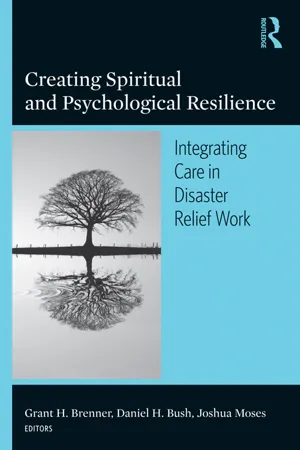
Creating Spiritual and Psychological Resilience explores the interface between spiritual and psychological care in the context of disaster recovery work, drawing upon recent disasters including but not limited to, the experiences of September 11, 2001. Each of the three sections that make up the book are structured around the cycle of disaster response and focus on the relevant phase of disaster recovery work. In each section, selected topics combining spiritual and mental health factors are examined; when possible, sections are co-written by a spiritual care provider and a mental health care provider with appropriate expertise. Existing interdisciplinary collaborations, creative partnerships, gaps in care, and needed interdisciplinary work are identified and addressed, making this book both a useful reference for theory and an invaluable hands-on resource.
eBook - ePub
Creating Spiritual and Psychological Resilience
Integrating Care in Disaster Relief Work
- 264 pages
- English
- ePUB (mobile friendly)
- Available on iOS & Android
eBook - ePub
Creating Spiritual and Psychological Resilience
Integrating Care in Disaster Relief Work
About this book
Information
Section I
Foundational Considerations for Effective Collaboration
1
Fundamentals of Collaboration
Introduction
Disasters are occurrences of variable time course, which are sufficiently different from the usual and expected course of events such that they significantly disrupt individual and collective function past the point of stress tolerance. The usual processes that are in place, and which people and organizations take for granted, start to show dysfunction ranging from mild to moderate to total breakdown. Furthermore, the disruption of usual individual and collective functioning itself becomes part of the disaster. This makes a difficult situation worse than it needs to be, creating “spin-off” crises from the inciting event, which reciprocally worsen response to the original event (Stacey, 2001). If poorly handled, disasters risk falling into a repetitive, self-amplifying cycle, loosely analogous to a person who keeps walking on a sprained ankle, not only keeping it from healing, but reinjuring it in the process, perhaps rippling out to other consequences as well.
This brief overview presents principles that may help to mitigate a potential avalanche of destructive aftershocks of disaster. Importantly, this chapter also addresses the issue of preparedness in between disasters, advocating the wisdom of expending scarce resources preventively, in the interest of maintaining resilient networks when there is no looming threat demanding them. It is imperative that on all levels, from the individual to the family to the workplace and other organizations to the societal and governmental levels, that we have developed effective collaboration when disaster strikes. What we learn from disaster collaboration will pay off in other unexpected areas as well. Being able to communicate, develop relationships and awareness of patterns of relatedness with others, recognize and verbalize our own needs, become aware of emotions and thoughts and their impact on decisions and behavior, and identify how we get in our own and others’ way and generate better choices are all highly relevant, not only in disasters and crises, but in the everyday trauma of ordinary living we all encounter. It is important to make good collaboration practice habitual because it is difficult to remember and implement effective approaches when one is spread too thinly, other priorities are more pressing, and capacities are diminished secondary to impaired cognition from distress (Covello, McCallum, & Pavlova, 1989). Burnout, compassion fatigue, and primary, secondary, and systemic trauma impede collaboration. As in other endeavors, the most effective approach is to develop proficiency by practice and over-learning when pressure is low and other resources are replete, so that when skills are needed they are at our figurative fingertips—implicit and less effortful.
I will (a) review collaboration, (b) discuss relevant aspects of trauma and its effects on individual and systemic function, (c) describe a framework for approaching the complex interactions that arise out of the chaos of disaster, (d) discuss features of effective collaboration and suggest some concrete tools that may foster collaboration, and (e) discuss some of the less concrete aspects of collaboration that are not as easily implemented.
Developing and maintaining a collaborative stance requires sustained, long-term effort and allocation of personal and organizational resources. Understanding how the expenditure of such resources is worthwhile requires a commitment to looking at the long-term picture and seeing how collective needs over the long haul outweigh apparent short-term gains. Taking this long-range view is often in contrast to where the immediacy of our crisis emotions may compel our expectations and perspective. Effective collaboration allows for synergy of participants working together, in which the whole of the work effort is greater than the sum of the parts. Collaboration results when complementarity wins out not just some of the time, but at all times, over competition, secrecy, and paranoia. Because disasters present novel and unpredictable situations every time, it may not be possible to be fully prepared other than to expect to be caught off guard and prospectively take appropriate steps to sustain functionality knowing some of the challenges disasters pose.
Collaboration: A Basic Overview
In this section, we will outline key elements pertaining to collaboration. We will briefly look at collaboration from four points of view:
- What is collaboration?
- What is necessary for collaboration?
- What facilitates collaboration?
- What impedes collaboration?
What is collaboration? Merriam–Webster’s online dictionary defines “collaborate” as (a) to work jointly with others or together especially in an intellectual endeavor, (b) to cooperate with or willingly assist an enemy of one’s country and especially an occupying force, (c) to cooperate with an agency or instrumentality with which one is not immediately connected. We can see immediately that this word has positive and negative connotations, and this is reflected in the great difficulty people have in collaborating effectively and especially in the paranoia that must be addressed when attempting to collaborate with groups that may not have all of the same common interests as you or your group. Collaboration arises unexpectedly, taking on a life of its own, when people smoothly and reciprocally act together in pursuing shared goals while maintaining their own distinct sets of goals individually and organizationally. From this point of view, collaboration and competition are seen to exist in a dynamic tension in relation to one another across a continuum.
What is necessary for collaboration? At bare minimum, collaboration requires the presence of basic dynamic elements for it to “catch fire” sufficiently to sustain its own process. The individuals seeking to constitute a working group, though collaboration waxes and wanes, must mindfully attend to these elements. Required elements include trust, communication, shared purpose, sharing of resources, contingent well-being (mutual interdependence), and perceived and actual goodwill coupled with sufficient shared necessity to offset absence of goodwill.
What facilitates collaboration? Beyond the bare necessities for a marginally effective but still sufficient degree of collaboration, several factors enhance collaborative process for a more effective (and enjoyable) experience and process. As noted, while collaboration is much more probable when necessity demands it, “bare necessity” collaboration falls apart quickly when there is no urgency. However, off-again, on-again collaboration is really insufficient, as it impedes efforts to remain prepared in between crises. Since in between crises resources dwindle and the sense of urgency dissipates, more conscious intention and effort is required to sustain the collaborative potential when there is no looming disaster.
Collaboration is facilitated by the cultivation of genuine goodwill, for example, through regular meetings and networking events, working through difference, and actively seeking better understanding of oneself and the other’s point of view. Effective negotiation of conflict, the cultivation of common goals and interests, the use of tact and diplomacy, and sharing and development of resources helps to bolster a healthy collaborative process. It is useful to make good collaborative practice routine, through regular meetings and the use of explicit contracting to address differences effectively, rather than by conflict and flight. It is easier to be angry than hurt. Collaboration is also facilitated by the adoption of a common system for communication and organizational structure to avoid a Tower of Babel effect. In the United States, responder organizations may all share the National Incident Management System (NIMS), or Incident Command System, in order to facilitate collaboration (FEMA, 1997).
While this may seem overly simplistic, what follows is much easier to write about in a state of relative calm than to deploy in any crisis, real or perceived. Human beings, like other animals, tend to act to relieve distressing feelings, and they act quickly, often without the capacity to reflect (Van der Kolk, Roth, Pelcovitz, Sunday, & Spinazzola, 2005). As discussed in more detail below, impulsive action may lead to destructive repetition, and this is no less true in the oft-times threatening and stressful circumstances surrounding disaster situations and efforts to work with other people who have different goals and interests; both situations contain elements of the uncertain and unknown. However, and this is key to collaboration, human beings have access to speech, formulated linguistic discourse, as a form of behavior, alternative to more destructive action. We can learn, when faced with the feeling of threat and when under distress, to act by speaking and speaking only when one is ready emotionally, spiritually, and cognitively, even though this may seem to be more anxiety-provoking than other forms of action. Developing the capacity to speak calmly and without distortion, and eschewing other more destructive and less contained forms of action and interaction is essential for sustainable collaboration.
What impedes collaboration? Generally, when seeking to understand how to make something work better, it is useful to identify and avoid common pitfalls. Therefore, in a basic sense, anything that interferes with the above helpful elements will impede collaboration. This is true, whether they are absent or present, but in an inauthentic “checking the boxes” way or other disconnected form. Actively present factors that disrupt collaboration include poor communication practice, especially inability to openly discuss, when appropriate; any unpleasant feelings and perceived or actual slights; or a negative, hostile, or oppositional stance, whether mutual or unilateral, such as characterized by prejudice, contempt, or other feelings that engender an “us–them” attitude. This includes the presence of overt deception, manipulation, and the bad-faith intention of one party to use the other parties without their consent to pursue clandestine goals. While there will inevitably be both goodwill and rancor in the normal process of relations—and, in fact, rupture and successful renegotiation around conflict leads to stronger collaborative relationships (Winnicott, 1992)—unmitigated bad will inevitably leads to irreparable breakdown in collaboration when necessity no longer moves groups together. Another factor that will disrupt collaboration is deliberate sabotage by one group or person toward another. While this is so self-evident as to almost seem not worth mentioning, it is nevertheless sadly common and noteworthy as a factor to bear in mind and try to mitigate when possible. More effort is required to restore broken trust than would have been required to prevent the breaking of trust in the first place.
A Basic Framework: Trauma, Dissociation, and Enactment
Trauma is nearly always an intimate aspect of disaster, at least for some of the involved people, organizations, and communities. It is helpful to understand some basics of trauma and dissociation theory, therefore, in order to understand the most effective ways of approaching collaboration in the presence of traumatic experience and its consequences. Trauma, a hotly debated concept, has many definitions. For our purposes, we can understand trauma as an event or experience, which passes a “tipping point” (Gladwell, 2002, pp. 7–9) of distress in which usual process becomes disrupted to the point of being overwhelmed. Exactly where this tipping point comes into play varies according to many factors: type of trauma; extent/intensity of trauma; presence of mitigating factors, such as innate hardiness and good support structures and routines; and factors relating to vulnerability, such as prior history and innate factors (Yehuda, 2004).
Traumatic experience may lead not only to functional impairment but also emotional distress and behavioral and relational consequences, any of which cannot be contained or articulated (Van der Kolk et al., 2005). In the absence of being processed and spoken of, traumatic experience instead may become displaced, avoided, and fragmented—a process known as dissociation (Howell, 2008)—literally a disruption of associational processes, which normally function both for the individual mind as well as for groups of individuals communicating within organizations to accomplish various tasks. When associative capacity starts to fray or break, information cannot be processed by individuals and systems, and emotions cannot be contained or adaptively expressed, leading to individuals feeling overwhelmed and group conflict and communication breakdown, impairing function and distracting from focusing on the task. This may concretely be seen as a cascading series of misunderstandings, which lead not only to poor work quality and deviation from desired outcomes, but also rancor and rupture of formerly good relationships, along with the weakening of already tenuous work arrangements via the magnification of existing conflict. Once ruptured, collaborative relationships are difficult to repair, though they may grow from the process of rupture and repair via mutual negotiation of needs, expression of feelings, and the potentially transformative experience of being understood and responded to by a caring other (Winnicott, 1992). It is important to note, however, that there is a time and a place for “processing” traumatic experience, and that attempting to do so when the circumstances are not right may lead to further trauma. In fact, not explicitly addressing troubling issues may at times be the most effective, diplomatic, and tactful approach. Lastly, there are times of heightened vulnerability in which communication is needed for systemic function, but individual participants are not ready to do so effectively.
In addition, for various reasons in the presence of dissociation and trauma, repetitive maladaptive enactments (Danieli, Chapter 14; Howell, 2008) may occur. An example is when an organization keeps making the same mistake, such as sending ine...
Table of contents
- Cover
- Half Title
- Title Page
- Copyright
- Contents
- Preface
- Introduction
- Contributors
- Section I: Foundational Considerations for Effective Collaboration
- Section II: Collaboration in Action: Tensions, Challenges, and Opportunities
- Section III: Collaboratively Nurturing Resilience After Catastrophic Trauma
- Index
Trusted by 375,005 students
Access to over 1.5 million titles for a fair monthly price.
Study more efficiently using our study tools.
Frequently asked questions
Yes, you can cancel anytime from the Subscription tab in your account settings on the Perlego website. Your subscription will stay active until the end of your current billing period. Learn how to cancel your subscription
No, books cannot be downloaded as external files, such as PDFs, for use outside of Perlego. However, you can download books within the Perlego app for offline reading on mobile or tablet. Learn how to download books offline
Perlego offers two plans: Essential and Complete
- Essential is ideal for learners and professionals who enjoy exploring a wide range of subjects. Access the Essential Library with 800,000+ trusted titles and best-sellers across business, personal growth, and the humanities. Includes unlimited reading time and Standard Read Aloud voice.
- Complete: Perfect for advanced learners and researchers needing full, unrestricted access. Unlock 1.5M+ books across hundreds of subjects, including academic and specialized titles. The Complete Plan also includes advanced features like Premium Read Aloud and Research Assistant.
We are an online textbook subscription service, where you can get access to an entire online library for less than the price of a single book per month. With over 1.5 million books across 990+ topics, we’ve got you covered! Learn about our mission
Look out for the read-aloud symbol on your next book to see if you can listen to it. The read-aloud tool reads text aloud for you, highlighting the text as it is being read. You can pause it, speed it up and slow it down. Learn more about Read Aloud
Yes! You can use the Perlego app on both iOS and Android devices to read anytime, anywhere — even offline. Perfect for commutes or when you’re on the go.
Please note we cannot support devices running on iOS 13 and Android 7 or earlier. Learn more about using the app
Please note we cannot support devices running on iOS 13 and Android 7 or earlier. Learn more about using the app
Yes, you can access Creating Spiritual and Psychological Resilience by Grant H. Brenner, Daniel H. Bush, Joshua Moses, Grant H. Brenner,Daniel H. Bush,Joshua Moses in PDF and/or ePUB format, as well as other popular books in Social Sciences & History & Theory in Psychology. We have over 1.5 million books available in our catalogue for you to explore.