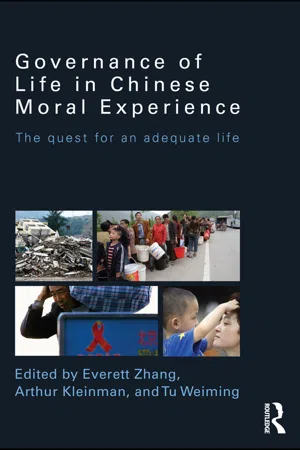
China has experienced a tremendous turn-around over the past three decades from the ethos of sacrificing life to the emergent appeal for valuing life. This book takes an interdisciplinary look at China during these decades of transformation through the defining theme of governance of life. With an emphasis on how to achieve an adequate life, the contributors integrate a whole range of life-related domains including: the death of Sun Zhigang, the peril caused by rising tobacco consumption, the emerging suicide intervention, the turning points in the fight against AIDS, the intensely evolving birth policy, the emerging biological citizenship, and so on. In doing so, they explore how biological life has been governed differently to enhance the wellbeing of the population instead of promoting ideological goals. This change, dubbed "the deepening in governmentality," is one of the most important driving forces for China's rise, and will have huge bearings on how the Chinese will achieve an adequate life in the 21st century. This book presents works by a number of internationally known scholars and will be of interest to students and scholars of anthropology, sociology, political science, history, Chinese philosophy, law, and public health.
eBook - ePub
Governance of Life in Chinese Moral Experience
The Quest for an Adequate Life
- 270 pages
- English
- ePUB (mobile friendly)
- Available on iOS & Android
eBook - ePub
Governance of Life in Chinese Moral Experience
The Quest for an Adequate Life
About this book
Information
Part I
Min yi shi wei tian
(People regard food as top priority)
1
Feeding the revolution
Public mess halls and coercive commensality in Maoist China
James L. Watson
It seems appropriate to begin with an ancient Chinese aphorism that captures something of the theme of this essay. The historian Sima Qian put it this way: “When the people are eating, they are in heaven” (Min yi shi wei tian). In other words, for most of Chinese history there can be nothing more important than a steady supply of food; all social life derives from this irreducible principle. A full stomach is the elemental definition of the “adequate life,” as defined in the introductory essay by Everett Zhang.
Those who have lived and worked in China know that there is more behind Sima Qian’s adage than a concern for material subsistence. K. C. Chang, the leading scholar on this subject, argued “that Chinese cuisine is the greatest in the world is highly debatable … [but] few can take exception to the statement that few other cultures are as food oriented as the Chinese” (1977: 11). During my four decades of field research in south China I have learned that the surest way to break the ice in unfamiliar settings is to broach the topic of food: “Last year I was in the mountains of western Jiangxi and I had steamed bean curd with catfish.” Or, another surefire conversation starter: “Two years ago I was just in time for the harvest of first-crop rice, served with pop-eyed shrimp in the Pearl River Delta, just south of Guangzhou.” After a few minutes of this, even the most hard-bitten, suspicious party secretary will be waxing lyrically about the noodles he had eaten as a youth in Shandong Province—and there will be tears in his eyes.
Commensality and social engineering
This essay departs, alas, from the pleasant themes of regional cuisines and convivial dining. Instead my focus is on low cuisine—downright bad food— served in the public mess halls that appeared all over China in the late 1950s. Two issues are addressed in this essay: the first is the question of commensality, the sharing of food as a means of building social groups and strengthening personal relationships. Since the foundation of our discipline, anthropologists have focused on the positive aspects of collective eating. Here I propose to explore a variation of this old theme, namely the consequences of forced commensality in politically charged settings mandated by the state.
The second issue considered in this essay is the role of the family in state socialism: How far can a society be pushed? What are the limits of social engineering? During a brief period in the late 1950s, Chinese communist leaders attempted to “storm the gates of socialism” in order to smash the old, “feudal” vestiges of a “backward” culture and rebuild a new, socialist culture in its place. Where better to start than an attack on the family kitchen?
Before proceeding, something needs to be said about research methodology: how can the author, a social anthropologist, study a social movement that he did not witness? This is a valid question, given that social anthropology was founded on the principles of long-term observation and first-hand encounters. The material presented here is part of a larger project on the politics of food and eating during the Chinese revolution. Over the past 40 years I have collected documentary materials on the land reform campaigns of the early 1950s, the Great Leap Forward of the late 1950s, and the Cultural Revolution of the late 1960s and early 1970s.1 This style of research draws heavily on mass media sources (especially newspaper articles) and on intensive interviews with people who lived through these political movements. The historical dimension of this project is refracted through personal experiences the author had in rural China during the late 1970s and early 1980s—a period when socialism was still alive and well, especially in the countryside.
Political background: the Great Leap Forward
On August 12, 1958, China’s leading newspaper, People’s Daily, carried the following headline: “Chairman Mao Inspects Villages in Henan Province” (he had been taken to see an experimental commune). There follows a quotation from Mao, in inch-high characters: “If there can be one Commune like this, there can be many Communes.”
For the next two years the promotion of people’s communes became national policy and the collectivization of all aspects of life began in earnest. The notion of private property all but disappeared and everything related to production became the corporate property of the masses: tools, farm animals, even the apple tree in one’s backyard. The communes became an integral part of the Great Leap Forward (dayuejin), a political campaign designed to help China “leap” onto the center stage of world powers, overtaking Britain in ten years of selfless dedication and single-minded effort.
The tone of the era is captured in the mass media: The following is a 1958 editorial from a leading party publication, Red Flag: “The broad masses of working people have unfalteringly accepted the people’s communes … The working people in their drive forward have advanced the following slogans that fulfill their revolutionary spirit: Militarize Organizations, Turn Action into Struggle, Collectivize Life” (cited in Schurmann 1971: 479). In the countryside, farmers were to become the “shock troops” of agricultural production; they were to be organized and disciplined (to quote from official sources) “like workers in a factory or soldiers in a military unit” (ibid.).
The year 1958 was a particularly dangerous one in the politics of the Pacific. The Taiwan Straits crisis (centering on the islands of Quemoy [Jinmen] and Matsu [Mazu]) threatened full-scale world war and many Chinese leaders, including Mao apparently, were convinced that a nuclear confrontation with the United States was imminent (see MacFarquhar 1983). Meanwhile relations with the Soviets were deteriorating rapidly, presenting the prospects of a second front. The Great Leap Forward was launched in the context of what Chinese leaders perceived to be a critical turning point in their history.
The campaign swept like a giant firestorm across China and affected every aspect of social life. No one escaped; every citizen over age 12 had to participate in Great Leap activities.2 Personal sacrifices were demanded of everyone because, as one popular slogan put it, “Bitter struggle for three years will bring a thousand years of happiness.” Communist utopia was just over the horizon; ordinary life was suspended for much of 1958 and 1959 as people were organized into military-style brigades to build dams, bridges, and irrigation canals (MacFarquhar 1983: 120ff.). This was also the era of the infamous backyard steel furnaces, designed to make every region of China self-sufficient in steel and thereby capable of surviving foreign invasion. Most of the so-called steel that was produced during this period turned out to be completely useless; the campaign succeeded only in wasting resources and exhausting a rapidly alienated citizenry. I will return to the backyard steel campaign later because it plays an important role in the assault on family kitchens.
Public mess hall campaign: the collectivization of eating
At the height of the Great Leap, during the fall and winter of 1958, the central government began to call for the organization of public mess halls in the Chinese countryside. Given that farmers were to be “shock troops” for the attainment of socialism and that social life was to be organized by the commune, the obvious next step was the collectivization of food and eating.3
Public mess halls (shitang) were by no means invented by the communists. Prior to the Great Leap, however, they were associated with schools, factories, and military units. When most Chinese over age 60 think of mess halls they conjure up visions of a great pot, or wok, into which food is dumped and cooked into an unappetizing mass. Many of my colleagues and friends from China and Taiwan have grim memories of “eating from the big pot” (chidaguofan). This is also the standard metaphor for egalitarianism—everyone is equal when eating from the same pot (Lou 2001; Watson 1987).
The dimensions of mess hall cooking during the Great Leap were such that shovels, not mere spoons, were used to ladle out the food. In my own experience of public mess halls in China, the quality of food varies from bad to awesomely vile. There is a saying among Chinese students who relied on mess hall food during the 1940s: “As we get thinner, the pigs get fatter,” the implication being that the fare was suitable only for the pigs that every mess hall cook raised in the backyard.
Women’s labor and communist consciousness
The ostensible reason for establishing mess halls was to release the labor power of women. The mass media played on this theme, quoting Engels’ famous dictum that true socialism can only be attained when women’s labor is released from the bonds of household drudgery (Engels 1884). Party officials calculated that rural mess halls would make it possible for every woman to devote three extra hours per day to labor activities that the state deemed to be “productive”4—notably agricultural work, iron/steel smelting, and dam building (see Manning 2005, 2006). In rural Guangdong, however, women ended up doing childcare, mess hall duty, public latrine cleaning, and eldercare.
The labor question was obviously important but there was a secondary agenda involved and this, to my mind, was the most important aspect of the mess hall campaign: a leading editorial in the People’s Daily noted that the formation of mess halls fosters “collective living habits” which leads to the development of “communist consciousness.” “Collective eating,” one official argued, “is a great historical question involving a change in social habits that have existed for a thousand years.”5 Another claimed that “[our farmers have] communized the problem of eating,” thereby leading to the “blooming of red communist flowers and the arrival of a blessed life.” And, in late 1958, an anti-family agenda began to emerge: “[We must] run the rural mess halls well, so as to enable commune members to eat more and better, and live a still happier life than in their own homes” (emphasis added).6
It is obvious that there is more here than a straightforward policy of releasing women’s productive labor. The mess halls were conceived as an essential cornerstone for the entire commune system. It was important to “run the mess halls well” in order to build a new socialist culture. How did communist authorities proceed? First, it was necessary to undermine the traditional pattern of maintaining separate kitchens for every household. Rather than launching a direct attack on the family as a feudal institution, farmers were “encouraged” to donate their iron cooking ware to the backyard steel furnaces. Party activists collected pots, pans, woks, ladles, spoons, mea...
Table of contents
- Contents
- Figures and tables
- Contributors
- Acknowledgments
- Foreword
- Introduction
- Part I Min yi shi wei tian
- Part II The politics and morality of death
- Part III Governing life
- Part IV From living being to well-being
- Index
Trusted by 375,005 students
Access to over 1.5 million titles for a fair monthly price.
Study more efficiently using our study tools.
Frequently asked questions
Yes, you can cancel anytime from the Subscription tab in your account settings on the Perlego website. Your subscription will stay active until the end of your current billing period. Learn how to cancel your subscription
No, books cannot be downloaded as external files, such as PDFs, for use outside of Perlego. However, you can download books within the Perlego app for offline reading on mobile or tablet. Learn how to download books offline
Perlego offers two plans: Essential and Complete
- Essential is ideal for learners and professionals who enjoy exploring a wide range of subjects. Access the Essential Library with 800,000+ trusted titles and best-sellers across business, personal growth, and the humanities. Includes unlimited reading time and Standard Read Aloud voice.
- Complete: Perfect for advanced learners and researchers needing full, unrestricted access. Unlock 1.5M+ books across hundreds of subjects, including academic and specialized titles. The Complete Plan also includes advanced features like Premium Read Aloud and Research Assistant.
We are an online textbook subscription service, where you can get access to an entire online library for less than the price of a single book per month. With over 1.5 million books across 990+ topics, we’ve got you covered! Learn about our mission
Look out for the read-aloud symbol on your next book to see if you can listen to it. The read-aloud tool reads text aloud for you, highlighting the text as it is being read. You can pause it, speed it up and slow it down. Learn more about Read Aloud
Yes! You can use the Perlego app on both iOS and Android devices to read anytime, anywhere — even offline. Perfect for commutes or when you’re on the go.
Please note we cannot support devices running on iOS 13 and Android 7 or earlier. Learn more about using the app
Please note we cannot support devices running on iOS 13 and Android 7 or earlier. Learn more about using the app
Yes, you can access Governance of Life in Chinese Moral Experience by Everett Zhang,Arthur Kleinman,Weiming Tu in PDF and/or ePUB format, as well as other popular books in Politics & International Relations & Public Health, Administration & Care. We have over 1.5 million books available in our catalogue for you to explore.