eBook - ePub
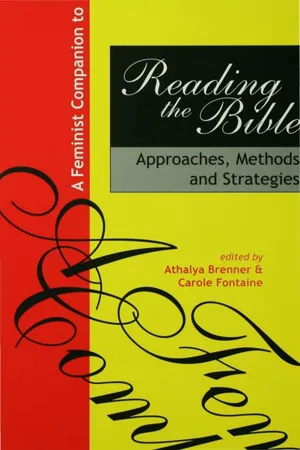
A Feminist Companion to Reading the Bible
Approaches, Methods and Strategies
- 654 pages
- English
- ePUB (mobile friendly)
- Available on iOS & Android
eBook - ePub
A Feminist Companion to Reading the Bible
Approaches, Methods and Strategies
About this book
This valuable resource both presents and demonstrates the numerous developments in feminist criticsm of the Bible and the enormous rage of influence that feminist criticism has come to have in biblical studies.
The purpose of the book is to raise issues of method that are largely glossed over or merely implied in most non-feminist works on the Bible. The editors have included broadly theoretical essays on feminist methods and the various roles they may play in research and pedagogy, as well as non-feminist essays that have direct bearing on the methods or subject matter that feminists use, as well as reading that illustrate the variety of methodological strategies adopted by feminist scholars.
Some 30 scholars, from North America and Europe, have contributed to this Companion.
Information
I
METACRITICS
FEMINIST CRITICISM AND BIBLICAL STUDIES ON
THE VERGE OF THE TWENTY-FIRST CENTURY *
Adele Reinhartz
The year 1995 marks a hundred years since the publication of The Woman's Bible, by Elizabeth Cady Stanton. Although one can by no means draw a direct line from Cady Stanton's efforts to the shape of feminist biblical criticism in the present,1 this anniversary provides an appropriate occasion for an assessment of the current relationship between feminist criticism and biblical studies, as well as an attempt to foresee its future course. I approached this task with the intention of providing a reasoned analysis, cataloguing achievements and challenges, and outlining a vision of the shape of the field in the twenty-first century. These intentions came to naught, however, when I discovered, to my horror, that my capacity for reasoned analysis has been damaged by my lifestyle. I refer specifically to my near-total immersion in narrative. From Judges, Judith and campus intrigue during the day, A. A. Milne, E. B. White and complicated schoolyard anecdotes in the evening, to Toni Morrison, Tony Hillerman and/ or the evening news at night, my days and my thoughts are bounded by stories. For this reason, every effort to approach my present task was thwarted by a still, or rather, shrill small voice, demanding, 'read me a story'. But what story, or stories could I read into, or read out of, the relationship between feminist criticism and biblical studies?
As every child, and the occasional narrative critic, knows, there are two essential ingredients to every story: character and plot. By resort ing to gross overgeneralization, oversimplification and reductionism, I managed to construct two protagonists out of the abstract terms 'feminist biblical criticism' and 'biblical studies'. To begin with the former. Most, though by no means all, participants in feminist criticism are women; all are concerned with issues related to women, and are engaged in diverse activities: writing women into biblical history, society and cult; examining the representation of women in canonical and non-canonical texts; searching for evidence of wom en's hands in material artifacts; addressing androcentrism and patri archy in texts as well as in scholarship, and exploring the relation ship between biblical texts and women's lives in all their complexity. Here there is, then, a female protagonist for our story. As for biblical studies, if not all biblical students are male, it is the case that many of us sat, or currently sit, at the feet of male teachers, where we are taught the norms and practices of what Elisabeth Schussler Fiorenza has termed 'malestream' biblical scholarship. Unlike feminist criti cism, this form of scholarship does not describe its agenda in terms of gendered interests and perspectives. Rather, its explicit goal is to reconstruct the original text, context and meaning of Scripture by applying objective, value-free, scientific methodology enshrined in historical and related criticisms. Yet it is clear, at least to feminist critics, that the interpretive activities directed towards this goal, far from being value-free, express the norms and world-view of the ex egetes themselves. Even now, despite the adoption of gender-inclu sive language, many major institutions, academic societies and their sponsored journals continue to embody the voices of the patriarchs of our field. Voila. biblical studies as male protagonist.
Now for the plot. What kind of story do these protagonists act out? A heart-warming romance, perhaps, in which the woman's reluc tance is overcome by the male protagonist, with the resulting passion ate love and living happily ever after? Or romantic comedy, in which bumbling male anti-hero is found and re-educated by beautiful, talented, persistent, forgiving heroine, and again, they live happily ever after? Or, to reverse the roles, a story in which ageing professor transforms young, brilliant, but uneducated flower girl into his fair lady, and is in turn transformed by her, with the requisite happy ending?
More promising, and more appropriate, perhaps, are biblical love stories. Again, there is a range to choose from: the pastoral romance of Ruth and Boaz in which rich, older male relative rescues beautiful young widow and provides her, and her mother-in-law, with a proto-messianic offspring. Or, on another reading of Ruth, the love between Ruth and Naomi, which transcends or, perhaps, erases the boundaries of age, gender, religion and ethnicity. Or, for a more sinister plot, the perversion of the love story in biblical tales of terror-the incestuous rape of Tamar, daughter of David (2 Sam. 13), the gang rape and murder of the Levite's concubine (Judg. 19), or the death by fire of Samson's Timnite wife (Judg. 15. 6).
How fitting are these stories as allegories of the relations between feminist criticism and biblical studies? There are, without question, scholars who, though trained in the traditions of the fathers, have taken serious account of feminist scholarship and allowed it to have a profound impact on their work. And certainly there are feminist critics whose encounters with a patriarchal establishment have left them rejected and violated. Yet I have misgivings about choosing the love story in any of its permutations as the appropriate basis for an allegory on the relationship between feminist criticism and biblical studies.
First, the biblical love story frequently results in either the literal or the figurative erasure of the female partner. Victims of tragedy such as the Levite's concubine and Samson's Timnite wife are blotted out through their murder, while Tamar, raped by her brother Amnon, 'dwelt, a desolate woman, in her brother Absalom's house' (2 Sam. 14. 20). The only way in which Naomi can provide security and a future for her beloved Ruth is to marry her off to Boaz, in compliance with levirate law. Indeed, after the conception and birth of her son, Obed (Ruth 4. 13), Ruth is mentioned no more.
Secondly, the very act of overgeneralization that permits the gen dered personification of feminist criticism is misleading precisely because it lifts feminist criticism out of its intellectual context in contemporary critical theory. For the challenge that feminist criticism poses to biblical studies does not lie specifically in its interest in women's history, theology, rituals and representation, but in its radical rethinking and re-evaluation of the norms and canons of biblical criticism. In the formulation and deployment of its critique, feminist biblical criticism has benefited not only from women's studies and feminist theory but also from generous interaction with a range of other 'isms' and 'ologies', including literary and social scientific criticism, post-colonialism, gay and lesbian studies and African, Asian and Latin American liberation theology. Feminist criticism comes well armed to do battle with mainstream biblical criticism on grounds that go beyond androcentrism and patriarchy to the foundational assumptions of our discipline. The feminist battle itself must be seen as only one front in an all out war within Western intellectual thought.
These military metaphors suggest that efforts to tell the story of feminist criticism and biblical studies might be better served by an apocalyptic paradigm, a cosmic struggle between the forces of Good and Evil, a feminist Star Wars, perhaps, or, better, a feminist Reve lation, complete with an eschatological vision of a future world in which the ecclesia of women is the new Jerusalem. In this model, the battle lines are drawn between believers in the primacy of value-free scholarship and those, including feminist critics, who argue that complete objectivity is neither possible nor desirable.
In a generally favorable review of two recent collections of feminist biblical writing, Yair Zakovitch confesses, 'If I squirmed nervously in my armchair while reading, this was principally because of what I am: a man and a Biblical scholar who tries, as much as posssible, to silence his inner voice in order to listen to the voices of the Biblical verses. Turning the Bible into a mirror [as Zakovitch claims feminists try to do] prevents one from seeing the depth of literary creativity and sophistication in it and tends to distort its significance. ' Such a reading, in his view, is not capable of revealing 'the secrets of the Bible', even though it opens a window for understanding the mind of the reader.2 In contrast, Carolyn Osiek argues that 'biblical interpre tation cannot function in isolation from the social and intellectual world of the interpreter' and that the notion that traditional scholar ship is value-free is simply false.3
The language in which these scholars define and defend their opposing perspectives does indeed call to mind the conflict inherent in the apocalyptic paradigm, if not the extravagance and phantas magorical nature of its imagery. But the apocalyptic model, like the romantic paradigm, is undermined by its own reductionism. The apocalyptic plot presumes a monolithic vision of each side which, I would venture, does not do justice to the complexity of the situation. Efforts to be 'right' on gender issues may inscribe other wrongs such as anti-Judaism, as in studies that attempt to vindicate Christianity by assigning its patriarchal elements to early Judaism. On the other hand, even as feminists draw from the well of women's studies and critical theory, so do we also utilize the specialized tools of biblical scholarship and seek entry into the institutions that it has created.
This becomes clear as we consider the fundamental question at stake in the discussion. does the text have a voice of its own, which can be heard only if one suppresses one's own; or, is the text itself mute, capable of being heard only through the diverse voices of those who read it? Though the two sides in the debate may have clear if divergent responses to this question, to my mind the answer is not an
'either/or'. Rather, it requires a more complex model of the relation ship between interpreter and text. Readings from a variety of social locations not only reflect the minds of the readers, as Zakovitch suggests, but also bring to light or illumine different aspects of the text. Further, to read out of one's own identity and social location does not make one incapable of hearing and learning from the read ings of others. To read an Asian-feminist interpretation of the book of Ruth opens one up not only to the authority structure of the tradi tional Japanese household in which the mother-in-law exerted con siderable power, but also to potentially oppressive undertones in the relationship between Ruth and Naomi within the biblical story itself. Similarly, African-American readings of the story of Hagar can become a touchstone for discussions of racism, the Eurocentric bias of standard commentaries on Genesis and the dynamics of class, ethnicity and economics in Genesis 16 through 21.
My own experience in biblical interpretation, and my readings of the work of others, have convinced me that reading from an 'invest ed' perspective does not, in fact, render us incapable of hearing the voice of the text, of imagining the way in which that text might have been heard or read by its earliest audience, or of considering its im pact on a contemporary reader who is unlike oneself. As a particular Jewish feminist reader of the fourth Gospel, I am particularly sensitive to a number of issues, such as its portrayal of Jews and its use of the term ''Iou8aioc;;, the depiction of Jewish-Christian women, the use of the language of wisdom and paternity in Johannine Christology and theology. Yet other issues, such as the parable-or is it allegory?-of the shepherd and the sheep, the structure of the signs stories, the use of prophetic motifs in the characterization of Jesus, are also of interest. A daughter of holocaust survivors, I am con cerned with the contribution of the fourth Gospel, and interpretations thereof, to Christian anti-Judaism. But, though not a Christian, I also care about its implications for the role of women in contemporary Christian life. These contemporary questions do not obscure an in trinsic curiosity about the historical, social and religious setting of the Gospel in the first century CE. In investigating these and other issues I will not hesitate to draw on the range of historical-critical method while acknowledging that the basic facts of my identity, as well as many other factors that may or may not always be visible to me, will shape the exegetical process and its results, just as they have for all readers of this text.
Not only the polarized characters but also the plot structure of the apocalyptic paradigm compromise its use as a model for the relations between feminist and biblical studies. The conflict between right and wrong implied in apocalyptic stories is ultimately one between the self (defined as right) and the other (defined as wrong), and is resolved when right, that is, self, asserts power and domina tion over wrong, that is, the other. Yet the goal of feminist criticism...
Table of contents
- Cover Page
- Title Page
- Copyright Page
- Dedication
- Contents
- Preface
- Abbreviations
- Introduction
- I Metacritics
- II Differences and Otherness
- III Other Worlds
- IV Other Close Contexts
- V Otherness and Translation
- VI Goddesses and Wisdom
- VII Intertextuality
- VIII Forays into Rabbinics
- IX The Personal/ Autobiographical
- X Back to the Traditional
- Bibliography
Trusted by 375,005 students
Access to over 1.5 million titles for a fair monthly price.
Study more efficiently using our study tools.
Frequently asked questions
Yes, you can cancel anytime from the Subscription tab in your account settings on the Perlego website. Your subscription will stay active until the end of your current billing period. Learn how to cancel your subscription
No, books cannot be downloaded as external files, such as PDFs, for use outside of Perlego. However, you can download books within the Perlego app for offline reading on mobile or tablet. Learn how to download books offline
Perlego offers two plans: Essential and Complete
- Essential is ideal for learners and professionals who enjoy exploring a wide range of subjects. Access the Essential Library with 800,000+ trusted titles and best-sellers across business, personal growth, and the humanities. Includes unlimited reading time and Standard Read Aloud voice.
- Complete: Perfect for advanced learners and researchers needing full, unrestricted access. Unlock 1.5M+ books across hundreds of subjects, including academic and specialized titles. The Complete Plan also includes advanced features like Premium Read Aloud and Research Assistant.
We are an online textbook subscription service, where you can get access to an entire online library for less than the price of a single book per month. With over 1.5 million books across 990+ topics, we’ve got you covered! Learn about our mission
Look out for the read-aloud symbol on your next book to see if you can listen to it. The read-aloud tool reads text aloud for you, highlighting the text as it is being read. You can pause it, speed it up and slow it down. Learn more about Read Aloud
Yes! You can use the Perlego app on both iOS and Android devices to read anytime, anywhere — even offline. Perfect for commutes or when you’re on the go.
Please note we cannot support devices running on iOS 13 and Android 7 or earlier. Learn more about using the app
Please note we cannot support devices running on iOS 13 and Android 7 or earlier. Learn more about using the app
Yes, you can access A Feminist Companion to Reading the Bible by Athalya Brenner,Carole Fontaine in PDF and/or ePUB format, as well as other popular books in Theology & Religion & Biblical Studies. We have over 1.5 million books available in our catalogue for you to explore.