A unique comparative study based on funded research, of eleven city regions across three continents looking at changes over the last 30 years. Detailed changes in land use are presented here with series of maps prepared especially for the study. The socio-economic and physical forms of city regions have been examined for comparative study and the findings will be of interest to all those concerned with urban development in their professional and academic work. The book features numerous maps which underline research findings. Cities covered are: Ankara, Bangkok, Boston, Madrid, Randstad, San Diego, Chile, Sao Paulo, Seattle and the Central Puget, Taipei, Tokyo, West Midlands.
Most urban regions around the world have experienced dramatic change during the twentieth century. They have grown in size and population, in many cases spectacularly so, but they have also changed their economies, population character, and spatial form. This book is concerned with these “structural” changes in city regions around the world at the end of the century.
What cities are becoming will in large measure determine what they can be like. But we take it as a premise that, within limits, citizens can create the cities of their choice. Much of the data in the following chapters is evidence for this. Cities are, after all, remarkably varied in their form and character. They will only continue to be, however, if citizens and urbanists understand and work effectively with the forces and trends which are prevailing.
GLOBALISM AND REGIONAL CHANGE
In this book, the significant unit of study is the “city region” defined by the spatial extent of closely linked economic activity, rather than the “city”, or jurisdictional definition of the settlement. Most city regions contain dozens, hundreds or even thousands of political subdivisions. Nonetheless, city regions are becoming a new political force out of necessity. Many of the problems which settlements face call for region-wide policies and coordinated action across many jurisdictions.
Globalization has had much to do with the growth in the potency of regions. The end of the nation state is often exaggerated, but throughout the world national governments have ceded much of their control over capital flows across their frontiers, and in the process have diminished their influence over the location of new investment. Motorization, the emergence of branding on a global scale, the spread of international symbols of affluence and pleasure, and the widespread adoption of land-extensive development forms such as the production line factory, the shopping center and single family housing subdivisions, have all been made possible, or have been aided on their way, by international capital flows and the lowering of trade barriers.
Central city governments, usually have limited capacity to enlarge their boundaries, and they have seen their influence wane as an increased fraction of economic activity takes place beyond city lines. The new anchors of regional development—airports and their peripheral development, new universities and associated science parks, recreational theme parks, wholesale marketing areas, and even new office and financial centers—are often located on the urbanizing fringe. Cities have become the sprawling, formless conurbations forecast by Mumford, Gottman, Doxiadis, and dozens of other prognosticators half a century ago.
In a few regions of the world, national or state governments have sought to align the boundaries of urban governments with the extent of the built-up urban area, or have created special authorities for particular urban functions that have jurisdiction across local government boundaries. In many more countries there is a devolution of responsibilities to local and regional governments, creating new patterns of planning and of delivering infrastructure and services. There is much to be gained by reviewing the results of these efforts, and by revisiting the efforts at regional planning in many more cities around the world. The spatial reality of regional cities, fueled by global trends, demands new forms of governance and management.
RAPID GROWTH AND CHANGE
Much of the rhetoric of urbanism through the twentieth century has focused on the huge growth rates of land occupancy and population in city regions. “Stemming the flood tide of urbanization” has been the call to action of dozens of national urban policies. But in most parts of the world, high growth rates are a symbol of the success rather than the failure of urban areas. By casting off traditional cultural accommodations, and installing new forms of social and economic institutions and infrastructure, cities became attractive magnets to those struggling in the countryside. And, as we shall argue later, it is far more productive to ask how the forces of modernization can be directed to improving the form of regional cities than to limit their growth by diverting activity elsewhere.
The technologies of economic modernization carry with them a preference for urban forms. First the telephone, then the motorized vehicle, more recently electronic communication—each altered the necessities of location. But none broke the bonds of urbanization entirely by eliminating the need for cities. The result, instead, has been a spread of urban functions over wide geographic regions. The traditional nineteenth century city remains, but as a specialist component, often for entertainment and consumption rather than as a zone of industrial production.
A NEW URBAN EPOCH
Now, at the end of the century, most urbanists and influential social scientists working in the field argue that we are in the midst of another period of dramatic structural change that will transform cities just as surely as industrialization and its artifacts. But there is little agreement about what will emerge to take the place of what we now call cities.
Ulrick Beck,1 speaking of the experience in the West, argues that we know only that we are immersed in a moment of change and that the old institutions under which we have lived have largely collapsed or been transformed. This feeling is most clearly revealed in our use of the term “post-” to describe the present condition. We live in the “post-industrial city”, with a culture of “post-modernism”, under the regime of a political economy often called “post-Fordism”. The urbanist Edward Soja2 has recently coined the phrase “post metropolis” to describe the city region of today. At least, from the point of view of the practitioner, we know what we are not but we do not yet know what we are or where we are going.
The purpose of this book is to bring the evidence of recent history to bear on the search for new paradigms for understanding and managing urban growth and development. Few revolutions occur without advance warning, and in many the broad outlines could be discerned by observing closely the circumstances before the change. By looking carefully at how cities, spread across four continents, have evolved in recent decades, and by keeping a special eye out for consistencies, the direction of change can become clearer.
It remains to be seen whether change will come as a radical departure from the forms of cities we now know, or as simply an acceleration of processes currently under way. But in at least one sense the current moment differs from the past: cities throughout the world are facing the same forces of change at the same moment in history. The variation of today’s cities speaks to the fact that they evolved on their own time scale, within a unique condition of national events and the national economy, and with local cultural traditions in the forefront. Today instantaneous communications leave no city isolated from global cultural and economic forces. Yet each region brings its own particular strategies and mix of advantages and disadvantages to the global marketplace, and is likely to benefit and be affected in different ways. But most of all, and for the first time, this is a shared moment of change.
AIMS AND CONTENT
The aim of this book is to take stock of what has been happening to the socio-economic and spatial structure of a selection of urban regions around the world over the past 30 years, and to identify the underlying societal dynamics. The book takes two main forms:
• Detailed analyses of the evolving form of 11 city regions, compiled by teams of the Global Cities Consortium in each of the regions.
• Essays by knowledgeable observers of urbanization, technological and social trends.
The book is the product of two international symposia given by members of the Global Cities Consortium3 and invited experts. Each symposium focused on one phase of data assembly and analysis by the consortium.
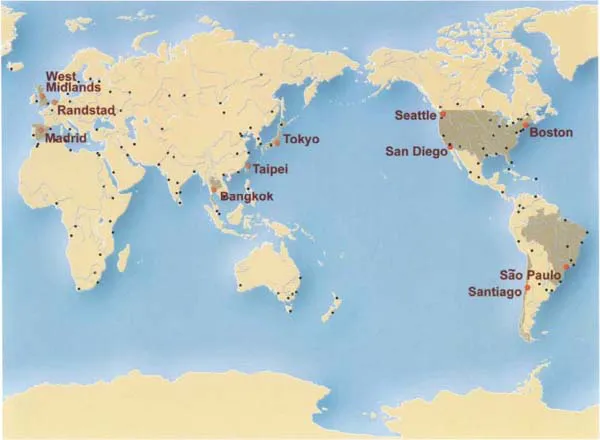
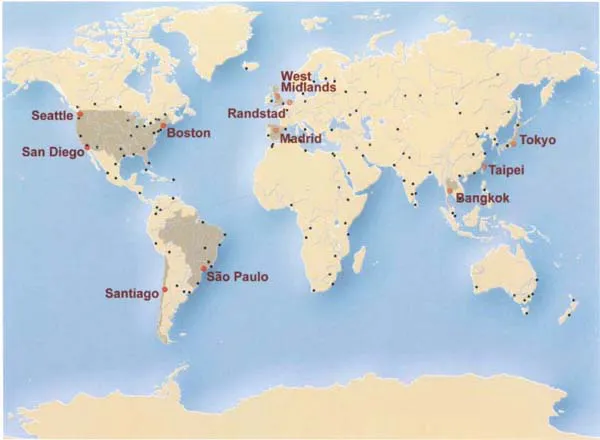
City regions selected for the consortium and included in this volume are indicative of urban conditions around the globe, rather than a carefully crafted representative sample. They have been chosen to reflect a range of population sizes (from less than 3 million to 32 million), levels of income (from lower income countries to the wealthiest), and ages (from old European settlements to the newly emerging cities). Three (Bangkok, Taipei, and Tokyo) are in Asia, but all are industrial cities or rapidly becoming so. Three are in Europe, one a strongly centered city (Madrid) and two of them multi-city conurbations (the Randstad, Holland, and the West Midlands, UK). The three North American examples include one of the oldest cities on the continent (Boston), and twentieth century cities (Seattle and San Diego). The two South American cities (Santiago and São Paolo) are sprawling metropolitan areas in the most advanced countries.
However, in other senses, the 11 regions were selected because they conformed to certain specifications. Each global city region:
• Is diverse economically—no single industry cities such as free-standing national capitals, resort cities, or resource-based cities.
Figure 1.1 The eleven global city regions, viewed from the Pacific
Figure 1.2 The eleven global city regions, viewed from the Atlantic
• Is undergoing economic transformation—either developing a manufacturing economy for the first time, or shifting to a service economy.
• Has experienced significant growth over the past two decades—no declining cities.
• Has developed in a country with a significant private sector economy—no socialist cities or tightly controlled economies.
• Has a history of attempts to deal with regional form and development.
In selecting the regions, there was also an attempt to reach out beyond those cities with well documented experiences in regional planning and development—Paris, London, New York among them—to enlarge the field of knowledge. These three regions are discussed, to some extent, in the following chapter.
Part 2 of the book contains 11 chapters which describe the evolution of each of the 11 city regions over a 30 year period, from 1965 to 1995. As far as possible, the information covers the complete city region, extending to the limits of the linked urban area. Data on key social, economic, and spatial indicators are presented at 10 year intervals. The accompanying narrative describes and interprets the policies and action programs of relevant agencies in the city region over the same time periods.
The information on the 11 regions is intended to allow the reader to make comparisons between them and between them and their own region and, in the process, form conclusions about several important questions:
• What evidence do we find for the general claim that most city regions have been passing through a moment of shared discontinuity or rapid transformation during this 30 year period?
• What trends, if any, can we discover in the changing social, economic and physical form of city regions around the world?
• Is a new kind of human settlement emergent?
Some of these questions are addressed in Part 3, which follows the 11 chapters. The evolving physical form of the cities has been compared along a number of relevant dimensions, including density, dispersal and location of major groups in the city. The cultures of governance and regional management have been similarly examined, bearing in mind the broad differences in cultural influences which have a profound bearing on political organization.
Finally, Part 4 includes a variety of essays, some interpretive, others provocative, on the subject of change in global city regions. These cover the interrelated questions of how the global economy affects urban prospects, technologies and their impacts on urban transport and urban form, the advantages of compact as opposed to distributed city forms, and the wider issue of city space and cyberspace.
Global cities are inevitably also regional cities. The ties between globalism and regionalism are, as we said earlier, the central preoccupation of this book.
NOTES
1 Ulrich Beck, Risk Society: Towards a New Modernity (English Language version), London: Sage, 1992.
2 Edward W. Soja, “Six Discourses on the Post Metropolis”, in S. Westwood and J. Williams (eds), Imagining Cities, London: Routledge, 1997.
3 The first Global Cities Symposium was sponsored by the Lincoln Institute of Land Policy and held in Cambridge MA in September 1995. Gary Hack, Roger Simmonds, and David Barkin acted as chairpersons. Representatives of 12 city regions and other invited speakers gave presentations. The second symposium was held in El Escoriai, Spain, in July 1997. It was sponsored by the Comunidad de Madrid (the autonomous regional government of Madrid), the Lincoln Institute of Land Policy, and the Universidad Complutense. Pedro Ortiz and Roger Simmonds acted as chairpersons. Representatives of the 11 city regions and other invited speakers gave presentations.
2 Planning the city region
A short history of Western practice
ROGER SIMMONDS AND...
Table of contents
Cover
Halftitle
Title
Copyright
Contents
Notes on contributors
Part 1 Assumptions And Objectives
Part 2 Studies Of Global City Regions
Part 3 Comparing And Contrasting The Cases
Part 4 Essays About City Regions
Index
Trusted by 375,005 students
Access to over 1.5 million titles for a fair monthly price.
Study more efficiently using our study tools.
Frequently asked questions
Yes, you can cancel anytime from the Subscription tab in your account settings on the Perlego website. Your subscription will stay active until the end of your current billing period. Learn how to cancel your subscription
No, books cannot be downloaded as external files, such as PDFs, for use outside of Perlego. However, you can download books within the Perlego app for offline reading on mobile or tablet. Learn how to download books offline
Perlego offers two plans: Essential and Complete
Essential is ideal for learners and professionals who enjoy exploring a wide range of subjects. Access the Essential Library with 800,000+ trusted titles and best-sellers across business, personal growth, and the humanities. Includes unlimited reading time and Standard Read Aloud voice.
Complete: Perfect for advanced learners and researchers needing full, unrestricted access. Unlock 1.5M+ books across hundreds of subjects, including academic and specialized titles. The Complete Plan also includes advanced features like Premium Read Aloud and Research Assistant.
Both plans are available with monthly, semester, or annual billing cycles.
We are an online textbook subscription service, where you can get access to an entire online library for less than the price of a single book per month. With over 1.5 million books across 990+ topics, we’ve got you covered! Learn about our mission
Look out for the read-aloud symbol on your next book to see if you can listen to it. The read-aloud tool reads text aloud for you, highlighting the text as it is being read. You can pause it, speed it up and slow it down. Learn more about Read Aloud
Yes! You can use the Perlego app on both iOS and Android devices to read anytime, anywhere — even offline. Perfect for commutes or when you’re on the go. Please note we cannot support devices running on iOS 13 and Android 7 or earlier. Learn more about using the app
Yes, you can access Global City Regions by Gary Hack,Roger Simmonds in PDF and/or ePUB format, as well as other popular books in Architektur & Architektur Allgemein. We have over 1.5 million books available in our catalogue for you to explore.