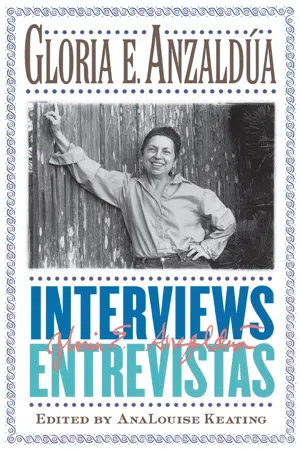
Gloria E. Anzaldúa, best known for her books Borderlands/La Frontera and This Bridge Called My Back, is one of the foremost feminist thinkers and activists of our time. As one of the first openly lesbian Chicana writers, Anzaldúa has played a major role in redefining queer, female, and Chicano/a identities, and in developing inclusionary movements for social justice.
In this memoir-like collection, Anzaldúa's powerful voice speaks clearly and passionately. She recounts her life, explains many aspects of her thought, and explores the intersections between her writings and postcolonial theory. Each selection deepens our understanding of an important cultural theorist's lifework. The interviews contain clear explanations of Anzaldúa's original concept of the Borderlands and mestizaje and her subsequent revisions of these ideas; her use of the term New Tribalism as a disruptive category that redefines previous ethnocentric forms of nationalism; and what Anzaldúa calls conocimientos-- alternate ways of knowing that synthesize reflection with action to create knowledge systems that challenge the status quo.
Highly personal and always rich in insight, these interviews, arranged and introduced by AnaLouise Keating, will not only serve as an accessible introduction to Anzaldúa's groundbreaking body of work, but will also be of significant interest to those already well-versed in her thinking. For readers engaged in postcoloniality, feminist theory, ethnic studies, or queer identity, Interviews/Entrevistas will be a key contemporary document.
- 320 pages
- English
- ePUB (mobile friendly)
- Available on iOS & Android
eBook - ePub
Interviews/Entrevistas
About this book
Information
1
Turning Points
An Interview with Linda Smuckler (1982)
(1988–1999)
ALK: You talk about some pretty wild stuff in this interview and even more extensively in the following interview with Christine Weiland—an “extra-terrestrial spirit,” different spirits entering your body, past-life regression, reincarnation, psychic readers, and more. How do you feel about these ideas being out there, in print?
GEA: I think it’s about time for these ideas to be in print. I went to psychic readers and workshops in psychic development right after one of my near-death experiences, and these saved my life. It really helped me get in touch with who I was and what I wanted to do. I’m happy it’s going to be in my interview book. People should know about this aspect of me and my life.
ALK: Don’t you think it’s going to make you less respectable and less reputable—because a lot of scholars don’t believe in such things?
GEA: Tough shit! Once I get past my own censorship of what I should write about, I don’t care what other people say. Some things were hard for me to reveal but my strong vocation for writing makes me more open. To be a writer means to communicate, to tell stories that other people haven’t told, to describe experiences that people normally don’t find in books (or at least in mainstream books).
ALK: This is just a different kind of risk-taking?
GEA: Yes. As you said, I’ll be ridiculed and some academics will lose their respect for my work. A small number—one-half of one percent—will applaud me for talking about these things. Scholars connected to universities—what I call the “dependent scholars,” dependent on their discipline and their school in order to survive—will object to this material, while independent scholars like myself who aren’t tied up to any institution will applaud my discussions of spiritual realities, imaginal realities, and the inner subjective life.
The scientific story—which has no way of measuring subjectivity—is losing validity. It has created an industrial consumer society that’s exploited the environment and put us in this crisis situation where we’re running out of resources. Many people live by the paradigm that progress means to produce and therefore consume more, so we’re in this race to consume and expand, to grow and to control the environment. As everyone knows, it’s not working. Science has to change its story: it must accept information that goes beyond the five senses. So right away you get into subjectivity, the inner life, thoughts, and feelings. You get into intuition, which is a very maligned sense; in fact, people don’t even think of it as a sense.
ALK: Are you saying that some of your statements—which might strike readers as “way out there”—are actually alternate ways of knowing that you’ve accessed, ways of knowing which have enriched your writing and which provide alternatives for all of us to think about?
GEA: Right, and I think these ideas will find legitimacy after the turn of the century. But there’s a lot of resistence when people are changing the way they perceive reality, the way they look at relationships and their environment. People want the old familiar ways. Traditional science has such a grip on us, it’s become the only way to describe reality. Every other way has been trivialized. I talk about this in Borderlands, where if you believe in some of these other ways you’re labeled superstitious. Once the century turns, more people will believe in the existence of something greater than the physical world. If you think of reality as a continuum or a spectrum, the reality we see with our eyes, hear with our ears, smell with our nose, and touch with our fingers—that spectrum is a skinny little territory. Parts of a person are unknown to that person or to the culture but are known through dreams, imagination, spiritual experiences, or intuitive feelings. If science is going to continue as the reigning paradigm, it will have to change its story, change the way it controls reality, and begin acknowledging the paranormal, intuition, and subjective inner life. A few physicists, like Fred Allen Wolfe, have already begun this exploration. The ideas I talk about and am currently writing about will probably be frowned upon during the next couple of decades, but if my writing lasts, it will eventually be respected.
ALK: May your words be prophetic. In this interview you associate your early menstruation with your theory concerning your four death experiences, when different spirits entered your body each time you died. Do you still hold this theory or has your perspective changed, and if so, how?
GEA: I still hold this theory. I checked it out with a Russian psychic reader in San Francisco and with Luisah Teish, and they both agreed with my theory. Luisah Teish did a pretty detailed reading for me (she told me my mothers are Yemanja and Oya). Aurora Levins Morales also did a very good reading; she went into a trance and told me some things I’d been thinking about: that I felt scattered and needed to put myself together again, very much like my reading of Coyolxauhqui. I felt a calling to be an artist in the sense of a shaman—healing through words, using words as a medium for expressing the flights of the soul, communing with the spirit, having access to these other realities or worlds. At that time I felt pulled away from my calling as a writer because so many people around me needed some kind of healing. (People saw me as a healer; one person even said, “¡Tú eres una curandera!”) I was doing tarot and psychic readings for other people, and it was taking up a lot of my energy. I thought, “Do I want to be a healer or do I want to heal through other means?” I backed away from those other types of healing and concentrated more on the writing. When Aurora Levins Morales did her reading, I was at that juncture, at that turning point, where I needed to rededicate myself to being an artist, a writer.
I have a piece called “Resisting the Spirit,” based on an out-of-body experience I had in Austin. Like a lot of other people at that time I was experimenting with drugs, but I was using them to gain access to other realities. One night I mixed alcohol with percada, a downer, and my body had a reaction. I thought I was dying. My soul left my body. This story may or may not go into La Prieta, The Dark One. Some editors and publishers may censor the drug stuff because drugs have become a major addiction in our society.
As to my bleeding at the age of three months—doctors could never figure it out; it’s a very rare hormonal disturbance or dysfunction. As far as I know only two people—including myself—have ever been diagnosed with it. Dysfunction is not due to the physiology of the body alone, other things impact on it. In my case some other entity or spirit had entered my body. This spirit was not used to incarnating in human bodies. (I do believe that we incarnate into different bodies, different races, different genders. Most of the souls in people originated from and have lived on the earth, but other souls or spirits come from beyond the earth). I got this idea early on but I couldn’t make sense of it and thought, “Gloria you’re going crazy, entertaining such ideas.” When I talked about it to people they looked at me like I was crazy. But as I grew older I began exploring it—through psychic readers, books, meditation—and following my intuition. I realized that it didn’t really matter whether an extraterrestrial spirit had actually entered my body or I had made it up. Human beings’ whole struggle is to give meaning to their experience, to their condition, and this was my way of giving meaning to my early bleeding. People shape their experience, that’s how reality is created. There’s no such thing as objective truth. It’s similar to how I create a story or a poem. The universe is created jointly by all the human minds and the universal intelligence in the trees, the deer, the snakes, and so on. By jointly, I mean all forms of consciousness, not just human. Even the rocks have a certain kind of consciousness, the trees, everything. I see the world as a text created by this collective consciousness.
ALK: You make a very provocative comment in this interview when you claim that “there are a lot of Indian souls inhabiting white bodies.” This statement is very antiessentialist (or perhaps essentialism done differently, taken into the spiritual). Do you still believe this, and if so could you explain in greater detail what you mean? Your statement could be seen as a different form of appropriation, because there are so many New Age people who claim to be Indian.
GEA: This belief is similar to my idea that the universe is a text. An individual is multiple and has multiple personalities and multiple little selves, along with the big self. I’m an individual but because I inhabit many worlds I can go from being at my mom’s little pueblito to an academic classroom to a lesbian musical event to a writer’s conference, and in each instance I can experience what the other people present are experiencing.
ALK: I’m not sure I see the connection between these examples, where you as an embodied individual move from one location to another, and your statement about “Indian souls” inhabiting white bodies.
GEA: It’s the same movement but instead of a concrete physical movement it’s the movement of the soul. The soul has little souls, just like the self has little selves, and these little souls can manifest in people who are white, black, men, women …
ALK: So you don’t really mean “Indian” souls. You mean souls which were in “Indian” bodies, now occupying “white” bodies. The souls themselves don’t have any kind of ethnic marker like “Indian” or “white.”
GEA: Right. I also believe we bring knowledge from previous existences with us each time we’re born. You’re not born as a blank slate; something from your previous lives bleeds through. If you’re incarnated as a black person for many, many times, when you become Russian or European, or Japanese, it kind of leaves a little trail.
ALK: It’s a form of growth?
GEA: Right! If I look at my experience with you and say, “Oh, she’s so typically Chinese,” or “Oh, she’s so typically Indian,” it just means that behind that soul is the other. Does that make sense to you?
ALK: Yes! It makes a lot more sense than the way you said it in the interview. In this early interview you discuss creating a “writing of convergence”—the coming together of “[t]he sexual, the mental, the emotional, the psychic, the supernatural.” That’s almost twenty years ago! Have you developed this theory and style of writing, abandoned it, changed it?
GEA: I’ve developed it in personal essay form and fiction. It’s integral to my teaching, my guided meditations, and my writing exercises. I believe that we’re very complex beings. We can’t just divide the mind from the body in sexuality, or creativity and rationality from intuition. One of the tasks I’ve chosen is to blur these boundaries. I try to do this with some of the Prieta stories where one reality bleeds into another, where fiction bleeds into concrete reality with dreams and visions, and the energy from sexuality is very much a part of mental thought and feelings. It’s not so much that I’ve written down the ideas rationally or concretely or theoretically, it’s more like I’m fooling around with stories and the impact the stories have on the reader. It’s very hard to paraphrase a story because when you read it and you’re experiencing the characters’ emotions—whether it’s elation, anger, or fear—your body is experiencing an emotional and psychic process. At the end of the story, you can’t sit down and say, “This is what the story really means” because it impacts on your unconscious in a way that you can’t articulate in your conscious mind. It’s very hard to get these ideas across fiction-wise; it’s much easier to explain rationally. But fiction has a greater impact on the whole psyche than theory does.
“Turning Points”
An Interview with Linda Smuckler (1982)
Early Writing Experiences
LS: I’d like to start by asking you to discuss your writing experiences as a child. What do you remember—any beginning stories of when you wrote?
GEA: I grew up listening to both my grandmothers tell stories about the old days. All the members of my family were storytellers. Most Chicanos are storytellers, especially those who haven’t had much schooling. They pass on their stories orally. I was the only one who really listened to my grandmothers and...
Table of contents
- Cover
- Half Title
- Title Page
- Copyright Page
- Dedication
- Table of Contents
- Acknowledgments
- Risking the Personal An Introduction
- 1. Turning Points
- 2. Within the Crossroads
- 3. Lesbian Wit
- 4. Making Choices
- 5. Quincentennial
- 6. Making Alliances, Queerness, and Bridging Conocimientos
- 7. Doing Gigs
- 8. Writing
- 9. Toward a Mestiza Rhetoric
- 10. Last Words? Spirit Journeys
- Primary Works Cited
- The Interviewers
- The Authors
- Index
Trusted by 375,005 students
Access to over 1.5 million titles for a fair monthly price.
Study more efficiently using our study tools.
Frequently asked questions
Yes, you can cancel anytime from the Subscription tab in your account settings on the Perlego website. Your subscription will stay active until the end of your current billing period. Learn how to cancel your subscription
No, books cannot be downloaded as external files, such as PDFs, for use outside of Perlego. However, you can download books within the Perlego app for offline reading on mobile or tablet. Learn how to download books offline
Perlego offers two plans: Essential and Complete
- Essential is ideal for learners and professionals who enjoy exploring a wide range of subjects. Access the Essential Library with 800,000+ trusted titles and best-sellers across business, personal growth, and the humanities. Includes unlimited reading time and Standard Read Aloud voice.
- Complete: Perfect for advanced learners and researchers needing full, unrestricted access. Unlock 1.5M+ books across hundreds of subjects, including academic and specialized titles. The Complete Plan also includes advanced features like Premium Read Aloud and Research Assistant.
We are an online textbook subscription service, where you can get access to an entire online library for less than the price of a single book per month. With over 1.5 million books across 990+ topics, we’ve got you covered! Learn about our mission
Look out for the read-aloud symbol on your next book to see if you can listen to it. The read-aloud tool reads text aloud for you, highlighting the text as it is being read. You can pause it, speed it up and slow it down. Learn more about Read Aloud
Yes! You can use the Perlego app on both iOS and Android devices to read anytime, anywhere — even offline. Perfect for commutes or when you’re on the go.
Please note we cannot support devices running on iOS 13 and Android 7 or earlier. Learn more about using the app
Please note we cannot support devices running on iOS 13 and Android 7 or earlier. Learn more about using the app
Yes, you can access Interviews/Entrevistas by Gloria E. Anzaldua, AnaLouise Keating in PDF and/or ePUB format, as well as other popular books in Social Sciences & Social Science Biographies. We have over 1.5 million books available in our catalogue for you to explore.