1 Introduction
Overview
Southeast Asia encompasses a huge diversity of peoples, languages, societies, cultures and literary traditions. English came to the region fairly recently, as part of the growth of European and American imperialism, and stayed past the era of empires to become a key intermediary for the processes of modernity and globalization. The modes of literary expression it has inspired make for a compelling story. Our narrative is mindful that a more complete picture would need to relate literary expression in English to writing in other major languages of the region. Within that larger ideal – difficult to realize within the confines of a single book even for a group of regional scholars – the narrative of literary productions from and about Southeast Asia in English merits reading on its own. Our main aim is to bring together texts that experts in their respective fields tend to treat separately, and our enterprise has profited from the work of scholars who have helped bring the Anglophone writing from the various regions of Southeast Asia together in a comparative context. We hope that this book will serve as a useful introduction to the literatures of Southeast Asia in English.
The geographical dimension: English in Southeast Asia
English is a global language rich in regional variety. It flourishes in Asia amidst a plurality of cultures expressed in a variety of languages. Having outgrown colonial origins, it combines a contemporary role as a medium of higher education and international communication with a capacity to bridge disparate linguistic and cultural communities. English is also cultural capital, and indeed the use of it may at times indicate privilege. The number of writers using it as a creative medium has grown steadily wherever the appeal of its expressive resources has been accompanied by the sense of joining a larger community of writers and readers. Authors from Southeast Asia have given proof of this appeal for more than a century, and produced a body of work ample in range and variety.
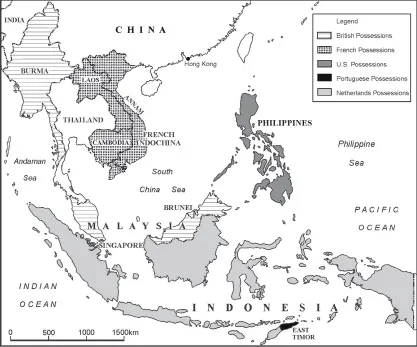
Figure 1 Map of Southeast Asia, 1939.
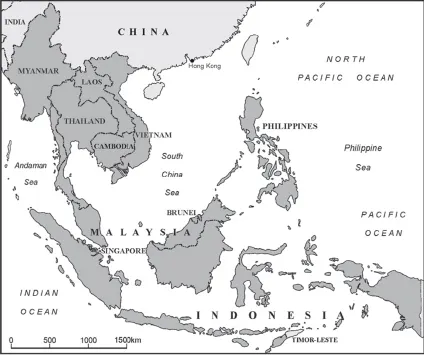
Within Southeast Asia, a tradition of using English as a creative medium narrows primary attention to three modern nation-states: Malaysia, Singapore and the Philippines, to which we have added a fourth territory, Hong Kong. Even though it is not linked to the three nation-states either by geographical proximity or by membership of a group such as ASEAN (Association of Southeast Asian Nations), Hong Kong’s inclusion is important for three reasons. First, it has strong historical links to the region we now call Southeast Asia. A shared history of British colonialism meant that there were strong connections between Chinese and other communities in Hong Kong and the Straits Settlements. Hong Kong was also an important place of refuge for Filipino revolutionaries, and later, a place of recreation for the Filipino Anglophone elite. Second, Hong Kong was often popularly considered part of Southeast Asia during its separation from China at the height of the Cold War. During this period there were increased connections with the Philippines, Malaysia and Singapore; and indeed possibly the most influential Filipino novel of the twentieth century, Nick Joaquin’s The Woman Who Had Two Navels (1961), is set in the territory. Third, contemporary Hong Kong shares with Singapore, Malaysia and the Philippines an experience of the role played by English within a context of multilingualism; this in turn has influenced the territory’s literary production, complementing writing in Chinese with growing confidence in using English for creative purposes, even if only by a tiny minority of expatriates and English-educated writers born or settled in Hong Kong.
Figure 2 Map of Southeast Asia, 2009.
Our secondary interest in this literary history extends to the marginal role played by English in the cultures of the other nations of Southeast Asia, where literatures in the national or regional languages represent the dominant form of literary expression, but leave some space for writing in English. We omit reference to translations from and into English, not because they are not of great significance, but rather, because there is such a wealth of material translated into English that it needs a critical history of its own, especially since such work activates issues across languages that need a very different context from that provided by a literary history such as this. Once it is recognized that English is only one – and by no means necessarily the largest – piece in the linguistic jigsaw, we can have a better sense both of the scope and the limits of our current undertaking. In the societies that provide us with our primary materials, English is most extensively used in the Philippines and Singapore; and despite the dominance of Malay in Malaysia, and Cantonese (now supplemented by Mandarin) in Hong Kong, English has shown increasing signs of remaining indispensable in both areas.
The historical dimension: from colonial to contemporary history
The history of how English came to Asia is part of the larger history of how the European languages spread across the world in a gradual, uneven and often involuntary process that extended from the sixteenth to the nineteenth century. The expansion was the indirect but lasting consequence of the gradual European mutation of exploration and economic enterprise into territorial annexation, political control and religious evangelism – the global consequences of modern Western colonialism – in which Europe was followed, with variations, by the United States.
Decolonization was slow and asynchronous. The Americas fought for their independence before the rest of the colonized world. In Asia, colonialism came to an end after the Second World War. Decolonization proved a complex and problematic undertaking, and some argue that cultural decolonization remains an incomplete and ongoing project in many former colonies, despite decades of political autonomy. Colonialism altered colonizers and the colonized in ways that proved long-lasting. Ironically, one of the most enduring influences of colonialism survives – indeed thrives, especially through English – in the form of the literary cultures generated from the colonial experience by the peoples who assimilated the languages to their societies while assimilating themselves to the languages, developing through those interactions the potential for adaptability and new growth that provides us with the materials of our literary history.
The British brought their language to the Malaya peninsula in the early nineteenth century and to Hong Kong in the middle of the nineteenth century. Shortly thereafter, the Americans brought their version of the language to the Philippines, spreading it rapidly there from 1898. English was disseminated to the peoples living in the various colonial territories in circumstances that differed widely from one territory to another, and it was assimilated at speeds that depended on the educational policies implemented by the colonizers – policies that were not always explicit or internally consistent. In addition, English was frequently appropriated by groups whose interests diverged from those of colonial governments, and put to new uses.
The economic and demographic growth of Singapore and Hong Kong, and the colonial policies that shaped them, neither needed nor encouraged the widespread use of English. The majority of writers from the region came to the language rather late in the day, at the eve of Empire. In contrast, the Americans propagated their language in the Philippines swiftly and systematically, replacing the thin purchase of the earlier colonial language of Spanish. Filipino writing in English had thus gained a sizeable lead in quantity and sophistication by the time the notion that local writers might create a new literary culture had begun to take root in British Malaya. Indeed, in both areas, the call for the right to self-rule often initially found expression in the colonial language, and English continued to have a place as an intercommunal language in the period of decolonization.
During the colonial period, English coexisted in a relation of uneasy tension with national, regional and community languages. The Philippines achieved independence in 1946, the Federation of Malaya in 1957, Singapore separated from Malaysia in 1965, and Hong Kong exchanged the role of British colony for that of a Special Administrative Region of the People’s Republic of China in 1997. After colonialism, English remained, and in the postcolonial era, despite an ambivalent relation to nationalism, English continues to play a prominent role in the life and culture of the Philippines and Singapore, a significant but more muted role in Malaysia and Hong Kong, and a marginal but often expanding one in the other nations of Southeast Asia. The manner in which it entered daily living, and the degree to which it attracted writers, were linked to the aspirations it engendered among ordinary people and the language policies of which it became part in the political projects of national unity, economic development and social modernity. The continued importance of English in the region is linked to the access it provides to global media and the systems of knowledge, trade and technology that remain goals for individuals and nations intent on their share of a rapidly and unevenly globalizing world.
The structural dimension: how this book works
In order to address the concerns and scope of inquiry we outline above, the volume commences with chapters giving two contexts: first, a brief history of Southeast Asia from the early modern period onwards, and second, an account of the challenges and possibilities opened up by the use of English in a multilingual context. Our next two chapters begin the work of literary history, and they do so by following two distinct historical strands. Each keeps the notion of ‘writing’ in peripheral vision, while maintaining that specific kind of writing which commonly aspires to be read as ‘literature’ (as distinguished, for example, from genres such as history, biography, autobiography, journalism, etc.) in central focus. Thus Chapter 4 covers the dissemination of English under British colonialism in Malaysia, Singapore and Hong Kong, and then explores literary writing in English during colonialism and during the process of decolonization. Chapter 5 does similar work concerning American colonialism in the Philippines; where the history of the dissemination of the language is necessarily shorter, but is balanced by a larger volume of literary production in English under colonialism, under the Commonwealth, and after independence from 1946 onwards.
We have chosen the terminal date for Chapters 4 and 5 as 1965. All historical periodization is, of course, arbitrary, resulting from the imposition of a taxonomic grid on the continuities of history, yet we feel this choice is justified for a number of reasons. In the case of Malaysia and Singapore, 1965 represents Singapore’s separation from Malaysia, and thus the final chapter of the formation of contemporary nation-states from former British colonies in the region. In the Philippines, the year would not have seemed momentous at the time, yet in retrospect it is surely significant: the election of Ferdinand Marcos as president would radically change Philippine politics for two decades. Two other events in the region in 1965 were also of great importance. The failed coup against Sukarno in Indonesia resulted in a counter-coup that would bring Suharto to power; in South Vietnam, the first American combat troops arrived. Both events are markers in a transition from a period of decolonization to the more rigid divisions of the Cold War, and are representative of larger political movements in the region that influenced social policies to which writers and artists in turn responded.
The succeeding chapters are unified by genre rather than country or region in order to fulfil the possibilities suggested by the volume’s regional approach. In writing these comparative chapters, we have made two strategic decisions. First, we have given slightly more length to poetry than to prose fiction or drama in order to facilitate quotations necessary for illustrating the manner in which poetic language works in a multilingual environment. Second, we have divided coverage into two distinct historical periods, pre-and post-1990. If 1990 contains less memorable historical events in the region than 1965, it does mark, at least approximately, a transition from the Cold War to a new, increasingly transnational world order in which neo-liberalism became dominant. This transition has had a profound effect on the region, caught as it is within capital and cultural flows. The tyranny of space requirements has resulted in a primary concentration on the traditional genres of poetry, drama and prose fiction, but we do conclude with a brief account of how new digital media are transforming literatures in English in the region.
The methodological dimension: a comparative approach
Literary histories based on the nation-state often find themselves drawn to narratives that claim a manifest or implied congruence between the development of literary traditions and the development of the nation. The comparative approach we adopt here is less prone to interpret all literary change as a function of national identity or culture. Instead, it provides a wider perspective from which to relate what authors write in a given time and place to the events, changes and continuities that constitute the life and culture of their communities. We have tried to remain alert to how literary writing invokes or alludes to ‘society’ and ‘tradition’, and to how such writing relates to ideas and values, whether personal or collective. We are also mindful of how literary writing affects ideas and beliefs pertaining to race, class, community, gender, sexual preference, religion and ethics.
What is at stake is not to portray literary works in the context of their age, but to represent the age that perceives them – our age – in the age during which they arose. It is this that makes literature into an organon of history; and to achieve this, and not to reduce literature to the material of history, is the task of the literary historian.
Walter Benjamin, ‘Literary History and the Study of Literature’ (1931)
Keeping these general considerations in mind, we have tried to present a balance between what could be described as the intrinsic and extrinsic dimensions of Southeast Asian writing in English. The idea of intrinsic dimensions refers to the internal relationships between themes and techniques, and the relation of formal features and expressive nuances to literary conventions (whether indigenous or foreign). The extrinsic dimension complements the intrinsic and refers to (a) the social and cultural contexts for the creative use of English; (b) the impact on literature of institutions of civil society and state policy; and of mentorship, patronage, publication and circulation; (c) the relation of literature to the histories of individuals, communities and nations; to ideology, beliefs and practices; to the discourses of colonialism, postcoloniality, modernism, postmodernism and feminism; to its audiences, at home and abroad; and to local and international critical canons.
Obviously, no single book of this size can hope to attempt all this except by being selective in its emphases. We have tried to harmonize the demands of central vision with what we believe must be retained in peripheral vision. Our primary focus is thus on cultural activity centred on the literary uses of English in Southeast Asia. We also make room, however briefly, for three kinds of lateral awareness. The first concerns the relation of English in Southeast Asia to other linguistic cultures within the region; the second concerns English as used in other parts of the world; and the third concerns expatriate writing, both by those migrating to and from the region, whenever such writing bears witness to some aspect of Southeast Asian cultures and histories.
We aim not for the chimera of ‘objectivity’ but for persuasion aimed at promoting historical and critical awareness. The overview provided by any literary history is necessarily subjective. Our book is written from a perspective based on many years of living in Singapore, where we have worked as university teachers, having lived previously in other parts of the world, and bringing to our interest in the cultures of the region a degree of awareness of other societies and literatures. We write for the interested general reader and for the student of literature, and we recognize that literary histories are a form of stock-taking whose need is renewed whenever assumptions and values change, and whenever new writing adds itself to the changing canon of texts and values. Our literary history will have accomplished its purpose if we succeed in persuading new readers that the authors and texts we introduce in brief compass will reward further acquaintance, or, equally, if we cause readers familiar with the works we discuss within the contexts of national canons to view them afresh in a comparative light.
Conclusion
- A literary history of writing in English from Southeast Asia works within two limiting conditions, one linguistic and the other regional.
- English came to the region at varying times and speeds of assimilation, as a result of Western imperialism.
- Its continued and flourishing use today testifies to the ways in which the status of English as an international language has moved across boundaries of culture and imperial as well as postcolonial history.
- If writers from Southeast Asia assimilated themselves to English, they also taught themselves to adapt and modify the language and its literary conventions to suit their own needs and circumstances.
- The achievements that have resulted from that process provide the basic justification for a narrative that focuses on the development of English literary writing...