rights and return
perils and fantasies of situated testimony after katrina
janet walker
“After the storm, I came back. Things were so … turned over that … I actually got disoriented in the neighborhood that I grew up in.”
James Gibson, III, Right to Return:
New Home Movies from the Lower 9th Ward1
The object of knowledge is, precisely, the fragmented and uncertain connection between elaborated representations of space on the one hand and representational spaces (along with their underpinnings) on the other; and this “object” implies (and explains) a subject—that subject in whom lived, perceived and conceived (known) come together within a spatial practice.
Henri Lefebvre, The Production of Space2
[T]he lived body is coterminous with place because it is by bodily movement that I find my way in place and take up habitation there.
Edward S. Casey, Remembering3
Judith Morgan and a friend command the space of Morgan’s demolished home, its raised foundation a haunting platform for their gestural and verbal descriptions of its former state. Now the debris has been removed, the premises cleaned and painted, and a small camping tent pitched in what was once the interior space of the home. The women, at first in front of the structure and then within its footprint, trace with physical movements the rooms and features that were washed away when the levees breached in the wake of Hurricane Katrina. “Duck your head,” reminds her friend, with conscious irony, as Morgan mounts the three short steps-to-nowhere—all that remains of a staircase that once led to a second story supported by a low beam.
This walking testimonial is one of many heart-rending on-site interviews that comprise the video footage and finished documentaries shot in New Orleans in the months and years after Hurricanes Katrina and Rita and the flood control system failures that put 80 percent of the city under water. The cameras captured a devastated landscape in which everything had shifted: houses lifted off foundations, or reduced to jutting piles of rubble; cars climbing the walls or weirdly conjoined, chassis to chassis; people wandering displaced, lost in the once-familiar neighborhoods where they had been born and raised. “That china closet doesn’t have no business being over here,” exclaims a grief-stricken Wilhelmina Blanchard, inspecting her destroyed home for the first time since having evacuated. As director Spike Lee comments on the documentary’s commentary track, “The foundation is not there. Your feet are not on solid ground.” The geography of the terrain— from its furnishings to its urban architecture to its ecology to its economic and racial relations—was massively altered such that the ways and means of rehabilitation and bioremediation are an open question. And yet the bodily presence of returning residents describes a strong and tangible connection to place, community, neighborhood, and home, an affective geography that is established and transitory, solid and imaginative.
The current chapter focuses on the potentialities and limitations of filmed or videotaped testimony delivered in situ, from the place where catastrophic past events—that generate the subject and the subject matter both—occurred. This is a form of situated direct address simultaneously to filmmaker, camera, and spectator. It is elicited for the purposes of retrospective documentary works, where typically it is intercut with other direct address interviews conducted with the same and different individuals in their homes, offices, by-ways, or against a neutral background arranged by the filmmaker. By figuring the relationship among the body of the individual, the ground from which s/he speaks, and the past events that transpired of a time but are, at the same time, brought into being by the testimonial act,4 situated testimony realizes the materiality of testimony in the power of place.
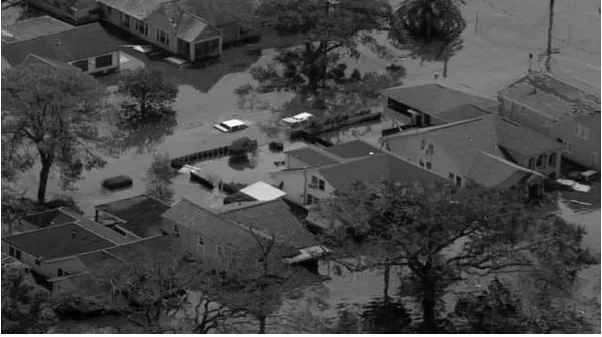
Figure 3.1
New Orleans under water (When the Levees Broke)
As a type of filmed interview, an audiovisual testimony is always in some sense “staged”; staged in that the interviewee would not be speaking if not for the occurrence of the filming, and staged in the sense of being put into a scene, a mise-en-scène in fact, that can be as simple as a black background or as complicated as a churchyard of Polish villagers surrounding a child survivor returned years later to the site of a genocide (as in Claude Lanzmann’s Shoah [France, 1985]).5 Situated testimony, then, not only staged but also localized to certain haunts, may be said to found a geography of return.
But what of reminiscence and the psychic aspects of testimonial reflection? Psychoanalytically informed trauma studies has drawn on the concept of temporal “belatedness” to theorize trauma as a psychic structure of experience for which violent acts and physical settings are of passing importance. As Cathy Caruth has written: “The impact of a traumatic event lies precisely in its belatedness, in its refusal to be simply located, in its insistent appearance outside the boundaries of any single place or time,” or, putting it differently, “in connection with another place and time.”6 Indeed Caruth’s influential work has inspired a rich debate about the historical truths and enigmas that traumatic experience arguably renders—but significantly less attention has been paid to its spatial aspects.
Focusing here as much on place as time, I want first to relate this notion of trauma’s distanced, other place to the apparently self-same geography of situated testimony. What of those occasions when testimony is given from the very spot, and not “another” spot, where catastrophic events transpired? What about the Rwandans who speak from the grounds of the Kigali Memorial Centre, built on the site of the graves of more than 250,000 Tutsi and moderate Hutu massacred during a one hundred day period, or from a school classroom near to where neighbors set against neighbors? What about the indigenous activists who edge as close as possible to land their families farmed for generations prior to its inundation by the construction of massive dams for hydroelectric power?7 It may be that the prominence of Holocaust subject matter in testimony studies, the prominence, that is, of a major diasporic testimonial paradigm in which the overwhelming majority of testimonies have been delivered at a temporal and geographic distance from the events they invoke, has obscured our view of the other distinctive testimonial paradigm: that of situated testimony as a kind of post-traumatic reassertion of physical belonging and right of return. Tens of thousands of people around the world have presented their audiovisual testimonies through the pain of disastrous propinquity: because they have chosen—or because they have no choice but—to reregister their presence in a place from which they (temporarily) and loved ones and/or neighbors (permanently) have been wiped out.
I wish, therefore, to examine rooted testimony, to take it seriously, that is, while still recognizing that the presence of returnees to a “fatal environment” does not by any means obviate the need to comprehend the psychic dimensions and the unassimilability of place and occurrence that make up the traumatic experience of which they speak.8 The ground of testimony sur place—like exilic space—is always, already “other.” Here, the insights of critical human geography are crucial, for in this post-positivist sub-discipline a materialist critical spatial perspective is reasserted (against what Edward Soja, for example, sees as “despatializing historicism”9) such that location matters, but place is not essentialized or reified as a truth-telling topography. The stones don’t speak except through a kind of critical ventriloquism, yet they are more than mere inert features of a fixed terrain.
Inspired by Henri Lefebvre’s concept of social space, art historian Irit Rogoff celebrates critical human geography’s “situated knowledge” as enabling a “shift from a moralizing discourse of geography and location, in which we are told what ought to be, who has the right to be where, and how it ought to be so, to a contingent ethics of geographical emplacement in which we might jointly puzzle out the perils of the fantasms of belonging as well as the tragedies of not belonging.”10 Contemporary works of art engage with the “problematic of geography,” she proposes, by arraying the “alternative strategies available to review our relationship with the spaces we inhabit” (frontispiece). And indeed, film and media studies—as a field that studies nothing if not the constitution of subjectivity within and through what Lefebvre has termed the “representation of space” (found, constructed, or both) and “representational spaces” (media aesthetics, institutions, and practices)—is benefiting from scholars’ increasing attention to the mutually formative aspects of spatial topography and being-in-the-world.11
Zooming in on several documentary works about people in a disaster landscape in the United States, this chapter studies how situated testimony as a performance of return materializes as both an expression of social suffering and a spatial practice that transforms the social ecology of place. Here in the United States, as elsewhere, “natural disasters” or sudden “acts of god”—wind, earthquake, fire, drought, flood—are inextricably entwined with public policy and private sector decisions that exacerbate or alleviate pollution, erosion, famine, displacement, and inter-group strife; here, as elsewhere, place is “space invested with meaning in the context of power.”12 In the case of “Katrina,” social justice was usurped by an aggressive discriminatory husbanding of resources, disguised as passive neglect, and I use the moniker in its popular sense to evoke the constellation of meteorological and man-made forces that wreaked havoc on the Gulf Coast and beyond.
The situated testimonies this chapter seeks to witness are protests delivered after (and sometimes before and during) Hurricane Katrina: what people say or do not, or cannot, say from their silted streets and water-ransacked homes; the meanings imported and exported with the cameras and crews who also “return” to the scene. From the vast and growing archive of online and physically distributed testimonial works about suffering and survival after Katrina,13 I will look at Spike Lee’s When the Levees Broke: A Requiem in Four Acts (US, HBO, 2006); Tia Lessen and Carl Deal’s Trouble the Water (US, 2008); and a video short, New Orleans for Sale! (US), by Brandan Odums and Nik Richard, with the group 2-cent;14 for how these works, each in its way, help us envision new and promising modes of “practicing space.”15
showing, telling, and missing new orleans
Spike Lee’s Emmy Award-winning four hour and fifteen minute documentary16 premiered at the New Orleans Arena on August 16, 2006 and aired on the HBO cable network in its entirety on August 29, 2006, the first anniversary of Katrina’s landfall. Described as “one of the most important films HBO has ever made,”17 the magisterial work stands as a passionate critique of the profound unnaturalness and ongoing negative effects of Katrina.
In documentary studies terms, the film may be categorized as an analysis documentary of the compilation type for its assemblage of archival footage drawn mainly from television news sources, on-and off-site interviews conducted for the purposes of the film, and original sequences in which peoples’ actions are facilitated and captured by the cameras of Lee and his crew.18 Broadly chronological, the film’s four acts carry us through from immediately before to after the hurricanes (Katrina and Rita) and flood.19 But a finer vernier reveals a “sort of overture” to each act,20 comprised in most cases of an achronological, associational montage set to music that includes at least one, usually more than one, aerial shot of New Orleans amongst images on the ground including a signature shot along a road narrowed by the heaped timbers and shingles of ruined homes. Each act or “movement” (to invoke the film’s rich soundtrack as well as its own titular musical reference) ends with a departure of sorts: Act II’s montage of dead and bloated bodies, left floating or breached by the receding waters, is followed by a low-angle long take of poet Shelton Shakespear Alexander delivering his piercing recitation against the high arched gate of a cemetery with the sky behind. Then comes a repetition of the roadway tracking shot, and finally, over the destroyed rooftops, an indelible image of the giant barge that allegedly (court cases are still pending) broke through the Industrial Canal Floodwall into a residential neighborhood in the Lower Ninth Ward causing massive physical destruction and contributing indirectly and directly to Katrina’s total death toll ...