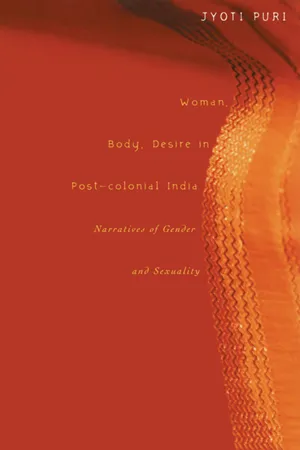
First published in 1999.Jyoti Puri draws on post-colonial and feminist theory to focus on how women in current-day India conceptualize their gender and sexuality. She provides a groundbreaking ethnographic study based on fifty-four middle- and upper-class Indian women, ranging from the ages of fifteen to thirty-eight. She argues that these women's narratives are shaped by not only the nation-state, but by transnational processes as well.
Woman, Bodyand Desire in Postcolonial India connects important issues of class an nationhood to the emerging sense of female identity in India, covering previously neglected topics such as menstruation, gay and straight sexual experience, sexual harassment and assault, marriage and motherhood. Puri discovers that attitudes about sexuality and gender are surprisingly similar in India and Western countries.
- 248 pages
- English
- ePUB (mobile friendly)
- Available on iOS & Android
eBook - ePub
About this book
Information
Chapter One
Fictions of Identity
Listening to the interview tapes is like visiting old acquaintances. But in fact, I met Seema—the subject of the first of 54 interviews with women of similar social backgrounds—only once. Comfortably seated in her office in Mumbai (formerly known as Bombay) on a midsummer afternoon, Seema, 21 years old, attractive and articulate, tells me about her life. She holds an administrative position at a nursing home and expects to marry sometime in the not-too-distant future. She describes herself as a little immature but passionate, and speaks at length about herself and her life. Frequently, especially when she is concentrating on her thoughts, Seema runs her fingers through her layered, loosely worn hair. She speaks about what matters to her, what it means to be a woman, her recollections about getting her first menstrual period, encounters with male sexual aggression, her sexual desires and practices, and her expectations related to marriage and motherhood.
As I sift through taped accounts of Seema’s story and others that followed, it is clear that to do justice to these women’s narratives, I must go against the prevailing wisdom of much of the literature that deals with aspects of gender and sexuality in contemporary, post-colonial India.1 My first concern is that by not questioning the premises of Indian culture, this literature helps reinforce stereotypes about Indian national cultural identity related to womanhood, gender, and sexuality. My second, interrelated concern is that this literature implicitly reinforces categories of womanhood, gender, and sexuality. From a feminist, postcolonial lens I argue that the narratives included in this book not only tell us much about contemporary aspects of womanhood and sexuality but help question these categories as well. When considered against the grain of the nation-state, these narratives challenge putative characterizations of the narrators as Indian women.
Broadly described, this book uses personal narratives of gender and sexuality in contemporary, post-colonial India to explore the ways in which middle-and upper-class women’s bodies, sexualities, and gender identities are regulated. These narratives highlight how social control is routinely enforced through definitions of what is normal and natural. But to consider how aspects of gender identities and sexuality are controlled through notions of normality is to throw into question the categories of womanhood and (hetero)sexuality. In effect, not only do these narratives provide important clues to social mandates on womanhood and female (hetero)sexuality, but they also suggest how the categories of gender and sexuality are made to appear natural and coherent in our lives.
Given the daunting breadth of the constructs of gender and sexuality, for the purpose of the interviews I emphasize aspects that are considered culturally normal in the life cycle of these middle- and upper-class women. The onset of menarche and early menstruation, and the realms of sexuality, marriage, and motherhood provide the focal points for these life history interviews. Of these aspects, the onset of menarche, early menstruation, and sexual aggression especially help realize the perception and experience of the female body. If menarche marks a burgeoning but chaste heterosexuality, then it is widely believed that women should express their sexualities within marriage. Thus, social expectations of heterosexuality and sexual respectability are sustained both before and after marriage. Furthermore, marriage and motherhood represent the more definitive markers of gender identity for women. But, as women’s narratives indicate, these seemingly commonplace aspects of their life cycles are also sources of normalizing and disciplinary strategies.
In this book, I focus on the narratives of middle- and upper-class urban women because their bodies, sexualities, and gender identities are sites where cultural notions of normality and, indeed, social respectability are contested. By highlighting their gender and social class affiliations, I do not suggest that such differences as ethnicity and religion are unimportant. The gross resurgence of Hindu nationalism and its articulation of Hindu women’s identities and roles are an alarming reminder of the significance of ethnic and religious differences among women. Rather, I argue that strategies of social control cut across ethnic and religious affiliations in the narratives that follow, and these strategies are not only produced and reinforced within contemporary India, but were also part of its transfomation into an independent nation-state.2 Collectively and individually, middle- and upper-class women are expected to embody national cultural identity. If their bodies and identities are used to articulate discourses of modernity and development in post-colonial India, then these are also the sites where fears of loss of national tradition are expressed. Cultural beliefs that middle- and upper-class women embody a changing, modernizing national cultural identity are frequently offset by concerns that these women are being corrupted by the influences of modernization, and especially, “westernization.” Viewed in this way, at the very least, these women’s narratives on gender and sexuality are hyphenated—neither one nor the other; at most, they challenge what means to be “Indian.”
I argue that it is necessary to identify and challenge the role of the postcolonial Indian nation-state in generating discourses that shape and constrain middle-and upper-class women’s narratives on aspects of gender and heterosexuality. More specifically, I highlight the kinds of hegemonic codes of gender and sexuality produced within the post-colonial nation-state that mark women’s narratives. But if it is necessary to identify these discourses, then it is equally important to consider the effects of transnational cultural codes in normalizing and regulating women’s narratives. An exploration of the effects of transnational, globalizing cultural discourses shows that these class- and gender-based forms of social regulation and normalization may not be unique to the Indian nation-state. Nationalist and transnational hegemonic codes unevenly crisscross women’s narratives, and the narratives help illustrate these complex and pernicious processes of regulation. Thus, the narratives problematize larger questions of how fictions of their gender, sexual, and national identities are shaped and normalized. At the same time, these narratives provide important insights into how women contend with and undermine these normalizing and disciplinary effects in their lives.
I analyze accounts on the onset of menarche, sexual aggression, erotic sexuality, marriage, and motherhood to isolate the effects of normalizing discourses and disciplinary strategies. Once these discourses and strategies are made explicit, I explore how the interviewees’ lives are shaped and regulated through daily experiences of their bodies, selves, and sexualities. Sometimes the women articulate the connections in their accounts, and at other times I attempt to highlight and analyze the more tacit aspects of the links between middle- and upper-class women’s narratives and the hegemonic codes of the post-colonial nation-state. In some instances, women recast social mandates—for example, sexual respectability—in ways that draw upon more transnational cultural discourses, and destabilize putative notions of chastity. Furthermore, women’s narratives are complex on at least one other account: As their narratives evince normalizing discourses and disciplinary strategies, they also reveal how the women internalize, reproduce, and challenge these strategies of social control.
On the one hand, women’s narratives foreground how strategies of control are somewhat effective precisely because they are reproduced and reinforced in the narratives on the body, on womanhood, and sexuality. What is also incontrovertible is how their narratives are shaped by forms of social privilege. As members of the middle and upper classes, the women who are the focus of this study are privileged. Moreover, as women speaking about normative aspects of sexuality and marriage, they are able to draw upon the privileges of a social system that mandates heterosexual relations. Therefore, to look for the ways in which these women are socially regulated is also to raise questions about their entanglements in that process. On the other hand, partly reflecting their discomfort with the nature of social regulation that attends privilege, these women also suggest how they undermine and challenge these constraints in their lives.
What became clear, after the completion of the interviews, was the importance of not limiting this study to explorations of normality through middle- and upper-class women’s narratives, but also through examining narratives from the margins, namely, from gays, lesbians, bisexuals and transgendered peoples. Clearly, these narratives evince the impact of the postcolonial nation-state—both in terms of nationhood and transnational cultural effects. The last chapter of this book considers queer narratives that speak to the post-colonial nation-state, nationalisms, and transnational cultural codes. What is perhaps most compelling about these narratives that are self-consciously produced from the social margins is how they recast notions of national identity and attempt to forge transnational alliances as political strategies. To that extent, these queer narratives launch, in comparison with middle-and upper-class women’s accounts, a fuller and more illustrative critique of the construct and legacies of the post-colonial state and nationalisms.
Conceptualizing the Constructs
Sex and Gender
Over the last few years, putative definitions of sex and gender have been challenged by feminist and queer theory.3 Standard sociological textbooks define sex as the raw material upon which culture operates in the form of gender attributes.4 Within this framework, sex is the pre-social, biological body, and gender is the cultural script that socializes the body and thereby produces women, men, and, where applicable, additional genders, in a given sociocultural context. If “sex” is male and female, then “gender” is femininity and masculinity, and the categories of woman and man fuse dominant perceptions of femaleness with femininity and maleness with masculinity. Such understandings of sex and gender are also pervasive in introductory texts used in courses in women’s studies and in the exploding field of gender studies.5
The problems with these understandings are manifold. To derive gender as the cultural overlay upon sex suggests that biology precedes or lies outside the domain of culture and history. Critical theorizing on sex or the sexed body belies such interpretations.6 What this theorizing has persuasively demonstrated is that seemingly raw biological sex and the body are no more outside the purview of cultural context and history than gender is. But it is not enough to merely revise sociological understandings by saying that sex, like gender, is constructed. For one, it makes the constructs of sex and gender redundant—instead of two constructs, only one is necessary. As Judith Butler astutely notes in her book Gender Trouble, if sex is gender, then it makes little sense to argue that gender is the cultural interpretation of sex.7 Furthermore, to argue that gender (and sex) are the product of social construction runs the risk of conceptualizing the body as a passive instrument of culture; instead of biology, culture becomes destiny of the body, according to Butler.8
Sociological understandings of sex and gender miss the crucial point that these constructs may be the effect of regulating, normative mechanisms of power.9 Indeed, it becomes necessary to uncover how and to what purposes the construct of sex operates to sustain the fictions that sex is biological, dual (male and female, and heterosexual), that there are two sexes for the reproduction of the species, or that gender is about women and men.10 Seen in this way, the slide from sex to gender to heterosexuality becomes disputable, and the attempt to privilege sex as the founding premise of gender, and implicitly, heterosexuality, becomes untenable. As Rosalind Morris succinctly notes in her review of the relation between sex and gender, contrary to sociological understandings of sex as the premise of gender, the reverse is true: Gender is the founding premise of sex.11
There is at least one additional problem with putative sociological conceptualizations of sex and gender related to the category of “woman.” Within this framework, sex and gender are imbricated in the category of woman, and this category provides theoretical, methodological, and political stability to forms of feminist criticism and analyses. But, clearly, woman as a category cannot be privileged within feminist discourse to the exclusion of categories of race, sexuality, ethnicity, nationality, color, class, and caste, among others. African-American, Asian-American, Chicana, Jewish, Latina, and “Third World” feminist theorizing has been at the forefront of complicating unitary notions of women as the basis for feminism; thereby, the category of woman occupies a much more fragmented space within feminism.12 Nonetheless, a persistent concern is that the category of “woman,” when taken as the common ground of feminist analysis, not only obscures ways of being that are anormative but implicitly requires that one identify as a woman.13
While these insights are more widely germane to theories of sex, gender, body, and sexuality within sociology and women’s studies, they are directly relevant to the project of this book. Drawing upon feminist insights into the strategies of power that produce the fiction of coherent sexualities and identities, I understand gender as an effect of disciplinary practices and regulating mechanisms of power.14 If the normative effects of gender in part sustain the appearance of natural links between sex, gender, and sexuality, then it is helpful, as Butler suggests, to see gender as performativity—”as the process through which difference and identity are constructed in and through discourses.”15 In Butler’s words, gender is not an essence but a set of repeated acts that only appear to be substantive.16 This conceptualization of gender identity necessitates understanding how gender is made to appear coherent through the category “woman” (or “man”), but also how it is produced and possibly sustained and disrupted through mundane repetitive acts. In the following chapters, I seek to unravel how the fictions of normative gender identity are sustained and disrupted through narratives on matters of menstruation, sexual aggression, marriage, and motherhood.
Conceptualizing gender in this respect, then, also casts serious doubts on ascribing the narratives to “women.” If gender is indeed a process of normative repetition that is occasionally repudiated, then not only do prevailing notions of womanhood and femininity become suspect, but using the category of “woman” is fraught with contradictions. Attributing the narratives to “women” paradoxically reinforces the requirement to identify as a woman even as the process of how the fiction of womanhood is sustained is questioned and challenged in the following chapters. At the same time, to cast doubts on the viability of the category of “woman” invariably throws into crisis the political ground of feminism. These tensions are frequently caricatured in feminist debates within the United States as the theoretical and political differences between postmodernism and identity politics.17 Thus, the category of “woman” appears to be at a theoretical and political impasse.
In the following chapters I use multiple strategies to negotiate this impasse. First, I understand the category of woman to be inextricable from history, culture, colonialism, nationalism, race, class, sexuality, postcoloniality, and transnational processes. Second, I focus analytically on the narratives of womanhood and heterosexuality. I take the approach that these narratives tell us much about the process through which the mundaneness of gender is repeated, sustained, and sometimes disrupted as identity. By focusing on marked aspects of gender identity—marriage and motherhood but also menstruation and sexual aggression—it is possible to see how the appearance of a stable identity of womanhood is reproduced and repudiated in the narratives. It would be naïve to suggest that women are not socially and culturally positioned as “women” but it is worthwhile not to outright reinforce the sociocultural requirements of identifying within a gender category.18 Third, I explore queer narratives which, by challenging the norms of heterosexuality, also unsettle normative notions of gender identity—”women” and “men.”
Drawing upon feminist theory, I understand sex, like gender, to be an effect of regulating and normative mechanisms of power. But sex is not the same as gender because sex acts to mark and signify the body in terms of sexual difference and heterosexual ity. Sex serves to constitute a newborn child as this or that sex and to specify expectations of sex-appropriate development. The seeming reality of physical differences, encapsulated in what we understand as “genital,” makes it possible to assign the newborn infant a sex, and the process of “normal” sexual and gender development begins. This originary sexing of the body is the product of two interrelated, epistemological frameworks: the medical framework, that organizes our perceptions of the reality of sex; and the social framework that organizes perceptions of sex based on cultural concepts of gender. Despite claims of the medical establishment to pre-social, objective facts, sex is the product of this dual framework that both produces obstacles in the development of knowledge and provides conditions for definitions of normality. Put differently, sex enables the mechanisms of power upon the body that make it impossible to view a body outside of the limitations of sex and to engender the compliance and consent of the individual to expectations of “normal” sexual and gender development.
Therefore, I take the approach that sex is the deeply rooted medicalized, binary construct that shapes the narratives that follow especially on matters of menstruation and sexual aggression. Sex shapes the nature of biological differences that appear self-evident at the birth of a child and at various sensitive conjunctures thereafter in order to determine sex-appropiate biological and social sexual development—for example, in menstruating. Whether manifest in accounts of menstrual pain or the trauma of sexual aggression, narratives on the body cannot be separated from sociocultural notions of sex that make it possible to have or experience the body. Furthermore, sex and gender are intertwined in terms of a heterosexist normalizing structure where “appearance” seems to correspond to “reality” and the concept of deviation or pathology serves to fill the gaps where there is a possibility of dissonance between appearance and reality, ...
Table of contents
- Cover
- Half Title
- Title Page
- Copyright
- Dedication
- Contents
- Preface
- Acknowledgments
- Chapter One: Fictions of Identity
- Chapter Two: Sex, Sexuality, and the Nation-State
- Chapter Three: Docile and Disruptive: Narratives on Menarche and Menstruation
- Chapter Four: Tensions of Sexual Respectability: Accounts of Sexual Aggression
- Chapter Five: Negotiating the Norm: Speaking of Heterosexual Desire
- Chapter Six: Rethinking the Requirements: Of Marriage and Motherhood
- Chapter Seven: Hybrid and Hyphenated: Reading Queer Narratives
- Chapter Eight: Conclusion Considering: New Courses or Stoking Fire
- Notes
- Index
Trusted by 375,005 students
Access to over 1.5 million titles for a fair monthly price.
Study more efficiently using our study tools.
Frequently asked questions
Yes, you can cancel anytime from the Subscription tab in your account settings on the Perlego website. Your subscription will stay active until the end of your current billing period. Learn how to cancel your subscription
No, books cannot be downloaded as external files, such as PDFs, for use outside of Perlego. However, you can download books within the Perlego app for offline reading on mobile or tablet. Learn how to download books offline
Perlego offers two plans: Essential and Complete
- Essential is ideal for learners and professionals who enjoy exploring a wide range of subjects. Access the Essential Library with 800,000+ trusted titles and best-sellers across business, personal growth, and the humanities. Includes unlimited reading time and Standard Read Aloud voice.
- Complete: Perfect for advanced learners and researchers needing full, unrestricted access. Unlock 1.5M+ books across hundreds of subjects, including academic and specialized titles. The Complete Plan also includes advanced features like Premium Read Aloud and Research Assistant.
We are an online textbook subscription service, where you can get access to an entire online library for less than the price of a single book per month. With over 1.5 million books across 990+ topics, we’ve got you covered! Learn about our mission
Look out for the read-aloud symbol on your next book to see if you can listen to it. The read-aloud tool reads text aloud for you, highlighting the text as it is being read. You can pause it, speed it up and slow it down. Learn more about Read Aloud
Yes! You can use the Perlego app on both iOS and Android devices to read anytime, anywhere — even offline. Perfect for commutes or when you’re on the go.
Please note we cannot support devices running on iOS 13 and Android 7 or earlier. Learn more about using the app
Please note we cannot support devices running on iOS 13 and Android 7 or earlier. Learn more about using the app
Yes, you can access Woman, Body, Desire in Post-Colonial India by Jyoti Puri in PDF and/or ePUB format, as well as other popular books in Social Sciences & Cultural & Social Anthropology. We have over 1.5 million books available in our catalogue for you to explore.