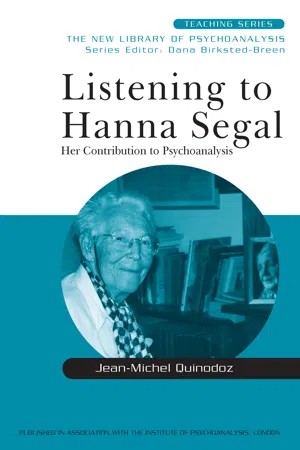
Listening to Hanna Segal
eBook - ePub

Listening to Hanna Segal

Her Contribution to Psychoanalysis

  1. 184 pages
  2. English
  3. ePUB (mobile friendly)
  4. Available on iOS & Android
eBook - ePub

Listening to Hanna Segal

Her Contribution to Psychoanalysis

About this book

Winner of the 2010 Sigourney Award!

How has Hanna Segal influenced psychoanalysis today?

Jean-Michel Quinodoz provides the reader with a comprehensive overview of Segal's life, her clinical and theoretical work, and her contribution to psychoanalysis over the past sixty years by combining actual biographical and conceptual interviews with Hanna Segal herself or with colleagues who have listened to Segal in various contexts.

Listening to Hanna Segal explores both Segal's personal and professional histories, and the interaction between the two. The book opens with an autobiographical account of Segal's life, from her birth in Poland to her analysis with Melanie Klein in London where she became the youngest member of the British Psychoanalytical Society. Quinodoz goes on to explain Segal's contributions in various fields of psychoanalysis including:

  • the psychoanalytic treatment of psychotic patients
  • the introduction of the "symbolic equation"
  • aesthetics and the creative impulse
  • the analysis of elderly patients
  • introducing the work of Melanie Klein.

Quinodoz concludes by examining Segal's most recent contribution to psychoanalysis - exploring nuclear terror, psychotic anxieties, and group phenomena.

Throughout the interviews Segal speaks of her close relationships with prominent colleagues such as Klein, Rosenfeld, and Bion, making this book both a valuable contribution to the history of psychoanalysis and an indication of the evolution of psychoanalytic ideas over the past six decades. This clear summary of Hanna Segal's life and her contribution to psychoanalysis will be an essential guide to anyone studying Segal and her contemporaries.

Frequently asked questions

Yes, you can cancel anytime from the Subscription tab in your account settings on the Perlego website. Your subscription will stay active until the end of your current billing period. Learn how to cancel your subscription.
No, books cannot be downloaded as external files, such as PDFs, for use outside of Perlego. However, you can download books within the Perlego app for offline reading on mobile or tablet. Learn more here.
Perlego offers two plans: Essential and Complete
  • Essential is ideal for learners and professionals who enjoy exploring a wide range of subjects. Access the Essential Library with 800,000+ trusted titles and best-sellers across business, personal growth, and the humanities. Includes unlimited reading time and Standard Read Aloud voice.
  • Complete: Perfect for advanced learners and researchers needing full, unrestricted access. Unlock 1.4M+ books across hundreds of subjects, including academic and specialized titles. The Complete Plan also includes advanced features like Premium Read Aloud and Research Assistant.
Both plans are available with monthly, semester, or annual billing cycles.
We are an online textbook subscription service, where you can get access to an entire online library for less than the price of a single book per month. With over 1 million books across 1000+ topics, we’ve got you covered! Learn more here.
Look out for the read-aloud symbol on your next book to see if you can listen to it. The read-aloud tool reads text aloud for you, highlighting the text as it is being read. You can pause it, speed it up and slow it down. Learn more here.
Yes! You can use the Perlego app on both iOS or Android devices to read anytime, anywhere — even offline. Perfect for commutes or when you’re on the go.
Please note we cannot support devices running on iOS 13 and Android 7 or earlier. Learn more about using the app.
Yes, you can access Listening to Hanna Segal by Jean-Michel Quinodoz, David Alcorn in PDF and/or ePUB format, as well as other popular books in Psicología & Historia y teoría en psicología. We have over one million books available in our catalogue for you to explore.

Information

Chapter 1
HANNA SEGAL: A PSYCHOANALYTIC AUTOBIOGRAPHY

FROM BIRTH IN POLAND TO PSYCHOANALYTIC TRAINING IN LONDON (1918–1947)
Hanna Segal has always emphasized the dominant influence of early childhood experiences on the individual’s subsequent development. In this, she follows the example of Melanie Klein; Hanna Segal is, indeed, one of the most noteworthy representatives of Klein’s thinking. However, she does not content herself simply with applying these ideas to her work with her patients and in supervision, she applies them also to herself and to her own past history. That is why she insisted on beginning this series of interviews by narrating the experiences which, from a psychoanalytic point of view, had a significant impact on her as a child, as an adolescent and as an adult. More than a mere biographical account, these ideas make up a true psychoanalytic autobiography in which Segal shares with us not only the new perspectives she was able to construct in the 1940s thanks to her analysis with Melanie Klein, but also the links she made afterwards during her uninterrupted and ongoing self-analysis.
Here, I have briefly noted the main biographical landmarks in Hanna Segal’s life, starting with her birth in 1918, until her marriage and her accreditation as a member of the British Psychoanalytical Society in 1947. The reader will find in the chapters that follow the autobiographical details she shared with me as regards later stages in her life and in her work up to the present day.
Some landmark dates
Hanna Segal was born on 20 August 1918 in Lodz, Poland. Her parents, Czeslaw Poznanski and Isabelle Weintraub, both came from well-assimilated Jewish families and lived for the most part in Warsaw, where her father was a practising lawyer.
1918:
When she was 3 months old, Hanna was abruptly weaned and separated from her mother, who had fallen ill during the epidemic of Spanish flu. Although her mother survived the epidemic, Hanna rarely saw her parents throughout her early childhood in Warsaw – most of the time she was looked after by nannies or maids.
1921:
Death of Wanda, Hanna’s sister, at 4 years of age from scarlet fever. Hanna was approximately 2 years old when her sister died. It was a deeply traumatic event. Hanna can remember a dream she had just after her sister’s death – an exceptionally early childhood memory. Hanna would henceforth remain her parents’ only child.
1925:
At 6 years of age, Hanna rebelled after having been left on her own for much of the summer. She asked her parents to take her with them in future and not leave her behind. The first family holiday she had was spent in Biarritz – where she discovered the sea. That was to be the beginning of a love story between Hanna and the sea, one that would last all her life.
1925–1930:
Hanna’s parents began to show more interest in their daughter. Her father, who had a vast humanistic culture, encouraged her to read and introduced her to literature and to art. Hanna discovered school life and made friends of her own age.
1930:
Her father tried to kill himself. This was a terrible disillusion, especially for Hanna, who admired him so much. Completely bankrupt and about to be prosecuted for gambling away his clients’ money, he left Poland with his family to settle in Switzerland.
1931:
The family settled in Geneva, where Hanna’s father found work as editor of the League of Nations Journal. Hanna began attending the International School. She became interested in French literature, and particularly in Proust. One of her parents’ friends was Eugenie Sokolnicka, a Polish psychoanalyst who was a pupil of Freud’s. That was the first time that Hanna heard her father mention psychoanalysis.
1934:
When she was 16, Hanna, feeling nostalgic about her native Poland, asked to be allowed to return to Warsaw to finish her schooling there. While in Poland, she became aware of how dramatic the social and economic problems were; she became an activist in the Student Section of the Polish Socialist Party and had Trotskyist leanings. After her Baccalaureate, Hanna decided to study medicine as a first step to becoming a psychoanalyst.
1938:
The League of Nations Journal, considered to be too anti-fascist, was shut down. Hanna’s father thus lost his job and found himself stateless, the Polish authorities having withdrawn his passport. He therefore had to leave Switzerland. He and his wife settled in Paris.
1939:
When Hitler invaded Poland in September 1939, Hanna happened to be in Paris, holidaying at her parents’ home. Unable to return to Warsaw, she continued her medical studies in France. In Paris she met once again Paul Segal, her future husband, whom she had known when they were children.
1940–1943:
Fleeing the invading German army, Hanna and her parents embarked on the very last Polish ship to leave for Great Britain. The family settled in London. Hanna sat the examinations required for admission to medical school first in Manchester, then in Edinburgh. While still a student, Hanna continued to explore psychoanalysis. In Edinburgh, she met Ronald Fairbairn, who spoke to her about Melanie Klein and Anna Freud. Hanna spent one year in analysis with David Matthew, one of Klein’s pupils. She graduated as a doctor in 1943 and returned to London; Fairbairn wrote for her a letter of recommendation addressed to Winnicott.
1943–1946:
Hanna began her formal psychoanalytic training at the Institute of Psychoanalysis in London. After making it clear that she wanted Melanie Klein to be her analyst, Hanna thereupon began analysis with her. She worked as a surgeon in Paddington Green hospital. Six months later, she began working as a psychiatrist in Long Grove psychiatric hospital, Epsom; she worked there until the war ended. At the same time, she continued her psychoanalytic training in London, where her supervisors were Joan Riviere and Paula Heimann. Hanna’s mother died of cancer at 54 years of age, shortly before the end of the war.
1946–1947:
Hanna completed her training as a psychoanalyst and married Paul Segal. While she was pregnant with their first child, she presented her first paper, “A psycho-analytical approach to aesthetics”. At the age of 29, she became the youngest member of the British Psychoanalytical Society.
“I think I had a very traumatic childhood”
“I think if I had turned out to be schizophrenic, people would have said: ‘No wonder, with that childhood!’”
Hanna Segal: I like talking about my early childhood, not only because old people like to reminisce but also because I find that in the biography of great analysts (and other people as well) information about their early childhood is always missing. We know a few things about Freud – that he was his mother’s favourite and how he, I think out of jealousy, threw shoes out of the window, things like that, but nothing consistent. I am rather lucky in that way in that I have very clear memories of my childhood and of a number of things, thanks to Mrs Klein’s approach, linked with it. What I can tell you is partly memory, partly what I discovered in analysis – certain links – and partly, let’s say, my speculations about it. A good memory for one’s childhood usually means more integration. Well, I consider my childhood decisive in the formation of my character and eventually in what took me to analysis. I think I had a very traumatic childhood. I think that if I had turned out to be schizophrenic, people would have said: “No wonder, with that childhood – mother not containing and so on”, but things are not quite as simple as that. A trauma can make a good analyst out of you, but so can good experiences.
Weaned and separated from mother at 3 months
I know that I had a bad start because – that’s not memory, it’s what’s been told to me – until the age of 3 months I screamed incessantly. I don’t know what it was – perhaps my mother didn’t have enough milk, or maybe it was what they call the three months’ colic. And then suddenly I was weaned, because my mother had Spanish flu. But apparently I thrived on the bottle. I immediately put on weight. So, it was either three months’ colic or something wrong with the feeding, but I know that I didn’t see my mother. The loss of the breast was combined with the loss of the person because my mother disappeared, I think. She survived [the epidemic], but she had a very severe flu.
Death of her sister when Hanna was 2 years old
I remember very little of my parents from my early childhood, but my older sister died when she was 4 years old and I was a little over 2. I have very clear memories of my sister, so I must have been even younger than 18 months when she first fell ill. And I remember the dream I had soon after her death – it was a very amusing dream and it was important to me because ours was a sort of rich bourgeois household where children were in the hands of nannies.
I hardly ever saw my parents, I think, and basically my sister was my good object. I have a photograph of her holding my hand and I remember the occasion it was taken. The mythology is that she loved me very much – I’m sure that’s true – but the amusing thing is that one day she stuffed my mouth with chocolate and I nearly choked, so it must have been ambivalent. I remember a blue carpet on which she was pretending to teach me to swim. She died of scarlet fever, and I remember her standing by my cot with my father feeding her. I remember the place I went to when the diagnosis was made – I was sent away immediately, of course.
Then the rest is very much what I reconstructed in analysis. I have a memory of my mother all in black and looking terribly detached and me running to her and getting no response. But what I worked out – certain things clicked – is that my mother’s way of dealing with depression was always to travel, so she must have left me and travelled and that was her return. […] So I was left with a very depressed father and a lot of stories from maids about what a pity it was that my sister had died rather than me, because she was the favourite and prettier and cleverer and so on. I think some of the comments must have been true, because sh...

Table of contents

  1. THE NEW LIBRARY OF PSYCHOANALYSIS
  2. CONTENTS
  3. INTRODUCTION
  4. ACKNOWLEDGEMENTS
  5. Chapter 1 HANNA SEGAL: A PSYCHOANALYTIC AUTOBIOGRAPHY
  6. Chapter 2 PSYCHOANALYSIS AND THE AESTHETIC EXPERIENCE
  7. Chapter 3 THE PSYCHOANALYTIC TREATMENT OF PSYCHOTIC PATIENTS
  8. Chapter 4 FROM SYMBOLIC EQUATION TO SYMBOLIC REPRESENTATION
  9. Chapter 5 THE FUNDAMENTAL CONFLICT BETWEEN THE LIFE AND DEATH DRIVES
  10. Chapter 6 PRESENTING THE KLEINIAN APPROACH TO PSYCHOANALYSIS
  11. Chapter 7 INTERPRETING THE FUNCTION OF DREAMS ALONG WITH THEIR CONTENT
  12. Chapter 8 THE ANALYSIS OF ELDERLY PATIENTS
  13. Chapter 9 SEMINARS AND SUPERVISIONS
  14. Chapter 10 NUCLEAR TERROR, PSYCHOTIC ANXIETIES AND GROUP PHENOMENA
  15. NOTES
  16. BIBLIOGRAPHY
  17. NAME INDEX
  18. SUBJECT INDEX